


Wormhole is the interoperability layer for the tokenized world.

Wormhole
Cross-chain messaging protocol securing transfers across 45+ blockchains
3.2/ 5
Our score
Fair
Design
Messaging protocol
Security model
Guardian network of 19 validators
Audited
Yes
What is Wormhole?
Wormhole is a cross-chain messaging protocol connecting more than 45 blockchains. Its infrastructure carries messages, tokens and application data, while Portal provides token transfers and swaps. The protocol says it has enabled $68 billion in all-time transfer volume as of October 2026.
Who runs Wormhole
Wormhole separated from Jump Trading Group in November 2023. Wormhole Labs became an independent company and core contributor focused on products, tools and reference implementations. Saeed Badreg is CEO of Wormhole Labs, while Dan Reecer is COO of the Wormhole Foundation.
Wormhole raised $225 million at a $2.5 billion valuation in November 2023. The round used token warrants rather than equity and included Brevan Howard, Coinbase Ventures, Multicoin Capital, ParaFi, Dialectic, Borderless Capital, Arrington Capital and Jump Trading. No single investor led the round.
How the bridge works
Wormhole uses a guardian network of 19 validators to observe activity on connected chains and attest to cross-chain messages. Applications verify these attestations, called VAAs, before acting on the destination chain. Wormhole is therefore a messaging layer rather than a single lock-and-mint bridge.
Portal supports transfers and swaps between supported networks. Native Token Transfers lets issuers move native versions of assets across chains while retaining control of their token contracts. The protocol also offers messaging, Queries and MultiGov. Supported ecosystems include Ethereum, Solana, Base, Arbitrum, Optimism, Polygon, Avalanche, BNB Chain, Sui and Aptos, alongside additional networks.
Products and availability
Wormhole supports native and wrapped assets, including stablecoins. Its Connect product can be embedded in applications and configured around selected chains and routes. Gas dropoff can convert part of a transfer into the destination chain’s native gas token.
Portal and Connect are consumer-facing interfaces, while the core messaging system is aimed at developers and protocols. Costs and transfer times depend on the route, asset and application used.
Security record and risks
Wormhole publishes open-source code and a security report. On February 2, 2022, an attacker exploited a signature-verification bug in its Solana implementation and minted roughly 120,000 wETH, worth more than $320 million at the time. Jump Trading supplied replacement ether, and affected users were made whole.
The guardian network creates validator-compromise risk, while smart-contract bugs can cause forged messages or stuck transfers. Wrapped assets can trade away from their intended value, and route liquidity can affect execution. Network support also changes: Scroll was deprecated in April 2026, and Terra Classic, Karura, Acala, XPLA and Oasis were disconnected in June 2026.
Best for:Multichain application developersInstitutions issuing native assetsCross-chain governance teamsUsers moving assets across networks
Pros and cons
Pros
- Connects more than 45 blockchains
- Guardian network has 19 validators
- Supports native token transfers through NTT
- Published security report and open-source infrastructure
- Reported $68B in transfer volume by October 2026
- Replacement ether covered the 2022 exploit loss
Cons
- 2022 signature-verification exploit caused a loss above $320M
- Guardian compromise could enable fraudulent cross-chain messages
- Wrapped assets can depeg from their underlying assets
- Route costs and transfer times vary by asset and chain
- Network support has changed, including several 2026 disconnections
Our review
3.2/5
Fair
Wormhole offers broad messaging and asset-transfer coverage, but its guardian model and $326 million 2022 exploit remain material bridge risks.
Wormhole is a messaging protocol rather than a single lock-and-mint bridge. Its guardian network of 19 validators attests to cross-chain messages, while Portal handles token transfers and swaps. Native Token Transfers lets issuers keep control of token supply across networks.
The protocol connects more than 45 blockchains and has enabled $68 billion in all-time transfer volume as of October 2026. Portal's documented network list includes Ethereum, Solana, Base, Arbitrum, Sui and Aptos, among others. Support is not permanent for every network: Scroll was removed from the Portal frontend in April 2026, while Terra Classic, Karura, Acala, XPLA and Oasis were disconnected in June. Transfer times and typical fees are route-dependent, and no single figure covers the full network.
On February 2, 2022, an attacker exploited a signature-verification bug in the Solana implementation and minted about 120,000 wETH, worth more than $320 million at the time. Jump Trading supplied replacement ether, and the recorded loss was returned. The incident exposed the consequences of a validator-attested bridge failure. Wormhole lists open-source infrastructure and security documentation, and its contracts have an audit record. Those safeguards do not remove guardian compromise, smart-contract, relayer, stuck-transfer or wrapped-asset risks.
Wormhole raised $225 million at a $2.5 billion valuation in November 2023, with investors including Brevan Howard, Coinbase Ventures, Multicoin Capital and Jump Trading. Wormhole Labs operates as an independent core contributor, while Saeed Badreg is its CEO and Dan Reecer is COO of the Wormhole Foundation. The separation from Jump gives the project an independent operating structure, though Jump remains part of its history.
Wormhole suits applications and asset issuers that need messaging, native token distribution or broad multichain reach. Portal is less suitable for users who want a canonical bridge with a simpler trust model, a fully specified route fee, or minimal exposure to validator and wrapped-asset risks.
Specs
| Design | Messaging protocol |
|---|---|
| Chains | Ethereum, BNB Chain, Arbitrum, Base, Optimism, Polygon, Avalanche, Solana, Sui, Aptos, Other |
| Security model | Guardian network of 19 validators |
| Audited | Yes |
| Token | W |
| Native token transfers (no wrapped tokens) | Yes · unverified |
Not disclosed by the provider: KYC required, Chains supported, Typical fee, Typical transfer time, Intent-based, Max transfer.
Data from the provider's website and public sources. Fees and availability change; confirm on the official site before you sign up.
Key features
Cross-chain messaging
Applications send messages and coordinate actions across more than 45 connected blockchains through Wormhole's guardian attestations.
Portal transfers
Portal supports token transfers and swaps between supported networks, including Ethereum, Solana, Base and Sui.
Native token transfers
NTT lets issuers move native assets across chains while retaining control of their token contracts.
Wrapped asset transfers
Wormhole supports wrapped token transfers when a native asset route is unavailable, with destination assets depending on the route.
Application widget
Wormhole Connect can be embedded and configured around selected chains, assets and transfer routes.
Gas dropoff
Connect can convert part of a transfer into the destination chain's native gas token for transaction fees.
Cross-chain governance
MultiGov carries voting and proposal execution across supported EVM networks, with Solana voting in development.
Inside Wormhole
Transfer tokens
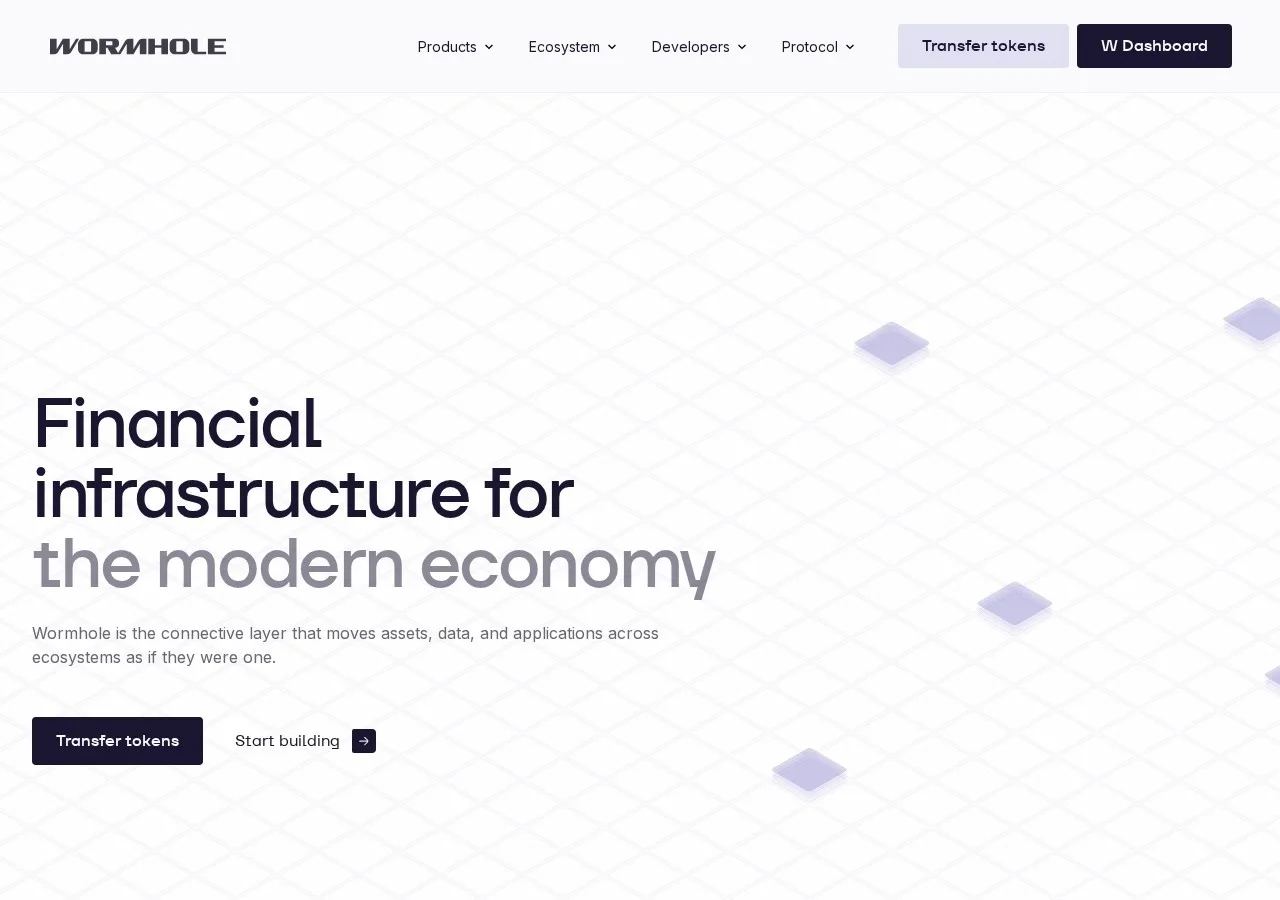
Wormhole's transfer flow moves tokens between supported blockchains. Portal provides the user-facing multichain transfer and swap experience, while routes can include native or Wormhole-wrapped assets.
Wormhole Messaging
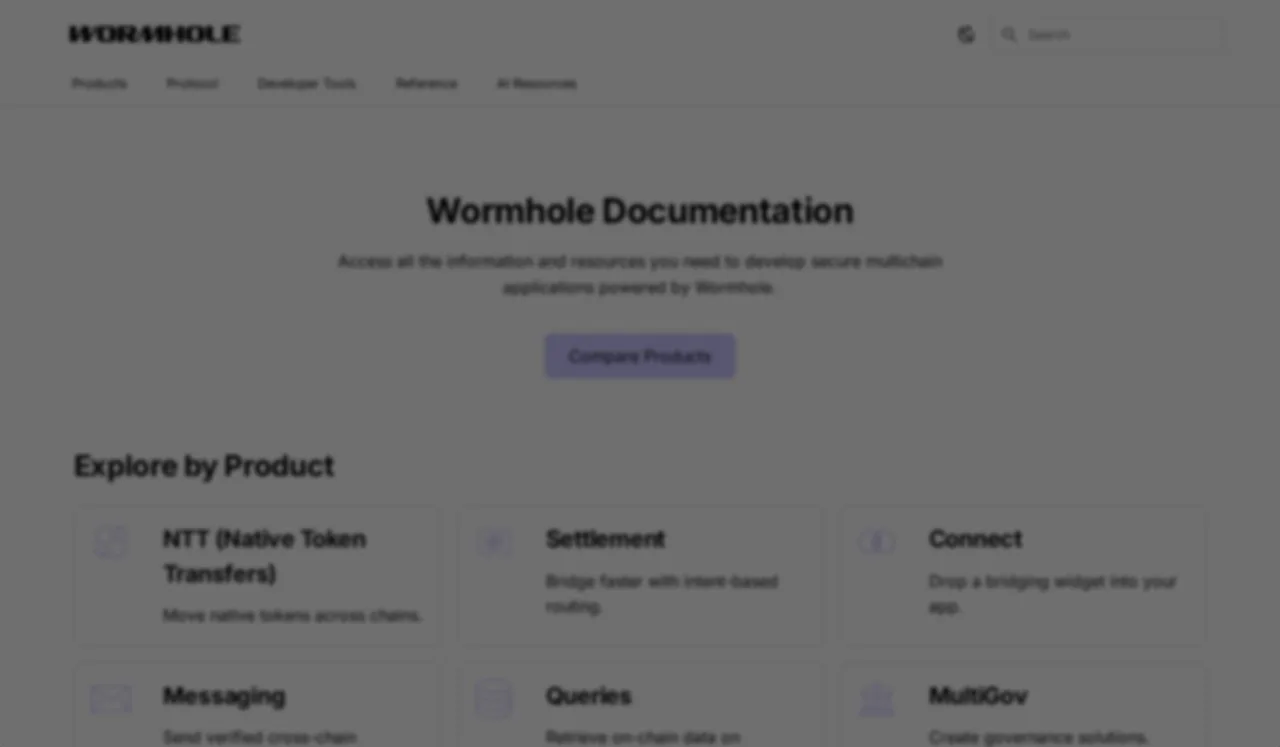
Wormhole Messaging lets developers send cross-chain messages, synchronize data and coordinate actions across supported blockchains. Applications can integrate the protocol through its core contracts and SDKs.
Native Token Transfers
Native Token Transfers provides infrastructure for moving an issuer's token across multiple chains while the issuer keeps control of its token. It is used for multichain asset distribution, including stablecoins and other tokenized assets.
Portal
Portal is Wormhole's multichain application for token transfers and swaps. Its documented network coverage includes Ethereum, Solana, Base, Arbitrum, Sui and Aptos.
Queries
Queries provides cross-chain data query infrastructure. Applications can use it to retrieve data across supported blockchain networks.
MultiGov
MultiGov extends DAO voting and proposal execution across multiple blockchain networks. Its current implementation uses an EVM hub with EVM and SVM spokes.
Wormhole screenshots
What users say about Wormhole
Users express strong frustration over the declining token value, lack of communication, and perceived abandonment of community programs, while acknowledging Wormhole's technical role in cross-chain transfers across many blockchains. The disconnect between platform metrics and token performance dominates feedback.
Top goods
Scam warning: Users report losses from fake site links and phishing attempts impersonating official channels.
Based on 69 X replies from the last 12 months, checked Oct 17, 2026. These are posts by users on other sites, not reviews submitted on CryptoReview.
User reviews
No user reviews yet. Have you used Wormhole? Share your experience below.
Funding and investors
$233.5MTotal raised
4Rounds
21Investors
-
Private Nov 2023 $225M
 Arrington CapitalHedge fund
Lead
 Borderless CapitalVenture capital
Lead
BH Brevan HowardHedge fund
Lead
 Coinbase VenturesExchange ventures arm
Lead
DI DialecticHedge fund
Lead
 Jump TradingOther
Lead
 Multicoin CapitalHedge fund
Lead
 ParaFi CapitalVenture capital
Lead
GV Gate VenturesExchange ventures arm
-
Funding round Nov 2023 $225MBH Brevan HowardHedge fund DI DialecticHedge fundSource Jump TradingOther
Multicoin CapitalHedge fund
ParaFi CapitalVenture capital
-
Funding round Sep 2021 $8.5M
 AC CapitalVenture capital
AB Adam BackAngel investor
Arrington CapitalHedge fund
 Autonomy CapitalVenture capital
BC B21 CapitalVenture capital
 Cabin VCVenture capital
Coinbase VenturesExchange ventures arm
CS Craig SellarsAngel investor
DI Dubai International Financial CentreOther
 Genblock CapitalVenture capital
 Krypital GroupVenture capital
LC LD CapitalVenture capital
MN Mike NovogratzAngel investor
-
Funding round Amount undisclosed
FAQ
Who runs Wormhole?
Saeed Badreg is CEO of Wormhole Labs, an independent core contributor, and Dan Reecer is COO of the Wormhole Foundation. Wormhole separated from Jump Trading Group in 2023.
Is Wormhole safe?
Wormhole uses a guardian network of 19 validators and has open-source security documentation and an audit record. A signature-verification flaw in its Solana implementation was exploited on February 2, 2022, causing about $326 million in losses that were replaced by Jump Trading.
Which chains does Wormhole support?
Wormhole connects more than 45 blockchains. Named supported networks include Ethereum, Solana, Base, Arbitrum, Optimism, Polygon, Avalanche, Sui and Aptos, while individual network availability can change.
Does Wormhole have a token?
Yes. W is Wormhole's native token and provides multichain access to the protocol.
What does Wormhole Portal do?
Portal is Wormhole's multichain application for token transfers and swaps between supported blockchains. Depending on the route and asset, transfers can involve native or Wormhole-wrapped tokens.
What is Wormhole Native Token Transfers?
Native Token Transfers lets token issuers move assets across supported chains while keeping control of their token supply. The framework supports multichain asset movement without requiring a separate wrapped-token model for every route.
Latest from Wormhole on X
$BUIDL is the tokenized U.S. Treasury fund from @BlackRock.
@Securitize tokenizes it, and Wormhole connects it across Ethereum, Solana, BNB Chain, Arbitrum, Avalanche, Optimism, Polygon and Aptos.
That's how the world's largest asset manager goes multichain. https://t.co/tMFOWMh6UF
@Securitize tokenizes it, and Wormhole connects it across Ethereum, Solana, BNB Chain, Arbitrum, Avalanche, Optimism, Polygon and Aptos.
That's how the world's largest asset manager goes multichain. https://t.co/tMFOWMh6UF

Mayan Deposit Addresses are live.
Users send any token. Apps receive the asset they need.
Mayan moves, Wormhole connects.
Users send any token. Apps receive the asset they need.
Mayan moves, Wormhole connects.
Every institution asks the same thing before going multichain: who's in control?
With Wormhole NTT, the issuer is. They keep full control of their token on every chain.
Teams like @Ripple, @Securitize, @LidoFinance, @m0, and more use NTT to take their assets multichain on their own terms.
With Wormhole NTT, the issuer is. They keep full control of their token on every chain.
Teams like @Ripple, @Securitize, @LidoFinance, @m0, and more use NTT to take their assets multichain on their own terms.

👇
Recent public posts from @wormhole, shown as published. Not reviewed or endorsed by CryptoReview.
Alternatives to Wormhole

Cross-chain swap aggregator routing tokens across 100+ EVM and non-EVM blockchains
AggregatorEthereum · BNB Chain +7Audited
Intent-based cross-chain bridge using optimistic verification, processing over $40B in total volume
No KYCIntent-basedEthereum · Arbitrum +4Audited

Intent-based cross-chain bridge and payment network across more than 85 blockchains
No KYCIntent-basedEthereum · Base +9Audited

Intent-based cross-chain protocol settling transfers across 25+ networks without locked liquidity pools
No KYCIntent-basedEthereum · BNB Chain +7Audited

Cross-chain swap protocol using intent routing and CCTP across Solana, EVM chains, and Sui
No KYCIntent-basedSolana · Ethereum +9Audited

Cross-chain DEX and bridge aggregator routing swaps across more than 80 blockchains
No KYCAggregatorBitcoin · Ethereum +3Audited