

https://t.co/winmyXF3NK

Mayan
Cross-chain swap protocol using intent routing and CCTP across Solana, EVM chains, and Sui
4.2/ 5
Our score
Very good
Design
Intent-based
Typical fee
Configurable integrator fee; dynamic driver execution costs
Typical transfer time
2 to 60 seconds
Security model
Depends on route: Swift auctions, Circle CCTP or Wormhole
Audited
Yes
What is Mayan?
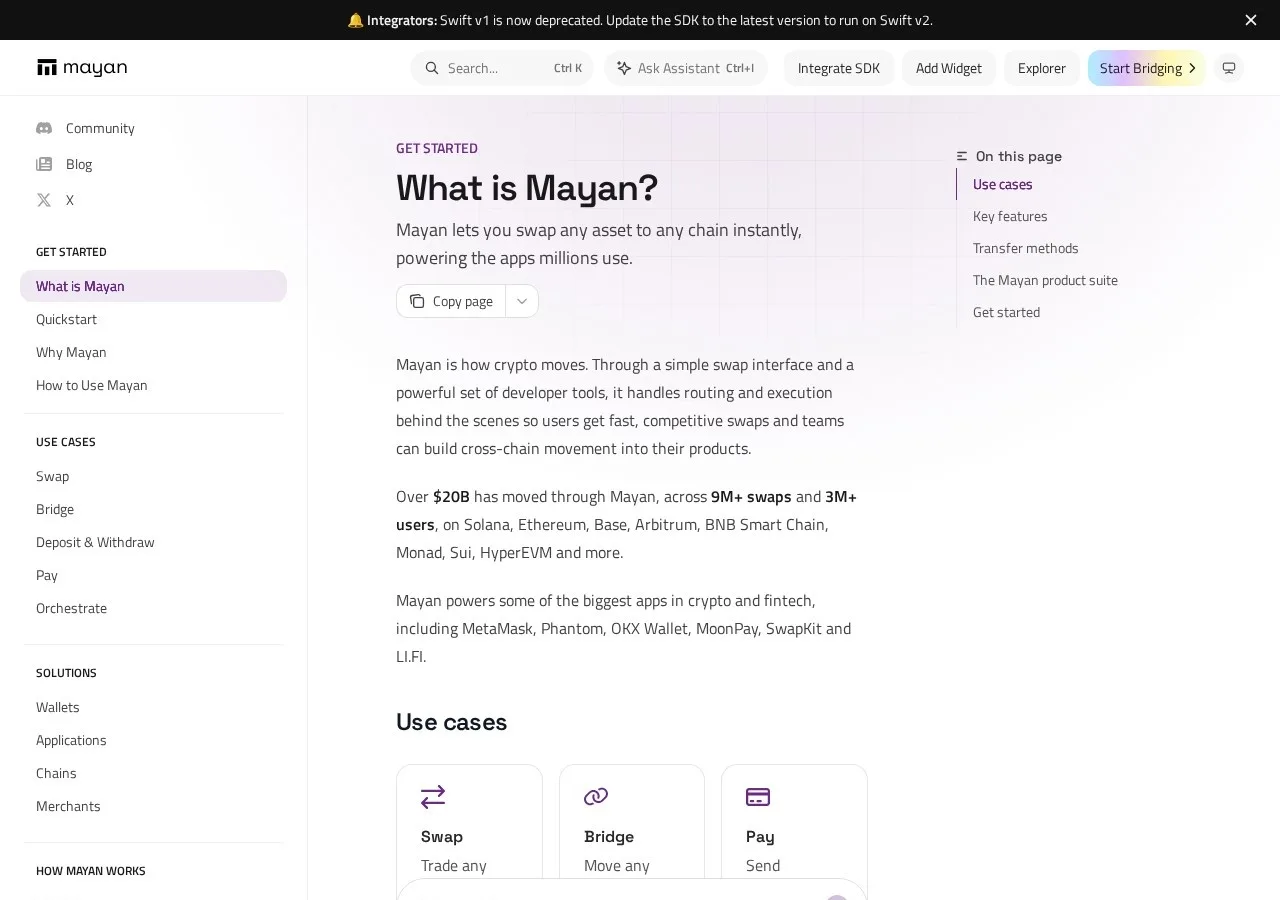
Mayan is a non-custodial cross-chain swap protocol designed to bridge and trade tokens across distinct networks in a single transaction. By linking networks including Solana, Ethereum, Base, Arbitrum, Sui, and HyperEVM, the protocol eliminates the friction of manually bridging an asset and finding a secondary decentralized exchange to swap it. Total value transferred exceeded $20B across more than 10 million individual swaps by October 2026.
How the routing architecture works
Mayan relies on three distinct execution pathways rather than a single bridge pool. Its primary intent-based route, Swift, uses off-chain drivers that fulfill orders from local inventory on the destination chain, settling in as little as 2 seconds for swaps up to roughly $1M. For high-value USDC transfers up to around $10M, Mayan routes via MCTP, using Circle's Cross-Chain Transfer Protocol to burn and mint native USDC in about 5 seconds. High-value SOL and ETH moves pass through Wormhole Swap, completing in under one minute. Because Mayan is non-custodial, users retain direct control of their keys throughout every swap.
Integrations, fees, and onboarding
The protocol requires no user registration, KYC, or account setup. Users connect a supported Web3 wallet and approve the transaction. On select routes, Mayan offers gasless execution, permitting transfers when the origin wallet holds no native gas tokens like ETH. Integrations span consumer wallets and aggregators such as MetaMask, Phantom, OKX Wallet, Bitget Wallet, and LI.FI. Integrators can embed the Mayan SDK and set custom fee tiers on routed flows, while users pay execution fees built directly into the transaction quote.
Audits and operational risks
Mayan was founded in 2022. Smart contracts on the platform have undergone security audits by OtterSec and Sec3. While intent-based bridging removes the risk of wrapped token depegging by delivering native assets, users still face protocol and execution trade-offs. Each order has an expiration deadline; unfilled orders refund the user's deposit, which can stall transfers if driver liquidity is constrained during heavy volatility. Users also carry smart contract exposure across the respective routing contracts, Circle CCTP infrastructure, and Wormhole messaging layers.
Best for:Solana and EVM cross-chain tradersUsers moving native USDC across networksTraders lacking source chain native gasApps embedding non-custodial cross-chain routing
Pros and cons
Pros
- Swaps tokens cross-chain in a single transaction without a manual secondary swap
- Swift route settles native assets in as little as 2 seconds
- Uses Circle CCTP for native USDC transfers without wrapped-asset depeg risk
- Smart contracts audited by OtterSec and Sec3
- Integrated directly into major wallets including MetaMask, Phantom, and Bitget Wallet
Cons
- Unfilled orders must wait for a deadline to pass before issuing refunds
- Execution relies on third-party driver liquidity and Circle or Wormhole messaging
- Guaranteed price quotes apply only to select same-asset routes
Our review
4.2/5
Very good
Mayan delivers fast, intent-based cross-chain swaps between Solana and EVM networks, though transfer mechanisms and underlying risks depend on whether Swift, MCTP, or Wormhole routes execute the order.
Mayan is a cross-chain swap protocol designed to exchange native tokens between non-EVM and EVM ecosystems in a single transaction. Instead of forcing users into standard lock-and-mint bridge mechanics, Mayan uses an intent-based architecture alongside messaging protocols. Over $20B in total volume across more than 10M swaps has settled through the system as of October 2026.
Routing flexibility stands out as Mayan's core operational strength. Swaps execute through three distinct pathways based on transaction size and token types:
- Swift handles intent-based swaps up to roughly $1M, where third-party drivers front capital on the destination network to settle trades in as little as 2 seconds.
- MCTP routes larger USDC transfers up to roughly $10M using Circle's native Cross-Chain Transfer Protocol (CCTP), avoiding wrapped assets and completing in about 5 seconds.
- Wormhole Swap provides an onchain messaging route for high-value SOL and ETH swaps that prioritizes price execution over maximum speed, settling in under a minute.
Smart contracts have been audited by OtterSec and Sec3, and the system operates non-custodially. If a driver fails to fill an intent-based order before an order deadline expires, the protocol refunds the unspent input assets back to the sender's origin address. Mayan has also eliminated standard gas friction by supporting gasless transfers on select routes, permitting trades when a wallet holds stablecoins but no native gas tokens.
Trade-offs center on route dependency and capital fragmentation. Users relying on Swift must trust that offchain drivers maintain sufficient liquidity across target networks, while MCTP remains tied to Circle's infrastructure. In addition, Mayan's low onchain total value locked of around $122,000 reflects an architecture that leans on external driver capital rather than deep internal liquidity pools.
Mayan suits users and integrators who require rapid Solana-to-EVM settlement without handling secondary swaps manually. It is less suited for traders seeking canonical mints on niche rollups outside its primary ecosystem coverage.
Sources (2)
Specs
| KYC required ⓘ | No · unverified |
|---|---|
| Design | Intent-based |
| Chains | Solana, Ethereum, Base, Arbitrum, BNB Chain, Optimism, Polygon, Avalanche, Sui, Hyperliquid, Other |
| Typical fee | Configurable integrator fee; dynamic driver execution costs · unverified |
| Typical transfer time | 2 to 60 seconds · unverified |
| Security model | Depends on route: Swift auctions, Circle CCTP or Wormhole |
| Audited | Yes |
| Intent-based | Yes · unverified |
| Native token transfers (no wrapped tokens) | Yes · unverified |
| Max transfer | $10,000,000 · unverified |
Not disclosed by the provider: Chains supported, Token.
Data from the provider's website and public sources. Fees and availability change; confirm on the official site before you sign up.
Key features
Swift intent-based swaps
Routes orders to destination-chain drivers who fill trades from existing capital, settling transfers in as little as 2 seconds.
MCTP stablecoin bridging
Integrates Circle's CCTP to burn and mint native USDC across supported networks in about 5 seconds without wrapped token risk.
Guaranteed price execution
Locks the quoted output amount on eligible same-asset routes such as USDC to USDC transfers.
Gasless transaction support
Enables users to initiate cross-chain swaps without holding the source network's native token for gas fees.
Direct account deposit addresses
Converts incoming tokens automatically into a designated receiving asset for protocol and exchange funding.
Wormhole swap integration
Settles high-value SOL and ETH transfers across ecosystems with low slippage in under one minute.
Inside Mayan
Swap
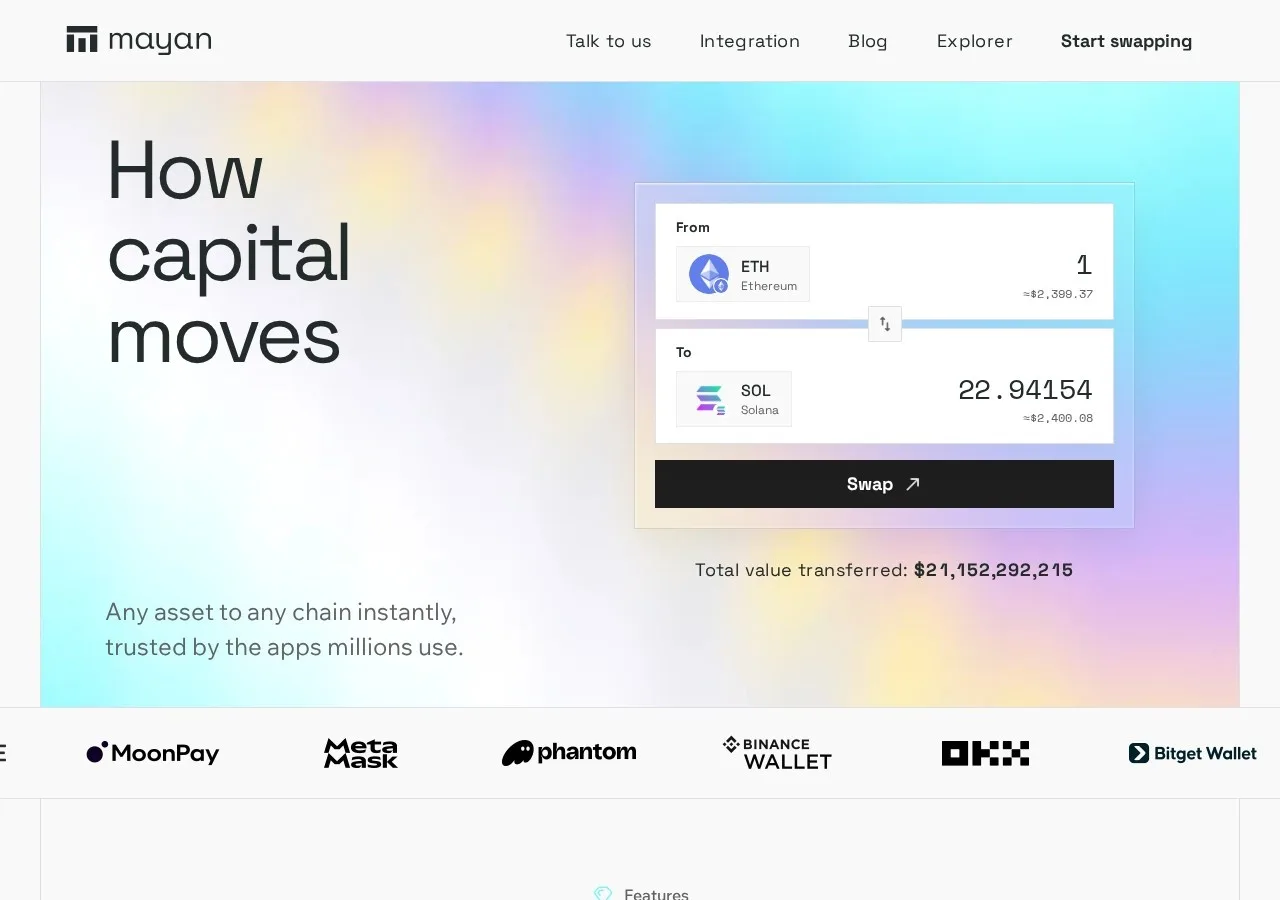
Cross-chain swap interface that exchanges any supported asset on one chain for a different asset on another chain in a single transaction.
Bridge
Native cross-chain bridging pipeline supporting high-speed transfers via Swift driver auctions and Circle CCTP.
Deposit Addresses
Direct funding mechanism that allows users or services to deposit any token on any supported chain and receive automated conversion into a designated asset.
SDK & API
Developer toolsets and embeddable widgets that let external applications, wallets, and aggregators route cross-chain swaps directly within their own products.
Explorer
Protocol search tool that provides real-time status updates, transfer hashes, and tracking across multi-chain swap paths.
Mayan screenshots
What users say about Mayan
Mayan Finance supports cross-chain swapping between networks like Ethereum and Solana.
Based on 4 Reddit posts and comments from the last 12 months, checked Oct 20, 2026. These are posts by users on other sites, not reviews submitted on CryptoReview.
User reviews
No user reviews yet. Have you used Mayan? Share your experience below.
FAQ
What is Mayan?
Mayan is a non-custodial cross-chain swap protocol that allows users to swap and bridge tokens across different blockchains in a single transaction. It handles routing and settlement automatically through intent drivers, Circle CCTP, and Wormhole.
How long do transfers take on Mayan?
Most intent-based swaps route through Swift and settle in as little as 2 seconds. MCTP stablecoin transfers take around 5 seconds, while Wormhole Swap transfers typically settle in under a minute.
Does Mayan require KYC?
No, Mayan is a non-custodial protocol accessed directly via Web3 wallets without identity verification or accounts. Users retain custody of their funds throughout the transaction process.
Has Mayan been audited?
Yes, Mayan's smart contracts have undergone security audits by OtterSec and Sec3.
What happens if a Mayan swap fails to complete?
Every transaction order includes an expiration deadline. If drivers do not fulfill the order before that deadline passes, the trade expires and the deposited assets return to the sender's wallet.
What chains does Mayan support?
Mayan supports Solana, Ethereum, Base, Arbitrum, BNB Smart Chain, Polygon, Avalanche, Sui, and HyperEVM networks.
Latest from Mayan on X
Mayan is now live on Jupiter Bridge by @JupiterExchange.
Jupiter Bridge aggregates routes to find users the best way into @Solana.
Mayan adds competitive cross-chain swaps so trades can start with any token on any chain and arrive instantly. https://t.co/DzyJDhVBwf
Jupiter Bridge aggregates routes to find users the best way into @Solana.
Mayan adds competitive cross-chain swaps so trades can start with any token on any chain and arrive instantly. https://t.co/DzyJDhVBwf
98% of Mayan swaps into tokenized stocks land on @Solana, adding up to a 5x increase from last year's total.
Solana via Mayan, by the numbers. https://t.co/Dm1d5FtgCb
Solana via Mayan, by the numbers. https://t.co/Dm1d5FtgCb

Someone moved $9M+ in a single swap this month, making it the largest transaction in Mayan's history.
$9M+ of USDC on Arbitrum to USDT on Ethereum. Settled in seconds and with the best execution.
When people need to move size, they move with Mayan. https://t.co/i2e4QqJiCB
$9M+ of USDC on Arbitrum to USDT on Ethereum. Settled in seconds and with the best execution.
When people need to move size, they move with Mayan. https://t.co/i2e4QqJiCB
A faster Solana 🤝 A faster Mayan
Recent public posts from @mayan, shown as published. Not reviewed or endorsed by CryptoReview.
Alternatives to Mayan

Cross-chain swap aggregator routing tokens across 100+ EVM and non-EVM blockchains
AggregatorEthereum · BNB Chain +7Audited

Intent-based cross-chain bridge using optimistic verification, processing over $40B in total volume
No KYCIntent-basedEthereum · Arbitrum +4Audited

Intent-based cross-chain bridge and payment network across more than 85 blockchains
No KYCIntent-basedEthereum · Base +9Audited

Intent-based cross-chain protocol settling transfers across 25+ networks without locked liquidity pools
No KYCIntent-basedEthereum · BNB Chain +7Audited

Cross-chain DEX and bridge aggregator routing swaps across more than 80 blockchains
No KYCAggregatorBitcoin · Ethereum +3Audited

Cross-chain messaging and token protocol connecting over 80 blockchains via decentralized oracle networks
Messaging protocolEthereum · BNB Chain +8Audited