Chainlink CCIP

Cross-chain messaging and token protocol connecting over 80 blockchains via decentralized oracle networks

Bridge Founded 2023 United States
Visit chain.link
Our score
Very good
Design Messaging protocol
Chains supported 80
Security model Chainlink oracle networks plus a separate Risk Management Network
Audited Yes

What is Chainlink CCIP?

Chainlink CCIP (Cross-Chain Interoperability Protocol) is a cross-chain messaging and token transfer protocol securing more than $85 billion in cross-chain token value across more than 80 connected networks. The infrastructure enables smart contracts to pass arbitrary data instructions, transfer tokens, and orchestrate actions across disparate public blockchains and private enterprise networks.

Founders and backing

Chainlink CCIP was developed by Chainlink Labs, co-founded by Sergey Nazarov and Steve Ellis, who co-authored the original Chainlink protocol white paper. The protocol builds on the decentralized oracle infrastructure that Chainlink has operated since 2017, using decentralized node operators to confirm and execute cross-chain events.

How the protocol works

CCIP functions as a decentralized messaging protocol rather than a standard liquidity pool bridge. By default, transactions must achieve consensus across a primary committee verifier network consisting of 16 independent node operators. With the CCIP 2.0 architecture, asset issuers and organizations can configure supplementary Cross-Chain Verifiers (CCVs) to run independent checks alongside Chainlink nodes before execution.

Token issuers use the Cross-Chain Token (CCT) standard to enable native cross-chain minting or lock-and-mint mechanisms while retaining contract ownership. Programmable Token Transfers allow developers to bundle asset transfers with contract execution instructions on destination networks. For compliance requirements, the protocol connects with Chainlink's Automated Compliance Engine (ACE) to enforce rules like KYC checks, anti-money laundering policies, and transaction thresholds.

Track record and audits

Launched in 2023, CCIP processed over $18 billion in transfer volume during the first quarter of 2026. The protocol connects networks including Ethereum, Arbitrum, Base, Avalanche, Polygon, BNB Chain, and Solana. Deloitte & Touche LLP completed a SOC 2 Type 2 examination covering CCIP in March 2026. Following an external exploit of a single-verifier bridge setup on Kelp DAO in April 2026, the protocol migrated its rsETH token infrastructure to CCIP, adding $15 billion in secured assets in four months.

Operational risks

Transfer speeds depend on source-chain block finality and decentralized consensus thresholds, making high-security transfers slower than intent-based relayers. While CCIP avoids shared liquidity pool depletion, cross-chain security relies on the integrity of participating oracle node sets, and custom-configured token pools remain exposed to contract vulnerabilities in issuer-controlled code.


Founders

Sergey NazarovCo-Founder

Co-founder of Chainlink and co-author of the Chainlink protocol white paper.

Steve EllisCo-Founder

Co-founder of Chainlink and co-author of the Chainlink protocol white paper.

Best for:Cross-chain DeFi asset issuersInstitutions requiring automated complianceDevelopers deploying multichain smart contracts

Pros and cons

Pros

  • Secures over $85 billion in cross-chain value across 80+ networks
  • Completed a SOC 2 Type 2 examination by Deloitte & Touche LLP
  • Requires consensus across 16 independent oracle operators by default
  • Programmable transfers execute contract instructions and move assets in one call

Cons

  • Full finality requirements result in slower settlement than intent-based bridges
  • Security depends on the collective liveness and integrity of oracle node operators
  • Token pool risk remains with custom issuer smart contract implementations

Our review

4.1/5
Very good

Chainlink CCIP provides institutional-grade defense-in-depth security across more than 80 chains, but it functions primarily as developer infrastructure rather than a direct retail bridging interface.

Security5.0
Speed3.5
Fees3.5
Chain coverage4.5
Ease of use3.0

Chainlink CCIP is a cross-chain messaging protocol and token transfer system developed by Chainlink Labs, the team founded by Sergey Nazarov and Steve Ellis. Unlike basic multisig bridges or liquidity pools, CCIP uses a defense-in-depth model that combines Chainlink decentralized oracle networks with an independent Risk Management Network. With the release of CCIP 2.0 in September 2026, the architecture expanded to allow custom Cross-Chain Verifiers alongside Chainlink default 16-operator committee verifier network, offering configurable risk controls for token issuers and enterprise integrations.

Security credentials remain the protocol primary asset. Deloitte & Touche LLP completed a SOC 2 Type 2 examination covering CCIP in early 2026, and the system has operated without an exploit. Its resilience became evident after the April 2026 Kelp DAO incident, where a single-verifier LayerZero setup suffered a $292 million exploit by the Lazarus Group, prompting Kelp DAO to migrate its rsETH bridging infrastructure to Chainlink. Total value locked in the bridge stood at approximately $1.93B in October 2026, while securing over $85 billion in cross-chain token value.

The system excels at institutional and programmatic distribution through Cross-Chain Tokens (CCTs), Programmable Token Transfers, and compliance tooling via the Automated Compliance Engine (ACE). Partners include Swift, ANZ, ADDX, and major DeFi protocols like Aave and Lido. Chain coverage spans over 80 networks, including Ethereum, Solana, Arbitrum, Base, Avalanche, and Hyperliquid L1.

The trade-offs involve accessibility and speed. CCIP is protocol-level messaging infrastructure designed for smart contract integration, meaning end users must rely on third-party consumer apps like Transporter to move assets manually. Settling transfers with full finality across multiple oracle networks and verifier committees introduces higher latency than optimistic intent-based bridges. CCIP suits institutional issuers and DeFi protocols needing uncompromising security, while retail traders seeking instant low-cost swaps should look at intent-based bridges.

Listings are researched and drafted with AI assistance from public sources, then checked for accuracy and readability. Spot an error? Tell us. Editorial policy.
Sources (2)

Specs

Design Messaging protocol
Chains Ethereum, BNB Chain, Arbitrum, Base, Optimism, Polygon, Avalanche, Solana, Hyperliquid, Other
Chains supported 80 · unverified
Security model Chainlink oracle networks plus a separate Risk Management Network
Audited Yes
Token LINK
Native token transfers (no wrapped tokens) Yes · unverified

Not disclosed by the provider: KYC required, Typical fee, Typical transfer time, Intent-based, Max transfer.

Data from the provider's website and public sources. Fees and availability change; confirm on the official site before you sign up.

Key features

Cross-Chain Verifiers

CCIP 2.0 lets issuers run independent verifier nodes alongside the default 16-operator node committee to approve cross-chain transactions.

Programmable token transfers

Transfers can bundle asset movement with arbitrary data payloads to execute smart contract instructions upon arrival on the destination chain.

Automated compliance engine

Issuer-defined compliance rules enforce KYC, AML checks, and transaction size limits at the messaging layer.

Cross-Chain Token standard

The CCT framework enables token deployments across 80+ networks while letting developers retain ownership of token contracts.

Configurable finality controls

Asset issuers can adjust required confirmation thresholds to trade off transfer speed against settlement finality.

Inside Chainlink CCIP

Cross-Chain Interoperability Protocol (CCIP)

The core protocol layer for transmitting arbitrary data and token transfers across public and private blockchains.

Cross-Chain Verifiers (CCVs)

Customizable security modules that let organizations add independent verifiers alongside the default 16-operator committee.

Cross-Chain Token (CCT)

A self-serve token standard allowing issuers to deploy or upgrade tokens for cross-chain movement while retaining contract ownership.

Programmable Token Transfers

A feature that couples token movement with smart contract execution instructions on the destination network in a single atomic transaction.

Automated Compliance Engine (ACE)

An integrated compliance tool that enforces issuer-defined policies such as sanctions screening, KYC, AML, and transaction limits.

Chainlink CCIP screenshots

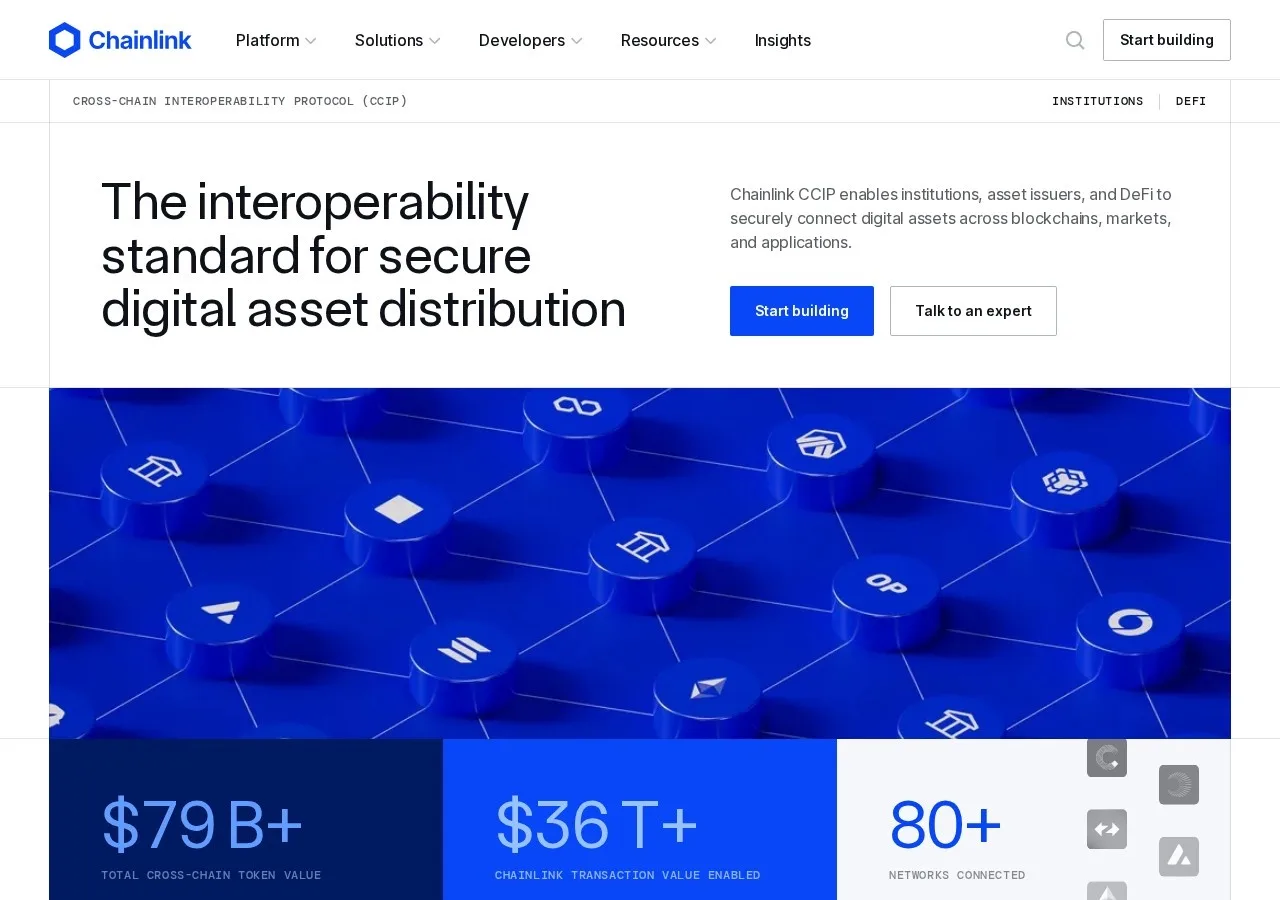
Chainlink CCIP’s product page with its headline, calls to action, network illustration, and platform statistics
Chainlink CCIP’s product page with its headline, calls to action, network illustration, and platform statistics · Oct 20, 2026
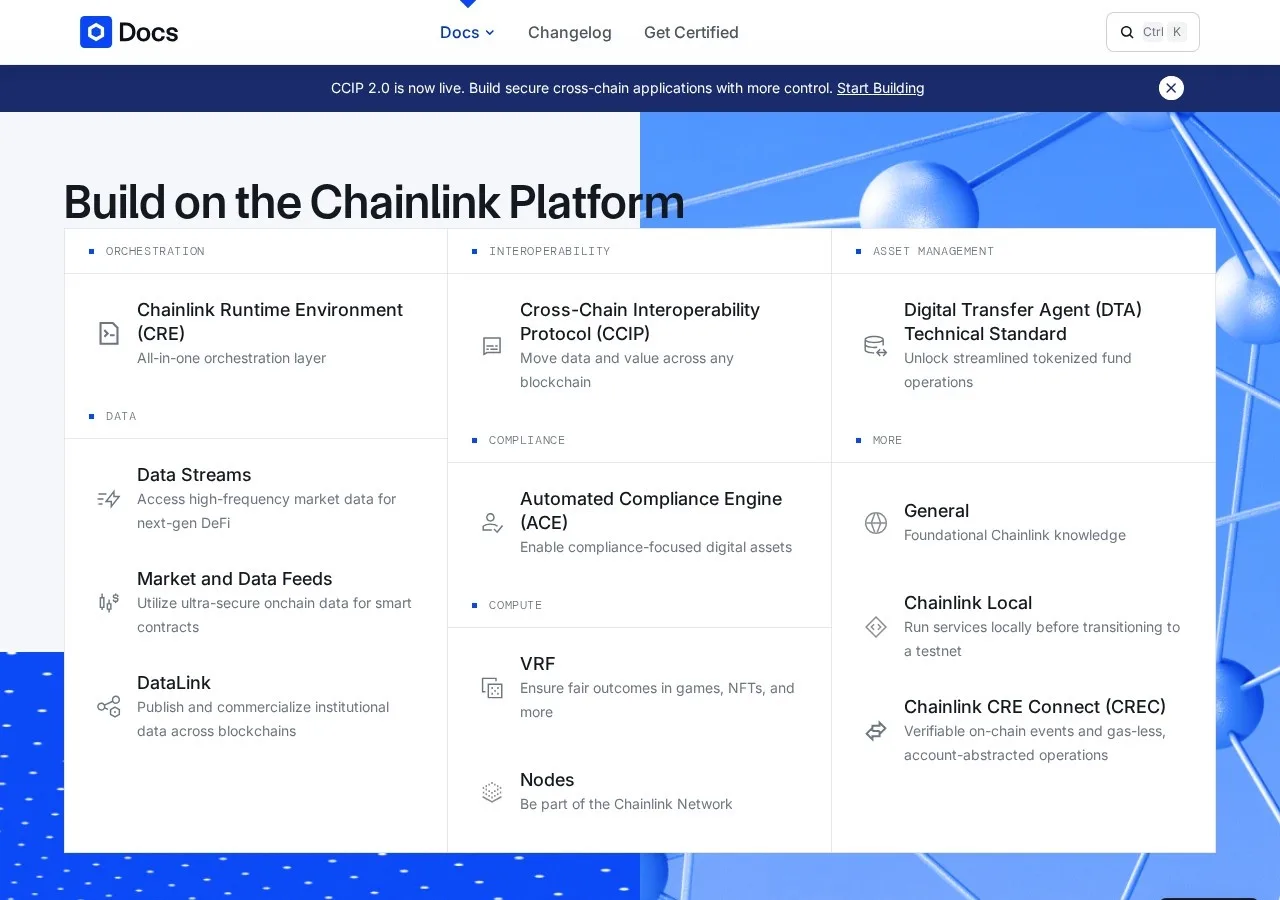
Docs: Chainlink Docs page showing platform documentation categories and product links
Docs: Chainlink Docs page showing platform documentation categories and product links · Oct 20, 2026

What users say about Chainlink CCIP

Discussions praise Chainlink's cross-chain infrastructure and CCIP security, noting heavy institutional adoption and migrations away from vulnerable legacy bridges. The primary criticism centers on tokenomics, with users frustrated over weak value accrual and utility for the native LINK token despite platform growth.

Top goods

  1. Widespread enterprise and institutional adoption 5 people 123
  2. Cross-chain security and bridge migration 3 people 123

Top bads

  1. Lack of token utility and value accrual 8 people 123
  2. Strict subreddit moderation and removed posts 2 people 123

In their own words

“CCIP 2.0 is Live CCIP 2.0 is officially live. Interoperability has meant a choice between two bad options: legacy bridges that have been exploited for more than $3.3 billion, or over half a year of custom engineering work per chain. Neither scales.”
Reddit · r/Chainlink · Sep 28, 2026 · View post
“Solv Protocol Migrates From LayerZero to Chainlink CCIP as Its Official Cross-Chain Infrastructure for $700M+ in Tokenized BTC As part of Solv’s ongoing security reviews and in light of recent cross-chain hacks observed in the industry, Solv is fully migrating to the Chainlink Cross-Chain…”
Reddit · r/CryptoCurrency · May 7, 2026 · View post
“DTCC JUST SPELLED IT OUT FOR YOU. ​"Interoperability is non-negotiable." ​They aren't picking a single chain. They are plugging the entire legacy system into CCIP. The pipes are laid. The multichain Singularity is here.”
Reddit · r/Chainlink · Feb 17, 2026 · View post
“Token not needed. Swift, J.P. Morgan, dtcc, visa, robinhood… still no value. Nothing burger.”
Reddit · r/Chainlink · Oct 4, 2026 · View post
“**Chainlink Labs continues its historic run of finding new use cases for everything except the LINK token.**”
Reddit · r/Chainlink · Sep 11, 2026 · View post
“Does chainlink adopters really uses LINK? This sub contain lots of news indicating widespread chain Link adoption from mainstream institutes. Are these financial institutes really using the public link chain and paying gas fee etc?”
Reddit · r/Chainlink · Jun 3, 2026 · View post

Based on 200 Reddit posts and comments from the last 12 months, checked Oct 20, 2026. These are posts by users on other sites, not reviews submitted on CryptoReview.

User reviews

No user reviews yet. Have you used Chainlink CCIP? Share your experience below.

Write a review of Chainlink CCIP

Your rating
At least 40 characters. Please write about your own experience.

Reviews are moderated before they appear.

FAQ

Who founded Chainlink CCIP?

Chainlink CCIP was created by Chainlink Labs, co-founded by Sergey Nazarov and Steve Ellis, who launched the cross-chain protocol in 2023.

Does Chainlink CCIP have a native token?

Yes, Chainlink CCIP uses the LINK token, which powers fee payments and security across the Chainlink oracle ecosystem.

Has Chainlink CCIP been audited or suffered any hacks?

Chainlink CCIP has suffered no security exploits and completed a SOC 2 Type 2 examination conducted by Deloitte & Touche LLP in 2026.

What chains does Chainlink CCIP support?

CCIP connects more than 80 networks, including Ethereum, Solana, Avalanche, Arbitrum, Base, Optimism, Polygon, BNB Chain, and Hyperliquid L1.

How does the security model of CCIP work?

CCIP secures transfers through multiple independent oracle networks, a 16-operator Committee Verifier, and secondary Cross-Chain Verifiers alongside a Risk Management Network.

Is KYC required to use Chainlink CCIP?

No KYC is required at the base protocol layer, though CCIP integrates with the Automated Compliance Engine (ACE) to allow institutional issuers to enforce KYC and AML policies.

Latest from Chainlink CCIP on X

Chainlink
@chainlink · 1.4M followers
Follow
Chainlink Adoption Update 🔗

Recently, there were 8 integrations of the Chainlink standard across 5 services and 3 different chains.

Users include @Anchorage, @further, HKGX, Hanwha Investments & Securities, @Polymarket, @SPGlobalRatings https://t.co/hEohNiB41F
Image attached to the post
22 87 608 28.4K View on X
"We are going to free up billions and billions of dollars of trapped liquidity that, in the current structure, is stuck."

At Link:NYC, @The_DTCC CEO Frank La Salla joined @SergeyNazarov the day after DTCC launched its tokenization service.

Watch the full fireside chat now ↓ https://t.co/X6VBOvZ3pa
28 107 700 41.9K View on X
$LINK RESERVE UPDATE

In the month of October, the Chainlink Reserve accumulated 427,577 LINK for $5.3M+.

Total holdings: 6,475,076 LINK. https://t.co/P24wlf0qIr
36 90 1K 53.2K View on X
NEW from Link:NYC: @Polymarket deepens its partnership with Chainlink, its official oracle infra, to expand its high-speed 15-minute markets beyond crypto.

Now live: gold and silver.

More commodities, with equities and FX to follow.

From Bitcoin to gold, Polymarkets run on Chainlink data.
24 81 604 78.6K View on X
⬡ Link:NYC RECAP ⬡

→ Chainlink 24/7 with @aave
→ CustodySync with @Anchorage Digital
→ Adoption by S&P Global Ratings, LG CNS, & more
→ Sergey Nazarov’s vision for building a new global financial system
→ Leader insights from DTCC, Swift, ICE, Fidelity, BlackRock, BoA, CFTC, & more

https://t.co/V5M39ndVWV
23 61 447 22.8K View on X

Recent public posts from @chainlink, shown as published. Not reviewed or endorsed by CryptoReview.

Alternatives to Chainlink CCIP

Cross-chain swap aggregator routing tokens across 100+ EVM and non-EVM blockchains

AggregatorEthereum · BNB Chain +7Audited
4.4

Intent-based cross-chain bridge using optimistic verification, processing over $40B in total volume

No KYCIntent-basedEthereum · Arbitrum +4Audited
4.3

Intent-based cross-chain bridge and payment network across more than 85 blockchains

No KYCIntent-basedEthereum · Base +9Audited
4.3

Intent-based cross-chain protocol settling transfers across 25+ networks without locked liquidity pools

No KYCIntent-basedEthereum · BNB Chain +7Audited
4.3

Cross-chain swap protocol using intent routing and CCTP across Solana, EVM chains, and Sui

No KYCIntent-basedSolana · Ethereum +9Audited
4.2

Cross-chain DEX and bridge aggregator routing swaps across more than 80 blockchains

No KYCAggregatorBitcoin · Ethereum +3Audited
4.2