


$580M in October.
Market conditions change. deBridge's commitment to reliability doesn't.
Just use deBridge. https://t.co/Om6SrPV2Kp

deBridge
Intent-based cross-chain protocol settling transfers across 25+ networks without locked liquidity pools
4.3/ 5
Our score
Very good
Design
Intent-based
Chains supported
26
Typical fee
4 bps lowest spread
Typical transfer time
1.96 seconds median
Security model
Decentralized validators and intent solver settlement without liquidity lockup
Audited
Yes
What is deBridge?
deBridge is a cross-chain interoperability protocol and liquidity layer connecting more than 25 blockchains, including Ethereum, Solana, BNB Chain, and Tron. Instead of locking tokens into shared bridge pools, it uses an intent-based architecture known as DLN where independent solvers fulfill cross-chain orders.
Team and funding
The project raised $5.5M in a September 2021 seed funding round led by ParaFi Capital, with backing from Animoca Brands, Crypto.com Capital, GSR, and IOSG Ventures. Total funding raised, including the IDO, reached roughly $10.5M.
How transfers and solvers work
deBridge operates on a non-custodial basis without mandatory identity checks. When an order is placed, solvers take the opposite side of the trade and deliver native assets directly to the destination chain. This intent framework settles trades without wrapping assets or trapping pool liquidity across chains. Spreads begin at 4 bps, and deBridge reports a median settlement speed of 1.96 seconds.
Track record and integrations
By late 2025, cumulative transfer volume reached $2.35B across 385,000 unique users. Route demand centers heavily on Tron, which accounted for over $600M in monthly volume in November 2025. In February 2026, deBridge rolled out its Model Context Protocol (MCP) server, allowing automated AI agents to execute cross-chain liquidity transactions, followed by TRON DAO integration in July 2026. The protocol issues the DBR governance token, which started contributor vesting in January 2026. deBridge has recorded zero exploits since launch and maintains a $200,000 bug bounty alongside audits from Halborn, Zokyo, and Ackee Blockchain.
Risks and discontinued routes
Users depend on third-party solver liquidity; low solver participation on specific routes can lead to delayed order fulfillment. Network coverage can also change abruptly. In October 2026, deBridge discontinued bridging support for Mantle, Plasma, Sophon, and Plume.
Founders
Alex SmirnovCo-founder and CEO
Mechanics and applied mathematics specialist who previously co-founded crypto infrastructure initiatives.
Best for:Solana to EVM arbitrageursHigh-speed native asset tradersDevelopers integrating cross-chain AI agentsTraders avoiding wrapped token risk
Pros and cons
Pros
- Median transfer settlement time of 1.96 seconds
- Zero reported exploits since inception across 26+ audits
- No wrapped token exposure due to native-to-native intent execution
- Direct native bridging support for Solana and Tron
- Does not require user identity verification
Cons
- Unfilled orders can stall if solvers lack liquidity for a pair
- Support for chains can be deprecated abruptly, such as Mantle and Plume in 2026
- DBR token unlocks have previously triggered substantial secondary market price volatility
Our review
4.3/5
Very good
deBridge provides fast intent-based transfers without pool-lockup risks across major networks like Solana and Ethereum, but users face variable market-maker pricing and token dilution risks.
deBridge is an intent-based cross-chain protocol connecting more than 25 blockchains, including Ethereum, Solana, BNB Chain, Tron, and Polygon. Instead of relying on conventional lock-and-mint bridge contracts or isolated liquidity pools, deBridge uses an order-execution architecture where external solvers fulfill user orders directly on the destination chain. This design uses native asset settlement, with a median time of 1.96 seconds and spreads starting at 4 basis points.
The security model combines decentralized validators with 26+ security audits. The protocol has undergone reviews by firms including Halborn, Zokyo, and Ackee Blockchain, maintains a $200,000 bug bounty program, and reports zero security exploits since launch. Total cumulative volume has exceeded $2.35 billion across 385,000 unique users, generating about $100,000 in daily protocol fees. The project raised $10.5 million across funding rounds, including a $5.5 million seed round led by ParaFi Capital.
- Solver execution depends on third-party market maker liquidity.
- Chain support changes dynamically, with deBridge discontinuing support for networks like Mantle, Plasma, Sophon, and Plume in October 2026.
- The native DBR governance token faces regular vesting pressure, including significant unlocks across 2025 and 2026 that have impacted token price stability.
Specs
| KYC required ⓘ | No · unverified |
|---|---|
| Design | Intent-based |
| Chains | Ethereum, BNB Chain, Arbitrum, Base, Optimism, Polygon, Avalanche, Solana, Other |
| Chains supported | 26 · unverified |
| Typical fee | 4 bps lowest spread · unverified |
| Typical transfer time | 1.96 seconds median · unverified |
| Security model | Decentralized validators and intent solver settlement without liquidity lockup · unverified |
| Audited | Yes |
| Token | DBR |
| Intent-based | Yes · unverified |
| Native token transfers (no wrapped tokens) | Yes · unverified |
Not disclosed by the provider: Max transfer.
Data from the provider's website and public sources. Fees and availability change; confirm on the official site before you sign up.
Key features
Intent-based DLN routing
Executes cross-chain limit orders through independent solvers using native liquidity rather than shared locked pools and wrapped assets.
Sub-two-second settlement
Delivers a median cross-chain settlement time of 1.96 seconds across supported routes.
Broad chain coverage
Enables transfers across more than 25 networks, including Solana, Tron, Ethereum, Arbitrum, Polygon, and BNB Chain.
AI agent MCP interface
Provides a Model Context Protocol server that lets automated AI agents and developers programmatically execute cross-chain liquidity flows.
Low spread swaps
Offers order execution spreads starting as low as 4 bps without custodial intermediate wrappers.
Developer borderless API
Supplies widgets and programmatic APIs for integrating cross-chain transactions and gasless flows.
Inside deBridge
Borderless API
A developer API that enables applications to integrate cross-chain swaps and gasless transfer flows directly into their own interfaces.
MCP (Model Context Protocol)
An execution interface that allows AI agents and programmatic systems to execute cross-chain liquidity and settlement commands.
Widget
An embeddable bridge interface that external websites and decentralized applications can deploy for instant cross-chain swaps.
Hooks
Smart contract workflow primitives for complex cross-chain contract calls.
deAnalytics
An onchain dashboard providing metrics on cross-chain volume, network flows, and user statistics.
deExplorer
A dedicated cross-chain tracking explorer that lets users track specific order statuses and monitor protocol transactions across all supported chains.
deBridge screenshots

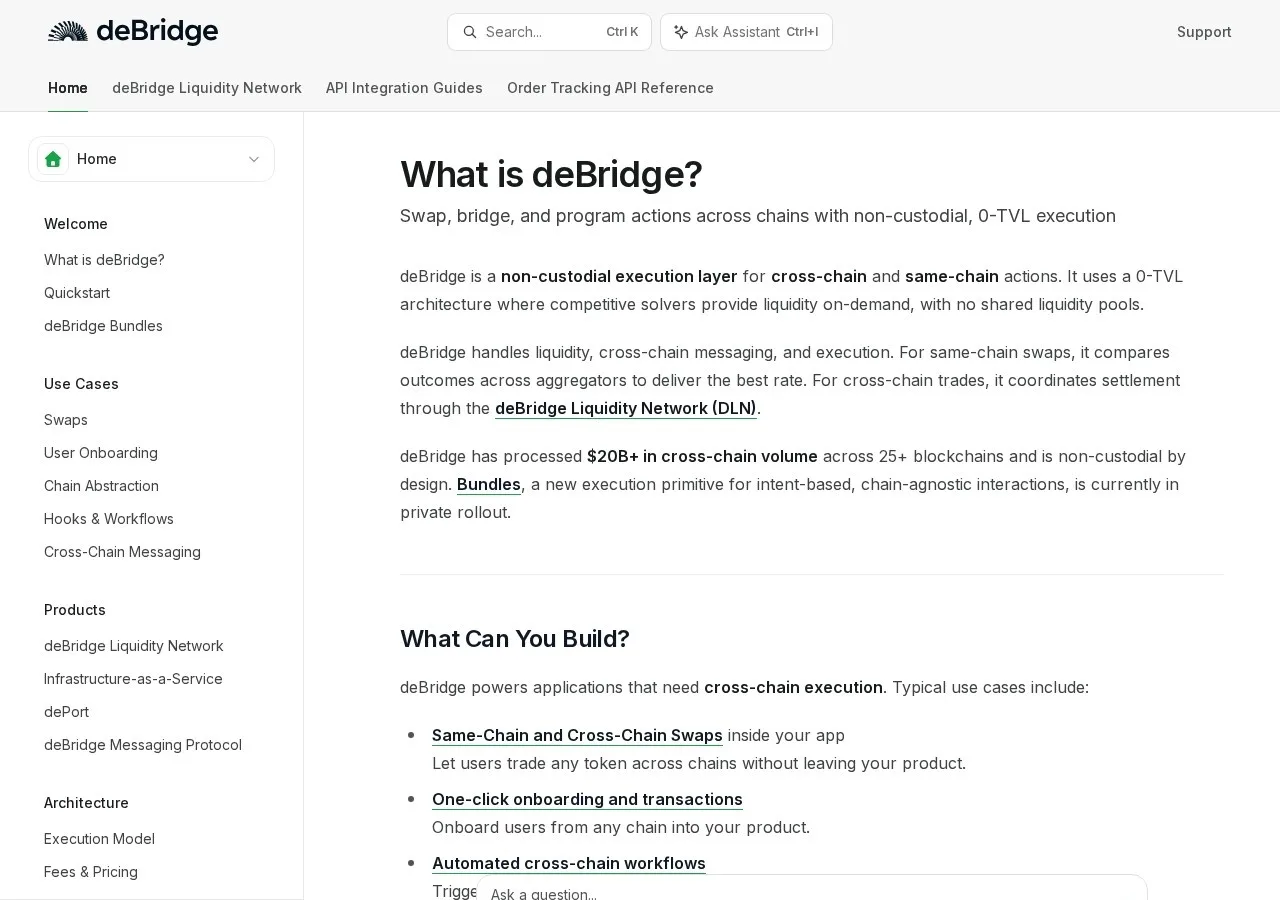
What users say about deBridge
User feedback for deBridge includes severe complaints regarding hidden exchange rate spreads during swaps alongside some general recommendations.
In their own words
“Warning: deBridge.com has MASSIVE hidden fees As recommended somewhere I've swapped through deBridge; 5 figures worth and I'm furious, UX was showing not even 0.1% slippage, I actually had 3%??!!”
Based on 18 Reddit posts and comments from the last 12 months, checked Oct 20, 2026. These are posts by users on other sites, not reviews submitted on CryptoReview.
User reviews
No user reviews yet. Have you used deBridge? Share your experience below.
Funding and investors
$10.5MTotal raised
2Rounds
16Investors
-
Seed Sep 2021 $5.5MSource
 ParaFi CapitalVenture capital
Lead
AC AccompliceVenture capital
AN AngelDAODAO / community fund
 Animoca BrandsCorporate VC
AV Axia8 VenturesVenture capital
BC Bitscale CapitalVenture capital
CO Chorus One VenturesCorporate VC
CC Crypto.com CapitalVenture capital
DV D64 VenturesVenture capital
DF Digital Finance GroupVenture capital
FL Fundamental LabsVenture capital
GS GSRCorporate VC
GD Gabby DizonVenture capital
HU HuobiExchange ventures arm
 IOSG VenturesVenture capital
-
Accelerator Amount undisclosed
FAQ
How does deBridge transfer assets across chains?
deBridge uses an intent-based order architecture where external solvers fill transfer orders directly on destination chains. This avoids locking liquidity in pooled bridge contracts and uses native asset transfers instead of wrapped tokens.
Is KYC required to use deBridge?
No identity verification or KYC is required to use deBridge. The protocol operates via non-custodial smart contracts directly through supported Web3 wallets.
Has deBridge ever been hacked?
No, deBridge has recorded zero security exploits since launch. Its code has undergone 26+ audits by firms including Halborn, Zokyo, and Ackee Blockchain.
What chains are supported by deBridge?
deBridge connects over 25 networks, including Ethereum, Solana, BNB Chain, Tron, Arbitrum, Polygon, and Arc. Support for Mantle, Plasma, Sophon, and Plume was discontinued in October 2026.
Does deBridge have a native token?
Yes, deBridge issues the DBR governance token. The protocol directs 100% of protocol earnings from its Reserve Fund to DBR buybacks on public markets.
What fees does deBridge charge?
deBridge transfers incur network gas costs and solver spreads that start as low as 4 basis points. Total execution costs vary depending on the destination chain and routing route.
Latest from deBridge on X
BNB Chain is now fully operational.
Following precautionary measures and continued monitoring, deBridge has determined that normal operations can safely resume.
Protecting users remains our top priority.
Following precautionary measures and continued monitoring, deBridge has determined that normal operations can safely resume.
Protecting users remains our top priority.
deBridge continues to operate normally.
As a precautionary measure, transfers to and from BNB Chain have been temporarily disabled.
All other supported chains remain unaffected. Transfers to and from BNB Chain will be re-enabled once ecosystem conditions return to normal.
As a precautionary measure, transfers to and from BNB Chain have been temporarily disabled.
All other supported chains remain unaffected. Transfers to and from BNB Chain will be re-enabled once ecosystem conditions return to normal.
$2B of deBridge's last $5B wasn't cross-chain
Ethereum ⇆ Ethereum
Base ⇆ Base
Solana ⇆ Solana
One app & API for any chain, asset, and market https://t.co/OqpuNExjwk
Ethereum ⇆ Ethereum
Base ⇆ Base
Solana ⇆ Solana
One app & API for any chain, asset, and market https://t.co/OqpuNExjwk

In Q3, deBridge handled:
+ $1.9B in volume
+ Over $500M in samechain volume
+ Robinhood Chain and Arc
+ Exceptional reliability and uptime throughout
Q4 brings new chains, milestones, and a completely new paradigm for onchain market execution
Stay with deBridge https://t.co/pgaUuDJd0l
+ $1.9B in volume
+ Over $500M in samechain volume
+ Robinhood Chain and Arc
+ Exceptional reliability and uptime throughout
Q4 brings new chains, milestones, and a completely new paradigm for onchain market execution
Stay with deBridge https://t.co/pgaUuDJd0l

Recent public posts from @deBridge, shown as published. Not reviewed or endorsed by CryptoReview.
Alternatives to deBridge

Cross-chain swap aggregator routing tokens across 100+ EVM and non-EVM blockchains
AggregatorEthereum · BNB Chain +7Audited

Intent-based cross-chain bridge using optimistic verification, processing over $40B in total volume
No KYCIntent-basedEthereum · Arbitrum +4Audited

Intent-based cross-chain bridge and payment network across more than 85 blockchains
No KYCIntent-basedEthereum · Base +9Audited

Cross-chain swap protocol using intent routing and CCTP across Solana, EVM chains, and Sui
No KYCIntent-basedSolana · Ethereum +9Audited

Cross-chain DEX and bridge aggregator routing swaps across more than 80 blockchains
No KYCAggregatorBitcoin · Ethereum +3Audited

Cross-chain messaging and token protocol connecting over 80 blockchains via decentralized oracle networks
Messaging protocolEthereum · BNB Chain +8Audited