



Solana access, at the speed of Relay 🚀

Relay
Intent-based cross-chain bridge and payment network across more than 85 blockchains
4.3/ 5
Our score
Very good
Design
Intent-based
Chains supported
85
Typical fee
Under $0.01 average cost plus dynamic execution fees
Typical transfer time
1 second
Security model
Non-custodial depository with authorized signer oracle Hub and relayer settlement
Audited
Yes
What is Relay?
Relay is an intent-based cross-chain bridging and payment network that routes token transfers and swaps across more than 85 blockchains. Instead of relying on pooled liquidity pools or lock-and-mint bridge designs, Relay pairs user transfer intents with independent solvers who fulfill orders directly on destination networks, completing transfers in an average of one second.
Team and funding
Relay was built by the team behind Reservoir and launched in 2024. Headquartered in New York, the organization operates with a team of roughly 27 people. In February 2026, the project raised a $17 million Series B round led by Archetype Ventures and Union Square Ventures (USV) to build Relay Chain, a dedicated settlement layer and verification hub for cross-chain execution.
Architecture and mechanics
Relay functions without a shared cross-chain treasury contract. Users interact with a non-custodial depository contract on the origin chain. Off-chain solvers front the requested assets directly on the destination chain, receiving reimbursement from the user deposit only after proof of settlement is validated. All transfers settle in native assets rather than synthetic wrapped tokens. Settlement is verified on the Relay Chain Hub using an authorized oracle signer structure that records balance changes deterministically.
Pricing and access
Transactions route without mandatory KYC checks. Relay is available globally through its consumer interface and developer API. Operating costs are low, with average transaction expenses running below $0.01 alongside standard network gas. The protocol incorporates DEX meta-aggregation, gas sponsorship for recipients, and fixed-rate settlement for stablecoin payments.
Track record and risks
By late 2026, Relay had processed over $5 billion in cumulative volume across more than 50 million transactions for roughly 5 million users. Smart contracts operate alongside an active bug bounty and MEV protection. Relay Vaults were retired in October 2026, with an active withdrawal deadline of December 31, 2026. The primary risks center on dependency on the authorized oracle signer model for fill verification, potential solver liquidity shortfalls for large single orders, and destination execution stalls if solvers experience pricing volatility.
Best for:Fast native multi-chain transfersCross-chain stablecoin settlementsDevelopers building cross-chain checkout
Pros and cons
Pros
- Average execution speed of one second across supported networks
- No wrapped tokens used, settling directly in native destination assets
- Average transaction fee sits below $0.01 plus network gas
- Connects over 85 networks without pooled treasury lock-in
- No KYC requirements for consumer web app or API transfers
Cons
- Verification hub depends on an authorized oracle signer architecture
- Solver capacity limits maximum transfer size during volatile market conditions
- Relay Vaults retired in late 2026, requiring manual user balance withdrawals
Our review
4.3/5
Very good
Relay delivers fast native-asset cross-chain transfers across more than 85 blockchains, but its settlement depends on an authorized oracle signer rather than a trustless light-client model.
Relay is an intent-based cross-chain payments and bridging network that swaps and transfers native assets across more than 85 blockchains. Developed by the team behind Reservoir and launched in 2024, Relay avoids wrapped tokens and pooled liquidity lockups. Instead, user funds sit in non-custodial depository contracts until external solvers fill transactions on the target network, settling fills deterministically in around one second.
The system brings several concrete strengths:
- Native settlement avoids synthetic wrapper risk, and solvers front destination liquidity.
- Transfers settle rapidly, averaging around one second per transaction.
- Broad reach spanning more than 85 chains, including EVM layers like Arbitrum, Base, and X Layer, alongside non-EVM ecosystems like Solana and Sui.
- Low costs, with average transaction expenses documented at under $0.01 alongside decentralized exchange meta-aggregation.
The principal trade-off lies in Relay's underlying security architecture. Rather than relying on canonical light clients or decentralized multi-party proof systems, the deterministic smart contract Hub on Relay Chain uses an authorized oracle signer model to validate fill attestations. While the protocol has completed independent security audits and maintains a bug bounty, this structure concentrates verification authority in designated signers. Relay retired its community liquidity Vaults in late 2026, requiring users to withdraw remaining balances.
Sources (2)
Specs
| KYC required ⓘ | No · unverified |
|---|---|
| Design | Intent-based |
| Chains | Ethereum, Base, Arbitrum, Optimism, Polygon, BNB Chain, Solana, Bitcoin, Sui, Tron, Other |
| Chains supported | 85 · unverified |
| Typical fee | Under $0.01 average cost plus dynamic execution fees · unverified |
| Typical transfer time | 1 second · unverified |
| Security model | Non-custodial depository with authorized signer oracle Hub and relayer settlement · unverified |
| Audited | Yes · unverified |
| Intent-based | Yes · unverified |
| Native token transfers (no wrapped tokens) | Yes · unverified |
Not disclosed by the provider: Token, Max transfer.
Data from the provider's website and public sources. Fees and availability change; confirm on the official site before you sign up.
Key features
Intent-based solver settlement
Solvers front native tokens on destination chains, settling orders within one second without minting wrapped assets.
Multi-network coverage
Routes transactions and token swaps across more than 85 supported blockchains, including Ethereum, Solana, Bitcoin, and Base.
Meta-aggregation swaps
Combines cross-chain bridging with decentralized exchange aggregation on source and destination networks in a single call.
Non-custodial depository
Deposited funds lock in non-custodial contracts and release to a solver only after the destination transfer completes.
Deterministic settlement hub
The Relay Chain Hub validates order completion and manages balances with publicly visible block explorer tracking.
Gas sponsorship options
Developers can sponsor destination gas through the Relay API so users can bridge without holding gas tokens.
Inside Relay
Relay Consumer App
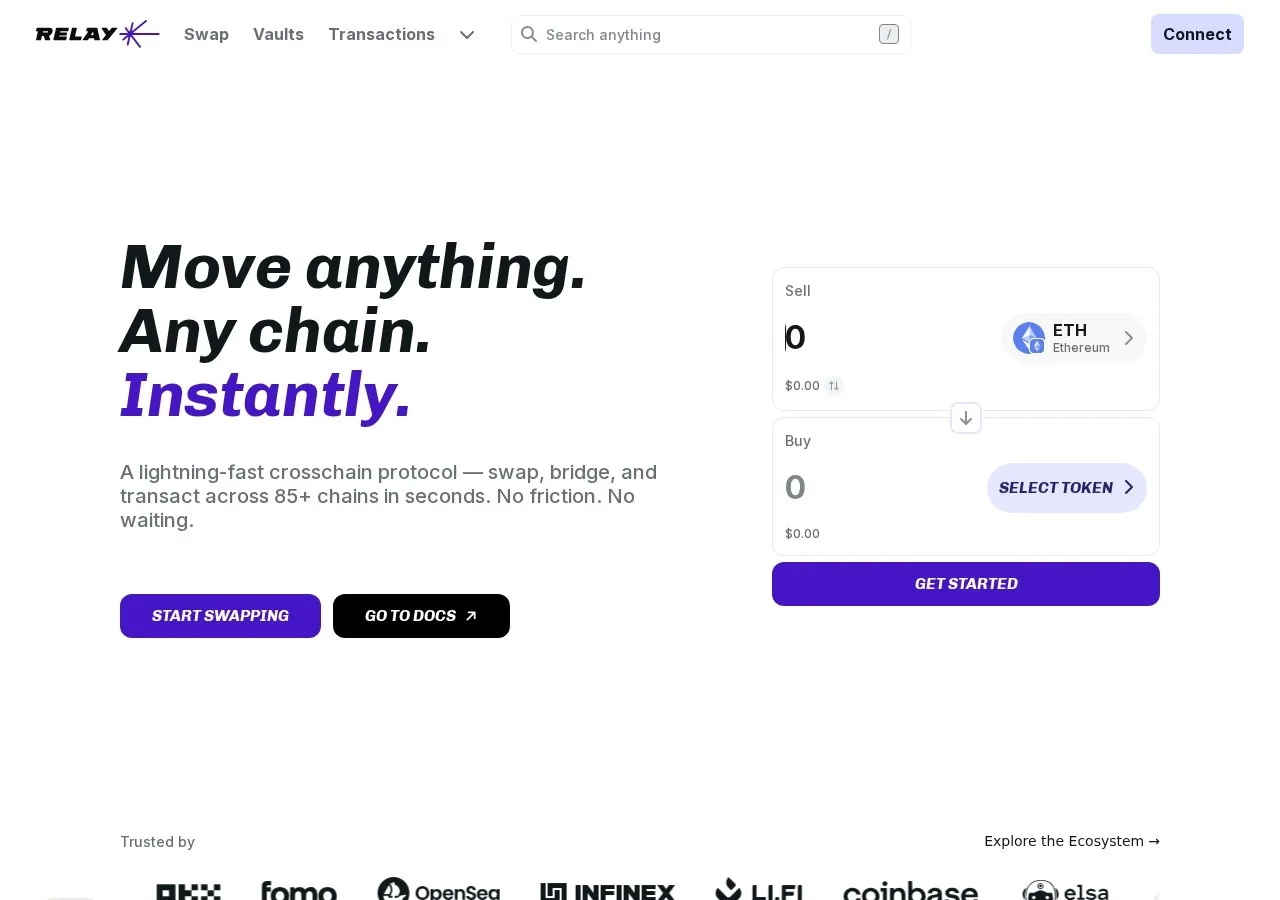
The web interface lets users bridge and swap native tokens across more than 85 networks with one-click execution.
Relay API
A developer integration providing cross-chain routing, DEX meta-aggregation, gas sponsorship, and live endpoint performance tracking.
Relay Chain & Settlement Hub
A deterministic settlement contract layer that verifies solver fills, validates orders, and records transparent balance accounting.
Relay screenshots
What users say about Relay
User sentiment is overwhelmingly positive, with frequent recommendations highlighting Relay as an easy, fast, and low-cost cross-chain bridge. Some posts mention transaction failures or issues involving other services.
In their own words
“I use Relay.link, for me the best, fastest and most reliable bridge. I use many networks, and just I need fast execution sending and receiving. I never had a single issue, over any blockchain. Enter, connect, send, it just work in seconds”
“relay.link is the cheapest and fastest so far base on my experience.”
“Relay.link One of my all-time favorite Bridges and very very low fees you can also swap between multiple wallets, not just one wallet 😁”
Based on 77 Reddit posts and comments from the last 12 months, checked Oct 20, 2026. These are posts by users on other sites, not reviews submitted on CryptoReview.
User reviews
No user reviews yet. Have you used Relay? Share your experience below.
Funding and investors
$17MTotal raised
1Round
2Investors
-
Series B Feb 2026 $17M
FAQ
Who created Relay?
Relay was built by the team behind Reservoir and launched in 2024. The New York-based project raised a $17 million Series B round in February 2026 led by Archetype Ventures and USV.
What fees does Relay charge for bridging?
Average transaction costs on Relay are under $0.01. The protocol routes cross-chain swaps via decentralized exchange aggregation with guaranteed execution rates.
Is KYC verification required to use Relay?
No, Relay is a non-custodial protocol that interacts directly with self-hosted web3 wallets without KYC verification.
How does Relay handle security and custody?
Relay operates without pooled treasury contracts, placing user deposits in non-custodial contracts until solvers fulfill orders. The settlement hub is audited and uses an authorized oracle signer model to verify order fills.
Which blockchains does Relay support?
Relay supports more than 85 blockchains, including Ethereum, Base, Arbitrum, Optimism, BNB Chain, Polygon, Solana, Bitcoin, Sui, Tron, and X Layer.
Does Relay issue wrapped tokens during transfers?
No, Relay delivers native assets on destination networks, avoiding synthetic wrapped tokens by having solvers fill orders directly.
Latest from Relay on X
Relay is for every onchain app.
Relay Vaults are being retired.
Have funds in Relay Vaults? Withdraw them at https://t.co/QIPzU0UHLF. New deposits are no longer supported.
The withdrawal page closes Dec 31, 2026. After that, you can still withdraw directly from the contracts.
Guide:
https://t.co/yhTKXivKwd
Have funds in Relay Vaults? Withdraw them at https://t.co/QIPzU0UHLF. New deposits are no longer supported.
The withdrawal page closes Dec 31, 2026. After that, you can still withdraw directly from the contracts.
Guide:
https://t.co/yhTKXivKwd
OUSD is now live on Relay.
Stablecoins are spreading across more chains. Getting between them should be the simplest part.
https://t.co/ojYPqlTODY https://t.co/HU9dEakkjF
Stablecoins are spreading across more chains. Getting between them should be the simplest part.
https://t.co/ojYPqlTODY https://t.co/HU9dEakkjF

X Layer is live on Relay.
Start from any chain Relay supports and receive USDC or OKB on @XLayerOfficial
https://t.co/2snNZXFdm4 https://t.co/pFfcDn8sJX
Start from any chain Relay supports and receive USDC or OKB on @XLayerOfficial
https://t.co/2snNZXFdm4 https://t.co/pFfcDn8sJX
Recent public posts from @RelayProtocol, shown as published. Not reviewed or endorsed by CryptoReview.
Alternatives to Relay

Cross-chain swap aggregator routing tokens across 100+ EVM and non-EVM blockchains
AggregatorEthereum · BNB Chain +7Audited

Intent-based cross-chain bridge using optimistic verification, processing over $40B in total volume
No KYCIntent-basedEthereum · Arbitrum +4Audited

Intent-based cross-chain protocol settling transfers across 25+ networks without locked liquidity pools
No KYCIntent-basedEthereum · BNB Chain +7Audited

Cross-chain swap protocol using intent routing and CCTP across Solana, EVM chains, and Sui
No KYCIntent-basedSolana · Ethereum +9Audited

Cross-chain DEX and bridge aggregator routing swaps across more than 80 blockchains
No KYCAggregatorBitcoin · Ethereum +3Audited

Cross-chain messaging and token protocol connecting over 80 blockchains via decentralized oracle networks
Messaging protocolEthereum · BNB Chain +8Audited