Migrating from a legacy solution, Loon collaborated with LayerZero to design a bespoke solution that satisfied the unique regulatory, compliance, security, and growth needs of $CADC.

Omnichain messaging protocol with 43+ configurable verifier networks
LayerZero is an omnichain messaging protocol for sending data and assets between blockchains. Its OFT standard lets issuers deploy native-transfer tokens across networks, including USDT0 and USDG. The protocol recorded about $11.38 billion in TVL on October 17, 2026, and its infrastructure supports 132 blockchains.
The protocol is developed by LayerZero Labs. Funding records include a $2 million seed round in April 2021, a $6 million Series A in September 2021, a $135 million Series A+ at a $1 billion valuation in March 2022, a $120 million Series B in April 2023, and a $55 million private token sale in April 2025. Named investors include a16z, Sequoia Capital, Binance Labs, Multicoin Capital, PayPal Ventures, Coinbase Ventures, Circle Ventures and Tether.
LayerZero does not hold transferred funds in a central account. Applications send messages through LayerZero endpoints and configure Decentralized Verifier Networks, or DVNs, to verify them. Each application chooses its verifier set and quorum, with 43 or more DVNs available. The system supports EVM networks as well as Solana, Aptos and Hyperliquid. Developers can build OApps, OFTs and ONFTs through the documentation and CLI tools.
OFT transfers burn or lock an issued token representation on one chain and create the corresponding supply on another, depending on the token design. Chain-specific gas rules and fee tokens affect delivery. Stargate is a related asset-movement product.
Costs depend on the source chain, destination chain, message size and configured delivery route. Users pay a messaging fee and source-chain gas. Native USDT0 transfers can carry no USDT0 fee, while the faster Aori route charges a small fee. LayerZero is permissionless infrastructure rather than a custodial exchange.
LayerZero Labs announced Console and ATLAS as products launching later in 2026. In March 2026, an attacker used social engineering to obtain developer session keys and poison RPC nodes used by the LayerZero Labs DVN. On April 18, 2026, a KelpDAO rsETH bridge using a 1-of-1 verifier setup lost about $292 million in 116,500 rsETH after a forged message was accepted. LayerZero later stopped signing messages for applications using that configuration.
The incident shows the main bridge risks: verifier compromise and forged messages. Applications still depend on their chosen DVNs and smart contracts.

LayerZero offers broad, configurable cross-chain messaging, but its security depends heavily on each application's verifier configuration and suffered a $292 million exploit in April 2026.
LayerZero is a messaging protocol rather than a conventional lock-and-mint bridge. Applications use its endpoints and configure Decentralized Verifier Networks (DVNs) to validate cross-chain messages. Its OFT standard lets supported assets move between chains without relying on a separate wrapped representation.
LayerZero deployments include Ethereum, Polygon, Base, Arbitrum, Solana, BNB Chain, Tron, Aptos and Avalanche, among other networks. Documentation covers EVM, Solana, Aptos and Hyperliquid development. The protocol had about $11.38 billion in TVL on October 17, 2026. Unlike a bridge with one fixed validator set, LayerZero lets each application select its DVNs and quorum settings from 43 or more available networks.
The main weakness is the record of that model in practice. In March 2026, an attacker used social engineering to obtain a LayerZero Labs developer's session keys, entered its RPC cloud environment and poisoned internal RPC nodes. On April 18, a KelpDAO rsETH bridge using a 1-of-1 DVN configuration accepted a forged message, resulting in the theft of about $292 million in 116,500 rsETH. LayerZero attributed the attack to TraderTraitor, retained CrowdStrike, Mandiant and zeroShadow, and later barred its DVN from signing applications with a 1-of-1 configuration. KelpDAO stated it is migrating rsETH off LayerZero's OFT standard to Chainlink CCIP. The incident exposes both operational risk and the danger of application teams choosing weak verification settings.
LayerZero has substantial backing, including a $135 million Series A+ round led by Sequoia Capital and a16z, a $120 million Series B led by a16z, and a $55 million private token sale led by a16z crypto. It also publishes monthly security reports and maintains a $15 million bug bounty.
LayerZero fits teams that need configurable messaging or native omnichain asset standards and can review DVN and execution settings.
| Design | Messaging protocol |
|---|---|
| Chains | Ethereum, BNB Chain, Arbitrum, Base, Optimism, Polygon, Avalanche, Solana, Aptos, Tron, Other |
| Chains supported | 132 · unverified |
| Typical fee | Messaging fee plus source-chain gas; native USDT0 transfers carry no USDT0 fee · unverified |
| Security model | Application-configured decentralized verifier networks (DVNs) |
| Audited | Yes |
| Token | ZRO |
| Native token transfers (no wrapped tokens) | Yes · unverified |
Not disclosed by the provider: KYC required, Typical transfer time, Intent-based, Max transfer.
Data from the provider's website and public sources. Fees and availability change; confirm on the official site before you sign up.
Applications send messages between supported networks through LayerZero endpoints, with EVM, Solana, Aptos and Hyperliquid development targets.
Each application selects its verifier networks and quorum from 43 or more available DVNs.
Issuers can deploy omnichain fungible tokens such as USDT0 and USDG across multiple supported chains.
OFT designs can burn and mint the same issued asset across networks instead of relying on separate wrapped-token liquidity.
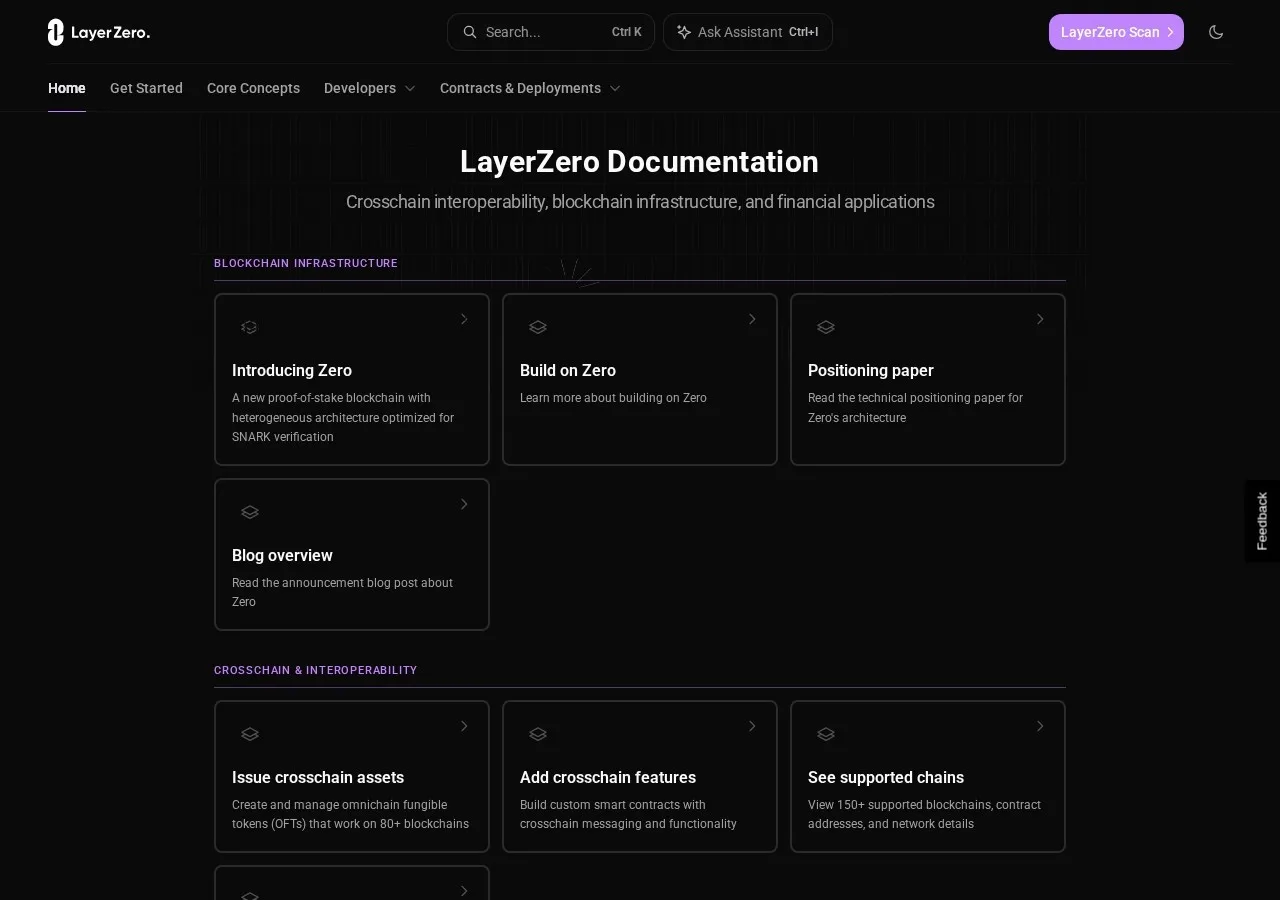
The documentation includes OApp, OFT and ONFT examples, plus a CLI quickstart for creating cross-chain applications.
LayerZero supports 132 blockchains, with different gas limits, fee tokens and execution rules across networks.
Blockaid Bridge Sentinel adds a DVN that screens proposed transactions against Blockaid's real-time threat intelligence.
Cross-chain infrastructure for deploying, expanding and connecting assets across supported blockchains. Developers can build omnichain applications and use OApp, OFT or ONFT projects through the documentation.
An enterprise control plane for deploying, managing, securing and monitoring multichain assets from one platform. The official site says it is launching later this year.
A heterogeneous blockchain architecture presented as infrastructure for global finance. The official site lists Zero as part of LayerZero's broader technology portfolio.
A headless exchange infrastructure product combining a centralized-exchange-style experience with decentralized settlement. The official site says it is launching later this year.
No user reviews yet. Have you used LayerZero? Share your experience below.
LayerZero is a cross-chain messaging protocol for sending data and supporting asset movement between blockchains. Applications configure verifier networks and can use standards such as OFT for omnichain tokens.
LayerZero deployments include Ethereum, Polygon, Base, Arbitrum, Solana, BNB Chain, Tron, Aptos and Avalanche, along with other networks. Its documentation also covers EVM chains, Hyperliquid and Solana development.
LayerZero users pay a messaging fee and source-chain gas. Native USDT0 transfers carry no USDT0 fee, while the faster Aori route charges a small fee.
LayerZero uses application-configured DVNs and has audited status, monthly security reports and a $15 million bug bounty. A KelpDAO rsETH bridge using a 1-of-1 DVN configuration lost about $292 million on April 18, 2026, after compromised RPC infrastructure enabled a forged message.
Yes. LayerZero's token is ZRO.
No. LayerZero is a messaging protocol, and its OFT standard supports native omnichain asset transfers. Security depends on the DVNs and quorum selected by each application.

Recent public posts from @LayerZero_Core, shown as published. Not reviewed or endorsed by CryptoReview.
Cross-chain swap aggregator routing tokens across 100+ EVM and non-EVM blockchains
Intent-based cross-chain bridge using optimistic verification, processing over $40B in total volume
Intent-based cross-chain bridge and payment network across more than 85 blockchains
Intent-based cross-chain protocol settling transfers across 25+ networks without locked liquidity pools
Cross-chain swap protocol using intent routing and CCTP across Solana, EVM chains, and Sui
Cross-chain DEX and bridge aggregator routing swaps across more than 80 blockchains
Type at least two characters. Press ↵ to see all results.