

Cross-chain swap aggregator routing tokens across 100+ EVM and non-EVM blockchains
AggregatorEthereum · BNB Chain +7Audited

Bridgeless Bitcoin cross-chain swap protocol using BitScaler atomic channels backed by $92M in funding
Portal is a cross-chain interoperability protocol built to execute atomic swaps across native Bitcoin, Bitcoin-native assets, and external networks without wrapped tokens or custodial bridges. By relying on state-channel and atomic swap designs, the network executes cross-chain transfers directly from non-custodial user balances.
Founded in 2018, Portal is based in San Francisco, United States. The founding team includes CEO Dr. Chandra Duggirala, a physician and technology entrepreneur; CTO Manoj Duggirala, who oversees core protocol engineering and the Portal Swap SDK; and serial entrepreneur George Burke, previously of FreshPay and BookSwim.com. The operational team includes Chief Operating Officer Jack Mills. Across its funding history, Portal has raised approximately $92M in venture capital, including a $34M seed round in January 2024 with participation from Arrington Capital, Coinbase Ventures, OKX Ventures, and Gate.io, followed by a $50M Series A round in August 2025 led by Paloma Investments.
The core infrastructure operates via BitScaler, a multi-party channel solution that coordinates cross-chain contracts and peer-to-peer atomic swaps on Bitcoin without requiring changes to base-layer opcodes. Node infrastructure runs through Portal OS, modular validator software incorporating the Liquidity Router and Coordinator to route settlement. Swap counterparties retain full asset custody in local wallets up to contract execution, avoiding bridge lock-up pools and synthetic representations of assets like wrapped BTC. Developers can implement native Bitcoin trades directly into independent applications through the Portal Swap SDK.
Portal deployed public testing infrastructure ahead of rolling mainnet phases, supporting Runes, Ordinals, and cross-chain Layer 1 integrations alongside the network's PTB utility token. In August 2025, the team allocated its Series A funding to onboard institutional liquidity providers, expand developer grant programs, and scale channel capacity for high-volume transactions.
While eliminating wrapped-asset depeg vulnerabilities and central pool honeypots, Portal's trust-minimized architecture introduces distinct operational trade-offs. The network's coordinator mechanism and channel settlement depend on responsive counterparty nodes and reliable validator routing.
Medical doctor and entrepreneur with experience in healthcare, technology, and blockchain ventures.
Technical lead and crypto engineer involved in the development of the Portal Swap SDK.
Serial entrepreneur who previously founded BookSwim.com and early Bitcoin processor FreshPay.
Portal facilitates custody-less, native Bitcoin swaps without wrapped tokens via BitScaler and is rolling out its mainnet in phases.
Portal to Bitcoin operates an interoperability protocol designed to turn native Bitcoin into a settlement layer for cross-chain swaps. Instead of using lock-and-mint mechanisms, liquidity pools with wrapped representations, or centralized custodians, the protocol relies on BitScaler. This system uses multi-party state channels and non-custodial delegation to execute native atomic swaps directly on Bitcoin without requiring new opcodes.
The primary advantage of Portal's architecture is the elimination of wrapped-asset depeg risks and central bridge honeypots. Users execute direct swaps between native BTC, Ordinals, Runes, and external layer-1 or layer-2 chains. Portal validators coordinate transactions via Portal OS without taking custody of user funds. Backed by $92 million in total capital, including a $34 million seed round in January 2024 and a $50 million Series A round in August 2025 led by Paloma Investments, the project holds significant development resources.
However, the protocol presents several trade-offs:
| KYC required ⓘ | No · unverified |
|---|---|
| Chains | Bitcoin · unverified |
| Security model | BitScaler trustless multi-party atomic swap channels and non-custodial validator nodes · unverified |
| Token | PTB · unverified |
| Native token transfers (no wrapped tokens) | Yes · unverified |
Not disclosed by the provider: Design, Chains supported, Typical fee, Typical transfer time, Audited, Intent-based, Max transfer.
Data from the provider's website and public sources. Fees and availability change; confirm on the official site before you sign up.
Executes trustless, multi-party channel swaps for native Bitcoin without requiring new consensus opcodes or minting synthetic wrapped tokens.
Coordinates cross-chain swap routing and peer-to-peer liquidity discovery across Bitcoin layers and external networks without pooling custody.
Provides developers with programmable integration hooks to execute non-custodial Bitcoin swaps directly inside third-party decentralized applications.
Features a built-in decentralized cross-chain exchange without moving funds through centralized intermediaries.
Equips network validators with modular Layer 1 and Layer 2 node components running alongside the network coordinator.
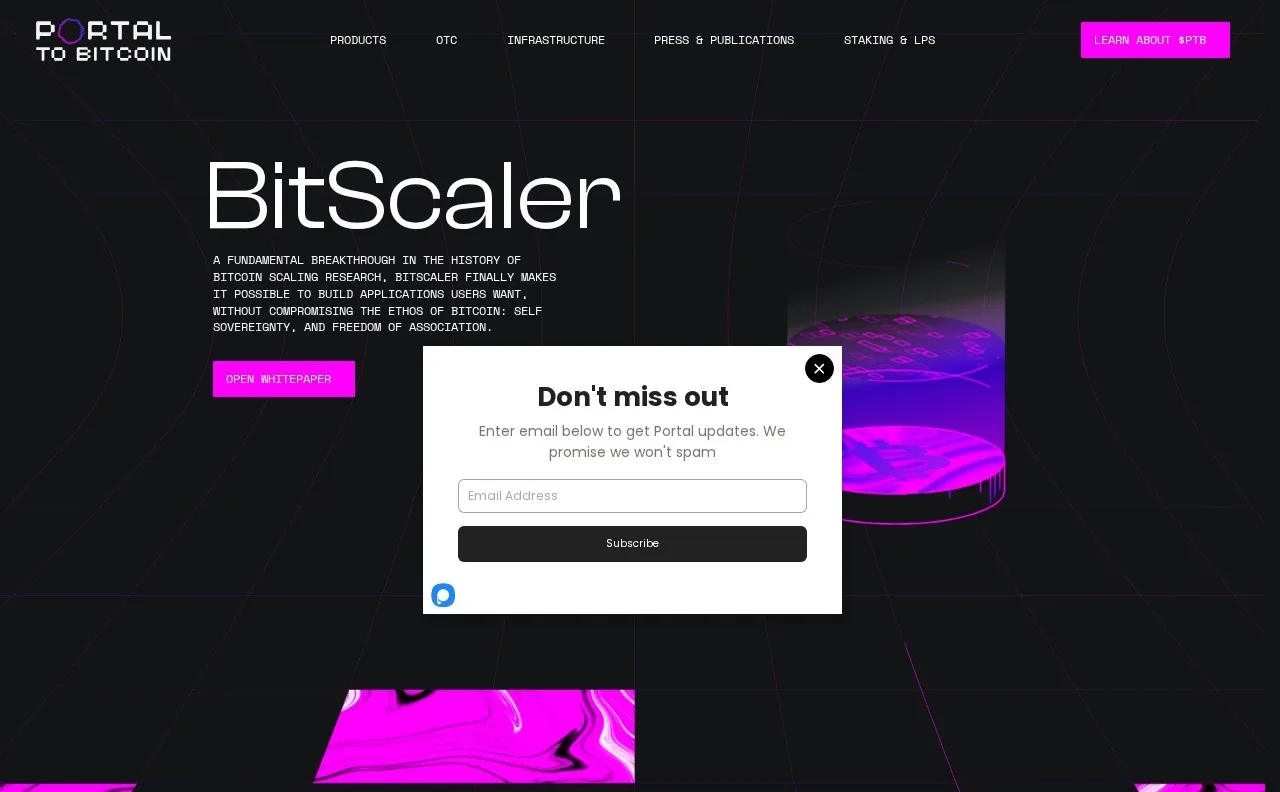
A trustless multi-party channel solution that scales Bitcoin for decentralized finance by enabling permissionless cross-chain contracts and atomic swaps without new opcodes.
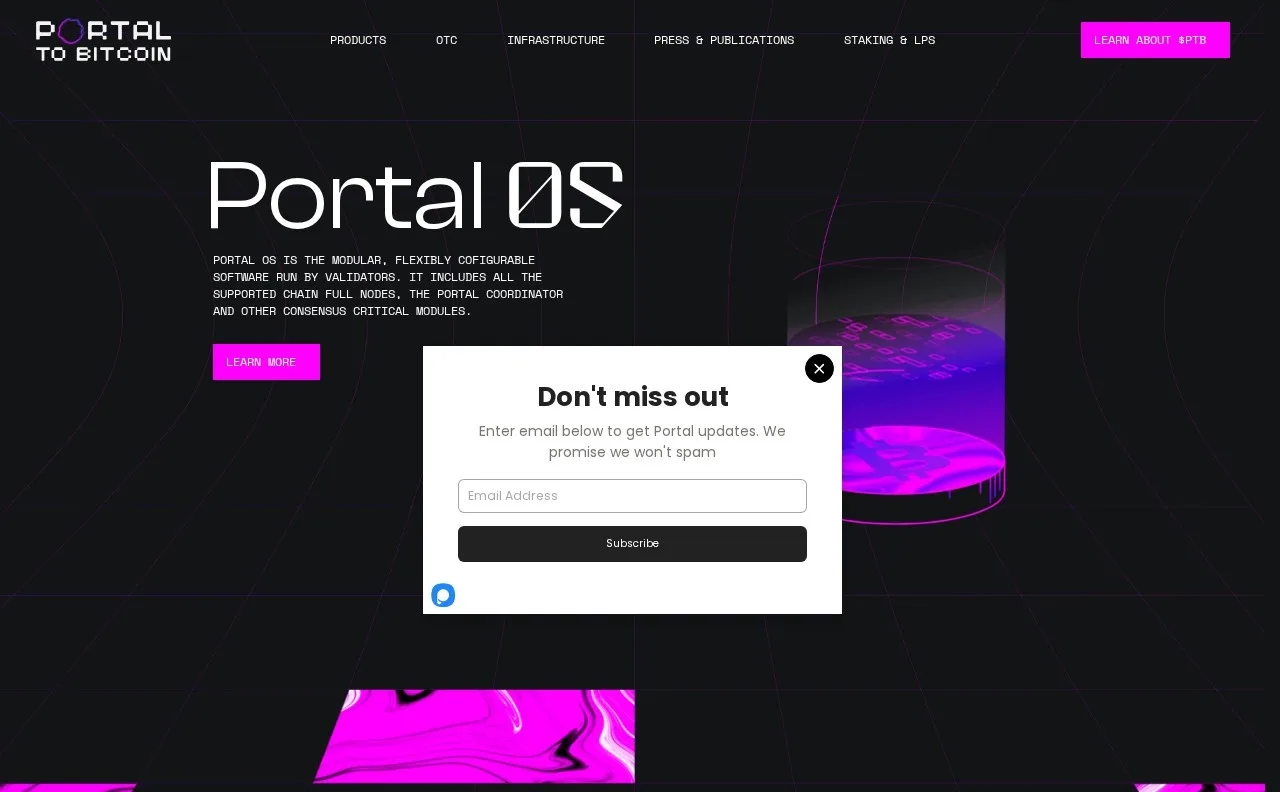
The multichain infrastructure operating system for Portal validators, packaging node configurations, the Portal Liquidity Router, and coordinator modules.
A bridgeless liquidity hub designed for asset routing and cross-chain swaps across native Bitcoin layers and external networks.
A developer toolkit for integrating direct Bitcoin liquidity and native cross-chain swaps into applications across multiple virtual machines.
A reference multicurrency wallet featuring a built-in decentralized cross-chain exchange supporting native BTC, Runes, and Ordinals.
A generative AI agent platform designed to analyze market data and assist users with crypto investment workflows.
No user reviews yet. Have you used Portal? Share your experience below.
Portal to Bitcoin was founded in 2018 by Dr. Chandra Duggirala (CEO and Chairman), Manoj Duggirala (CTO), and serial entrepreneur George Burke.
No, Portal uses BitScaler state-channel technology to execute native peer-to-peer atomic swaps without wrapping tokens or relying on custodial bridge vaults.
Yes, Portal's network operates with the PTB token.
Portal supports native Bitcoin (BTC), Ordinals, Runes, and compatible layer-1 and layer-2 assets through its Liquidity Router and Swap SDK.
Portal OS validators run modular node infrastructure to coordinate swaps and routing, but smart contracts and state channels prevent validators from ever taking custody of user funds.
Cross-chain swap aggregator routing tokens across 100+ EVM and non-EVM blockchains
Intent-based cross-chain bridge using optimistic verification, processing over $40B in total volume
Intent-based cross-chain bridge and payment network across more than 85 blockchains
Intent-based cross-chain protocol settling transfers across 25+ networks without locked liquidity pools
Cross-chain swap protocol using intent routing and CCTP across Solana, EVM chains, and Sui
Cross-chain DEX and bridge aggregator routing swaps across more than 80 blockchains
Type at least two characters. Press ↵ to see all results.