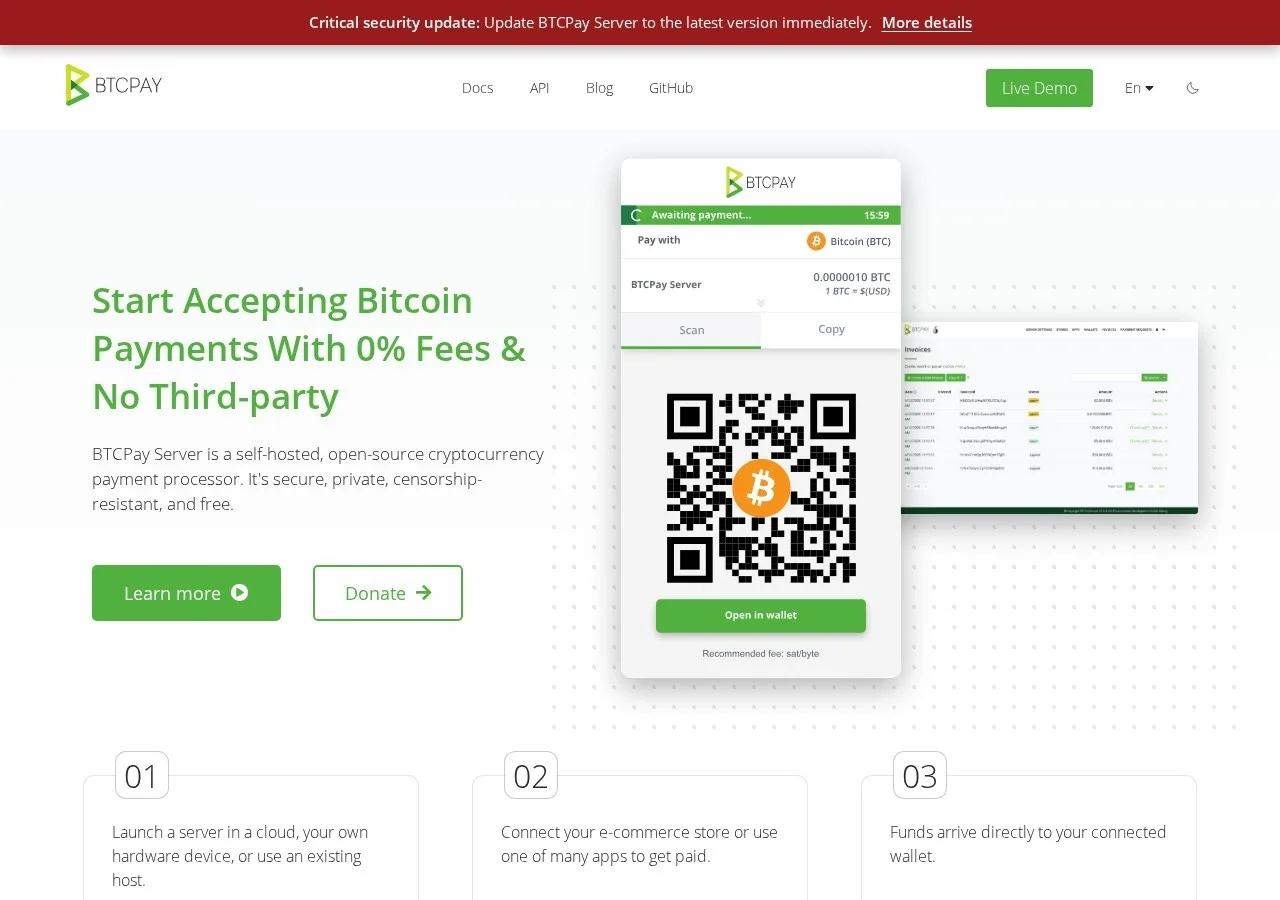
We have no credible reports of hot wallet drains for users running the latest 2.4.7 release. We again urge everyone to keep their BTCPay Server updated.
If you were impacted, please send all details and logs to [email protected]

Open-source, self-hosted Bitcoin and Lightning payment processor charging 0% processing fees
BTCPay Server is a free, self-hosted cryptocurrency payment processor released under an MIT license. It lets merchants accept on-chain Bitcoin and Lightning Network payments directly into their own wallets without intermediaries, charging a 0% processing fee.
Nicolas Dorier created BTCPay Server in August 2017 as an open-source alternative to BitPay during the SegWit2x dispute. The project operates as an open-source community rather than a corporation, supported by the BTCPay Server Foundation established in September 2019. More than 170 developers have contributed code. Funding comes from ecosystem grants, including $100,000 from Square Crypto in September 2019, $100,000 from OKCoin and $150,000 from Kraken in 2020, followed by consecutive $100,000 grants from Tether in 2024 and 2025.
Merchants run BTCPay Server on cloud instances, private hardware devices, or shared servers. The system does not hold private keys or custody merchant funds. Incoming payments route directly to connected self-custody wallets or integrated hardware wallets. The software provides invoice generation, native wallet management, a web point-of-sale interface, crowdfunding tools, and an API. BTCPay Server charges zero setup costs, zero monthly subscriptions, and no transaction fees. Users pay only native Bitcoin or Lightning network fees and third-party hosting server expenses.
Because the platform is self-hosted and non-custodial, it enforces no KYB requirements and is available globally without geographic restrictions. Pre-built e-commerce plugins connect to platforms like WooCommerce, Shopify, Magento, PrestaShop, OpenCart, Odoo, Wix, and Zapier, alongside custom setups through its REST API.
By October 2024, BTCPay Server had processed over 1.1 million Bitcoin transactions totaling more than $73 million in transaction revenue, including enterprise adoption by domain registrar Namecheap. The project surpassed one million downloads by 2025. Running self-hosted infrastructure exposes operators to technical maintenance risks. In March 2021, Tesla responsibly disclosed a vulnerability that developers patched. In August 2026, a vulnerability allowed attackers to access LND admin macaroons on unpatched servers, prompting emergency release 2.4.2 to regenerate credentials, followed by Core Lightning updates in October 2026. Merchants also retain direct exposure to cryptocurrency price volatility, as the software does not provide automated fiat settlement.

Bitcoin consultant who developed BTCPay Server as an open-source alternative to BitPay during the 2017 SegWit2x dispute.
BTCPay Server eliminates intermediary fees and counterparty custody risk, but running and maintaining the self-hosted infrastructure requires technical competence and immediate patch management.
BTCPay Server is an open-source, non-custodial payment processor designed to eliminate third-party intermediaries from digital commerce. Created in 2017 by Nicolas Dorier as an independent alternative to BitPay, the project charges 0% processing fees and no subscription costs. Payments settle directly into merchant-controlled wallets on either the Bitcoin base chain or the Lightning Network, which removes holding periods, account freezes, and counterparty custody risks.
For deployment, store operators can run an instance on their own hardware, provision a cloud server, or connect to a trusted shared host. The platform includes integrations and plugins for major e-commerce systems such as WooCommerce, Shopify, Magento, PrestaShop, and Drupal. Merchants can also use native tools for invoicing, point-of-sale terminals, and mass payouts through an API.
The self-hosted architecture introduces specific operational demands. Unlike custodial processors that handle automatic fiat conversion and bank deposits, BTCPay Server delivers native cryptocurrency, leaving price volatility risks entirely to the merchant. Operating an instance also shifts maintenance and security onto the user. Infrastructure vulnerabilities demand active oversight: an August 2026 flaw exposed LND admin macaroons on affected instances, requiring rapid patching to version 2.4.2, followed by a Core Lightning vulnerability patch in October 2026.
BTCPay Server is funded through grants from organizations including Square Crypto, Kraken, OKCoin, and Tether rather than venture equity. It suits technical merchants and companies seeking direct sovereignty over payment flows. Businesses wanting automated fiat off-ramps or managed technical support should look to hosted custodial payment gateways instead.
| Processing fee | 0% · unverified |
|---|---|
| Settlement | Crypto · unverified |
| Integrations | WooCommerce, Shopify, Magento, PrestaShop, OpenCart, Odoo, Wix, Pretix, BigCommerce, Zapier, Drupal, Ghost, Invoice Ninja · unverified |
| Invoicing | Yes · unverified |
| Recurring payments | Yes · unverified |
| Mass payouts | Yes · unverified |
| Point of sale | Yes · unverified |
| Self-hosted option | Yes |
| Business verification (KYB) | No · unverified |
| Settle in stablecoins | No · unverified |
| API & SDKs | Yes · unverified |
Not disclosed by the provider: Coins supported, Merchant countries.
Data from the provider's website and public sources. Fees and availability change; confirm on the official site before you sign up.
Payments route directly to merchant-controlled wallets on the Bitcoin network and Lightning Network without intermediary custody.
Merchants can generate web-based point-of-sale registers for retail checkouts and physical store payments.
Automates invoice creation, payment status notifications, and bookkeeping data exports across multiple file formats.
Integrates directly with e-commerce systems including WooCommerce, Shopify, Magento, PrestaShop, and OpenCart.
Connects directly with major hardware wallets to sign transactions and manage store funds safely.
Provides programmatic endpoints to automate invoice issuance, store configuration, access control, and webhooks.
Generates and monitors on-chain and Lightning payment requests with real-time settlement notifications. It supports data exports for external bookkeeping.
Provides an interface for in-person retail checkouts to accept payments on phones or dedicated tablets. It lets cashiers input sums or choose from custom item lists.
Enables operators to manage incoming and outgoing transactions directly within the server interface. It includes support for hardware signing devices.
Connects store frontends like WooCommerce, Shopify, and Magento directly to a server instance. The plugin system automates order state updates as soon as invoices confirm.
Allows programmatic creation of stores, users, and checkout invoices. Developers use it to automate accounting tasks and build custom billing applications.
User sentiment is generally favorable, with BTCPay Server frequently recommended as a free, open-source, and self-hosted non-custodial payment solution. There are no major recurring complaints identified.
“Bitpay has been an enemy to Bitcoin since at least 2017 >"This is lies, my trust in you is broken, I will make you obsolete" Which is why we made an open source and free to use protocol and payment processor called BTCpay that many merchants use today **with no KYC and free to use**.”
“\- it's free and selfhosted. But you need your own server to install and use it.”
Based on 13 Reddit posts and comments from the last 12 months, checked Oct 19, 2026. These are posts by users on other sites, not reviews submitted on CryptoReview.
No user reviews yet. Have you used BTCPay Server? Share your experience below.
BTCPay Server was created in 2017 by Bitcoin consultant Nicolas Dorier as an open-source, non-custodial alternative to BitPay. The project is maintained by a distributed developer community and supported by the BTCPay Server Foundation.
BTCPay Server charges 0% processing fees and no monthly subscriptions. Merchants pay only the standard Bitcoin or Lightning Network mining and routing fees.
No, BTCPay Server requires no business verification or KYB documents. Because it is self-hosted software, anyone can install and run it without creating an account with a centralized company.
BTCPay Server natively processes Bitcoin on-chain and Lightning Network payments. Settlement occurs directly to the merchant's connected hardware or software wallet.
No, BTCPay Server is non-custodial and never holds customer or merchant funds. Customer payments route directly to the wallet keys configured by the server administrator.
Yes, security issues were patched with Tesla's assistance in 2021, and an August 2026 vulnerability involving LND credentials required an immediate update to version 2.4.2. In October 2026, administrators using Core Lightning were also urged to update to address a potential node exploit.


Recent public posts from @BtcpayServer, shown as published. Not reviewed or endorsed by CryptoReview.
Enterprise crypto payment gateway and wallet infrastructure supporting over 350 digital assets
Crypto payment gateway processing over $300M annually with zero-fee options and fiat settlement
Digital asset payment gateway with 99+ assets and 0% conversion or custody fees on payouts
Crypto payment gateway supporting 350+ assets with a 1% starting fee
Crypto payment gateway with 1% processing and MiCA licensing since 2025
Open-source, self-hosted crypto payment processor charging 0% transaction fees
Type at least two characters. Press ↵ to see all results.