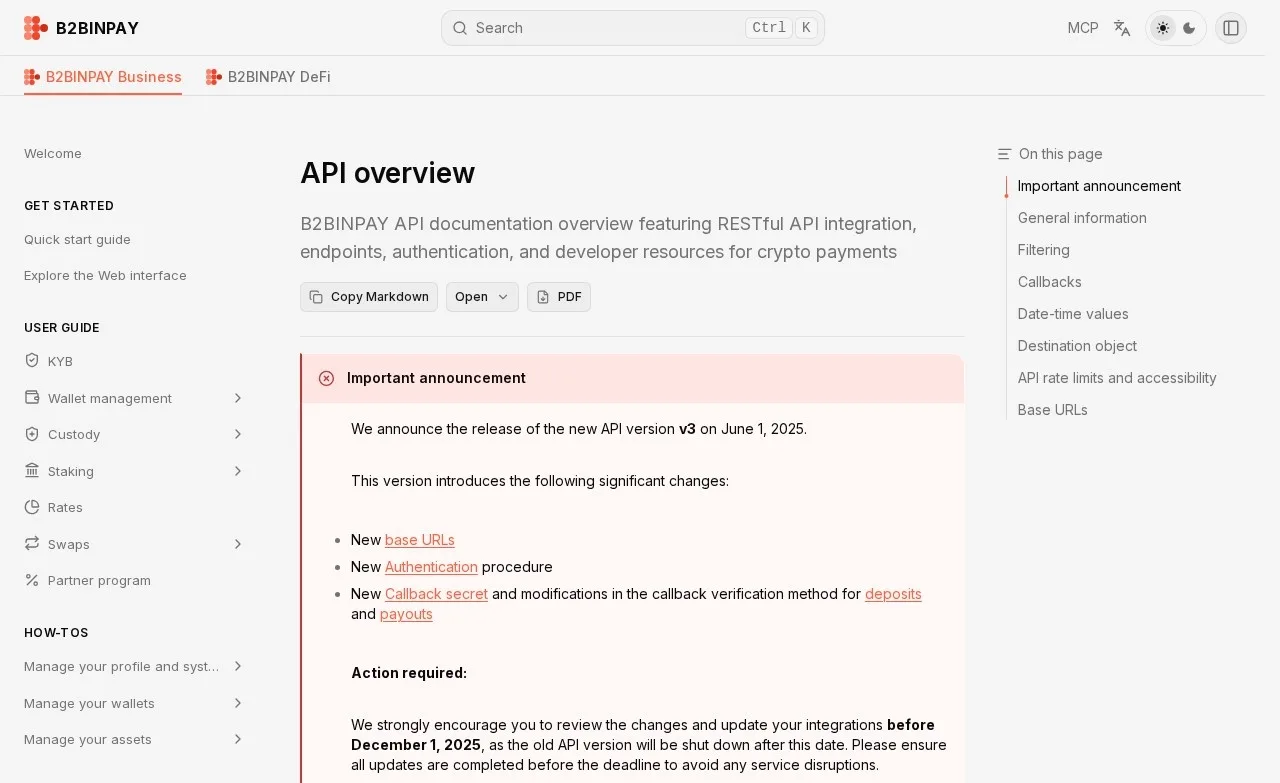
B2BinPay is an enterprise-grade cryptocurrency payment gateway and wallet infrastructure platform designed for online merchants, brokers, and financial institutions. By 2025, the platform had completed over 6.7 million transactions and processed $5.1B in total incoming transaction volume across 983 corporate clients.
Corporate background
B2BinPay operates as part of B2Broker Group, a global fintech and liquidity provider founded by CEO Arthur Azizov. B2Broker develops turnkey technology and liquidity mechanisms for brokerages and exchanges. The payment service entity holds regulatory registrations as a Digital Asset Service Provider and Bitcoin Wallet provider in El Salvador, alongside a Virtual Asset Service Provider license in Mauritius.
Platform architecture and settlements
The system allows businesses to accept and transfer digital assets. Merchants can choose between crypto-to-crypto settlements or automatic crypto-to-fiat conversion into USD and EUR with payouts via SEPA or SWIFT. Processing supports over 350 digital currencies across networks such as Bitcoin, Ethereum, Tron, Solana, Cardano, BNB Chain, and TON. For every transaction, the API generates unique deposit addresses and routes funds into consolidated merchant wallets, using proprietary off-chain transfers to reduce network fees.
Pricing and account tiers
Payment processing fees for incoming merchant transfers start at 0.40% for monthly volumes up to $1 million, scaling down to 0.25% for volumes exceeding $5 million. Outgoing merchant payouts incur no processing fee from the gateway. Enterprise clients using the Wallet as a Service infrastructure pay a $1,000 onboarding fee, zero incoming transaction charges, and outgoing fees ranging from 0.050% down to 0.025% based on monthly payout volume.
Risks and operational trade-offs
Merchant operations require mandatory business verification (KYB) and compliance checks through automated transaction screening. Because custodial settlement models centralize merchant balances prior to withdrawal or bank payout, businesses take on direct counterparty credit exposure. Incoming cryptocurrency payments also remain irreversible, so merchant refund errors or deposit mistakes must be resolved through internal treasury reserves.