

Appreciate everyone taking an interest in Peer and our recent announcement. Here is an explainer on how Peer works and what users should be aware of using the protocol:
Peer is a noncustodial messaging protocol comprised of a set of smart contracts and attestors. Peer currently supports 12 payment methods with the most recent one being Alipay. Any developer can create a payment method integration, integrate the protocol into their app, or create an alternative interface to https://t.co/00wnZZ53BK
How the protocol works:
A seller posts a USDC listing into a smart contract, a buyer pays the seller directly, and the contract releases the USDC automatically once the payment is verified in a Trusted Execution Environment (TEE). As an onchain and permissionless protocol, Peer never holds or transmits users' fiat and never takes custody of their USDC.
Verification uses no developer APIs from Alipay or from other existing supported platforms. Instead, users initiate verification using their own session encrypted to the TEE, which confirms the payment and signs an attestation that the contract verifies without Peer or anyone in the middle.
Read our protocol docs: https://t.co/T1taTx27fD
For users:
Peer directly inherits verified identity from the integrated payment platforms, and our interface follows industry standard wallet address screening. Users are encouraged to do additional vetting for their counterparties.
Peer gives sellers controls in the smart contract for managing risk for their own ads. This includes tools for whitelisting buyers, requiring additional KYC, and controls such as order limits, price floors, up to T+14 deferred settlement, and onchain dispute resolution.
The protocol is permissionless, with these controls built in. These technical features and controls do not override applicable law or guarantee protection against account restrictions or freezes. Users are responsible for how they use the protocol, including complying with the laws and platform terms that apply to them.
Thank you for your attention to this matter.
Get started now at https://t.co/00wnZZ53BK
3.4/ 5
Our score
Fair
Typical fee
Up to 0.95% taker service fee paid by the buyer; up to 0.5% bridge fee when bridging to another chain; sellers set their own spread.
Payment methods
Bank transfer
Sell to fiat (off-ramp)
Yes
KYC required
No
What is Peer?
Peer is a peer-to-peer marketplace and payment protocol for buying and selling crypto through payment apps. Buyers pay sellers directly, while smart contracts hold the crypto until a private proof verifies the fiat payment. The service is operated by P2P Labs Inc. and is currently labeled beta.
How it works
A buyer connects a wallet, or signs in with email or social accounts, selects an offer and pays the seller through a supported app. The seller's USDC is locked in an onchain contract during the order. Once Peer verifies the payment, the USDC is released to the buyer's wallet.
Sellers deposit USDC, choose payment apps and currencies, then set their own rate. Fiat moves directly between the two parties. Peer says it does not hold or transmit user funds. Payment verification uses a buyer-generated cryptographic proof and shares only the amount, recipient and timestamp. Credentials and account history remain on the user's device in unencrypted form only within the verification process.
Payments, chains and assets
The current web app supports Venmo, PayPal, Revolut, Cash App, Zelle, Wise, Monzo, Chime, Alipay, X Money and UPI. Payment-app availability differs by surface and flow. Zelle payments from Capital One, Chase, Bank of America and Citi are supported through the stated verification flows.
The site shows USDC on Base, ETH on Ethereum, SOL on Solana, BTC, HYPE, USDT on Tron, ZEC, XRP, BNB, AVAX, TRX and POL. The protocol has smart contracts across Layer 1 and Layer 2 public blockchains, while Base is the settlement chain identified for current protocol volume.
Fees and access
Peer charges buyers a taker service fee of up to 0.95%. A bridge fee of up to 0.5% applies when an order uses another chain. Sellers set their own rate and keep the spread they choose. Payment apps may apply their own terms or restrictions.
Peer is available through a web app, mobile apps and a Chrome extension used for provider metadata capture and payment verification. Its stated flow requires no additional identity verification. Access still depends on the payment app, currency, country and available offers.
Track record and risks
ZKP2P, the protocol underlying Peer, began as an Ethereum Foundation PSE-supported research project and later settled peer-to-peer volume on Base. Peer consists of smart contracts, a web app, mobile apps and a Chrome extension. The Terms of Service were last modified in March 2026, and the Privacy Policy was last updated in April 2026.
The model shifts custody risk away from a central ramp but introduces counterparty and payment-reversal risk because fiat moves directly between buyer and seller. Orders depend on payment-app access, available liquidity and accurate payment verification. Failed or disputed payments can delay settlement, while bridge use adds cost and another contract dependency. Regional payment coverage and supported assets vary by flow.
Best for:Payment-app crypto buyersUSDC sellers setting their own ratesUsers seeking non-custodial rampsMultichain payment flows
Pros and cons
Pros
- Non-custodial escrow keeps crypto in an onchain smart contract
- Supports payment apps including Venmo, PayPal, Revolut and Zelle
- Buyer taker fee is capped at 0.95%
- Private proofs limit shared payment details to amount, recipient and timestamp
- Offers web, mobile and Chrome extension access
Cons
- Fiat moves directly between counterparties, creating payment-reversal and dispute risk
- Payment-app and regional availability differs by flow
- Bridge orders can add a fee of up to 0.5%
- Sellers set spreads, so total pricing varies by offer
- The service is currently labeled beta
Our review
3.4/5
Fair
Peer combines private payment verification with non-custodial escrow, but coverage, pricing and settlement depend on local payment apps and available sellers.
Peer is a peer-to-peer on- and off-ramp built around payment apps and direct peer-to-peer settlement. Buyers pay sellers directly through services such as Venmo, PayPal, Revolut, Cash App, Zelle, Wise, Monzo, Chime, Alipay, X Money and UPI. The current web app lists 11 payment apps, while the available currencies and payment routes differ by app and surface.
Its clearest strength is custody. USDC is locked in an onchain smart contract while a buyer-generated proof verifies the payment. Fiat moves directly between the two parties, and Peer says it does not hold or control user funds. Private verification exposes the amount and recipient rather than unencrypted payment credentials or account history. That differs from custodial ramps, although the trade-off is reliance on the payment provider and the seller's liquidity.
Fees include: the buyer pays a taker service fee of up to 0.95%, a bridge can add up to 0.5%, and sellers set their own spread. The final price therefore depends on both protocol charges and the offer selected. Funds arrive after payment verification, onchain release and any bridge route, so a direct payment app order can still depend on the selected rail.
The site shows USDC on Base alongside Ethereum, Solana, Bitcoin, Hyperliquid, Tron, Zcash, XRP, BNB, Avalanche and Polygon-related assets, while Base is identified as the current settled chain. The product is labeled beta, and sellers may not be available for every route.
Peer is operated by P2P Labs Inc. The underlying ZKP2P project began as an Ethereum Foundation PSE-supported research project and later settled peer-to-peer volume on Base. Peer also has mobile apps and a Chrome extension, and its public GitHub footprint includes 203 followers. The product is marked beta.
Specs
| Service | On-ramp, Off-ramp · unverified |
|---|---|
| Payment methods | Bank transfer · unverified |
| Typical fee | Up to 0.95% taker service fee paid by the buyer; up to 0.5% bridge fee when bridging to another chain; sellers set their own spread. · unverified |
| Assets | 12 · unverified |
| KYC required | No · unverified |
| Sell to fiat (off-ramp) | Yes · unverified |
| Delivery time | After payment verification, onchain release and any bridge route; timing varies by payment rail. · unverified |
Not disclosed by the provider: Countries, Minimum purchase, Developer widget / API, Apple Pay, Max purchase.
Data from the provider's website and public sources. Fees and availability change; confirm on the official site before you sign up.
Key features
Peer-to-peer trading
Buyers pay sellers directly through Venmo, PayPal, Revolut, Cash App, Zelle, Wise and other supported apps.
Onchain escrow
Smart contracts lock the seller's USDC until the buyer's fiat payment is verified.
Private payment proofs
Payment verification shares the amount, recipient and timestamp rather than publishing sensitive account history onchain.
Seller-set rates
Sellers choose accepted apps and currencies, set their own rate, and keep the spread on completed trades.
Multichain assets
The site shows assets including USDC on Base, ETH, SOL, BTC, HYPE, USDT on Tron and ZEC.
Mobile and browser access
Peer offers a web app, mobile apps and a Chrome extension for provider metadata capture and payment verification.
Cross-chain settlement
Orders can use a bridge to another chain, with a bridge fee of up to 0.5%.
Inside Peer
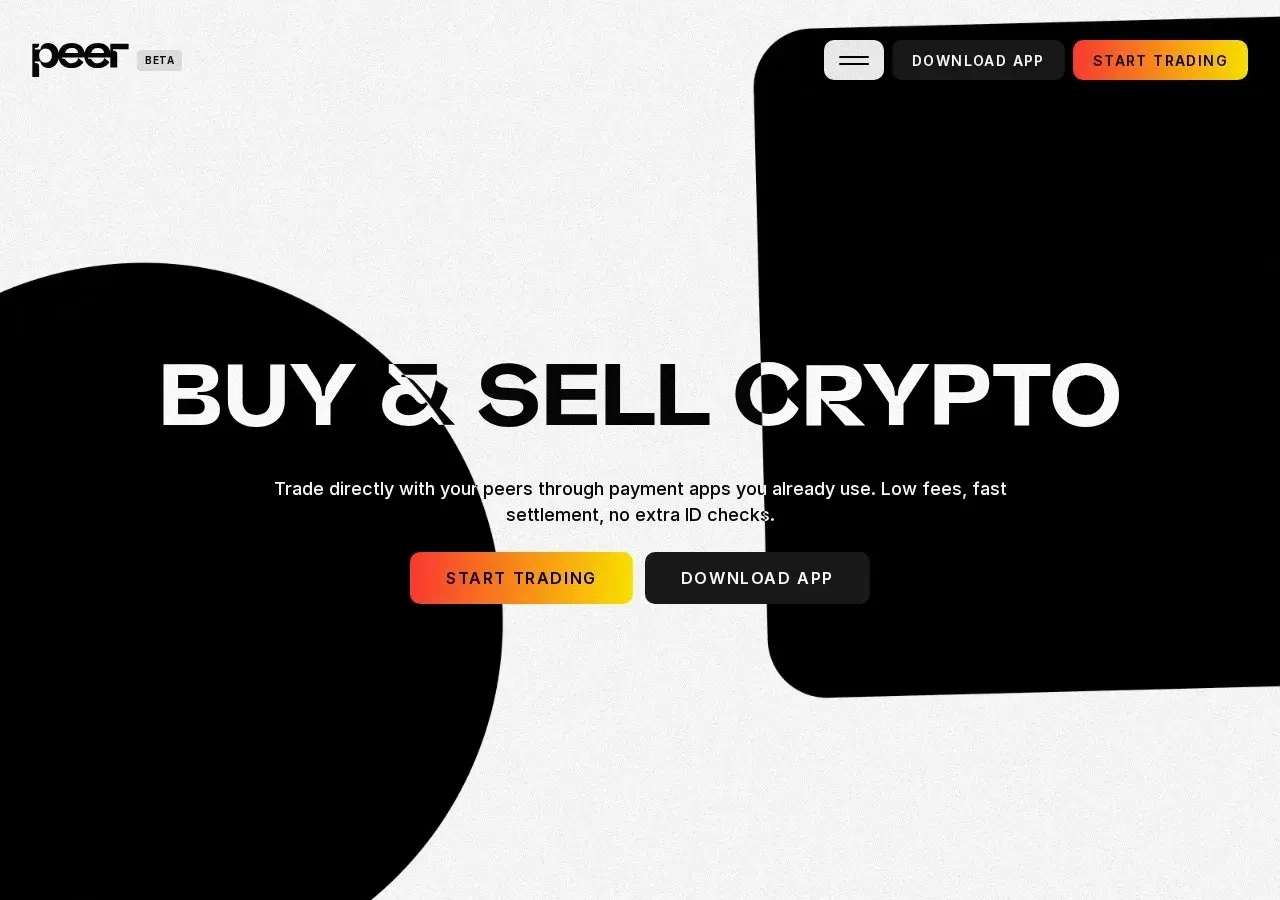
BUY & SELL CRYPTO
The main marketplace lets users buy crypto from peers through payment apps or sell crypto for fiat. Buyers choose an offer, while sellers deposit USDC, select accepted payment apps and currencies, and set a rate.
HOW PEER WORKS
Peer locks the seller's USDC in an onchain smart contract while a private cryptographic proof verifies the fiat payment. Once verification succeeds, the crypto is released to the buyer's wallet.
PAYMENT APPS
This section lists payment routes including Venmo, PayPal, Revolut, Cash App, Zelle, Wise, Monzo, Chime, Alipay, X Money and UPI. Availability depends on the payment app, currency and Peer surface.
TOKENS
Supported assets shown on the site include USDC, ETH, SOL, BTC, HYPE, USDT, ZEC, XRP, BNB, AVAX, TRX and POL. The displayed chain and asset combination depends on the trade route.
Peer screenshots
What users say about Peer
Users mainly praise Peer for bank-based on- and off-ramps, especially through Wise, and for sending funds to personal wallets. No specific product complaint is raised by at least two different authors in these posts.
In their own words
“have you tried peer.xyz? previously it was zkp2p. Their system is pretty cool, you use wise to get the coins. I have used it a few times for a few grand, and I recommend it. Give it a shot with a small amount.”
“You're right. I missed that. The route I have taken is: self custody -> use peer.xyz to swap and receive in my Wise account”
“peer.xyz is pretty safe. It's escrow-locked and pays directly to your wallet. Just keep the amount per transaction under 1000$”
Based on 24 Reddit posts and comments from the last 12 months, checked Oct 18, 2026. These are posts by users on other sites, not reviews submitted on CryptoReview.
User reviews
No user reviews yet. Have you used Peer? Share your experience below.
FAQ
Who runs Peer?
Peer is operated by P2P Labs Inc. Its underlying ZKP2P project began as an Ethereum Foundation PSE-supported research project and later settled peer-to-peer volume on Base.
What fees does Peer charge?
Peer charges buyers a taker service fee of up to 0.95%. Bridging to another chain can add up to 0.5%, while sellers set their own spread.
Does Peer require KYC?
Peer says no additional identity verification is required. Users connect a wallet or sign in with email or social accounts, while payment verification checks the transaction details needed to settle it.
Is Peer safe to use?
Peer uses onchain smart contracts to lock crypto until payment verification and says it does not hold or control user funds.
Which payment apps and assets does Peer support?
The current web app supports Venmo, PayPal, Revolut, Cash App, Zelle, Wise, Monzo, Chime, Alipay, X Money and UPI. The site lists USDC, ETH, SOL, BTC, HYPE, USDT, ZEC, XRP, BNB, AVAX, TRX and POL, with availability varying by route.
How does buying crypto through Peer work?
A buyer selects an offer, pays the seller through the chosen payment app, and receives crypto after the payment is privately verified. The seller's USDC stays locked in an onchain contract during the order.
Latest from Peer on X
Today, we're launching Peer Payouts on @PeerPay_
Cash out your customers / players to Venmo, Cash App, PayPal, Revolut & more.
- No wallet or knowledge of crypto required
- Fund in stablecoins, BTC, ETH or other major tokens
- 0% fee and your customer gets the full amount https://t.co/YRF9uGXhs9
Cash out your customers / players to Venmo, Cash App, PayPal, Revolut & more.
- No wallet or knowledge of crypto required
- Fund in stablecoins, BTC, ETH or other major tokens
- 0% fee and your customer gets the full amount https://t.co/YRF9uGXhs9
Alipay is live on Peer in Beta 🇨🇳
Buy USDC by paying a seller in CNY, or sell USDC and get paid in CNY on Alipay.
Guides and support in Chinese live on @Peer_zh. https://t.co/rzilnjmsUU
Buy USDC by paying a seller in CNY, or sell USDC and get paid in CNY on Alipay.
Guides and support in Chinese live on @Peer_zh. https://t.co/rzilnjmsUU

PayPal Business accounts can now sell USDC on Peer.
Prove your https://t.co/13guzDhXDS username with the Peer Extension, connect Autopilot to the inbox that gets your PayPal receipts, and each order releases when the receipt lands. https://t.co/a2xcS5xdqA
Prove your https://t.co/13guzDhXDS username with the Peer Extension, connect Autopilot to the inbox that gets your PayPal receipts, and each order releases when the receipt lands. https://t.co/a2xcS5xdqA
Feature Friday 🎉
We refreshed the Peer developer portal. Builders can now contribute a payment integration with AI, or test and harden an existing community provider.
Get started with Interac (CA), GCash (PH), QQ Wallet (CN) and 80+ on our list, or choose your own https://t.co/KZmmdP71t6
We refreshed the Peer developer portal. Builders can now contribute a payment integration with AI, or test and harden an existing community provider.
Get started with Interac (CA), GCash (PH), QQ Wallet (CN) and 80+ on our list, or choose your own https://t.co/KZmmdP71t6
Recent public posts from @peerxyz, shown as published. Not reviewed or endorsed by CryptoReview.
Alternatives to Peer

Fiat-to-crypto on-ramp launched in 2014, serving 180+ countries with 35+ payment methods
KYC requiredOn-ramp · Off-ramp +1Card · Bank transfer +3Developer widget / API

Bitcoin and Lightning on-ramp with fee-free recurring purchases and support across 100+ countries
On-ramp · Off-ramp +1Card · Bank transfer +2Developer widget / API

Self-custodial crypto on-ramp with 30+ assets across 16 chains
No KYCOn-ramp · Off-ramp +1Card · Bank transfer +1Developer widget / API

Fiat on-ramp aggregator connecting one integration to 30+ providers and 175+ payment methods
KYC requiredOn-ramp · Off-ramp +2Card · Bank transfer +2Developer widget / API

Fiat-to-crypto on-ramp with 150+ countries and 70+ supported cryptocurrencies
KYC requiredOn-ramp · Off-ramp +1Card · Bank transfer +3Developer widget / API

Self-custodial on- and off-ramp operating since 2017, with 120+ cryptoassets
KYC requiredOn-ramp · Off-ramp +1Card · Bank transfer +4Developer widget / API