

⏰ UK crypto firms: don’t repeat Europe’s MiCA mistakes.
Paybis CEO and co-founder @InnokentyIsers told @Forbes : “MiCA was a revolution at a time when the industry needed an evolution.”
Forbes breaks down what UK firms must learn before the FCA comes knocking.
Read the full article 👇 https://t.co/jbSXLfm77B

Paybis
Fiat-to-crypto on-ramp launched in 2014, serving 180+ countries with 35+ payment methods
4.2/ 5
Our score
Very good
Typical fee
First card purchase: 0 Paybis fee. Other fees are shown at checkout and included in the quoted exchange rate.
Payment methods
CardBank transferApple PayGoogle Pay+1
Countries
180
Sell to fiat (off-ramp)
Yes
KYC required
Yes
What is Paybis?
Paybis is a cryptocurrency on-ramp launched in 2014. It lets customers buy crypto with cards, bank transfers, mobile payments and other methods, then send the assets to an external address or store them in a free Paybis Wallet. The company reports 6.9 million customers served and $5.5 billion in lifetime transaction volume as of October 16, 2026.
Company and founders
Paybis was co-founded by Arturs Markevics, its Treasury Manager, and Innokenty Isers. Paybis describes both as part of the early team that built the company around access to crypto and digital assets. Its business also includes Paybis Ramp for web and mobile applications, plus crypto payouts and payment infrastructure for businesses.
How the service works
The checkout does not use an order book or a separate deposit and withdrawal cycle. A customer chooses an asset, enters a local-currency or crypto amount, provides an external wallet address or selects Paybis Wallet, completes payment, and receives the crypto after the payment clears. Card purchases can usually arrive within minutes, subject to payment processing and network conditions.
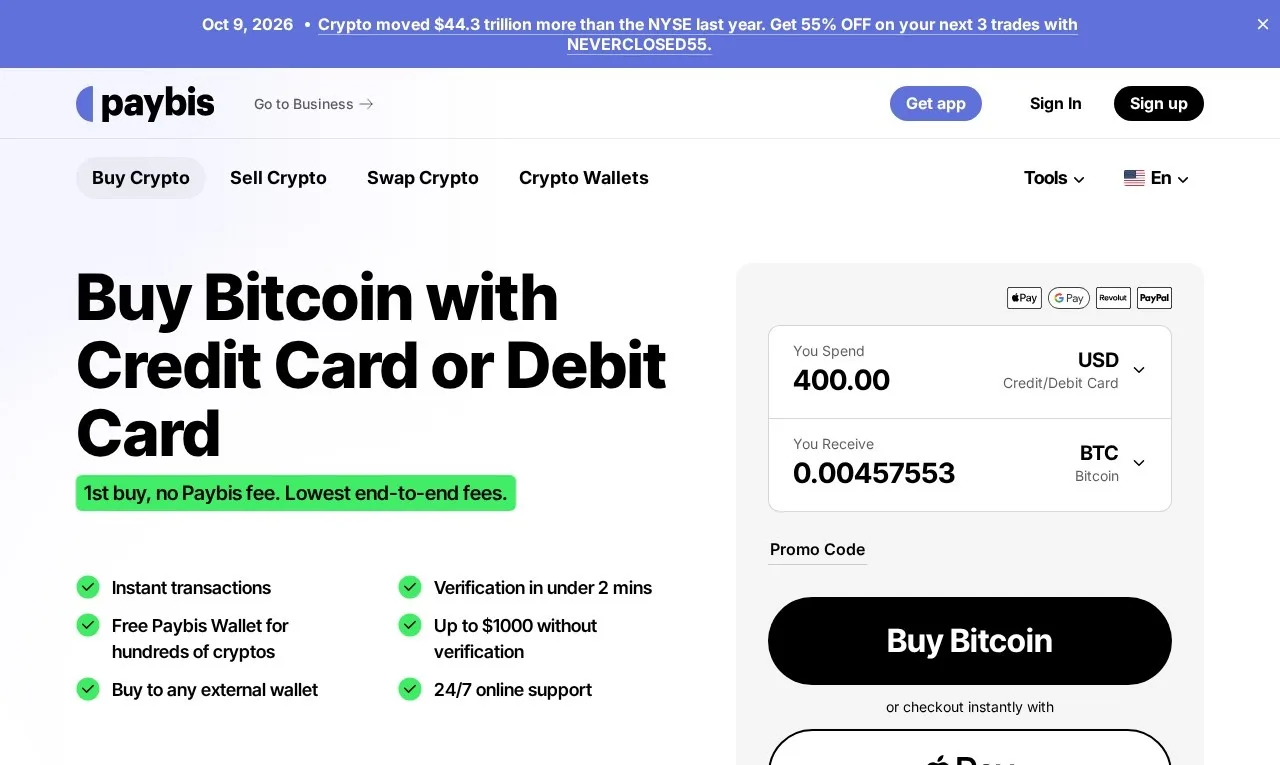
Paybis supports hundreds of cryptocurrencies in its wallet, along with buying, selling, swapping and fiat conversion. Its business Ramp became available through a React Native library for iOS and Android in May 2026. Simplified verification allows card purchases of up to $1,000 per year without full KYC, while other transactions can require identity documents and additional checks.
Fees and payment methods
The first card purchase has a Paybis fee of 0. Paybis displays the service fee and exchange rate at checkout, with the fee included in the quoted rate. Payment-method costs vary, and bank-based payments generally cost less than cards. A blockchain network fee also applies to each transaction and changes with network demand. More than 35 payment methods are available, including cards, Apple Pay, Google Pay, PayPal, SEPA and bank transfers.
Coverage and record
Paybis says it serves more than 180 countries and 48 US states. The company is authorised as a Crypto Asset Service Provider under MiCA, with authorisation number 27-55/2026/6, and as a Payment Institution under PSD2, with authorisation number 27-55/2026/7. It is also registered with FinCEN as Money Service Business 31000272911973.
Paybis recorded $2 billion in transaction volume during 2025. In May 2026, it added automatic Travel Rule collection for transactions above $1,000, real-time payment-status visibility, faster corporate onboarding through Sumsub and TOTP-based two-factor authentication.
Limits and risks
Card fees and spreads can exceed those of bank-based methods, while payments can fail, reverse or remain subject to compliance checks. Regional coverage and payment options differ by country. Crypto delivery also depends on the relevant blockchain and its network conditions.
Founders
Arturs MarkevicsCo-founder and Treasury Manager
Paybis identifies him as a co-founder who helped start the company as a gateway to crypto and digital assets.
Innokenty IsersCo-founder
Paybis identifies him as a co-founder involved in building the company from its early stages.
Best for:Card-based crypto purchasesDirect wallet deliveryEU and US on-ramp usersBusinesses adding crypto checkout
Pros and cons
Pros
- Serves more than 180 countries and 48 US states
- Offers over 35 payment methods
- First card purchase has a Paybis fee of 0
- Sends crypto directly to an external wallet
- Provides 24/7 customer support
- Supports simplified verification up to $1,000 per year
Cons
- Card fees and spreads vary by payment method
- Network fees apply to every transaction
- Paybis Wallet introduces custodial exposure
- KYC and payment options vary by region
- Payments can fail, reverse or trigger compliance checks
- Asset delivery depends on blockchain network conditions
Our review
4.2/5
Very good
Paybis combines broad payment coverage with direct wallet delivery, but card costs, regional restrictions and verification holds remain important trade-offs.
Paybis is an established crypto on-ramp launched in 2014 by co-founders Arturs Markevics and Innokenty Isers. Its main advantage is breadth: the service covers more than 180 countries and offers 35+ payment methods, including cards, bank transfers, Apple Pay, Google Pay, PayPal, Skrill and SEPA. The site also lists service in 48 US states.
Customers enter an amount, choose an external address or the Paybis Wallet, then pay without an order book or separate deposit step. Card purchases are delivered within minutes after payment clears, although blockchain congestion can affect timing. Paybis also supports selling crypto to fiat, swaps and conversion into more than 65 fiat currencies. Its business product, Paybis Ramp, gives apps a crypto purchase widget and added a React Native library for iOS and Android in May 2026.
Pricing is shown before payment, with the service fee and exchange rate included in the quote. The first card purchase has a Paybis fee of 0. Bank-based payments generally cost less than cards, while network fees vary with demand. Simplified verification allows card purchases up to $1,000 per year; larger activity can require identity checks.
- Strengths include 180-country coverage, 35+ payment methods and delivery to a wallet chosen at checkout.
- Weaknesses include card-related costs, regional gaps and the possibility of KYC holds or payment reversals common to brokered on-ramps.
- The Paybis Wallet adds convenience but introduces platform custody, unlike an external self-custody wallet.
The company reports 6.9 million customers and $5.5 billion in lifetime transaction volume as of October 2026, with 624 businesses powered. It is registered as a FinCEN Money Service Business and lists EU CASP and Payment Institution authorisations. Paybis suits people and apps that value payment choice and a direct checkout.
Specs
| Service | On-ramp, Off-ramp, Widget / API · unverified |
|---|---|
| Payment methods | Card, Bank transfer, Apple Pay, Google Pay, SEPA · unverified |
| Typical fee | First card purchase: 0 Paybis fee. Other fees are shown at checkout and included in the quoted exchange rate. · unverified |
| Countries | 180 · unverified |
| Developer widget / API | Yes · unverified |
| KYC required | Yes · unverified |
| Sell to fiat (off-ramp) | Yes · unverified |
| Apple Pay | Yes · unverified |
| Delivery time | Within minutes for card purchases, subject to payment clearance and network congestion · unverified |
Not disclosed by the provider: Assets, Minimum purchase, Max purchase.
Data from the provider's website and public sources. Fees and availability change; confirm on the official site before you sign up.
Key features
Direct wallet delivery
Customers can send purchased crypto to an external wallet address in the same checkout, without a separate deposit step.
Multiple payment methods
Paybis supports more than 35 payment methods, including cards, Apple Pay, Google Pay, PayPal, SEPA and bank transfers.
Simplified card verification
Card purchases of up to $1,000 per year can use simplified verification without full KYC.
Paybis Wallet
The free wallet stores and lets customers send or receive hundreds of cryptocurrencies.
Crypto selling
Customers can sell crypto for fiat and receive funds through supported bank and payment methods.
Business Ramp
Paybis Ramp gives businesses a web and mobile integration, including a React Native library for iOS and Android.
Crypto swaps
The platform supports swaps between crypto assets, including BTC, ETH, USDT and USDC on listed networks.
Payment tracking
Real-time payment-status visibility was added in May 2026, alongside automatic Travel Rule collection above $1,000.
Inside Paybis
Buy
The Buy section lets customers purchase crypto with cards, bank transfers, Apple Pay, Google Pay, PayPal, Skrill and other payment methods. Crypto can go directly to an external wallet or the free Paybis Wallet.
Sell
Sell lets customers convert crypto into fiat and receive funds through supported payout methods. The site lists bank accounts, cards, PIX, Skrill, Neteller and SWIFT withdrawals.
Swap
Swap exchanges one cryptocurrency for another, including pairs such as USDT on TRON, Ethereum and Polygon, and BTC with ETH, BNB, USDC or XRP.
Convert
Convert changes crypto into fiat or fiat into crypto. Paybis lists conversion support for more than 65 fiat currencies, including USD, EUR, GBP, JPY and CAD.
Wallet
The Paybis Wallet stores, sends and receives hundreds of cryptocurrencies. Customers can select it during checkout instead of entering an external wallet address.
Earn Soon
Earn Soon is the platform's crypto earning section. The site presents returns of up to 20% per year.
Pay Soon
Pay Soon is the spending section for using stored digital assets. The site describes it as a way to spend crypto.
Paybis screenshots
What users say about Paybis
Reported experiences mention straightforward purchases, crypto calculators, and limited identity checks for some small transactions. Some reported complaints mention higher fees than alternatives and unwanted marketing messages.
Top goods
In their own words
“Honestly if you just want to get from ETH into SOL without overthinking gas and bridges, one of the simpler ways I’ve used is a direct swap service like you send your ETH and it converts straight to SOL in one step, so you don’t have to bridge to USDC then swap on-chain.”
“Before swapping anything, I just sanity-check what I should be getting. Using something like Paybis makes it easy to spot bad rates right away.”
“It depends on the crypto currency, but I was able to send bitcoin via without identifying myself too much (I think just mail and phone number for 2FA?). Maybe that’s a method for you, it’s also the provider AstroVials is mentioning in their website”
“I used paybis.com the last time and they do not do any KYC verification, at least not in my EU country, as long as you stay below a certain threshold. 200€ was okay. Received the money in 1 hour and was able to pay via CC without any passport validation.”
“It really depends on how quickly you need access to the funds. For larger amounts, a standard exchange like Kraken or Coinbase usually makes more sense since the overall fees are lower if you’re not in a rush. When speed matters more to me, I skip the trading interface and use Paybis instead.”
Based on 81 Reddit posts and comments from the last 12 months, checked Oct 18, 2026. These are posts by users on other sites, not reviews submitted on CryptoReview.
User reviews
No user reviews yet. Have you used Paybis? Share your experience below.
FAQ
Who founded Paybis?
Paybis was founded in 2014 by Arturs Markevics and Innokenty Isers. Markevics is identified as co-founder and Treasury Manager, while Isers is identified as co-founder.
What fees does Paybis charge?
The first card purchase has a Paybis fee of 0. Later quotes show the service fee and exchange rate before payment, while network fees vary with blockchain demand and payment-method costs vary by method.
Where is Paybis available, and is KYC required?
Paybis is available in more than 180 countries and lists service in 48 US states. Card purchases up to $1,000 per year can use simplified verification, while a verification check can require an identity document.
Is Paybis safe to use?
Paybis lists regulation or registration in the US, Canada and the EU, uses TLS encryption and offers TOTP-based two-factor authentication. Customers can send crypto to an external wallet or use the Paybis Wallet, and Fireblocks is named as a digital-asset custody partner.
What cryptocurrencies does Paybis support?
Paybis supports hundreds of cryptocurrencies in its wallet and offers buying, selling and swapping services. The checkout can send purchased crypto to an external wallet. Available assets and networks depend on the transaction.
Can Paybis sell crypto for fiat?
Yes, Paybis supports selling crypto and converting it into fiat in more than 65 currencies. The site lists bank-account, SWIFT and card routes for withdrawals, along with several local payment options.
Latest from Paybis on X
🔥 On this day, Nov 2 2008: Bitcoin’s $BTC first public reply arrived, just 2 days after Satoshi’s whitepaper. The critique? “It does not seem to scale.” That early doubt later sparked major debates, faster payment systems, and the upgrades still used today. https://t.co/YooN3J8c6j

Lisbon was a good one. 🇵🇹
200+ guests joined P.S. Lisbon, our side event during SBC Summit.
Next stop: Rome. During SiGMA Rome, 2-5 November, join us for La Dolce Vita by Paybis & Repay, hosted with @INPUT_global : cocktails, wine and a DJ at La Ménagère in central Rome, for founders, investors and operators in digital assets, payments and iGaming.
Register here:
https://t.co/BlDr1ESqfD
#SBCSummit #SiGMARome #Paybis
I took one question to London’s financial district: “Do you trust Bitcoin?” Let’s see what the suits say…
$BTC https://t.co/JJvJB85IRV
$BTC https://t.co/JJvJB85IRV
iDEAL accounted for 71% of online purchases in the Netherlands in 2025. Now, Paybis customers can use this trusted local payment method to access 90+ cryptocurrencies, including $BTC, $ETH and $SOL, with a familiar bank-based payment experience. https://t.co/wOKI66Py7J

Recent public posts from @paybis, shown as published. Not reviewed or endorsed by CryptoReview.
Alternatives to Paybis

Bitcoin and Lightning on-ramp with fee-free recurring purchases and support across 100+ countries
On-ramp · Off-ramp +1Card · Bank transfer +2Developer widget / API

Self-custodial crypto on-ramp with 30+ assets across 16 chains
No KYCOn-ramp · Off-ramp +1Card · Bank transfer +1Developer widget / API

Fiat on-ramp aggregator connecting one integration to 30+ providers and 175+ payment methods
KYC requiredOn-ramp · Off-ramp +2Card · Bank transfer +2Developer widget / API

Fiat-to-crypto on-ramp with 150+ countries and 70+ supported cryptocurrencies
KYC requiredOn-ramp · Off-ramp +1Card · Bank transfer +3Developer widget / API

Self-custodial on- and off-ramp operating since 2017, with 120+ cryptoassets
KYC requiredOn-ramp · Off-ramp +1Card · Bank transfer +4Developer widget / API

European crypto broker founded in 2013 with 1.5M+ customers
KYC requiredOn-ramp · Off-ramp +1Card · Bank transfer +1Developer widget / API