


VolatilePair Hook is live on Robinhood Chain
Built to keep more value with LPs, the hook sets a fee for each side of the trade and adjusts both as the market moves
The first pool up: ETH/USDG https://t.co/Y1vaDOrTZf


Decentralized AMM launched in 2018, with support across 16+ EVM mainnets
Uniswap is a decentralized exchange protocol built around automated market makers and liquidity pools. Its v3 and v4 systems, along with UniswapX, are available through deployments on multiple EVM networks. The Uniswap API supports 16+ EVM mainnets, while total value locked was about $1.58 billion on October 17, 2026.
Uniswap Labs develops the protocol and related products. Hayden Adams is founder and CEO; before creating Uniswap, he worked as a mechanical engineer at Siemens. Uniswap Labs is headquartered in New York City and has 51–200 employees. The company raised a $2 million seed round in January 2019, a Series A in August 2020 at a reported $79 million valuation, and a $165 million Series B in October 2022, led by Polychain. Andreessen Horowitz, Paradigm, SV Angel and Variant also participated in the Series B. BlackRock made an undisclosed strategic investment in February 2026.
Users connect a crypto wallet and trade against smart-contract liquidity pools rather than a central order book or custodian. Uniswap v2 uses constant-product pools. V3 lets liquidity providers select price ranges and choose among 0.01%, 0.05%, 0.3% and 1% pool fee tiers. V4 adds hooks, which are external contracts that can change pool behavior around swaps and liquidity actions.
UniswapX uses intent-based execution. Users authorize orders off-chain, and external fillers compete to complete them. The filler pays gas. Permit2 handles reusable token approvals, while Universal Router supports v2, v3 and v4 swaps in one transaction. The Uniswap API supports trading integrations, with free development access and production access requiring an API key.
Swap fees depend on the selected pool and its fee tier. Network gas is separate. Through the Uniswap API, supported networks include Ethereum, Arbitrum, Base and OP Mainnet, as well as Polygon, BNB Smart Chain, Unichain and Avalanche. The list also includes Linea, Celo, Zora, World Chain, Soneium, X Layer, Monad and zkSync, with additional deployments. The interface is non-custodial, so users retain control of wallet keys and sign transactions themselves.
Uniswap was created on November 2, 2018. Uniswap Labs launched Uniswap v2, v3, v4 and UniswapX on Robinhood Chain in August 2026, then brought the protocol, Web App, Wallet and API to Arc in September 2026. Published audit materials cover Uniswap v3 core and periphery, including a report by ConsenSys Diligence.
Smart-contract exploits, oracle manipulation and MEV can affect trades or liquidity positions. Slippage can be high in thin long-tail pools, and concentrated liquidity can move out of range. UniswapX and v4 hooks add external execution and contract dependencies. The UNI token gives holders a governance role but does not remove protocol or market risk.
Former mechanical engineer at Siemens.
Uniswap offers broad EVM liquidity and several trading routes, but smart-contract, slippage, MEV and long-tail liquidity risks remain.
Uniswap is an AMM-based DEX with v2, v3 and v4 pools, plus UniswapX for intent-based execution. Its API supports 16+ EVM mainnets, including Ethereum, Arbitrum, Base, Polygon, BNB Smart Chain and Unichain. The web app also supports swaps and liquidity provision across multiple chains.
TVL was about $1.58 billion on October 17, 2026, and the protocol processed more than $44 billion through v4 in the prior 30 days. Deep pools can reduce price impact on major pairs, while long-tail tokens still carry thin-liquidity and slippage risk. V3 lets liquidity providers select price ranges, and v4 hooks can add dynamic fees, custom curves, limit-order logic or MEV redistribution.
Trading costs are variable rather than a single exchange fee. V3 lists pool tiers of 0.01%, 0.05%, 0.3% and 1%, before network gas and any route-specific costs. UniswapX can make the user gasless because a filler pays gas, while external fillers compete to execute signed orders. UniswapX adds intent-based execution alongside pool-based swaps, while the documented products do not offer perpetual futures or conventional order-book trading.
Uniswap's code is open source, and published audit materials cover the v3 core and periphery codebases, including a ConsenSys Diligence report for an early deployment. Users retain wallet custody rather than depositing funds with an exchange. Smart-contract exploits, malicious tokens, oracle or pricing attacks and MEV remain material weaknesses. Concentrated liquidity can also leave LPs exposed when prices move outside their ranges.
Uniswap Labs was founded by Hayden Adams, a former Siemens engineer, in 2018. The company is based in New York City, raised a $165 million Series B in October 2022 led by Polychain, and completed an undisclosed-stage funding round in February 2026. Uniswap suits on-chain traders and developers who want self-custodied swaps or API access. A custodial exchange or an order-book venue is a better fit for users seeking those models.
| KYC required ⓘ | No · unverified |
|---|---|
| Type | AMM |
| Chains | Ethereum, Base, Arbitrum, BNB Chain, Other |
| Limit orders | Yes · unverified |
| Cross-chain swaps | Yes · unverified |
| Audited | Yes · unverified |
| Open source | Yes · unverified |
| Governance token | UNI · unverified |
| Perpetual futures | No · unverified |
| Routes across other DEXs | Yes · unverified |
| MEV protection | Yes · unverified |
| Mobile app | Yes · unverified |
Not disclosed by the provider: Swap fee, Max leverage (x), Points or rewards program.
Data from the provider's website and public sources. Fees and availability change; confirm on the official site before you sign up.
Uniswap uses liquidity pools instead of an order book, with live v2, v3 and v4 protocol versions.
V3 lets liquidity providers select price ranges and pool fee tiers of 0.01%, 0.05%, 0.3% or 1%.
External hook contracts can act before or after swaps and liquidity actions, including dynamic-fee and limit-order designs.
UniswapX lets users sign off-chain orders while external fillers compete to execute them and pay gas.
The Uniswap API supports 16+ EVM mainnets, including Ethereum, Arbitrum, Base, Polygon and Unichain.
Universal Router provides one smart-contract entry point for v2, v3 and v4 swaps.
Permit2 lets users approve the contract once per token and sign individual spending permits.
Liquidity Launchpad uses Continuous Clearing Auctions to bootstrap token liquidity before migrating proceeds into a v4 pool.
The core AMM protocol uses liquidity pools for token swaps. Versions v2, v3 and v4 are live, with v3 offering concentrated liquidity and v4 supporting hooks.
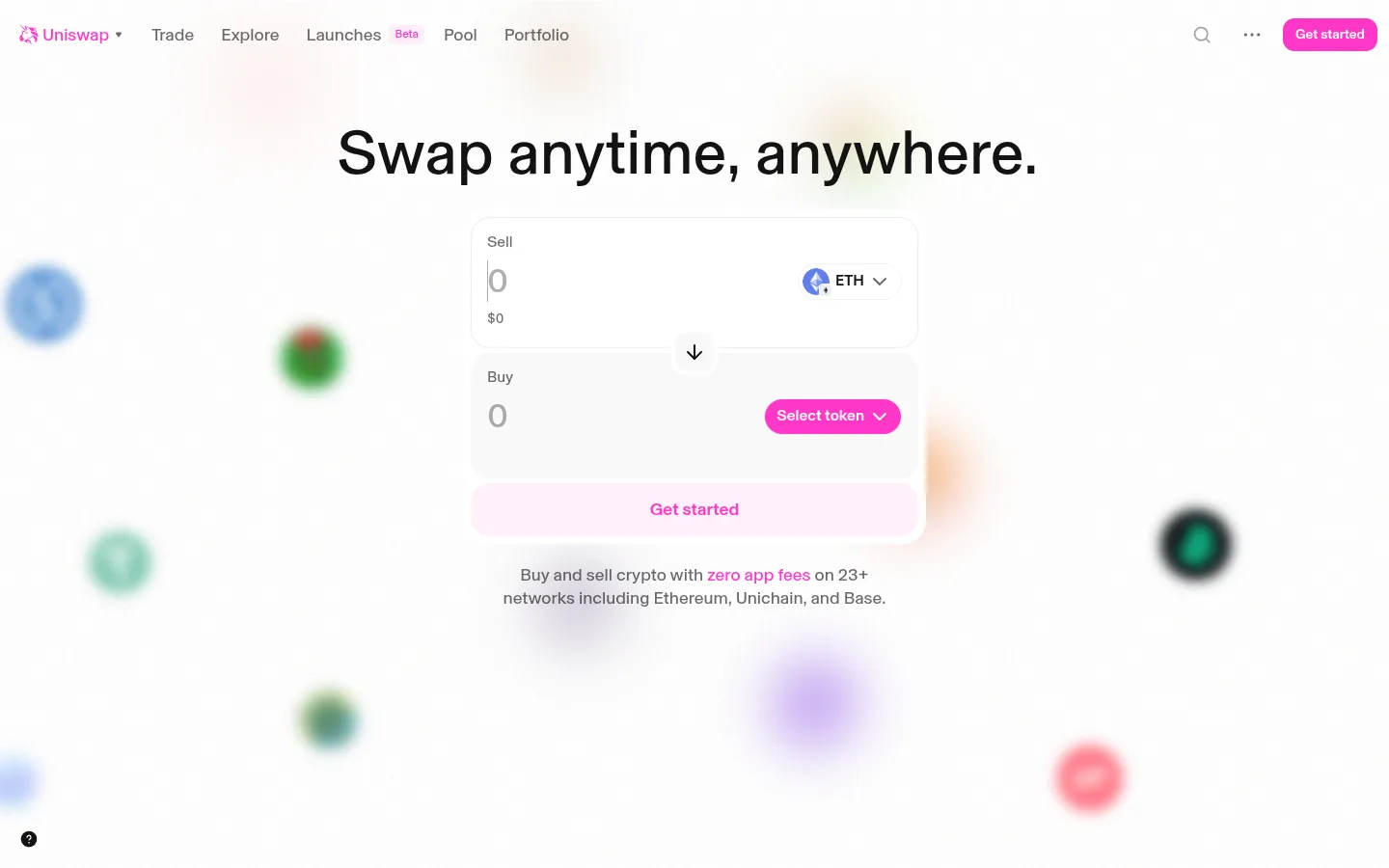
The web interface lets users swap tokens and provide liquidity through the Uniswap Protocol across supported chains.
The mobile wallet supports swaps across multiple chains and provides a wallet interface for interacting with Uniswap products.
The API provides trading integrations and supported-chain token access. Development use is free, while production access requires an API key and is subject to rate limits.
This intent-based trading protocol lets users authorize orders off-chain while external fillers compete to execute them. The filler pays gas for the user.
Permit2 is a token-approval protocol shared across integrations. After approving Permit2 once for a token, users can sign permits for individual spending actions.
Universal Router is the smart-contract entry point for v2, v3 and v4 swaps in a single transaction.
Unichain is an OP Stack Layer 2 aligned with Uniswap. Its documented mainnet chain ID is 130.
Users discuss Uniswap’s liquidity, v4 hooks, and fee-design capabilities positively. Complaints focus on cross-chain swaps, wallet recovery, interface responsiveness, fragmented pricing, and potential liquidity-provider losses.
“A fee that follows the move instead of eating it is the kind of change LPs feel immediately”
“Beginner question: why does deep liquidity matter for a stablecoin swap? More money sitting in the pool means your trade barely moves the price, so you land closer to 1:1. First step: open the swap preview and check the minimum received line against the amount you typed.”
“Swapping from BTC.b avalanche So I am made a noob mistake and ended up with BTC.b on the avalanche chain/network and cannot seem to find a way to swap it to anything at all. I am using the coinbase wallet.”
“getting nowhere with uniswap support - heeellllpp!! I have tried support through the app, but the chatbot only seems to repeat the same things, and the email address bounces back - so I am reaching out if anyone here can help, I sincerely hope you good people can assist.”
“I was earning Uniswap LP fees and still underperforming just holding ETH I have been LPing ETH USDC on Uniswap v3 and what kept bothering me was that even with a decent range and fees coming in I still ended up behind just holding ETH once price started trending, I kept changing ranges thinking it…”
“Send USDc out of Smart Wallet. I should have read the documentation, my bad I guess. So, I sent some UDSC to my Uniswap Smart Wallet (xxxx.uni.eth) in order to fund my Lighter account (lighter.exchange).”
Scam warning: Fake support accounts and private messages impersonating Uniswap support can target users.
Scam warning: Suspicious unsolicited tokens and linked sites may be phishing attempts.
Based on 100 Reddit posts and comments, 100 X replies from the last 12 months, checked Oct 17, 2026. These are posts by users on other sites, not reviews submitted on CryptoReview.
No user reviews yet. Have you used Uniswap? Share your experience below.
 Andreessen HorowitzVenture capital
 ParadigmVenture capital
SA SV AngelVenture capital
 VariantVenture capital
Hayden Adams founded Uniswap in 2018 and is the founder and CEO of Uniswap Labs. He previously worked as an engineer at Siemens.
Uniswap v3 pool fee tiers are 0.01%, 0.05%, 0.3% and 1%. Network gas and route-specific costs can apply, while UniswapX uses competing fillers and the filler pays gas for the user.
Uniswap is a self-custodied DEX protocol that connects to a wallet rather than requiring an exchange account.
Uniswap's v2 and v3 codebases are open source and have published audit materials, including a Consensys Diligence report. Users still face smart-contract, malicious-token, pricing, MEV and slippage risks.
The Uniswap API supports 16+ EVM mainnets, including Ethereum, Arbitrum, Base, OP Mainnet, Polygon, BNB Smart Chain, Avalanche, Linea, Celo, Zora, World Chain, Soneium, X Layer, Monad, zkSync and Unichain.
Yes, UNI is Uniswap's governance token. UNI holders can participate in governance decisions, including votes on protocol direction and treasury use.
Recent public posts from @Uniswap, shown as published. Not reviewed or endorsed by CryptoReview.
Cosmos appchain DEX and cross-chain AMM connecting over 100 ecosystems with IBC
Multichain AMM founded in 2020, with about $1.56B locked on October 17, 2026
Cross-chain liquidity and stablecoin activation stack settling transfers across 30+ blockchains
Perpetual and spot DEX with 50.1M reported users and a native 50ms Layer 1
DEX aggregator routing swaps across 18+ networks, including Ethereum and Solana
Self-custodial perpetuals DEX with 200+ markets on a Cosmos-based chain
Type at least two characters. Press ↵ to see all results.