

More teams are using the https://t.co/TvaIYryuDf Console every month, so we’ve given it an upgrade.
Our customers now get a cleaner interface, faster navigation, and more structured workflows across Smart Deposit Addresses, cross-chain and conversion, transaction monitoring, analytics, and team management.

rhino.fi
Cross-chain liquidity and stablecoin activation stack settling transfers across 30+ blockchains
4.0/ 5
Our score
Very good
Chains
EthereumBitcoinSolanaBNB Chain+8
Perpetual futures
No
Audited
Yes
Governance token
DVF
What is rhino.fi?
rhino.fi is a cross-chain liquidity and stablecoin activation platform that connects fragmented networks to process multi-chain swaps, bridge transfers, and deposit flows across more than 30 blockchains.
Founders and backing
rhino.fi, formerly known as DeversiFi, was co-founded by Chief Executive Officer Will Harborne and Chief Product Officer Dan Yanev.
How it works
The platform runs an internal solver and pre-funded proprietary liquidity network rather than routing transactions through third-party DEX aggregators. Users and enterprise clients interact across supported networks such as Ethereum, Arbitrum, Base, Polygon, Solana, Tron, BNB Chain, and Bitcoin. The system handles direct bridging of identical assets as well as cross-chain swaps, converting tokens into destination assets like USDT, USDC, and EURC. Enterprise integrations use Smart Deposit Addresses (SDAs) to accept deposits on one network and settle them on another in under 10 seconds. Each transfer includes automated Know Your Transaction (KYT), anti-money laundering, and sanctions screening before final settlement.
Fees and costs
Originating blockchain network gas costs are paid directly by the user, and additional source chain gas charges can apply to deposit workflows on networks such as Tron. For enterprise and B2B API integrations, access to the activation stack is structured around monthly subscription tiers, including Growth, Scale, and Enterprise plans, with usage-based overage pricing. Enterprise operators can also configure and program custom margin fees on incoming flows.
Track record and audits
The protocol initiated a brand refresh and strategic repositioning in June 2025 toward stablecoin interoperability and B2B payments infrastructure. The platform has settled more than $15B in stablecoin volume across 30+ chains, alongside reporting over 2M onboarded users and $5.5B in bridged volume during 2024. Security evaluations on the platform's smart contract infrastructure have been performed by auditing firms PeckShield and CryptoExperts.
Risks and limitations
Using rhino.fi involves smart contract risk and reliance on proprietary solver rebalancing. Because the system uses an internal liquidity network rather than an open peer-to-peer automated market maker pool, users rely on platform-managed liquidity depth. Native non-swappable bridging rules also apply: assets such as ETH or BNB can only be bridged identically without in-flight swaps to another token. Automated KYT screening applies to deposits, including sanctions filtering.
Founders
Will HarborneCo-Founder & CEO
Dan YanevCo-Founder & CPO
Best for:Cross-chain stablecoin bridgingFintechs needing multi-chain depositsMerchants accepting crypto paymentsTraders moving funds between L2s
Pros and cons
Pros
- Near-instant cross-chain execution settling in under 10 seconds
- Covers more than 30 blockchains including EVM networks, Solana, Tron, and Bitcoin
- Proprietary liquidity network eliminates third-party DEX aggregator slippage
- Smart contracts audited by PeckShield and CryptoExperts
Cons
- No swapping into ETH or BNB when bridging across chains
- Enterprise API access requires fixed monthly subscription plans
- Mandatory KYT screening applies to incoming deposits
- Sending from smart contracts is restricted on selected networks like Base
Our review
4.0/5
Very good
rhino.fi delivers fast, deterministic cross-chain stablecoin settlement across more than 30 networks, and it pivoted toward B2B infrastructure in June 2025.
Formerly known as DeversiFi, rhino.fi shifted its core focus in June 2025 to become a stablecoin payments and cross-chain liquidity layer. The platform relies on an internal solver and pre-funded liquidity network. This model allows cross-chain swaps and bridges across more than 30 networks, including Ethereum, Solana, Tron, Arbitrum, Base, Polygon, and TON, settling transfers deterministically in under 10 seconds without third-party aggregator routing.
It supports assets like USDT and USDC alongside non-USD tokens like EURC and native assets such as BTC and ETH. By using proprietary first-party liquidity rather than external DEX routing, rhino.fi presents deterministic settlement outcomes. Security audits by PeckShield and CryptoExperts inspect its smart contract infrastructure, and the platform has processed more than $15 billion in cumulative stablecoin transfers.
However, the architecture brings notable trade-offs for typical on-chain traders:
- The protocol enforces 100% KYT screening alongside sanctions and Travel Rule checks on incoming deposits.
- Subscription pricing model: enterprise API clients face monthly software tiers alongside network gas fees, while retail users must navigate asset restrictions such as ETH and BNB functioning purely as bridge assets rather than swap destinations.
rhino.fi is led by co-founders Will Harborne and Dan Yanev. It is designed for fintech platforms and payment processors requiring multi-chain deposit routing and deterministic stablecoin liquidity.
Specs
| Chains | Ethereum, Bitcoin, Solana, BNB Chain, Arbitrum, Base, Optimism, Polygon, Avalanche, TON, Tron, Other · unverified |
|---|---|
| Cross-chain swaps | Yes · unverified |
| Audited | Yes · unverified |
| Governance token | DVF · unverified |
| Perpetual futures | No · unverified |
| Routes across other DEXs | No · unverified |
Not disclosed by the provider: KYC required, Type, Swap fee, Limit orders, Open source, Max leverage (x), MEV protection, Mobile app, Points or rewards program.
Data from the provider's website and public sources. Fees and availability change; confirm on the official site before you sign up.
Key features
Smart deposit addresses
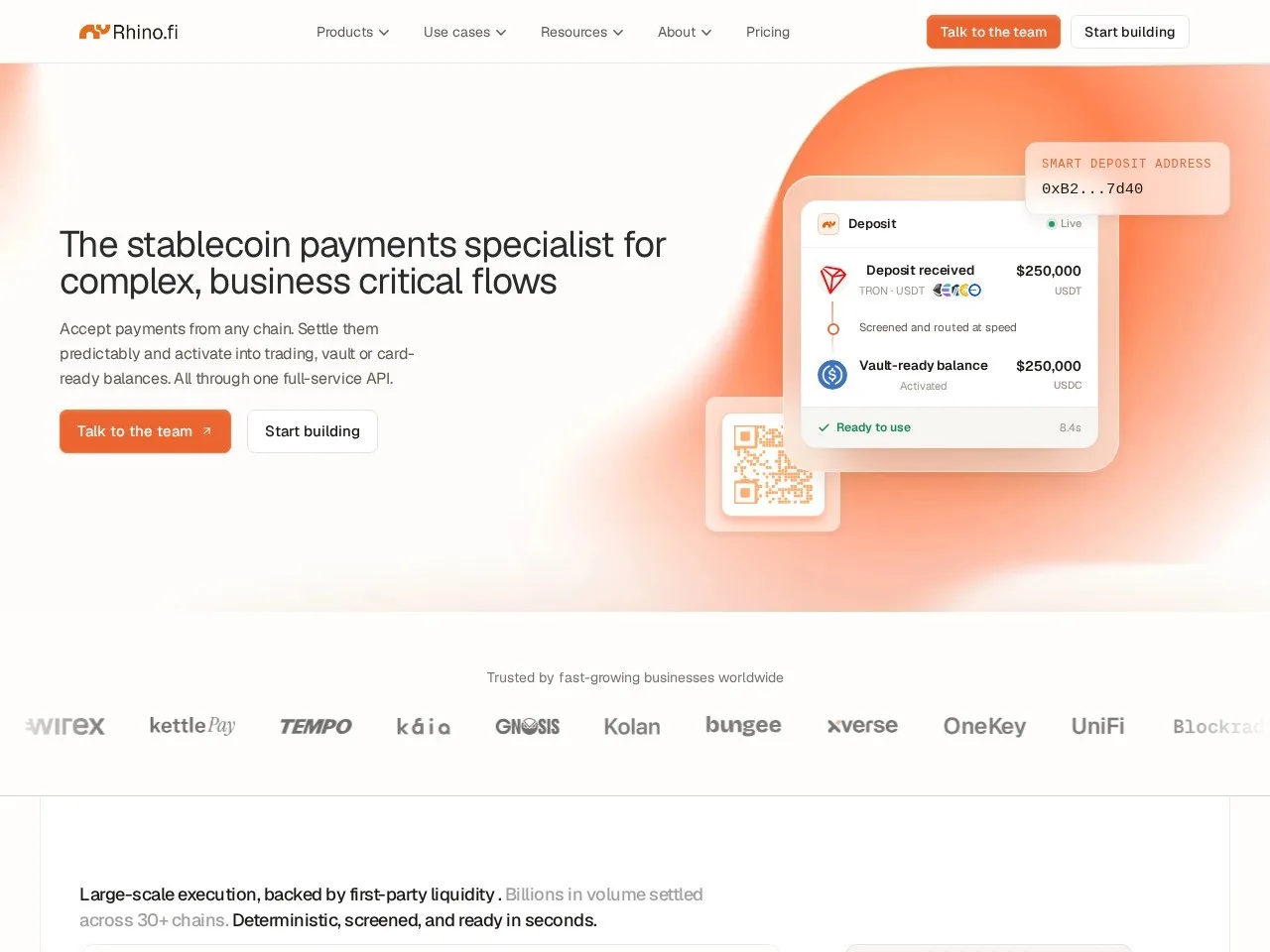
Generates single deposit addresses that detect incoming networks, route assets, and settle into target balances in under 10 seconds.
Cross-chain swaps
Converts and transfers stablecoins and major assets across more than 30 supported blockchains, including Base, Solana, Arbitrum, and Tron.
Proprietary solver execution
Routes transactions through an internal pre-funded liquidity network instead of relying on external third-party DEX aggregators.
Automated transaction screening
Runs automated KYT, AML, and sanctions checks on every deposit before funds reach final destination balances.
Native Bitcoin bridging
Accepts native Bitcoin deposits and automatically routes settlements into stablecoins such as USDT, USDC, or EURC.
Programmable fee controls
Allows integrated platforms to apply custom margins, sponsor fees, or route platform revenue based on transfer sizes.
Inside rhino.fi
Smart Deposit Addresses
A deposit primitive that assigns a single address per user across multiple networks, automatically handling chain detection, routing, compliance screening, and settlement.
Bridge & Swap Solver
An internal settlement system powered by pre-funded liquidity that enables transfers and asset conversions between supported blockchains without third-party aggregators.
Activation Stack & API
An enterprise integration API that routes settled incoming deposits into external yield vaults, trading balances, or debit card accounts.
Console & Fee Management
An administrative interface that lets businesses set custom markups, sponsor network costs, and configure automated routing policies for cross-chain payments.
rhino.fi screenshots


What users say about rhino.fi
Rhino.fi receives almost no relevant discussion, as nearly all collected feedback refers to Rhino 3D modeling software instead of the crypto platform.
Scam warning: Scammers operating fake exchanges and employment crypto scams have used rhino.fi as an alleged mirror or impersonation target.
Based on 200 Reddit posts and comments from the last 12 months, checked Oct 21, 2026. These are posts by users on other sites, not reviews submitted on CryptoReview.
User reviews
No user reviews yet. Have you used rhino.fi? Share your experience below.
FAQ
Who founded rhino.fi?
rhino.fi was co-founded by CEO Will Harborne and CPO Dan Yanev. The project previously launched and operated under the name DeversiFi.
Which blockchains does rhino.fi support?
rhino.fi supports more than 30 blockchains, including Ethereum, Solana, Tron, TON, Arbitrum, Base, Polygon, Avalanche, and BNB Chain.
How does rhino.fi charge fees?
rhino.fi bills institutional and enterprise clients through monthly subscription tiers, including Starter, Growth, Scale, and Enterprise packages with overage fees. End users pay standard originating transaction gas fees.
Has rhino.fi been audited?
Yes, rhino.fi has undergone smart contract security audits by PeckShield and CryptoExperts.
Does rhino.fi require compliance checks?
Yes, rhino.fi enforces automated transaction screening on deposits, including 100% Know-Your-Transaction (KYT) checks, AML monitoring, sanctions filtering, and Travel Rule compliance.
Can you trade perpetuals or place limit orders on rhino.fi?
Rhino.fi does not support perpetual contracts. It functions as a cross-chain liquidity and settlement layer for stablecoins and select native assets.
Latest from rhino.fi on X
Robinhood Chain is live on https://t.co/i3Pm5da8gi.
Robinhood Chain runs primarily on USDG and USDe, but businesses building on Robinhood Chain often serve users who hold assets across other networks and in other stablecoins like USDC or USDT. https://t.co/Kw0pVjnyor
Robinhood Chain runs primarily on USDG and USDe, but businesses building on Robinhood Chain often serve users who hold assets across other networks and in other stablecoins like USDC or USDT. https://t.co/Kw0pVjnyor
Our CEO, Will Harborne, joined @sobradob on the On The Margin podcast.
They discussed where stablecoins are gaining real-world traction and how https://t.co/TvaIYryuDf makes them seamless for fintechs and merchants.
Stablecoin adoption for high-value, time-critical payments is quietly exploding.
For merchants releasing bulk commodities, supplying jet fuel, or handing over a high-value watch, settlement speed, low cost, and total certainty are critical.
Card limits, bank cutoffs, chargebacks and slow payment reviews can make time-critical, high-value transactions unpredictable.
Stablecoins offer businesses a 24/7 settlement path while meeting compliance requirements.
Learn more on this podcast 🎙️
Arc is live on https://t.co/TvaIYryuDf from day one.
We’ve launched support for cross-stablecoin acceptance and USDC interoperability for Arc.
What you can do from day 1 of Arc mainnet launch:
• Bridge and convert USDC from Arc into supported stablecoins across 30+ chains
• Accept USDC from Arc through https://t.co/TvaIYryuDf Smart Deposit Address
• Accept 13 other supported tokens from 30+ chains and settle in USDC on Arc
• Guarantee exact dollar settlement through https://t.co/TvaIYryuDf 1:1 Stablecoin Settlement
• Settle up to $10M in a single transaction, instantly
All onchain deposits powered by Rhino's API.
Huge milestone for @wirexapp and in less than 12 months.
Huge milestone for @wirexapp and in less than 12 months.
Recent public posts from @rhinofi, shown as published. Not reviewed or endorsed by CryptoReview.
Alternatives to rhino.fi

Decentralized AMM launched in 2018, with support across 16+ EVM mainnets
No KYCAMMEthereum · Base +3Limit orders

Cosmos appchain DEX and cross-chain AMM connecting over 100 ecosystems with IBC
No KYCAMM · Order bookOtherLimit orders

Multichain AMM founded in 2020, with about $1.56B locked on October 17, 2026
No KYCAMMBNB Chain · Ethereum +3Cross-chain swaps

Perpetual and spot DEX with 50.1M reported users and a native 50ms Layer 1
No KYCPerpetualsBNB Chain · Ethereum +3Limit orders

DEX aggregator routing swaps across 18+ networks, including Ethereum and Solana
AggregatorEthereum · BNB ChainCross-chain swaps
Self-custodial perpetuals DEX with 200+ markets on a Cosmos-based chain
Order book · PerpetualsEthereum · OtherLimit orders