

Decentralized AMM launched in 2018, with support across 16+ EVM mainnets
No KYCAMMEthereum · Base +3Limit orders

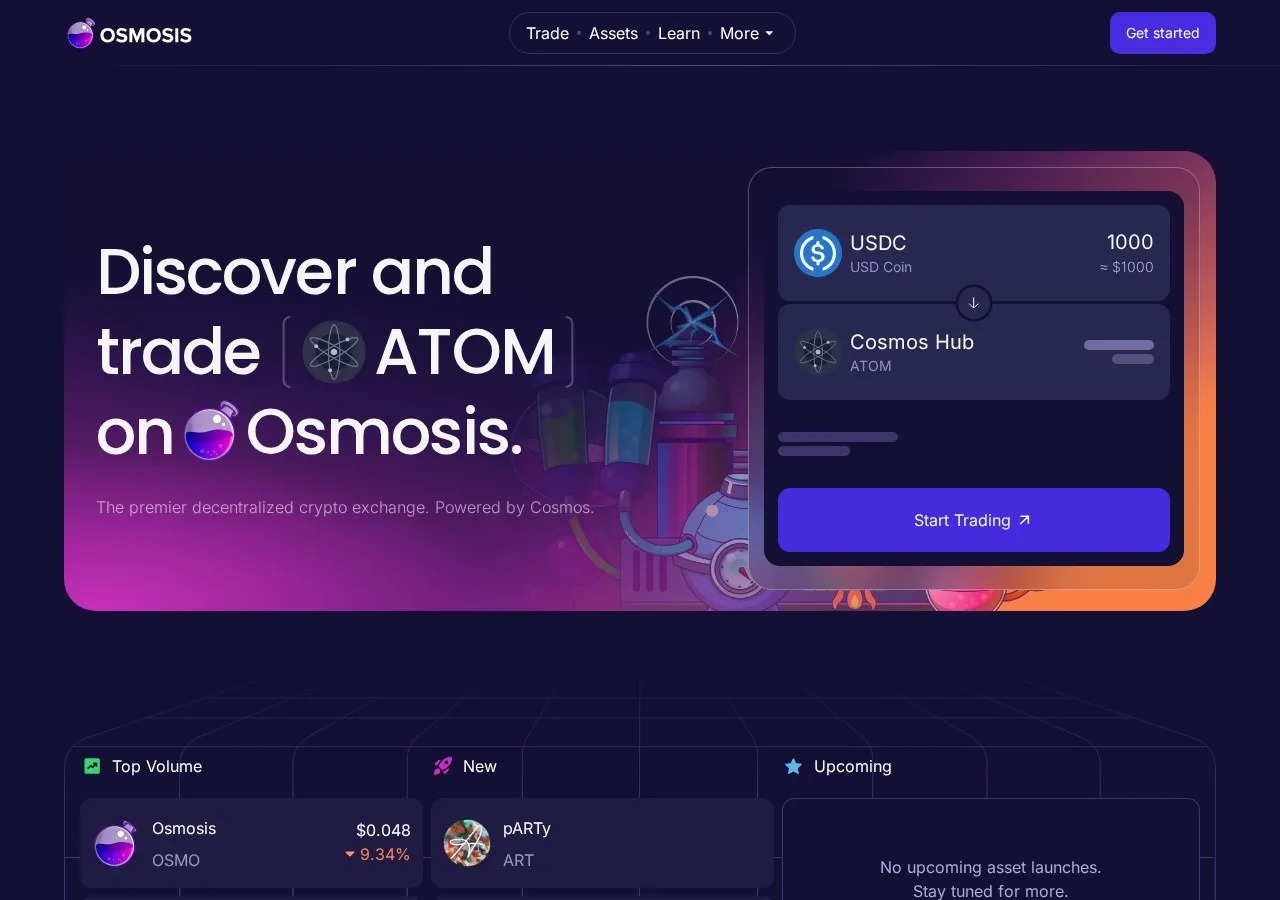
Cosmos appchain DEX and cross-chain AMM connecting over 100 ecosystems with IBC
Osmosis is an automated market maker (AMM) and independent Layer-1 appchain built within the Cosmos ecosystem. Operating as an interchain liquidity hub, it connects over 100 blockchain ecosystems via the Inter-Blockchain Communication (IBC) protocol, processing more than $44.2 billion in cumulative lifetime volume.
Osmosis Labs was founded in 2021 by Sunny Aggarwal, a former Tendermint core developer, and Josh Lee, former Tendermint developer and co-founder of Keplr wallet creator Chainapsis. The project is headquartered in Singapore. In October 2021, Osmosis completed a $21 million token sale led by Paradigm, with participation from Robot Ventures, Nascent, Ethereal Ventures, Figment, and Do Kwon.
Osmosis runs non-custodially. Users trade directly from self-custody wallets without account registration or KYC checks. Its architecture supports both traditional liquidity pools and concentrated liquidity positions, letting liquidity providers target capital into specific price ranges. Trading pairs include native Cosmos tokens, bridged Bitcoin and Ethereum assets, and stablecoins. Swap fees are customizable on a per-pool basis, set either by pool creators or through governance proposals. Network gas fees feature fee abstraction. Users can pay transaction costs in more than 160 supported tokens rather than requiring OSMO for every transfer.
The protocol launched in 2021 as an IBC-native exchange and expanded in 2022 by introducing superfluid staking, which allows liquidity providers to stake underlying OSMO tokens while simultaneously earning swap fees. In 2023, Osmosis implemented concentrated liquidity alongside the ProtoRev module, an on-chain MEV-capture system designed to extract arbitrage revenue back to the protocol. Cross-chain connectivity was expanded in 2024 through integrations with Wormhole and Skip Protocol. As of October 2026, the platform reports over $98 million in assets, 24-hour trading volume of approximately $3.78 million, and a user base exceeding one million users. Protocol TVL sat at approximately $11.3 million in October 2026.
Osmosis exposes users to standard automated market maker risks, including slippage and impermanent loss on volatile trading pairs. Because cross-chain trading relies on IBC channels and bridge providers like Wormhole, users face counterparty bridge risks and smart contract vulnerabilities on connected external chains. To limit the financial impact of external bridge exploits, Osmosis uses an IBC rate limit module that restricts high-value inflows and outflows during short time windows, which can temporarily sacrifice bridge transfer liveness during major market dislocations.
Osmosis serves as the primary decentralized exchange for the Cosmos ecosystem with native cross-chain routing across connected networks.
Osmosis is a dedicated proof-of-stake application chain and automated market maker built for the Cosmos ecosystem. Co-founded in 2021 by Sunny Aggarwal and Josh Lee, both former Tendermint developers, the platform is an interchain trading hub. The project established institutional backing early with a $21 million token sale in October 2021 led by Paradigm, alongside participants including Robot Ventures and Nascent.
The exchange operates on customizable liquidity pools alongside concentrated liquidity mechanisms and an integrated orderbook module. Because it runs on its own chain, Osmosis handles cross-chain swaps natively across the Inter-Blockchain Communication protocol, linking more than 50 connected blockchains as well as bridged tokens from external ecosystems. Transaction execution benefits from the ProtoRev module, which captures cyclic arbitrage at the block production layer to return MEV value to the protocol, while gas fee abstraction allows users to pay transaction costs across dozens of different supported assets.
Liquidity depth presents a notable trade-off. While Osmosis has processed over $44 billion in all-time trading volume, assets on the platform stood at roughly $98.8 million in October 2026, with DEX-specific TVL reported at around $11.3 million. High-volume trades outside core Cosmos pairings such as OSMO, ATOM, and Celestia can incur slippage. Cross-chain traffic also depends on the security of IBC channels and external bridge implementations like Wormhole. To limit systemic bridge risks, the network applies governance-managed IBC rate limits that cap token inflows and outflows during sudden spikes.
| KYC required ⓘ | No · unverified |
|---|---|
| Type | AMM, Order book · unverified |
| Chains | Other |
| Swap fee | Varies by pool · unverified |
| Limit orders | Yes · unverified |
| Cross-chain swaps | Yes · unverified |
| Open source | Yes · unverified |
| Governance token | OSMO · unverified |
| MEV protection | Yes · unverified |
| Points or rewards program | Yes · unverified |
Not disclosed by the provider: Audited, Perpetual futures, Max leverage (x), Routes across other DEXs, Mobile app.
Data from the provider's website and public sources. Fees and availability change; confirm on the official site before you sign up.
Routes swaps across more than 100 connected blockchain ecosystems using the Cosmos Inter-Blockchain Communication protocol.
Allows liquidity providers to allocate capital within customized price bounds to increase fee efficiency.
Enables liquidity providers to stake the underlying OSMO tokens in liquidity pools to earn staking rewards and secure the network.
Lets traders pay network transaction gas fees in over 160 different supported tokens without holding OSMO.
Captures cyclical arbitrage opportunities at the protocol level to retain MEV profits for the ecosystem.
Enforces governance-set inflow and outflow transfer limits to reduce potential losses from bugs or exploits affecting high-value bridged assets.
Allows liquidity providers to allocate capital within customized price ranges to improve capital efficiency and earn swap fees.
Enables liquidity providers to stake the underlying OSMO tokens inside their pool shares to earn staking rewards while providing liquidity.
A built-in protocol module that captures cyclical arbitrage opportunities directly at the blockchain layer.
A safety middleware contract that limits net inflows and outflows of bridged tokens across set intervals to prevent total asset depegging during bridge bugs.
Allows traders to execute transactions and pay network gas fees across a wide selection of alternative Cosmos assets.
User sentiment toward Osmosis is mixed to negative, with long-term participants expressing nostalgia alongside frustration over platform abandonment. Discussions center on slow customer support, technical glitches with deposits and orders, and declining liquidity.
“I am finding this support is not 24/7.....had a ticket up for 30+ hours with no response and its in regards to a deposit. I would think is a highly urgent for customer service as in my company anybody wanting to pay/deposit money into us would surely get a fast response.”
“Deposit Failed, but hash showing successful Hi, I was depositing Gnodi from Keplr to my Osmosis wallet like I have done before in the past when I wanted to offload it.”
“Still Can't Make Limit Orders I've been placing limit orders this past year with no issues, until a couple months ago. We'll I just purchased 2 new cellphones Samsung Galaxy and Google Pixel. On both phones, 2 separate accounts, each one is unable to place a limit order.”
“Osmosis withdrawal amount bug has been fixed I posted a month ago about my withdrawal transactions leaving a small fraction of tokens on OSMO chain and requiring two transactions to effectively complete withdrawals to other IBC chains.”
Scam warning: Malicious links sent via transaction history and fake proposals attempt to drain connected wallets.
Based on 200 Reddit posts and comments from the last 12 months, checked Oct 21, 2026. These are posts by users on other sites, not reviews submitted on CryptoReview.
No user reviews yet. Have you used Osmosis Labs? Share your experience below.
Osmosis Labs was founded in 2021 by Sunny Aggarwal and Josh Lee, both former Tendermint developers. Lee also co-founded Chainapsis, the team behind Keplr Wallet.
No, Osmosis does not require identity verification or KYC. Users interact directly with smart contracts and liquidity pools using self-custodial wallets.
Swap fees on Osmosis are customized per liquidity pool by pool creators and governance. Network gas fees can be paid using OSMO or alternative supported tokens through fee abstraction.
OSMO is the native governance and staking token of the Osmosis blockchain. It secures the network via proof of stake, participates in governance votes, and can be used in superfluid staking to earn rewards while providing liquidity.
Osmosis uses IBC Rate Limit modules that cap inflow and outflow percentages over fixed intervals. This automated safety control is designed to limit capital loss if an interconnected bridge or counterparty chain suffers an exploit.
Decentralized AMM launched in 2018, with support across 16+ EVM mainnets
Multichain AMM founded in 2020, with about $1.56B locked on October 17, 2026
Cross-chain liquidity and stablecoin activation stack settling transfers across 30+ blockchains
Perpetual and spot DEX with 50.1M reported users and a native 50ms Layer 1
DEX aggregator routing swaps across 18+ networks, including Ethereum and Solana
Self-custodial perpetuals DEX with 200+ markets on a Cosmos-based chain
Type at least two characters. Press ↵ to see all results.