SynFutures is an onchain derivatives and trading platform combining an onchain order book with its Oyster AMM architecture. It lets traders buy and sell perpetual contracts on crypto pairs and trade 58 tokenized US equities and ETFs directly from self-custodial Web3 wallets without an intermediary.
Founding and financial backing
Singapore-based SynFutures was co-founded by CEO Rachel Lin. The project raised a total of $38M across three funding rounds, starting with a seed round led by Standard Crypto in December 2020. In October 2023, SynFutures closed a $22M Series B round led by Pantera Capital, alongside SIG DT Investments and HashKey Capital.
How trading and tokenized assets work
The exchange operates on Base, Blast, and Monad. Its perpetual futures match trades through a maker-taker model integrated with the Oyster AMM, accepting margin deposits in WETH and USDC with liquidation and margin parameters managed through onchain oracles like Chainlink. For real-world assets, SynFutures offers 58 tokenized US-listed stocks and ETFs issued by Anchored as standard ERC-20 tokens, backed 1:1 by underlying shares held in regulated brokerage accounts and verified daily by Accountable. RWA trades settle via mUSD, an internal dollar-denominated accounting credit, while eligible cash dividends distribute automatically as USDC to holders.
Fee structure and access
No KYC identity verification is required to trade real-world assets or perpetuals on the platform. Perpetual contracts on major pairs like BTC-USDC charge a 0.05% market order taker fee, a 0.02 USDC execution fee, and provide a 0% limit order fee rebate. RWA trades incur a 0 bps deposit fee, a 21 bps withdrawal fee, an 11 bps buy order fee, and a 1 bps sell order fee. RWA market orders only fill during regular US equity market trading hours, though limit orders can be placed at any time.
Track record and platform risks
SynFutures deployed its V3 Oyster AMM architecture in October 2023 and completed smart contract audits with Quantstamp and Sherlock. By October 2026, protocol TVL stood at approximately $2.8M. Users face protocol-level trade-offs, including oracle latency and smart contract vulnerabilities. Equity orders also carry third-party custodian dependency through Anchored, alongside liquidity constraints on newly launched community perpetual listings.
Best for:Traders wanting onchain stock exposurePerpetual traders avoiding centralized KYCBase and Monad DeFi users
Pros and cons
Pros
No KYC required to trade perpetuals or 58 tokenized equities
Underlying tokenized stock reserves verified daily by an independent auditor
Non-custodial trading directly from Web3 wallets using standard ERC-20 tokens
Cash dividends pay out automatically as USDC directly to user wallets
Smart contracts audited by Quantstamp and Sherlock
Cons
Tokenized stock market orders execute only during US market hours
Tokenized equities do not confer voting or corporate reporting rights
Third-party counterparty risk tied to stock tokenization issuer Anchored
Network migration required due to the shutdown of Blast
Community perpetual pairs may suffer thin liquidity and sudden delistings
Our review
3.6/5
Good
SynFutures offers non-custodial perpetuals and tokenized US equities with deep liquidity mechanics, but its TVL remains modest and tokenized stock market orders depend strictly on US market hours.
Liquidity & pricing3.0
Fees4.0
Security4.0
Ease of use3.5
Chain coverage3.5
SynFutures is a decentralized derivatives exchange and infrastructure protocol headquartered in Singapore, founded under the leadership of CEO Rachel Lin. The exchange operates across Base, Blast, and Monad, though users on Blast were advised to withdraw balances ahead of network sunsetting. Backed by $38 million in total funding from investors including Pantera Capital, Standard Crypto, SIG DT Investments, and HashKey Capital, SynFutures combines its proprietary Oyster AMM with an onchain limit order matching engine.
The platform supports perpetual futures trading alongside a catalog of 58 tokenized US equities and ETFs, including TSLA, AAPL, and MSTR. These real-world assets are issued by Anchored, backed 1:1 by underlying shares held in regulated custody, and verified daily by independent auditor Accountable. Tokenized stock holders receive eligible cash dividends directly in USDC. Spot swap routing is also integrated through an aggregator tapping pools like Uniswap, PancakeSwap, and Aerodrome.
Trading fees vary by product line. Perpetual futures on pairs like BTC-USDC incur a 0.05% market order fee with an additional 0.02 USDC execution fee, while limit orders carry zero fee rebates. Real-world asset trades charge an 11 bps fee for buys, 1 bps for sells, zero deposit fees, and 21 bps on withdrawals using the mUSD accounting unit. Smart contracts have been audited by Quantstamp, and Anchored's contracts were audited by Sherlock. SynFutures maintains a non-custodial model without mandatory KYC verification.
Trade-offs center on market accessibility and liquidity. Protocol TVL sat at approximately $2.8 million in October 2026, which is relatively modest for a derivatives platform. Real-world asset market orders are restricted to regular US market hours, and community listings on the Perp Launchpad face high volatility and delisting risk if trading volume dwindles. The platform suits active on-chain derivatives traders and non-US market participants seeking direct equity exposure, while institutional traders requiring deep liquidity books or 24/7 equity market execution may prefer alternative venues.
Listings are researched and drafted with AI assistance from public sources, then checked for accuracy and readability. Spot an error? Tell us. Editorial policy.
AMM, Order book, Perpetuals, Aggregator · unverified
Chains
Base, Other
Swap fee
0.05% market order fee on BTC-USDC perp · unverified
Limit orders
Yes· unverified
Audited
Yes· unverified
Open source
Yes· unverified
Governance token
F · unverified
Perpetual futures
Yes· unverified
Routes across other DEXs
Yes· unverified
Not disclosed by the provider: Cross-chain swaps, Max leverage (x), MEV protection, Mobile app, Points or rewards program.
Data from the provider's website and public sources. Fees and availability change; confirm on the official site before you sign up.
Key features
Oyster AMM matching
Combines a concentrated AMM with a maker-taker onchain order book engine for perpetual futures on Base and Monad.
Tokenized US equities
Supports 58 tokenized US stocks and ETFs like TSLA and AAPL backed 1:1 by brokerage-held shares verified every 24 hours.
Automated dividend payouts
Distributes cash dividends directly to non-custodial user wallets as USDC without requiring manual claim actions.
Permissionless market launchpad
Allows community users and liquidity providers to launch new perpetual futures pairs on Base.
DEX liquidity aggregator
Routes spot swaps through external decentralized venues including Uniswap, Aerodrome, and PancakeSwap.
Transparent RWA fee schedule
Charges an 11 bps fee on buy orders, 1 bps on sell orders, and 21 bps on withdrawals with zero deposit fees.
Inside SynFutures
1
Perp
Supports perpetual futures trading using an onchain order book matched against the Oyster AMM, featuring margin management and position controls.
2
RWA
Enables non-custodial trading of 58 US-listed tokenized equities and ETFs backed 1:1 by shares held via regulated custody, with automated USDC dividend payouts.
3
Spot
Routes spot token swaps through an aggregator integrated with decentralized exchanges including Uniswap, PancakeSwap, and Aerodrome.
4
Perp Launchpad
Allows permissionless listing and deployment of new perpetual trading markets with community liquidity provision.
SynFutures screenshots
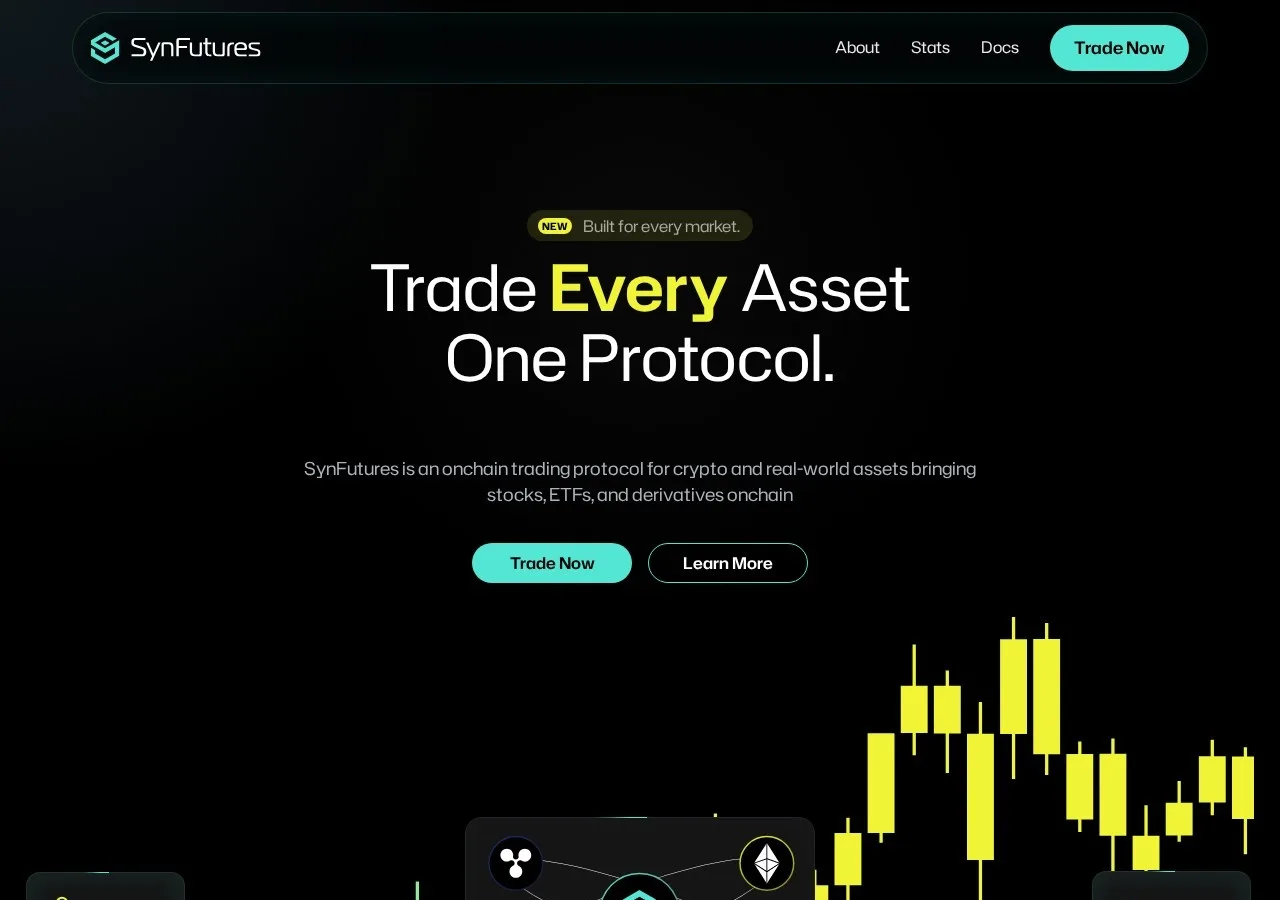
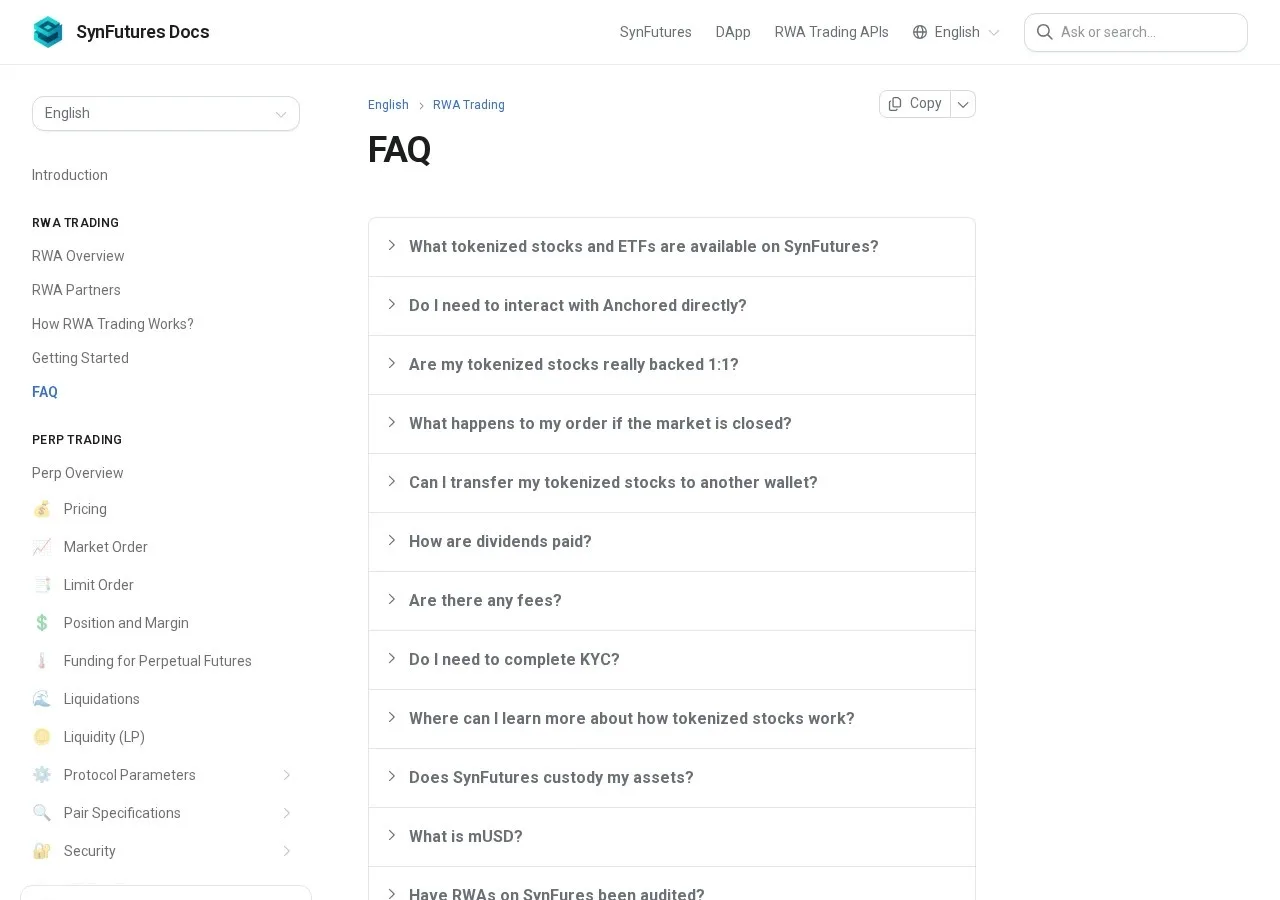
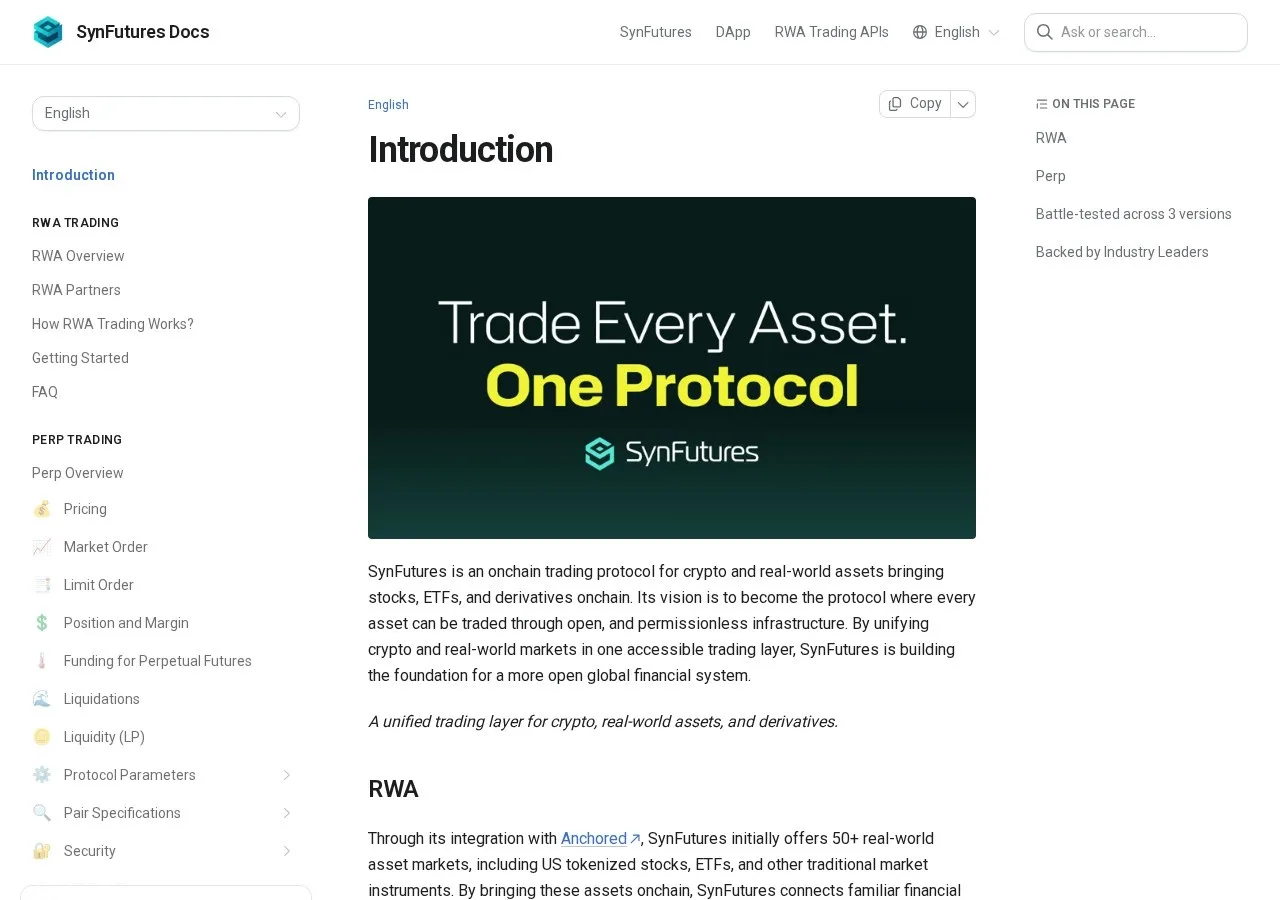
SynFutures homepage with navigation, trading headline, description, and Trade Now and Learn More buttons · Oct 21, 2026FAQ: SynFutures Docs displays an RWA Trading FAQ page with expandable questions and navigation links · Oct 21, 2026Docs: SynFutures documentation introduction page with navigation, protocol overview, and RWA trading information · Oct 21, 2026
User reviews
No user reviews yet. Have you used SynFutures? Share your experience below.
SynFutures was co-founded by CEO Rachel Lin. The company is based in Singapore and has raised $38 million across three funding rounds led by investors such as Pantera Capital and Standard Crypto.
Does SynFutures require KYC verification?
No, SynFutures does not require KYC to trade perpetual futures or tokenized real-world assets. Users trade directly from their non-custodial Web3 wallets.
What trading fees does SynFutures charge?
Perpetual futures pairs like BTC-USDC charge a 0.05% market order fee and a 0.02 USDC execution fee. RWA equity trades charge 11 bps on buys, 1 bps on sells, and 21 bps on withdrawals.
Has SynFutures been audited for security?
Yes, SynFutures contracts have been audited by Quantstamp. Additionally, smart contracts for its tokenized asset partner Anchored were audited by Sherlock.
Does SynFutures have a native governance token?
Yes, SynFutures uses the token ticker F for its native tokenomics, contract ecosystem, and staking.
What assets can be traded on SynFutures?
Traders can access perpetual futures on cryptocurrencies such as BTC and ETH, as well as 58 tokenized US stocks and ETFs including TSLA, AAPL, and COIN.
Here’s what's been shaping up for tokenization and DeFi 👇
• US spot BTC ETFs pulled in $526.7M, their biggest daily inflow since September 22
• @WebullGlobal announced plans to launch US perpetual futures in November
• Weekly RWA perp volume climbed 74.7% to $39.8B
• @SoFi launched interest-bearing tokenized deposits with 4.4% APY
• @pendle_fi expanded leveraged trading to tokenized US stocks on @base
Perps are moving closer to traditional finance, while tokenized assets are becoming increasingly tradable.
The line between TradFi and DeFi keeps getting thinner.
• US spot BTC and ETH ETFs shed $1.22B in weekly outflows
• BTC and ETH ETF flows turned positive on October 13
• @HyperliquidX led perp DEXs with $48.1B in seven-day volume
• Tokenized RWAs reached $39B, up roughly 81% since the start of 2026
• @Securitize brought tokenized US stocks to Solana, including Apple, Nvidia, and Tesla
• BNY and Citadel completed their first tokenized Treasury triparty repo
Tokenization is breaking records and Wall Street is building the rails.
Here’s more of the news shaping the past week 👇
• Tokenized equities hit a record $4.87B in market cap
• Onchain stock trading reached a record $15.6B in monthly volume
• OKX + ICE filed to launch a 24/7 tokenized stock trading venue
• The CFTC proposed a new framework for leveraged retail crypto trading
• Onchain RWAs reached $39.3B, with tokenized stockholders surpassing 4M
• CFTC guidance opened the door for eligible tokenized assets to be used as collateral by derivatives firms
Tokenization is moving beyond putting assets onchain. The next challenge is making them liquid, accessible, and truly tradable.
It’s clear that RWAs are having a moment at TOKEN2049.
Tokenization is one of the conversations dominating Singapore this week, with institutions, asset managers, and builders all exploring what happens when traditional markets move onchain.
And another number shows just how far the market is moving:
$3.8B 🔔
That's the current market cap of tokenized stocks.
→ More assets moving onchain.
→ More institutions entering the conversation.
→ More awareness around what tokenization can unlock.
The shift to onchain markets is happening, and it's not slowing down anytime soon.