
Decentralized AMM launched in 2018, with support across 16+ EVM mainnets
No KYCAMMEthereum · Base +3Limit orders
Raydium is a decentralised exchange on Solana. It supports token swaps, liquidity provision, farming and token launches, combining AMM pools with concentrated liquidity and LaunchLab, its token launch tooling. The protocol had about $1.18 billion in TVL on 17 October 2026.
Raydium is non-custodial. A Solana wallet serves as the user's identity, so the app requires no account, password or signup process. Swaps execute through on-chain AMM pools. Liquidity providers deposit assets and receive liquidity-provider tokens. Most pools charge a 0.25% trading fee, although pool tiers of 0.01%, 0.05% and 1% also exist.
The protocol runs on Solana and supports its token ecosystem, including SPL assets and Token-2022 tokens. Users need SOL for network fees and may pay an optional priority fee to validators during congestion. Raydium also offers farming, token launches through LaunchLab and staking for its RAY token. RAY is optional for swaps and liquidity provision.
A swap on most pools costs 0.25%, split between liquidity providers and the protocol. Solana network fees are approximately 0.0005 to 0.002 SOL per transaction. Token-2022 transfer fees can add to the pool charge, while failed transactions still consume network fees. Raydium's documentation recommends keeping a 0.02 SOL buffer for transaction costs.
Raydium itself does not require KYC and is available through a compatible, non-custodial Solana wallet. Its own app has no mobile application, although it can load in a supported wallet's dApp browser.
Raydium launched in 2021 and remains focused on Solana. TVL was about $1.18 billion on 17 October 2026, and reported 24-hour DEX volume reached $192.2 million in October 2026. The protocol offers a maximum bug bounty of $505,000.
In June 2026, an exploit in the deprecated AMM V3 program drained approximately $1.34 million from five inactive liquidity pools. Raydium committed to full reimbursement and a protocol-wide security audit. The incident illustrates smart-contract and upgrade risk.
AMM trading exposes users to slippage and impermanent loss. Long-tail pairs may also have thin liquidity. Solana congestion can cause failed transactions and priority-fee costs, while MEV can affect execution. Token launches add issuer and token-contract risk. RAY staking and buybacks connect part of the ecosystem to token incentives. The 2026 V3 exploit shows that deprecated contracts can retain material exposure.
Raydium offers deep Solana liquidity and flexible AMM pools, but its single-chain scope and 2026 exploit remain significant trade-offs.
Raydium is a Solana-only DEX built around automated market maker pools. It supports token swaps, liquidity provision, farming and token launches without an account or KYC on Raydium itself, letting users connect a wallet instead of opening a custodial account while placing wallet security and transaction approval with the user.
TVL was about $1.18 billion on 17 October 2026, and reported 24-hour DEX volume reached $192.2 million in October 2026. The protocol also supports concentrated liquidity pools.
Most pools charge a 0.25% trading fee. Other tiers are 0.01%, 0.05% or 1%, and Solana network fees add about 0.0005 to 0.002 SOL per transaction. Raydium offers a priority-fee selector during congestion, though that adds another variable to execution costs.
Chain coverage is limited to Solana. Raydium is an AMM rather than a general order-book venue, and Raydium does not offer native cross-chain swaps or perpetual futures.
Security has a serious weakness in its recent record. An exploit in a deprecated AMM V3 program drained about $1.34 million from five inactive pools in June 2026. Raydium committed to full reimbursement and a protocol-wide security audit. The protocol also has a maximum bug bounty of $505,000, but that does not remove smart-contract or slippage risk.
Raydium provides Solana AMM pools and token launches without custody.
| KYC required ⓘ | No · unverified |
|---|---|
| Type | AMM |
| Chains | Solana |
| Swap fee | 0.25% on most pools; 0.01%, 0.05% or 1% on some tiers · unverified |
| Cross-chain swaps | No · unverified |
| Governance token | RAY · unverified |
| Perpetual futures | No · unverified |
| Mobile app | No · unverified |
| Points or rewards program | Yes · unverified |
Not disclosed by the provider: Limit orders, Audited, Open source, Max leverage (x), Routes across other DEXs, MEV protection.
Data from the provider's website and public sources. Fees and availability change; confirm on the official site before you sign up.
Swaps run through on-chain AMM pools on Solana. Most pools charge a 0.25% trading fee, with 0.01%, 0.05% and 1% tiers also available.
Liquidity providers can use concentrated-liquidity pools, which assign capital to selected price ranges rather than across the full curve.
Users can deposit token pairs into pools and receive liquidity-provider tokens. Farming adds reward mechanisms to selected pools.
LaunchLab provides tools for launching tokens on Solana, alongside Raydium's swap and liquidity markets.
RAY is Raydium's native SPL token and can be staked in the app. RAY is not required for swaps or liquidity provision.
The interface offers Normal, Turbo and Max priority-fee settings for Solana transactions during network congestion.
Token-2022 assets can trade on Raydium, though their transfer fees may compound with the pool trading fee.
Swap tokens through Raydium's Solana AMM pools. Most pools charge a 0.25% trading fee, with other pool tiers at 0.01%, 0.05% or 1%.
Provide liquidity to Raydium pools and receive pool exposure through its AMM design. Concentrated liquidity pools let providers set a narrower active price range.
Farm rewards by supplying liquidity to eligible pools. Returns and exposure depend on the selected pool and its incentive structure.
Launch and buy Solana tokens through Raydium's token launch tools, including the LaunchLab launchpad.
Stake Raydium's native SPL token, RAY, in the app. RAY is optional and is not required for swaps or liquidity provision.
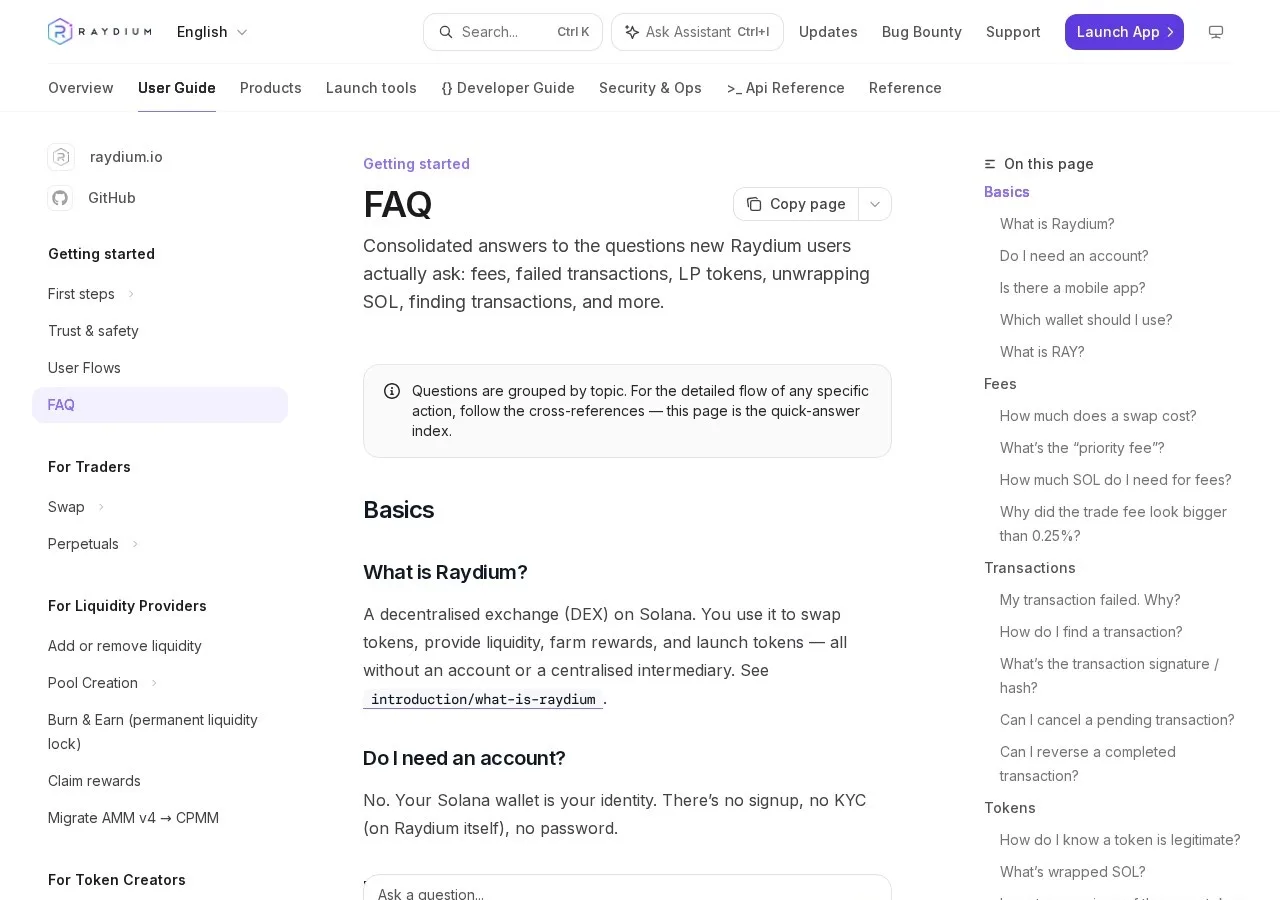
The posts contain very little direct feedback about Raydium. One user reports confusion around liquidity-pool setup and resulting losses, while another says they used Raydium to create liquidity. No theme is raised by at least two different authors.
“I use callsol.host to creat a token and raydium.io to create liquidity Everything's fast and easy to use”
Based on 50 Reddit posts and comments from the last 12 months, checked Oct 18, 2026. These are posts by users on other sites, not reviews submitted on CryptoReview.
No user reviews yet. Have you used Raydium? Share your experience below.
Most Raydium pools charge a 0.25% trading fee. Some pools use 0.01%, 0.05% or 1% tiers, and Solana network fees are approximately 0.0005–0.002 SOL per transaction.
Raydium does not require an account or KYC on the protocol itself. A Solana wallet signs transactions, and any separate fiat on-ramp can impose its own identity checks.
Raydium had an exploit in June 2026 that drained about $1.34 million from five inactive pools in its deprecated AMM V3 program. Raydium committed to full reimbursement and a protocol-wide security audit, while smart-contract and transaction risks remain.
Raydium supports Solana. Assets held on other networks require a separate bridge or exchange before they can be used on the protocol.
Raydium's native token is RAY, an SPL token that can be staked in the Raydium app. RAY is optional for swaps and liquidity provision, and 12% of trading fees are directed to daily RAY buybacks.
Decentralized AMM launched in 2018, with support across 16+ EVM mainnets
Cosmos appchain DEX and cross-chain AMM connecting over 100 ecosystems with IBC
Multichain AMM founded in 2020, with about $1.56B locked on October 17, 2026
Cross-chain liquidity and stablecoin activation stack settling transfers across 30+ blockchains
Perpetual and spot DEX with 50.1M reported users and a native 50ms Layer 1
DEX aggregator routing swaps across 18+ networks, including Ethereum and Solana
Type at least two characters. Press ↵ to see all results.