

Prediction are insurance. Curve is supported
Curve Finance
Stablecoin-focused AMM launched in 2020, with $1.22B TVL in October 2026
3.5/ 5
Our score
Good
Chains
EthereumArbitrumOther
Type
AMM
Perpetual futures
No
Audited
Yes
Governance token
CRV
What is Curve Finance?
Curve Finance is a decentralized exchange protocol built around stablecoin and other correlated-asset markets. Its AMM uses liquidity pools rather than an order book, and protocol TVL was about $1.22 billion on 16 October 2026. Curve also issues the crvUSD stablecoin and operates lending products through LlamaLend.
Who is behind it
Curve launched in 2020 and was founded by Michael Egorov. Egorov is a theoretical physicist and cryptography expert who also co-founded NuCypher, a privacy infrastructure project for decentralized applications. Curve DAO governs pool additions, protocol parameters and other ecosystem decisions through community votes. CRV is the governance token.
How Curve works
Users connect a wallet to the Curve interface and interact with smart contracts on supported networks. The core product is an automated market maker whose pools target assets expected to have similar values, such as stablecoins, wrapped assets and other related tokens. This design aims to reduce price impact on suitable pairs, although the result depends on pool liquidity and market conditions.
Curve infrastructure is available on Ethereum and additional networks including Arbitrum, Base, Polygon, Avalanche, Optimism, Sonic, Taiko, Plume, Hyperliquid and Monad. LlamaLend V2 adds isolated lending markets with market-specific risk parameters. It reached Optimism in June 2026 and Ethereum mainnet in July 2026, including support for Curve LP tokens as collateral.
Fees and availability
Swap costs vary by pool and transaction costs also depend on the underlying network. Users connect a wallet to Curve's interface and interact with smart contracts on supported networks. Access can also depend on the network and the interface used. Curve's contracts can be accessed through its front end.
Track record
Curve reported about $126 billion in trading volume and 2,209 new pools during 2025, with average protocol TVL above $3.05 billion that year. Active loans reached $70.9 million in September 2026, after rising 68% in the third quarter. The protocol publishes audit reports in its documentation. Its contracts and governance introduce technical and economic risks.
Risks and limitations
AMM users face slippage, impermanent loss, smart contract exploits, oracle or pricing attacks and transaction-ordering risks such as MEV. Long-tail pools can have thin liquidity. LP yields and incentives can depend on token rewards, while crvUSD and lending markets add collateral and liquidation risks. Governance decisions can change pool parameters or supported markets.
Founders
Michael EgorovFounder
Theoretical physicist and cryptography expert; co-founder of NuCypher.
Best for:Stablecoin swappingCorrelated-asset tradingCurve LP holdersOn-chain liquidity providers
Pros and cons
Pros
- Designed for low-slippage stablecoin swaps
- About $1.22B TVL on 16 October 2026
- Deployments span Ethereum and many additional chains
- LlamaLend V2 supports isolated lending markets
- Curve DAO governs pool additions and parameters
Cons
- AMM trades remain exposed to slippage and MEV
- Long-tail pools can have thin liquidity
- LP yields can depend on CRV incentives
- Lending markets add liquidation and collateral risk
Our review
3.5/5
Good
Curve's stable-asset AMM has about $1.22 billion in TVL and broad chain coverage, but its specialised pools bring smart-contract, slippage and incentive risks.
Curve Finance is an AMM built around stablecoins and other assets designed to trade near the same price. That focus is its main difference from general-purpose DEXs: pricing can be efficient for correlated pairs, while long-tail or volatile assets are not its central use case. The protocol had about $1.22 billion in TVL on 16 October 2026 and reported $126 billion in trading volume during 2025.
Chain coverage is broad. Curve operates on Ethereum and additional networks including Arbitrum, Base, Polygon, Avalanche, Optimism, Sonic, Taiko, Plume, Hyperliquid and XDC. Pool availability and liquidity vary by network.
Curve focuses on stable-asset pricing and had about $1.22 billion in TVL on 16 October 2026. Curve DAO governs pool additions and protocol parameters. CRV is the governance token. The wider system also includes crvUSD and LlamaLend V2, which added isolated lending markets on Optimism in June 2026 and Ethereum mainnet in July 2026. In October 2026, LlamaLend V2 opened its first market using Curve pool LP tokens as collateral.
The trade-offs are material. Pool-specific risks include smart-contract exploits, oracle or pricing attacks, MEV, slippage and thin liquidity. Incentive-driven yields can also change as pool conditions and governance decisions change. The front end connects users to contracts, and transactions depend on wallet approvals and deployed code.
Curve launched in 2020 under Michael Egorov, a theoretical physicist and cryptography expert who co-founded NuCypher. Its documentation lists audit reports, while contract risk remains. Curve suits traders swapping stablecoins or correlated assets across supported chains.
Specs
| Type | AMM |
|---|---|
| Chains | Ethereum, Arbitrum, Other |
| Audited | Yes · unverified |
| Governance token | CRV · unverified |
| Perpetual futures | No · unverified |
| Points or rewards program | Yes · unverified |
Not disclosed by the provider: KYC required, Swap fee, Limit orders, Cross-chain swaps, Open source, Max leverage (x), Routes across other DEXs, MEV protection, Mobile app.
Data from the provider's website and public sources. Fees and availability change; confirm on the official site before you sign up.
Key features
Stablecoin AMM pools
The AMM focuses on stablecoins and other correlated assets, using liquidity pools instead of an order book.
Low-slippage markets
Pools are designed for efficient swaps between assets expected to have similar values, subject to liquidity and price conditions.
Multichain deployments
Curve operates on Ethereum, Arbitrum, Base, Polygon, Avalanche, Optimism and additional networks including Sonic and Monad.
LP token lending
LlamaLend V2 supports isolated markets and Curve LP tokens as collateral, including its first LP-token market in October 2026.
crvUSD stablecoin
Curve issues crvUSD, which is used across parts of its lending and liquidity infrastructure.
DAO governance
Curve DAO votes on pool additions, protocol parameters and other ecosystem decisions using CRV-based governance.
Inside Curve Finance
Curve DEX
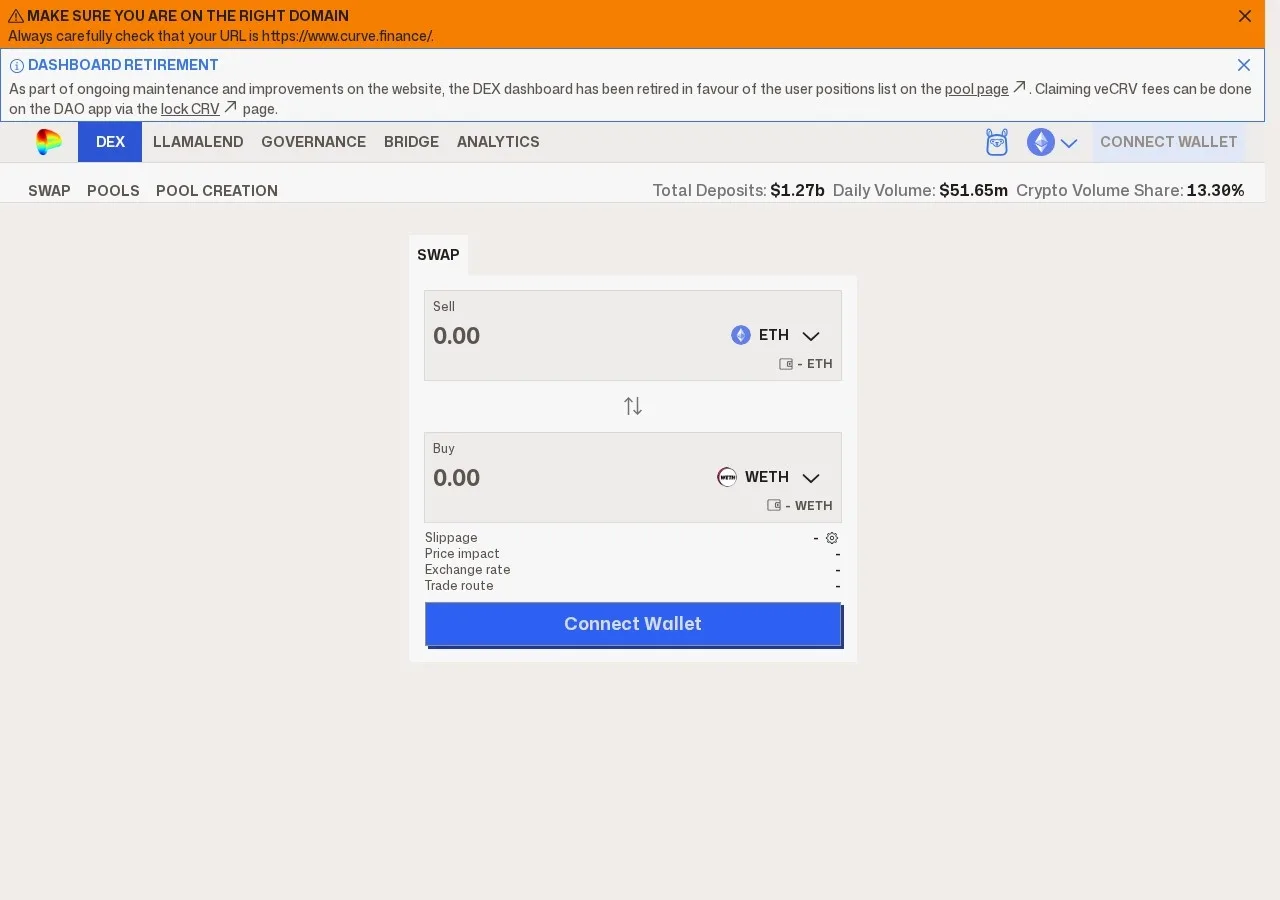
Curve DEX provides liquidity pools for stablecoins and other correlated assets. Users can swap supported tokens through the AMM, with pricing and available liquidity determined by the selected pool.
LlamaLend V2
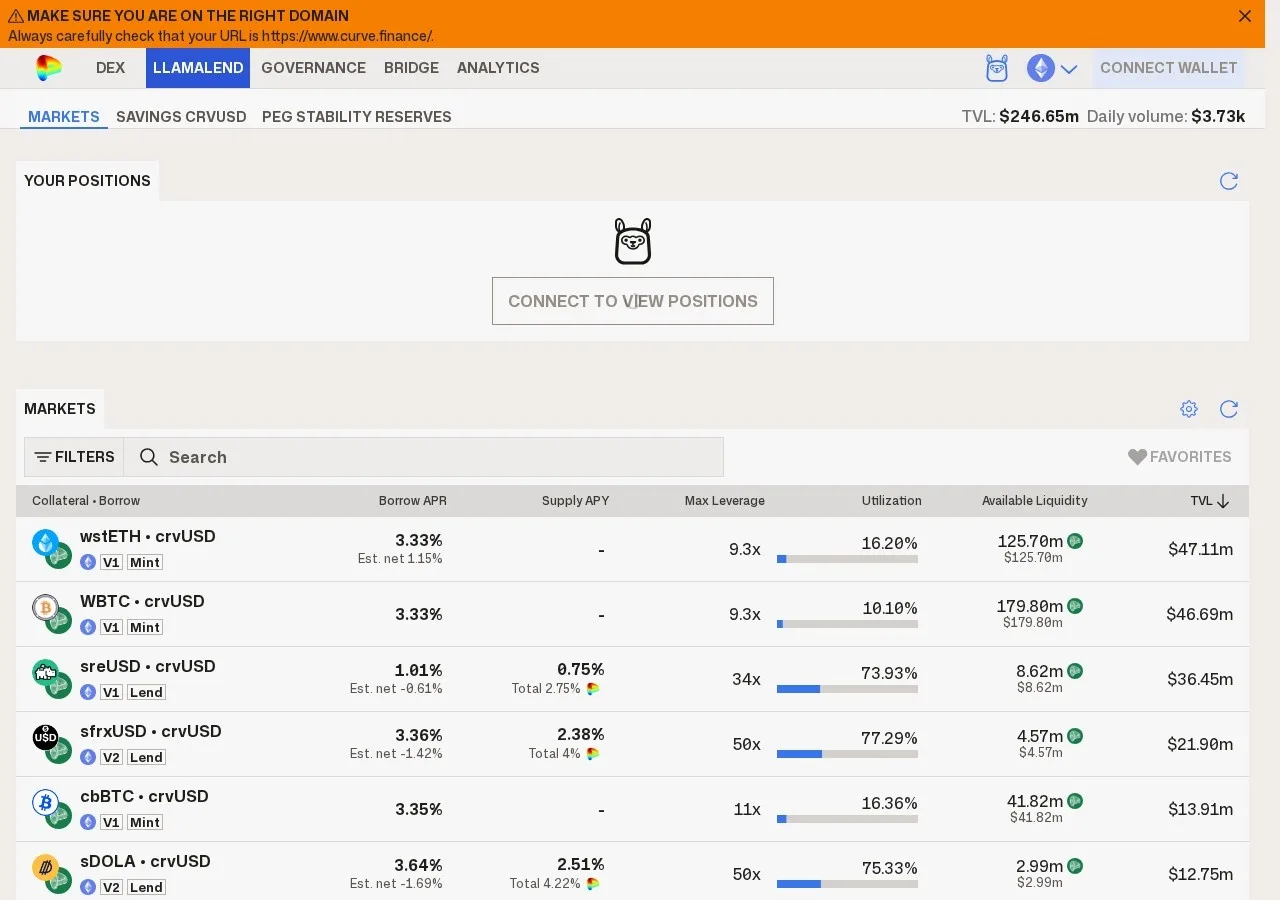
LlamaLend V2 provides isolated lending markets with flexible asset pairings and market-specific risk parameters. It launched on Optimism in June 2026 and Ethereum mainnet in July 2026, and supports Curve LP tokens as collateral.
crvUSD
crvUSD is Curve's stablecoin and part of its lending and liquidity infrastructure. LlamaLend markets can use supported assets around borrowing and collateral positions.
Curve DAO
Curve DAO governs protocol decisions, including pool additions and changes to protocol parameters. CRV is the governance token used in that system.
Curve Finance screenshots
What users say about Curve Finance
The limited discussion contains no repeated product-specific praise or complaints. One post describes Curve Finance as conservative, while another says a separate broker was the scammer rather than the site.
Based on 4 Reddit posts and comments from the last 12 months, checked Oct 18, 2026. These are posts by users on other sites, not reviews submitted on CryptoReview.
User reviews
No user reviews yet. Have you used Curve Finance? Share your experience below.
Funding and investors
1Round
1Investor
-
Funding round Amount undisclosed
FAQ
Who founded Curve Finance?
Michael Egorov founded Curve Finance in 2020. He is a theoretical physicist and cryptography expert who also co-founded NuCypher.
What fees does Curve Finance charge?
Transaction costs depend on the underlying network.
Does Curve Finance require KYC?
Curve's interface connects users to smart contracts.
Is Curve Finance safe?
Curve is non-custodial and publishes an index of audit reports, but users remain exposed to smart-contract exploits, oracle attacks, MEV, slippage and pool-specific liquidity risk.
Which chains does Curve Finance support?
Curve has deployments on Ethereum, Arbitrum, Base, Polygon, Avalanche, Optimism, Sonic, Taiko, Plume, Hyperliquid and other networks. Pool and asset availability differs by deployment.
Does Curve Finance have a token?
Yes. CRV is Curve's governance token, and Curve DAO uses community votes for pool additions and protocol parameters.
Latest from Curve Finance on X
Ok guys, we are all in the same boat. Let's work together on making all crypto safer. For the sake of our industry
DeFi was safer than CeFi all along
ethereum:0xb45ad160634c528cc3d2926d9807104fa3157305 looped 20x on LlamaLend v2 earns 37.1% this week.
Everything else worth farming is in the weekly yields article.
https://t.co/dQUYENBHNV
Everything else worth farming is in the weekly yields article.
https://t.co/dQUYENBHNV
All routes lead to Curve. Now from @StellarOrg, too.
https://t.co/kgFZ7fiSko
https://t.co/VnWLBPfDb2 https://t.co/nH98DH2geM
https://t.co/kgFZ7fiSko
https://t.co/VnWLBPfDb2 https://t.co/nH98DH2geM

Recent public posts from @CurveFinance, shown as published. Not reviewed or endorsed by CryptoReview.
Alternatives to Curve Finance

Decentralized AMM launched in 2018, with support across 16+ EVM mainnets
No KYCAMMEthereum · Base +3Limit orders

Cosmos appchain DEX and cross-chain AMM connecting over 100 ecosystems with IBC
No KYCAMM · Order bookOtherLimit orders

Multichain AMM founded in 2020, with about $1.56B locked on October 17, 2026
No KYCAMMBNB Chain · Ethereum +3Cross-chain swaps

Cross-chain liquidity and stablecoin activation stack settling transfers across 30+ blockchains
Ethereum · Bitcoin +10Cross-chain swapsAudited
Perpetual and spot DEX with 50.1M reported users and a native 50ms Layer 1
No KYCPerpetualsBNB Chain · Ethereum +3Limit orders

DEX aggregator routing swaps across 18+ networks, including Ethereum and Solana
AggregatorEthereum · BNB ChainCross-chain swaps