

A note on the Binance incident
We identified attempts to move funds linked to the recent Binance security incident through Symbiosis. We’re doing everything we can to stop this and are in contact with @binance.
Symbiosis is a decentralised protocol and this is new territory for us. Our screening is built for normal flows, not for tracking fast-moving, sophisticated attempts so some mechanisms have gaps. We’re closing them as we go.
If your funds are in pending or were reverted by mistake, reach out — we’ll review and resolve it as fast as we can.
@cz_binance @_RichardTeng @heyibinance

Symbiosis
Cross-chain liquidity network routing swaps across Bitcoin, Solana, TON and over 50 EVM chains
3.8/ 5
Our score
Good
Design
Liquidity network
Chains supported
50
Audited
Yes
What is Symbiosis?
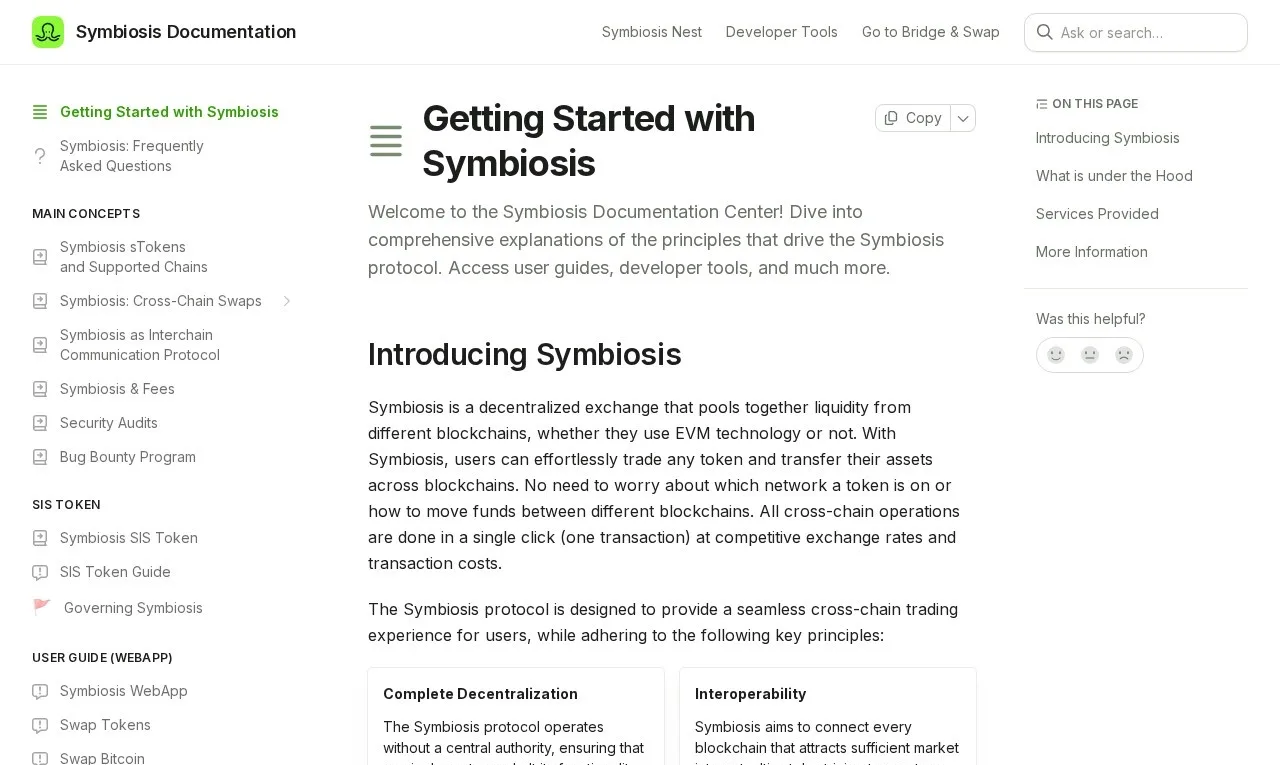
Symbiosis is a cross-chain liquidity engine and decentralized exchange aggregator founded in 2021. It routes single-transaction swaps between incompatible ecosystems, including Bitcoin, Solana, Tron, TON, and dozens of EVM-compatible blockchains.
Founders and backing
The protocol was co-founded by Chief Technology Officer Aleksei Lushnikov. Symbiosis raised a $2 million seed round in October 2021, backed by investors including Dragonfly Capital, KuCoin Labs, the Avalanche Foundation, Blockchain.com Ventures, and Kenetic Capital. It subsequently held an initial coin offering in November 2021 and secured a strategic funding round in February 2022 from backers including YZi Labs.
How swaps and routing work
Symbiosis functions as a non-custodial liquidity network. When a user executes a cross-chain swap, the protocol's smart routing engine compares native liquidity pools alongside partner venues like 1inch, 0x, and LI.FI to identify the best output amount. Transactions execute without identity verification or centralized custody: users connect a self-custody wallet, select their input and output assets, and sign a single transaction. The native utility and governance token is SIS.
Supported networks and limits
The network covers more than 50 chains, spanning non-EVM ecosystems such as Bitcoin, Solana, Tron, and TON, alongside major EVM networks like Ethereum, Base, Arbitrum, BNB Chain, and Polygon. It also supports specialized rollups and execution layers, including Hyperliquid L1 and X Layer. On protocol-owned liquidity routes, Symbiosis allows transfers of up to $1,000,000 per transaction.
Track record and protocol risks
Since its 2021 deployment, Symbiosis has processed more than 5 million transactions and over $10 billion in total volume across roughly 855,000 unique wallet addresses. Protocol smart contracts have undergone third-party security audits published in the project's public repository. In September 2026, the protocol experienced a security incident involving an unbacked cross-chain mint exploit on its Bitcoin bridge, resulting in a loss of approximately $336,000. Typical risks include bridge smart contract vulnerabilities, cross-chain messaging delays, and potential liquidity imbalances in underlying pools during periods of extreme market volatility.
Best for:Swapping between EVM networks and non-EVM chainsDeFi traders moving native Bitcoin and Solana assetsDevelopers integrating cross-chain swaps via SDK
Pros and cons
Pros
- Connects non-EVM chains like Bitcoin, Solana, and TON directly with EVM networks
- Requires no account creation or KYC identity verification to bridge
- Processed more than $10B in cumulative volume across 50+ supported blockchains
- Smart routing compares multiple external liquidity sources to minimize slippage
Cons
- Suffered a $336,000 unbacked mint exploit on its Bitcoin bridge in September 2026
- Cross-chain transactions remain vulnerable to network congestion delays on non-EVM chains
- High-volume routes depend heavily on protocol-owned pool liquidity
Our review
3.8/5
Good
Symbiosis connects over 50 EVM and non-EVM networks through non-custodial swaps, but an exploit on its Bitcoin bridge in September 2026 highlights cross-chain contract risks.
Symbiosis is a cross-chain liquidity network and automated market maker that enables single-transaction swaps between more than 50 blockchain networks. Operating since 2021, the protocol routes trades across EVM chains like Ethereum, Base, and Arbitrum, alongside non-EVM networks including Bitcoin, Solana, TRON, and TON. Rather than serving purely as a messaging layer, Symbiosis uses on-chain liquidity pools and smart order routing to swap assets natively or pool-to-pool.
The platform differs in its route flexibility. Users can swap between tokens across diverse ecosystems, such as sending USDT on TRON directly to SOL on Solana, without undergoing KYC checks or depositing funds into a centralized exchange. For developers, Symbiosis provides REST APIs, a JavaScript SDK, and Model Context Protocol integrations to embed cross-chain swapping into external decentralized applications or automated agents.
However, the protocol carries specific security trade-offs. In September 2026, Symbiosis suffered an exploit on its Bitcoin bridge involving an unbacked cross-chain mint that resulted in a loss of approximately $336,000. While public audits cover its core contracts, past exploits show the risks of bridge contract bugs and complex multi-chain execution. In addition, total value locked on the platform stood at about $7.7M in October 2026, meaning large trades outside core stablecoin pairs may face slippage.
Symbiosis suits DeFi users and developers needing fast, non-custodial asset movement across incompatible ecosystems like Bitcoin, TRON, and EVM rollups. Traders who strictly focus on formal verification or rely exclusively on canonical native bridges like Circle CCTP or native rollup bridges should consider those single-purpose alternatives instead.
Specs
| KYC required ⓘ | No · unverified |
|---|---|
| Design | Liquidity network |
| Chains | Ethereum, Bitcoin, Solana, Tron, TON, BNB Chain, Arbitrum, Base, Polygon, Hyperliquid, Other |
| Chains supported | 50 · unverified |
| Audited | Yes |
| Token | SIS |
| Native token transfers (no wrapped tokens) | Yes · unverified |
| Max transfer | $1,000,000 · unverified |
Not disclosed by the provider: Typical fee, Typical transfer time, Security model, Intent-based.
Data from the provider's website and public sources. Fees and availability change; confirm on the official site before you sign up.
Key features
Cross-chain smart routing
Evaluates internal automated market maker pools and third-party aggregators such as 1inch and 0x to route trades for optimal execution.
Non-EVM ecosystem bridging
Executes single-step swaps between non-EVM chains like Bitcoin, Solana, TON, and Tron without using wrapped custodian intermediaries.
High-value swap capacity
Accommodates transfers of up to $1,000,000 in a single transaction across selected protocol-owned liquidity routes.
Developer integration tools
Provides a REST API, JavaScript SDK, and Model Context Protocol tooling to embed cross-chain swapping into external apps and automated agents.
Private transfers on TON
Supports private swap and send functionality for assets on the TON blockchain without linking source and destination wallets on-chain.
Inside Symbiosis
Bridge & Swap
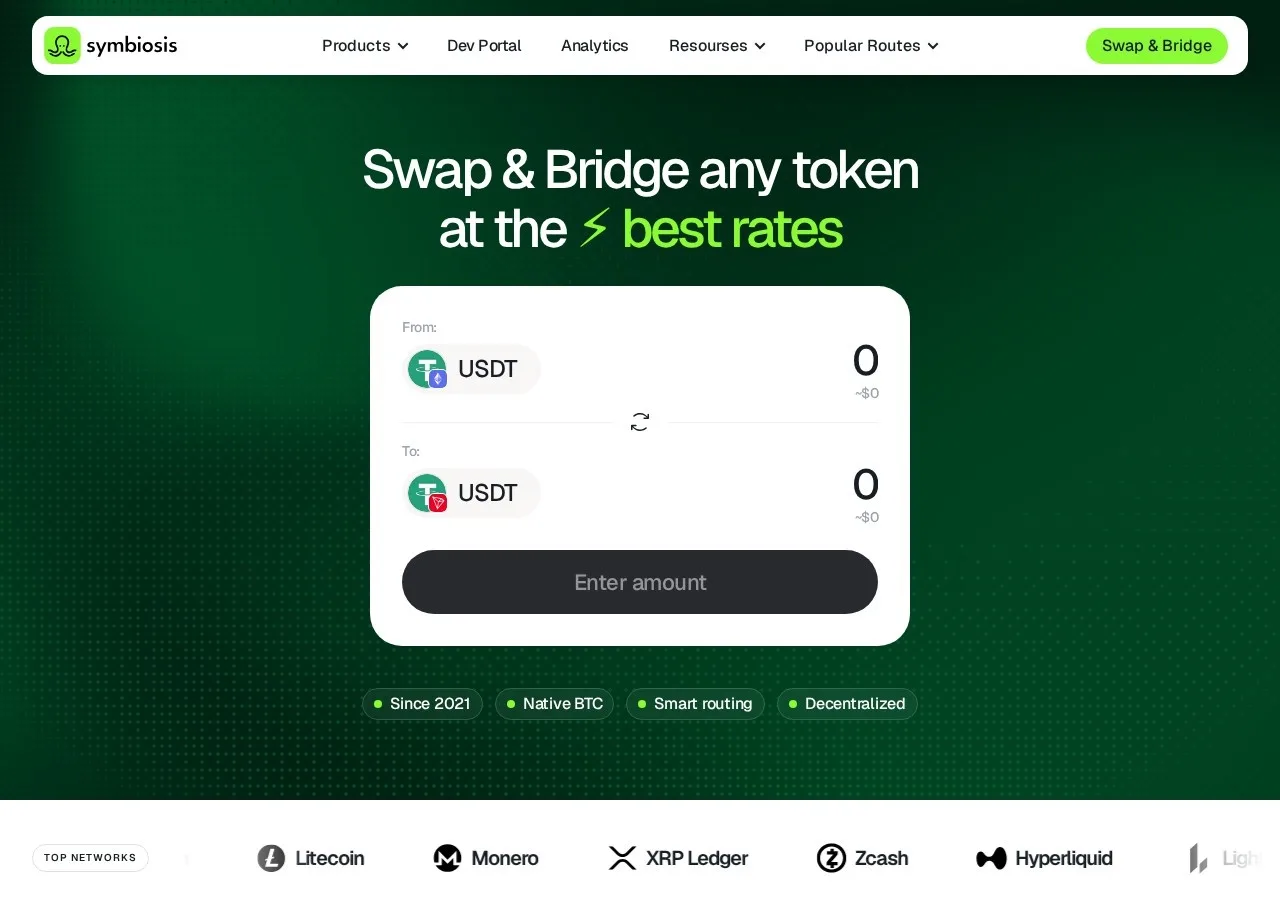
The main user interface for swapping and bridging tokens across 50 or more networks in a single non-custodial transaction.
Smart Routing
An execution engine that compares partner liquidity and internal pools to identify optimal swap prices across chains.
API + MCP
Developer toolkits that provide REST APIs, a JavaScript SDK, and Model Context Protocol endpoints to integrate cross-chain swaps into applications and AI agents.
Symbiosis screenshots
What users say about Symbiosis
Symbiosis allows cross-chain swaps without KYC requirements. The platform supports more than 50 blockchains, routing any-to-any trades in a single transaction without intermediate bridge hops.
In their own words
“Probit exchange used to be $ 5k daily limit for anything with no KYC. Haven't used them for a while so not sure if it's still the same. Myself using Symbiosis.finance for any swap and to avoid cexes as well. Works well and done many swaps. There is loads of others just DYOR before using them”
“One way people handle moving value across chains without going through centralized exchanges or KYC processes is by using decentralized liquidity networks.”
“Looking for a cross-chain swap that actually supports a wide range of networks, not just the main ones. I’ve had decent results with when I needed broader coverage.”
Based on 44 Reddit posts and comments from the last 12 months, checked Oct 20, 2026. These are posts by users on other sites, not reviews submitted on CryptoReview.
User reviews
No user reviews yet. Have you used Symbiosis? Share your experience below.
Funding and investors
$26MTotal raised
2Rounds
13Investors
-
Initial Coin Offering Nov 2021 Amount undisclosed
-
Seed Oct 2021 $2MAF Avalanche FoundationVenture capital BI BTC InvestmentVenture capital BC Blockchain.com VenturesExchange ventures arm DM DAO MakerVenture capital DR DragonflyVenture capital GI Gate.ioVenture capital IN InjectiveVenture capital KL Kairon LabsVenture capital KC Kenetic CapitalVenture capital KV KuCoin VenturesExchange ventures arm PV Primitive VenturesVenture capital SC Shima CapitalVenture capital WD Wave Digital AssetsVenture capital
FAQ
Who founded Symbiosis?
Symbiosis was co-founded by Aleksei Lushnikov, who serves as the protocol's Chief Technology Officer.
Does Symbiosis require KYC?
No, Symbiosis is a non-custodial protocol that allows wallet-to-wallet cross-chain swaps without identity verification.
Has Symbiosis ever been hacked?
Yes, on September 11, 2026, the Bitcoin bridge component of Symbiosis suffered an unbacked cross-chain mint exploit resulting in a loss of about $336,000.
What chains does Symbiosis support?
Symbiosis supports over 50 networks, including Ethereum, Solana, Bitcoin, TRON, TON, Arbitrum, Base, BNB Chain, and Polygon.
Does Symbiosis have a native token?
Yes, Symbiosis has a governance and utility token that trades under the ticker SIS.
What type of bridge is Symbiosis?
Symbiosis operates as a cross-chain automated market maker and liquidity network that combines decentralized exchange aggregation with smart routing.
Latest from Symbiosis on X
Fresh UI update on Symbiosis. Looks cool, doesn’t it?
Rate it from 1 to 10: https://t.co/cyYiFTxsGn https://t.co/F5Krfnd9i9
Rate it from 1 to 10: https://t.co/cyYiFTxsGn https://t.co/F5Krfnd9i9

Reminder: you can swap to and from @monero on Symbiosis.
Any token on any chain into XMR, in one flow. Total XMR volume through Symbiosis has passed $30M.
https://t.co/cyYiFTxsGn https://t.co/5Hflr2zn5J
Any token on any chain into XMR, in one flow. Total XMR volume through Symbiosis has passed $30M.
https://t.co/cyYiFTxsGn https://t.co/5Hflr2zn5J

Every USDT transfer on @trondao is public. Send 100K from your main wallet to a new one, and anyone can open the explorer and follow the whole chain, from where the money came to where it landed.
Private Swaps & Send breaks that link between the two addresses. Over $10M moved through it in the last week.
https://t.co/mx197oOVAW
Private Swaps & Send breaks that link between the two addresses. Over $10M moved through it in the last week.
https://t.co/mx197oOVAW

More liquidity sources, better execution.
OKX DEX joined the aggregators Symbiosis routes through as part of @XLayerOfficial integration. Any token on any chain, zero fee on the on-chain aggregation leg and on-chain swaps. https://t.co/YjAoajGbGj
OKX DEX joined the aggregators Symbiosis routes through as part of @XLayerOfficial integration. Any token on any chain, zero fee on the on-chain aggregation leg and on-chain swaps. https://t.co/YjAoajGbGj

Recent public posts from @symbiosis_fi, shown as published. Not reviewed or endorsed by CryptoReview.
Alternatives to Symbiosis

Cross-chain swap aggregator routing tokens across 100+ EVM and non-EVM blockchains
AggregatorEthereum · BNB Chain +7Audited

Intent-based cross-chain bridge using optimistic verification, processing over $40B in total volume
No KYCIntent-basedEthereum · Arbitrum +4Audited

Intent-based cross-chain bridge and payment network across more than 85 blockchains
No KYCIntent-basedEthereum · Base +9Audited

Intent-based cross-chain protocol settling transfers across 25+ networks without locked liquidity pools
No KYCIntent-basedEthereum · BNB Chain +7Audited

Cross-chain swap protocol using intent routing and CCTP across Solana, EVM chains, and Sui
No KYCIntent-basedSolana · Ethereum +9Audited

Cross-chain DEX and bridge aggregator routing swaps across more than 80 blockchains
No KYCAggregatorBitcoin · Ethereum +3Audited