

Reminder: Stargate v2 support for Gravity, Camp, GOAT, and Metis ends this Friday, October 23.

Stargate
Cross-chain liquidity network built on LayerZero connecting over 50 blockchains
4.1/ 5
Our score
Very good
Design
Liquidity network
Chains supported
50
Security model
LayerZero messaging
Audited
Yes
What is Stargate?
Stargate is an omnichain liquidity transport network built on the LayerZero messaging protocol. It lets users and decentralized applications transfer native assets including USDC, USDT, and ETH across disparate networks without relying on intermediate wrapped tokens.
Governance and architecture
The protocol launched in March 2022 as a decentralized community initiative powered by the STG governance token. Rather than maintaining isolated pair-wise bridge channels, Stargate relies on LayerZero cross-chain messaging alongside unified liquidity pools shared across supported networks. This architecture gives destination chains guaranteed finality without minting synthetic IOU tokens.
Cross-chain transfers and fee mechanics
Transfers require no account creation or identity verification. Users connect a non-custodial Web3 wallet to move assets across major networks such as Ethereum, Arbitrum, Base, Optimism, Polygon, and Avalanche. Stargate V2 integrates batching, Hydra modules, and an automated planning module to lower transfer overhead. Swaps incur standard destination gas fees alongside small protocol pool fees that vary depending on pool rebalancing incentives and target liquidity depth.
Security track record and risks
Stargate contracts and related LayerZero OFT standards have undergone security audits by firms including Zellic. The project maintains a bug bounty program on Immunefi with rewards up to $10 million for critical vulnerability reports. In October 2026, total value locked stood at approximately $78M.
As with all liquidity network bridges, users face smart contract exposure and dependence on LayerZero messaging relayer and verifier infrastructure. Liquidity shortfalls can delay large transfers or increase slippage when pools become unbalanced. Stargate has also faced phishing incidents; in December 2023, an attacker posted a fraudulent Snapshot proposal containing phishing links that drained around $43,000 from participating community members.
Best for:DeFi traders moving native stablecoinsDevelopers needing omnichain asset routingCross-chain transfers without wrapped tokens
Pros and cons
Pros
- Connects over 50 blockchains via LayerZero messaging
- Bridges native assets directly without wrapped token depeg risks
- No KYC checks or account registration required
- Bug bounty program offering rewards up to $10 million on Immunefi
Cons
- Dependent on LayerZero validator and relayer infrastructure
- Subject to transfer delays or higher fees during pool liquidity imbalances
- Phishing attacks targeted governance participants on Snapshot in December 2023
- Deprecates low-volume chain endpoints periodically, requiring liquidity provider withdrawals
Our review
4.1/5
Very good
Stargate enables native asset transfers across dozens of chains without synthetic wrapping, but users remain dependent on LayerZero messaging security and shifting chain support.
Launched in March 2022, Stargate operates as a composable liquidity transport protocol built on LayerZero cross-chain messaging. Instead of locking assets on a source chain to mint wrapped tokens on a destination, it relies on unified liquidity pools. Users swap native assets like USDC, USDT, and ETH across more than 50 connected networks, avoiding the depeg risks tied to synthetic bridge assets.
Security and track record show both diligence and organizational risks. Stargate maintains smart contract audits, including reviews by Zellic, and funds an active bug bounty program on Immunefi offering up to $10,000,000 for critical issues. Core bridge contracts have avoided major smart contract exploits, but governance infrastructure suffered an incident in December 2023. A scammer staked 50,000 STG to post a fraudulent proposal on Snapshot, draining roughly $43,000 from over 1,000 users through phishing links.
Operational continuity presents trade-offs that traders must monitor. Protocol TVL sat at approximately $78.2M in October 2026. Stargate regularly prunes inactive networks alongside changes to LayerZero offchain infrastructure; during late 2026, the protocol deprecated chains such as Aurora, Gnosis, Metis, and Superposition, requiring liquidity providers and token holders to redeem assets manually before cutoffs.
Stargate suits traders and omnichain developers seeking direct transfers of native tokens across major EVM ecosystems, Solana, and Hyperliquid. Those needing permanent support for low-activity networks or complete independence from specialized messaging relays should consider canonical roll-up bridges or intent-based alternatives instead.
Specs
| KYC required ⓘ | No · unverified |
|---|---|
| Design | Liquidity network |
| Chains | Ethereum, BNB Chain, Arbitrum, Base, Optimism, Polygon, Avalanche, Other |
| Chains supported | 50 · unverified |
| Security model | LayerZero messaging |
| Audited | Yes |
| Token | STG |
| Native token transfers (no wrapped tokens) | Yes · unverified |
Not disclosed by the provider: Typical fee, Typical transfer time, Intent-based, Max transfer.
Data from the provider's website and public sources. Fees and availability change; confirm on the official site before you sign up.
Key features
Native asset bridging
Transfers native tokens like USDC, USDT, and ETH across supported chains directly into native assets without minting wrapped tokens.
LayerZero messaging
Executes cross-chain communications using LayerZero endpoints, Decentralized Verifier Networks, and Omnichain Fungible Token (OFT) standards.
Unified liquidity pools
Shares single-asset liquidity pools across multiple chains to prevent fractured liquidity and guarantee instant finality on destination networks.
Stargate V2 efficiency
Employs transaction batching, Hydra modules, and an AI-driven planning module to optimize capital routing and reduce cross-chain execution fees.
Developer integration APIs
Provides composable smart contracts and APIs that allow external decentralized applications to embed cross-chain swaps natively.
Inside Stargate
Stargate Bridge
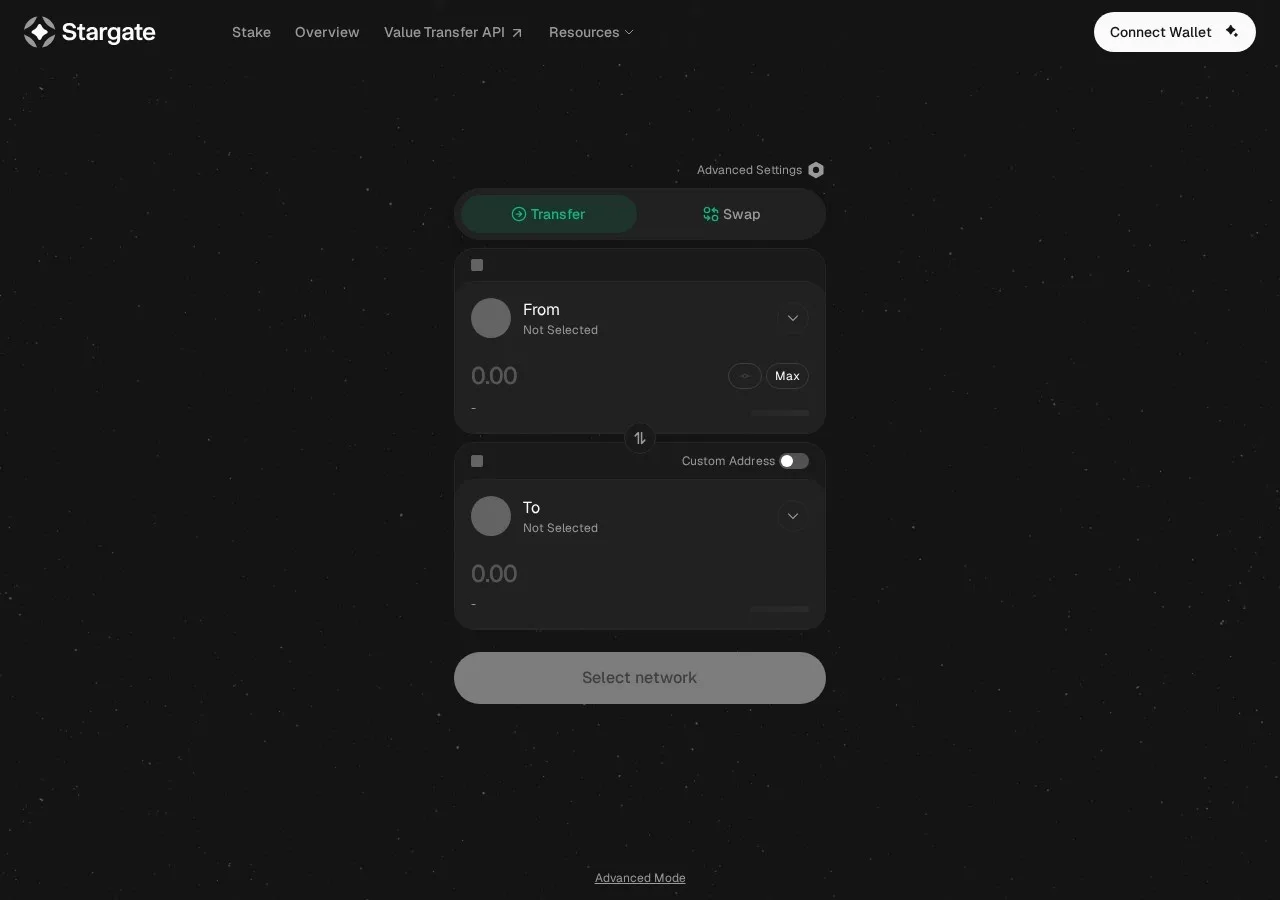
The main user interface for swapping native tokens across supported chains using unified liquidity pools without asset wrapping.
Stargate for Developers
Provides omnichain APIs, contracts, and documentation for decentralized applications to integrate cross-chain liquidity transfers natively.
Stargate screenshots
What users say about Stargate
User feedback primarily consists of neutral-to-positive recommendations for cross-chain token bridging and stablecoin transfers. No specific complaints or negative experiences are raised.
In their own words
“You can refer to this page for all bridging info I’d say Across protocol for eth gas and a mix of Layer Zero(stargate.finance) and chainlink CCIP(transporter.io) for stables.”
“what ever you do, don't use changelly - they are scamsters. chainflip.io the above 4 are good ones where you can anonymously swap your USDT to BTC without KYC and without any worry.”
“You can try withdrawing XAUT through **stargate.finance** or **jumper.exchange** both work well for cross-chain moves. Once bridged, you can swap to USDC without the spot market issue.”
Based on 20 Reddit posts and comments from the last 12 months, checked Oct 20, 2026. These are posts by users on other sites, not reviews submitted on CryptoReview.
User reviews
No user reviews yet. Have you used Stargate? Share your experience below.
FAQ
What is Stargate?
Stargate is a cross-chain liquidity network built on LayerZero. It transfers native assets like USDC, USDT, and ETH across blockchains without using wrapped tokens.
Does Stargate require KYC?
No, Stargate does not require KYC verification. Users interact directly with smart contracts via non-custodial crypto wallets.
Has Stargate ever been hacked?
Stargate's core smart contracts have avoided exploit losses, but a governance phishing attack on Snapshot drained roughly $43,000 from users in December 2023. The project maintains an active bug bounty up to $10,000,000 on Immunefi.
What chains does Stargate support?
Stargate supports over 50 blockchains, including Ethereum, BNB Chain, Arbitrum, Base, Optimism, Polygon, Solana, and Hyperliquid. Network coverage changes periodically as inactive chains are phased out.
Does Stargate have a native token?
Yes, Stargate operates with the STG utility and governance token. Holders use STG to participate in protocol governance votes.
How does Stargate transfer assets without wrapping?
Stargate uses unified liquidity pools deployed across supported chains alongside LayerZero messaging. When you deposit on one chain, equivalent native assets are released directly from a pool on the destination chain.
Latest from Stargate on X
$M from @MemeCore_M is now powered by the OFT standard, and live on Stargate.
The MemeCore chain is also live on the LayerZero interoperability mesh.
Working cross-chain with the MemeCore ecosystem has never been easier.
The MemeCore chain is also live on the LayerZero interoperability mesh.
Working cross-chain with the MemeCore ecosystem has never been easier.
Reminder: For a number of chains with minimal activity, LayerZero is winding down offchain support. This means that LayerZero DVN and Executor services will no longer be available for these chains.
We will be deprecating support for the following chains via Stargate v2, effective October 23rd, 2026:
Gravity, Camp, GOAT, Metis
Stargate Pool liquidity providers and ETH liquidity providers should withdraw their funds from the respective pools to redeem their assets before the effective deprecation date.
Stargate hydra (USDC.e, USDT) holders should bridge their funds to Stargate Pools to redeem their assets before the effective deprecation date.
For the full list of impacted chains and effective dates, read here: https://t.co/AhVenA9Zr7
Deeper liquidity and better pricing are now live for Stargate swaps, powered by @eco
Deeper liquidity and better pricing are now live for Stargate swaps, powered by @eco
Swap stablecoin->stablecoin or stablecoin->any token across Arbitrum, Ethereum, Solana, Hyperliquid, Base, and Polygon.
Stargate is the home for moving assets across chains.
Swap stablecoin->stablecoin or stablecoin->any token across Arbitrum, Ethereum, Solana, Hyperliquid, Base, and Polygon.
Stargate is the home for moving assets across chains.
Recent public posts from @StargateFinance, shown as published. Not reviewed or endorsed by CryptoReview.
Alternatives to Stargate

Cross-chain swap aggregator routing tokens across 100+ EVM and non-EVM blockchains
AggregatorEthereum · BNB Chain +7Audited

Intent-based cross-chain bridge using optimistic verification, processing over $40B in total volume
No KYCIntent-basedEthereum · Arbitrum +4Audited

Intent-based cross-chain bridge and payment network across more than 85 blockchains
No KYCIntent-basedEthereum · Base +9Audited

Intent-based cross-chain protocol settling transfers across 25+ networks without locked liquidity pools
No KYCIntent-basedEthereum · BNB Chain +7Audited

Cross-chain swap protocol using intent routing and CCTP across Solana, EVM chains, and Sui
No KYCIntent-basedSolana · Ethereum +9Audited

Cross-chain DEX and bridge aggregator routing swaps across more than 80 blockchains
No KYCAggregatorBitcoin · Ethereum +3Audited