



You can code a market making strategy from scratch on your Claude instance, or just tap Easy Mode on BeTheCEO like a civilized human.

Skate
Universal application layer connecting EVM, SVM, and Move chains through shared state
3.7/ 5
Our score
Good
Design
Intent-based
Chains supported
6
Security model
OP Stack rollup settling to Ethereum with Avail DA and EigenLayer AVS attestations
Audited
Yes
What is Skate?
Skate is a universal cross-chain application infrastructure that maintains a unified state layer across heterogeneous virtual machines. By decoupling application state from local asset custody, the network allows decentralized applications to run unified orderbooks, automated market makers, and logic across different blockchains without redeploying isolated instances on each network.
Team and funding
The protocol is developed by SkateFi, which originally launched in 2023 under the name Range Protocol. In September 2023, the team closed a $3.75 million seed funding round co-led by HashKey Capital and Nomad Capital, with participation from Mirana Ventures. The project also received backing from founders affiliated with networks including EigenLayer, Polygon, Axelar, and Biconomy.
Architecture and mechanics
The core of the network is the Skate Hub Chain, an optimistic rollup built on the OP Stack. It settles directly to Ethereum and posts transaction data to Avail. Rather than moving assets via traditional lock-and-mint bridges, Skate keeps user assets stationed on periphery chains such as Solana, Sui, Arbitrum, Base, and BNB Chain. When a user interacts on a periphery network, off-chain entities called executors package the action into an intent, transmit it to the Hub Chain Kernel Manager for state validation, and then execute idempotent settlement tasks on the destination chain or refund tasks on the origin chain.
Validation and security profile
Off-chain coordination relies on the Skate Execution Network alongside the Skate EigenCloud AVS, which secures cross-chain attestations using restaked capital through EigenLayer. Nethermind conducted an independent security audit of the core contracts. The SKATE token powers governance through Skate DAO. Token holders vote on protocol upgrades, fee settings, and emissions.
Risks and operational trade-offs
Because the network relies on specialized executors to route and fill user intents across chains, users face counterparty execution dependencies. If executors lack local inventory or suffer downtime, actions can experience delays until refund logic triggers. The protocol also inherits the dispute-resolution and security assumptions of its rollup structure and restaked validation network.
Best for:Cross-chain AMM liquidity providersDevelopers deploying multichain state appsTraders operating between EVM, Solana, and Sui
Pros and cons
Pros
- Retains user assets locally without relying on wrapped token mints
- Connects EVM networks directly to non-EVM chains like Solana and Sui
- Smart contract architecture audited by Nethermind
- Secured by restaked capital via EigenLayer AVS integration
Cons
- Executor network operates on a whitelist-only onboarding model
- Unfilled intents depend on periphery refund task processing to recover funds
- Protocol security depends on the stability of the underlying OP Stack rollup and Avail DA
Our review
3.7/5
Good
Skate unifies multichain application state across EVM, SVM, and Move using an OP Stack rollup, but relies on a whitelisted executor set for settlement.
Skate, developed by SkateFi and rebranded from Range Protocol, is an intent-based messaging and cross-chain execution hub. Rather than copying liquidity or redeploying code across disparate ecosystems, Skate runs an optimistic rollup built on the OP Stack that settles to Ethereum and posts batch data to Avail. Logic resides centrally on this Skate Hub Chain, while peripheral contracts custody assets locally across networks including Ethereum, Arbitrum, Base, BNB Chain, Solana, and Sui.
The security model uses a combination of optimistic rollup architecture and the Skate EigenCloud AVS, which relies on restaked capital through EigenLayer alongside an audit completed by Nethermind. User intents flow through an AccountRegistry that indexes addresses across EVM and non-EVM runtimes using bytes32 identifiers. Assets remain in origin or destination periphery contracts, with funds moving only on the chains that hold them.
Trade-offs center on execution trust and operational transparency. Relaying and settling intents currently depends on a whitelisted executor set, limiting decentralization at the settlement stage. While liquidity providers earn pool fees through targeted pools, protocol fees vary based on executor bids and pool configurations rather than a fixed global pricing schedule.
Backed by $3.75 million in seed funding co-led by HashKey Capital and Nomad Capital, Skate provides shared liquidity across virtual machines without manual token bridging.
Specs
| KYC required ⓘ | No · unverified |
|---|---|
| Design | Intent-based · unverified |
| Chains | Ethereum, Solana, Sui, Arbitrum, Base, BNB Chain · unverified |
| Chains supported | 6 · unverified |
| Security model | OP Stack rollup settling to Ethereum with Avail DA and EigenLayer AVS attestations · unverified |
| Audited | Yes · unverified |
| Token | SKATE · unverified |
| Intent-based | Yes · unverified |
| Native token transfers (no wrapped tokens) | Yes · unverified |
Not disclosed by the provider: Typical fee, Typical transfer time, Max transfer.
Data from the provider's website and public sources. Fees and availability change; confirm on the official site before you sign up.
Key features
Unified hub state
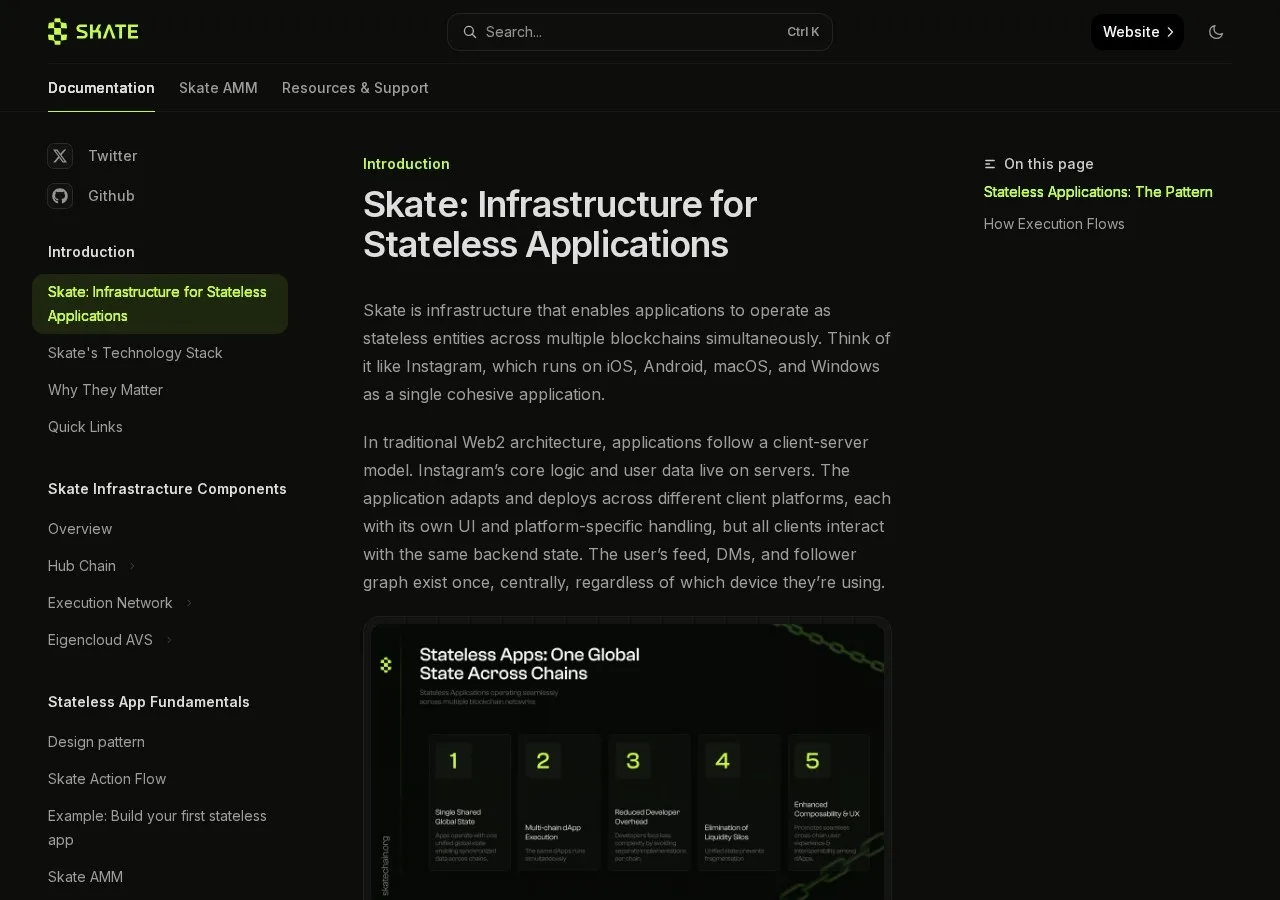
Runs on an OP Stack optimistic rollup that settles to Ethereum, holding global application state while assets remain on their native chains.
Cross-VM execution
Connects EVM environments with non-EVM runtimes, handling addresses and intent messaging across Solana (SVM) and Sui (Move).
Avail data availability
Employs Avail as its primary data availability solution alongside integrated EigenDA configurations to post off-chain transaction data.
Restaked attestation network
Uses an EigenLayer AVS framework to attest to state transitions and relay verified confirmations to off-chain executors.
Multichain developer SDKs
Provides dedicated SDKs for core kernel logic, Solana periphery programs, and Sui Move modules to manage quotes and swaps.
Idempotent refund handling
Emits revert tasks to the origin chain when an intent fails, where the periphery runs the app's refund logic.
Inside Skate
Skate Hub Chain
A layer built on OP Stack technology that finalizes transactions on Ethereum and publishes transaction data through Avail to maintain coordinated state across external ecosystems.
Kernel Core Contracts
The central smart contract layer on the hub chain, including the Kernel Manager and MessageBox, which processes signed intents and emits settlement tasks.
Skate Execution Network
An off-chain coordinator network of whitelisted executors and relayers that process user intents and complete cross-chain settlement.
Skate AMM
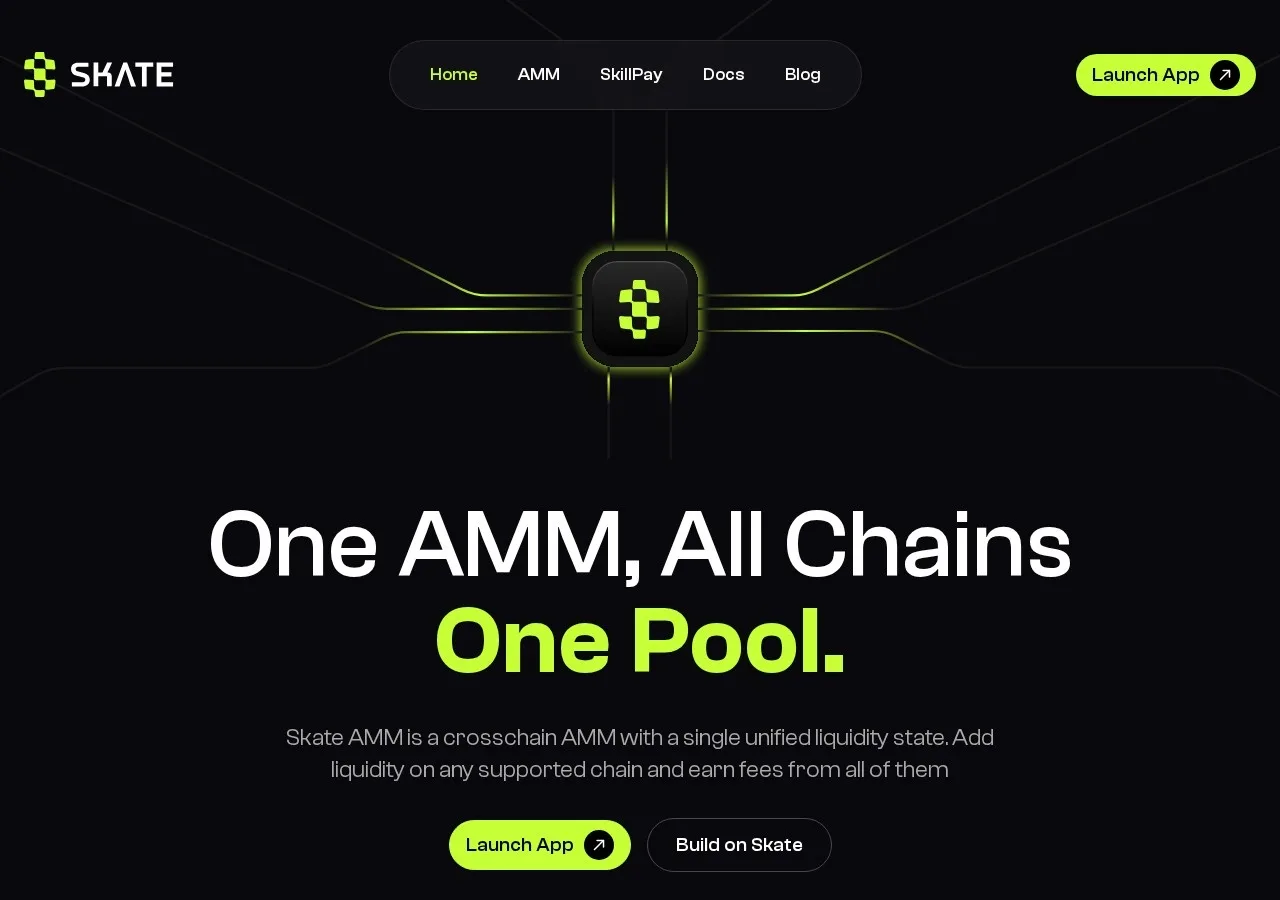
A cross-chain automated market maker that centralizes liquidity positions and fee calculations on the Skate hub while settling swaps locally on peripheral chains.
AccountRegistry
A registry contract that maps user wallet addresses from EVM, Solana, and Move environments to a single unified account.
Skate screenshots
User reviews
No user reviews yet. Have you used Skate? Share your experience below.
Funding and investors
$3.8MTotal raised
1Round
3Investors
FAQ
What is Skate?
Skate is a cross-chain application infrastructure and hub chain that lets applications maintain a single shared state across EVM, SVM, and Move environments. It runs as an optimistic rollup built on the OP Stack, settling transactions to Ethereum while posting data to Avail.
Who is behind Skate?
Skate is developed by SkateFi, formerly known as Range Protocol. The project raised a $3.75 million seed round co-led by HashKey Capital and Nomad Capital.
Which chains does Skate support?
Skate connects to Ethereum, Arbitrum, Base, BNB Chain, Solana, and Sui.
Has Skate been audited?
Yes, Skate has an audit report completed by Nethermind.
Does Skate have a native token?
Yes, the SKATE token is used for protocol governance in the Skate DAO to vote on protocol upgrades, emissions, and fee settings.
How does Skate execute cross-chain actions?
Skate uses an intent-driven model where user transactions on periphery chains are converted into tasks on the Skate Hub Chain. Whitelisted executors fulfill these tasks and settle assets directly on destination chains.
Latest from Skate on X
Going live soon, strategy recipes for options trading on @DeriveXYZ options https://t.co/EqzgKal1TH
And it's a wrap for our first agentic trading campaign.
We have airdropped USDC to the eligible participants directly to their Ethereum wallets. More big surprises are coming in the next few days, and then we'll launch our second agentic trading campaign.
We have airdropped USDC to the eligible participants directly to their Ethereum wallets. More big surprises are coming in the next few days, and then we'll launch our second agentic trading campaign.
Your mode, your move.
BeTheCEO now lets you switch between Easy and Pro modes for agentic trading.
Choose the experience that works for you. https://t.co/EI6jPvJDnO
BeTheCEO now lets you switch between Easy and Pro modes for agentic trading.
Choose the experience that works for you. https://t.co/EI6jPvJDnO

Higher
BeTheCEO users have now crossed $5M in agentic options volume on @DeriveXYZ https://t.co/66cxQL4oU4
BeTheCEO users have now crossed $5M in agentic options volume on @DeriveXYZ https://t.co/66cxQL4oU4

Recent public posts from @skate_chain, shown as published. Not reviewed or endorsed by CryptoReview.
Alternatives to Skate

Cross-chain swap aggregator routing tokens across 100+ EVM and non-EVM blockchains
AggregatorEthereum · BNB Chain +7Audited
Intent-based cross-chain bridge using optimistic verification, processing over $40B in total volume
No KYCIntent-basedEthereum · Arbitrum +4Audited

Intent-based cross-chain bridge and payment network across more than 85 blockchains
No KYCIntent-basedEthereum · Base +9Audited

Intent-based cross-chain protocol settling transfers across 25+ networks without locked liquidity pools
No KYCIntent-basedEthereum · BNB Chain +7Audited

Cross-chain swap protocol using intent routing and CCTP across Solana, EVM chains, and Sui
No KYCIntent-basedSolana · Ethereum +9Audited

Cross-chain DEX and bridge aggregator routing swaps across more than 80 blockchains
No KYCAggregatorBitcoin · Ethereum +3Audited