

Join me on KCEX @KCEX_Official to enjoy the lowest fees in the market, free withdrawals, and up to 1000 USDT in futures bonuses! Use my invitation code ZSQNU1 and click here to sign up now: https://t.co/lo4LVAtwZd

Jumper
Cross-chain bridge and DEX aggregator routing liquidity across 50+ blockchains with 0% platform fees
4.0/ 5
Our score
Very good
Design
Aggregator
Chains supported
50
Typical fee
0% platform fee
Security model
Depends on the underlying bridge selected for each route
What is Jumper?
Jumper is a multi-chain liquidity aggregator that finds and executes token swaps and transfers across more than 50 blockchain networks. Originally launched as the flagship consumer application by the LI.FI protocol team, the platform functions by querying multiple underlying bridges, decentralized exchanges, and automated solvers to identify optimal execution paths.
Team and backing
Jumper was launched in March 2023 by the LI.FI team, co-founded by CEO Philipp Zentner. Incorporated in the British Virgin Islands, Jumper spun out as an independent company in September 2026. The underlying infrastructure and development have drawn backing from institutional crypto investors including Dragonfly Capital, Multicoin Capital, CoinFund, L1 Digital, AngelDAO, Bloccelerate, and Theta Capital Management, including a Series A Extension round finalized in December 2025.
How routing works
The platform aggregates bridging protocols and decentralized exchanges across chains such as Ethereum, Solana, Arbitrum, Base, Optimism, BNB Chain, and Polygon. Jumper does not hold user funds. It connects non-custodial Web3 wallets and splits or routes transactions via integrated solvers and liquidity protocols, including PropellerHeads, Enso, and Odos. Beyond bridging, the dApp incorporates Jumper Earn for finding multi-protocol DeFi yields and Jumper Portfolio for cross-chain balance tracking. Users complete transactions without registering an account or completing KYC verification.
Fees and transfer costs
Jumper charges a 0% platform fee for its routing service. Traders pay standard source and destination network gas fees along with the underlying fees charged by the chosen bridges and decentralized exchanges. These costs, along with estimated execution times, are displayed alongside routing comparisons before a transaction is signed.
Track record and risks
By September 2026, Jumper reported more than $40B in cumulative volume and over 100,000 monthly active users. In late September 2026, the project introduced its JUMP token sale on Legion. Jumper only routes liquidity through third-party bridges and exchanges that maintain independent smart contract audits. However, users remain exposed to the composite security risks of aggregated protocols: smart contract vulnerabilities in third-party bridges, validator compromise, stuck intermediate transfers, and slippage during multi-step cross-chain transactions.
Founders
Philipp ZentnerCo-Founder
Co-founder and CEO of LI.FI.
Best for:Multi-chain DeFi tradersUsers moving assets to non-EVM chainsTraders comparing real-time bridge routes
Pros and cons
Pros
- No platform fees added to underlying bridge or DEX costs
- Routes across more than 50 blockchain networks including Solana and Ethereum
- Processed over $40 billion in volume with 100,000+ monthly users
- No account creation or KYC identity checks required
Cons
- Security depends entirely on the third-party bridge chosen for each route
- Multi-step transactions risk stuck funds if an underlying bridge stalls
- Gas fees must be paid across multiple destination networks
Our review
4.0/5
Very good
Jumper aggregates routes across 50 blockchains with zero platform fees, but users face variable execution risks and third-party smart contract dependencies across underlying protocols.
Jumper operates as a multi-chain bridge and swap aggregator that connects decentralized exchanges, messaging bridges, and solver networks such as Odos, Enso, and PropellerHeads. Originally built by the LI.FI team in March 2023 and spun out as an independent entity in September 2026, the application acts as an execution routing layer rather than a standalone custody bridge. By September 2026, the platform reported processing over $40 billion in cumulative volume across more than 50 blockchain networks.
The platform presents clear structural advantages for users shifting capital across ecosystems:
- Jumper evaluates liquidity across multiple third-party bridges and DEX venues in real time to locate the lowest slippage and fastest settlement.
- Users can move funds between more than 50 chains, spanning major EVM layers such as Ethereum, Arbitrum, Base, and Polygon, alongside non-EVM ecosystems like Solana.
- Jumper charges a 0% front-end platform fee, passing through only underlying DEX and bridge expenses.
The primary trade-off stems directly from the aggregator security model. Jumper requires users to approve transactions that interact with disparate underlying protocols. Although the team enforces a policy of integrating only previously audited venues, capital security relies on the specific bridges chosen for each route. A vulnerability in an external bridge or liquidity pool exposes the transfer to settlement failure or exploit risks. Also, multi-hop routing introduces execution lag, where volatile network congestion can lead to delayed transactions or slippage changes mid-route.
Backed by investors including Dragonfly Capital, Multicoin Capital, and CoinFund, Jumper suits active DeFi participants and cross-chain traders who focus on network coverage and automated price routing. Users seeking canonical finality or dedicated single-bridge security models may prefer direct native bridges instead.
Specs
| KYC required ⓘ | No · unverified |
|---|---|
| Design | Aggregator |
| Chains | Ethereum, BNB Chain, Arbitrum, Base, Optimism, Polygon, Avalanche, Solana, Other |
| Chains supported | 50 · unverified |
| Typical fee | 0% platform fee · unverified |
| Security model | Depends on the underlying bridge selected for each route |
| Token | JUMP · unverified |
| Intent-based | Yes · unverified |
Not disclosed by the provider: Typical transfer time, Audited, Native token transfers (no wrapped tokens), Max transfer.
Data from the provider's website and public sources. Fees and availability change; confirm on the official site before you sign up.
Key features
Smart multi-chain routing
Routes transactions across 50+ blockchains by scanning multiple bridges, DEXs, and solvers including Odos, Enso, and PropellerHeads.
Zero platform fees
Applies a 0% interface fee, passing through only native network gas and underlying bridge or DEX execution costs.
Jumper Earn
Aggregates third-party DeFi yield pools, allowing deposits directly across multiple chains in a single transaction.
Cross-chain portfolio tracking
Monitors token balances and active DeFi positions across supported networks through an integrated dashboard.
Non-custodial access
Executes transfers directly from connected Web3 wallets with no account registration or KYC requirements.
Inside Jumper
Jumper Swap & Bridge
Routes cross-chain asset transfers and swaps across 50 blockchains using integrated DEXs, messaging bridges, and external solvers.
Jumper Earn
Aggregates yield pools across multiple DeFi protocols, letting users discover and deposit capital across chains in single transactions.
Jumper Portfolio
Tracks balances and multichain DeFi positions across connected wallets in one central interface.
Jumper Pass
Provides an onchain loyalty system where users complete bridging tasks and milestones to earn platform rewards.
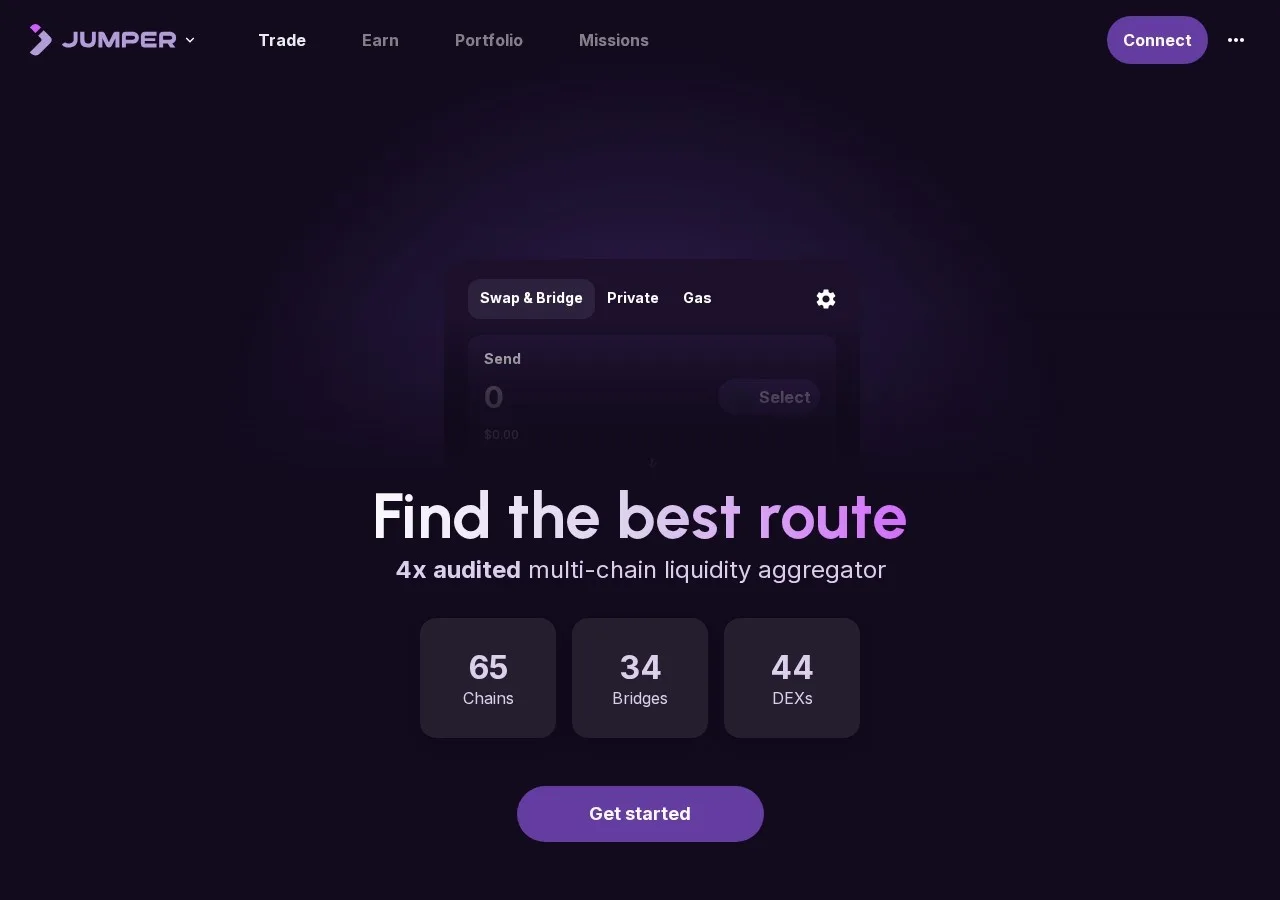
Jumper screenshots
What users say about Jumper
User sentiment towards Jumper remains positive, with community members frequently recommending it as a cross-chain bridge and DEX aggregator that finds low-fee routes.
In their own words
“Jumper.xyz always provided me with most economic routes but also compare with defillama”
“I love how other people are confidently wrong. Yes you can bridge into Hyperliquid. Use relay (relay.link) or jumper (jumper.xyz). They are both safe and offer relatively cheaper fees.”
“I usually use Jumper it’s a bridge aggregator that finds the best options for you.”
Based on 16 Reddit posts and comments from the last 12 months, checked Oct 20, 2026. These are posts by users on other sites, not reviews submitted on CryptoReview.
User reviews
No user reviews yet. Have you used Jumper? Share your experience below.
Funding and investors
3Rounds
7Investors
-
Series A Extension Dec 2025 Amount undisclosed
-
Series A Apr 2023 Amount undisclosed
-
Seed Jul 2022 Amount undisclosed
FAQ
What is Jumper?
Jumper is a cross-chain liquidity aggregator that routes token swaps and bridging transactions across decentralized exchanges, bridges, and solver networks. It was launched in March 2023 by LI.FI before spinning out as an independent company in September 2026.
Who founded Jumper?
Jumper was founded by Philipp Zentner and the LI.FI team, later expanding into an independent operation led by CEO Marko Jurina.
What fees does Jumper charge?
Jumper charges a 0% platform fee for bridging and swapping. Users pay only the standard network gas fees and costs charged by the underlying bridge or liquidity provider.
Does Jumper require KYC verification?
No, Jumper does not require identity verification or KYC. Transactions execute directly onchain through connected non-custodial Web3 wallets.
Does Jumper have a token?
Yes, Jumper introduced the JUMP token, with a public token sale launched on Legion in September 2026.
How does Jumper secure cross-chain transfers?
Jumper does not custody user funds directly; its security model depends on the third-party bridge or DEX routing the transaction. The team restricts integrations to external protocols that have completed independent security audits.
Latest from Jumper on X
Jumper Tabi 🟧
Follow
@Jumper · 64 followers
activating my profile on @humanApp
code: 810 #JUMPER https://t.co/subGmhAax4
code: 810 #JUMPER https://t.co/subGmhAax4

🔥 Each person gets 3 free spins, with great prizes waiting for you. Give it a try—just a tap and you could earn money! https://t.co/8JOEthEr5B xboDHp 8XWogJ/Ww4T XaRkuAyhMLfMfN0DVc=
https://t.co/ioJs6aEpRT CRY to MAMA for missing $BOINK drop 💩💎 Come play @BoinkersIO telegram game and farm a shit TON of points towards the upcoming $BOINK drop on TON💩💎Get starter bonus here: https://t.co/doNoiUaJ08
I have just claimed my $WAT airdrop on TokenTable. Come check it out and claim your $WAT. https://t.co/FBZMMlL6Rh
Recent public posts from @Jumper, shown as published. Not reviewed or endorsed by CryptoReview.
Alternatives to Jumper

Cross-chain swap aggregator routing tokens across 100+ EVM and non-EVM blockchains
AggregatorEthereum · BNB Chain +7Audited

Intent-based cross-chain bridge using optimistic verification, processing over $40B in total volume
No KYCIntent-basedEthereum · Arbitrum +4Audited

Intent-based cross-chain bridge and payment network across more than 85 blockchains
No KYCIntent-basedEthereum · Base +9Audited

Intent-based cross-chain protocol settling transfers across 25+ networks without locked liquidity pools
No KYCIntent-basedEthereum · BNB Chain +7Audited

Cross-chain swap protocol using intent routing and CCTP across Solana, EVM chains, and Sui
No KYCIntent-basedSolana · Ethereum +9Audited

Cross-chain DEX and bridge aggregator routing swaps across more than 80 blockchains
No KYCAggregatorBitcoin · Ethereum +3Audited