




‘There is no tokenized finance without tokenized liquidity’, says Emma Pecenicic (Fidelity @DigitalAssets) in the recent interview with @blockhead
Tokenized liquidity and treasury funds grew from ~$1.5B in 2024 to ~$16B this year
And yet, they still redeem on fund hours, so someone has to be willing to buy in between 👀
https://t.co/X5SGbAfBIB

Symbiotic
Permissionless restaking and shared collateral protocol backed by Paradigm and Pantera on Ethereum
3.6/ 5
Our score
Good
Type
Restaking
Audited
Yes
What is Symbiotic?
Symbiotic is a permissionless restaking and shared collateral protocol deployed on Ethereum mainnet. It lets capital providers back decentralized networks and financial obligations, including credit facilities, insurance pools, and real-world asset redemption layers, while earning yield across more than 100 vaults.
Founding and leadership
Symbiotic was founded in 2024 by Misha Putiatin and Algys Ievlev. Headquartered in George Town, Cayman Islands, the project raised $5.8M in a seed funding round co-led by Paradigm and cyber•Fund in June 2024. In April 2025, it secured a $29M Series A round led by Pantera Capital with participation from Coinbase Ventures, bringing its total funding to $34.8M. In September 2026, former Société Générale Asset Management APAC CEO Mahendran Nathan joined to lead onchain solutions and capital formation.
How the collateral engine works
Symbiotic functions through non-custodial smart contract vaults on Ethereum. Depositors commit ERC-20 assets, including liquid staking tokens like stETH as well as synthetic assets such as ENA and sUSDe. Curators configure specific underwriting parameters, slasher logic, and default criteria upfront. Deposited capital backs network validators through Symbiotic Relay or supports credit and liquidity mechanisms, such as Liquid Lane. In Liquid Lane, vaults provide atomic, T+0 settlements for tokenized funds, while unallocated balances can simultaneously generate base yield on lending markets such as Morpho.
Availability and access
The core protocol operates directly on Ethereum mainnet for standard smart contract interactions. Anyone holding compatible ERC-20 tokens can interact with open vaults. However, curated vaults targeting specific private credit or institutional tokenized assets may apply gating depending on the third-party curator.
Track record and growth milestones
Symbiotic launched in mid-2024, reaching $1.4B in TVL by August 2024 following deposit cap expansions. In July 2026, it released Core V2 to formalize broader collateral markets beyond proof-of-stake security. In August 2026, Liquid Lane deployed T+0 USDC redemptions for Janus Henderson and NYLIM funds on Centrifuge across $1.6B in tokenized assets under management. As of October 2026, protocol TVL was approximately $452M, supported by 111 network operators and smart contract audits published in its public repository.
Key risks and trade-offs
Participants face smart contract vulnerabilities and slashing risk if an operator breaches commitments or default conditions occur. Layering assets across restaking and credit facilities creates compounded counterparty exposure. In addition, assets committed to specific underwriting vaults or settlement queues can experience delayed access if underlying redemption queues stall.
Best for:Holders restaking diverse ERC-20 tokensInstitutional RWA redemption providersDecentralized networks seeking shared security
Pros and cons
Pros
- Supports non-ETH collateral assets like sUSDe and ENA alongside standard staking tokens
- TVL of approximately $452M supported by 111 independent operators as of October 2026
- Instant T+0 redemptions for tokenized real-world assets via Liquid Lane
- Backed by $34.8M in funding from Paradigm, Pantera Capital, and Coinbase Ventures
Cons
- Operates strictly on Ethereum mainnet without native multichain deployments
- Capital is exposed to slashing and multi-protocol default risks
- Layering capital into lending markets and bridge financing introduces compounded smart contract risk
- Specific curated vaults depend on third-party liquidity adapters and curator terms
Our review
3.6/5
Good
Symbiotic offers flexible shared collateral across diverse ERC-20 assets, but exposes depositors to layered default and slashing risks across emerging credit and real-world asset markets.
Symbiotic operates as a permissionless restaking and shared collateral protocol on Ethereum mainnet. Founded by Misha Putiatin and Algys Ievlev, the protocol raised $34.8 million across a seed round co-led by Paradigm and cyber•Fund and a Series A led by Pantera Capital with participation from Coinbase Ventures. Unlike protocols limited strictly to native ETH or liquid staking tokens, Symbiotic lets users deposit a wide variety of ERC-20 collateral, including stETH, ENA, and sUSDe, into more than 100 configurable vaults.
Depositors on Symbiotic commit capital that serves dual roles: earning underlying yields while backing external obligations. These obligations span network validation through Symbiotic Relay along with credit underwriting and immediate settlement. In August 2026, the protocol integrated Liquid Lane to provide atomic T+0 redemptions for Janus Henderson and NYLIM tokenized funds on Centrifuge across $1.6B in assets under management. Capital in vaults like Clearstar Labs and Keyrock also finances bridge auctions while remaining productive on lending platforms such as Morpho.
The protocol brings several concrete strengths:
- Broad collateral support accommodating varied ERC-20 assets rather than restricting deposits to ETH.
- Composability that lets single deposits generate lending yield alongside bridge financing premiums.
- Independent smart contract security audits published directly in its open GitHub repository.
The platform introduces specific trade-offs. Restaking capital across multiple protocols carries compounding smart contract exposure and layered default risks. If a borrower defaults or an underwritten obligation triggers enforcement, committed collateral is slashed automatically by code. Also, with $452M in TVL as of October 2026, Symbiotic holds significantly less liquidity than EigenLayer, which tracked $15.5B in TVL in August 2024. Symbiotic suits institutional curators and sophisticated stakers seeking multi-asset yield, while retail stakers who prefer simple, single-asset staking without underwriting risk typically rely on native staking options.
Specs
| Type | Restaking |
|---|---|
| Stakeable assets | ERC-20 tokens |
| Chains | Ethereum |
| Node operators | 111 operators · unverified |
| Audited | Yes |
| Restaking | Yes · unverified |
| Typical reward rate ⓘ | 5.82% - 8.11% · unverified |
Not disclosed by the provider: KYC required, Receipt token, Protocol fee, Minimum stake, Withdrawal time, Slashing cover.
Data from the provider's website and public sources. Fees and availability change; confirm on the official site before you sign up.
Key features
Flexible ERC-20 collateral
Accepts standard ERC-20 tokens beyond native ETH, including liquid staking tokens like stETH along with ENA and sUSDe.
Configurable collateral vaults
Curators define fixed loss conditions, slashing criteria, and yield terms across more than 100 live vaults.
Liquid Lane settlement
Provides an RFQ-based settlement layer for atomic, T+0 redemptions of tokenized real-world assets and structured products.
Symbiotic Relay security
Delivers shared, stake-backed validator security to decentralized applications and off-chain networks.
Dual yield deployment
Enables committed vault capital to earn base lending yield on protocols like Morpho between financing obligations.
Inside Symbiotic
Core
The shared collateral infrastructure where depositors place ERC-20 assets into configurable vaults to back financial obligations while earning multiple yields.
Network Security
Stake-backed security powered by Symbiotic Relay, connecting decentralized networks to operator networks and pooled collateral.
Liquid Lane
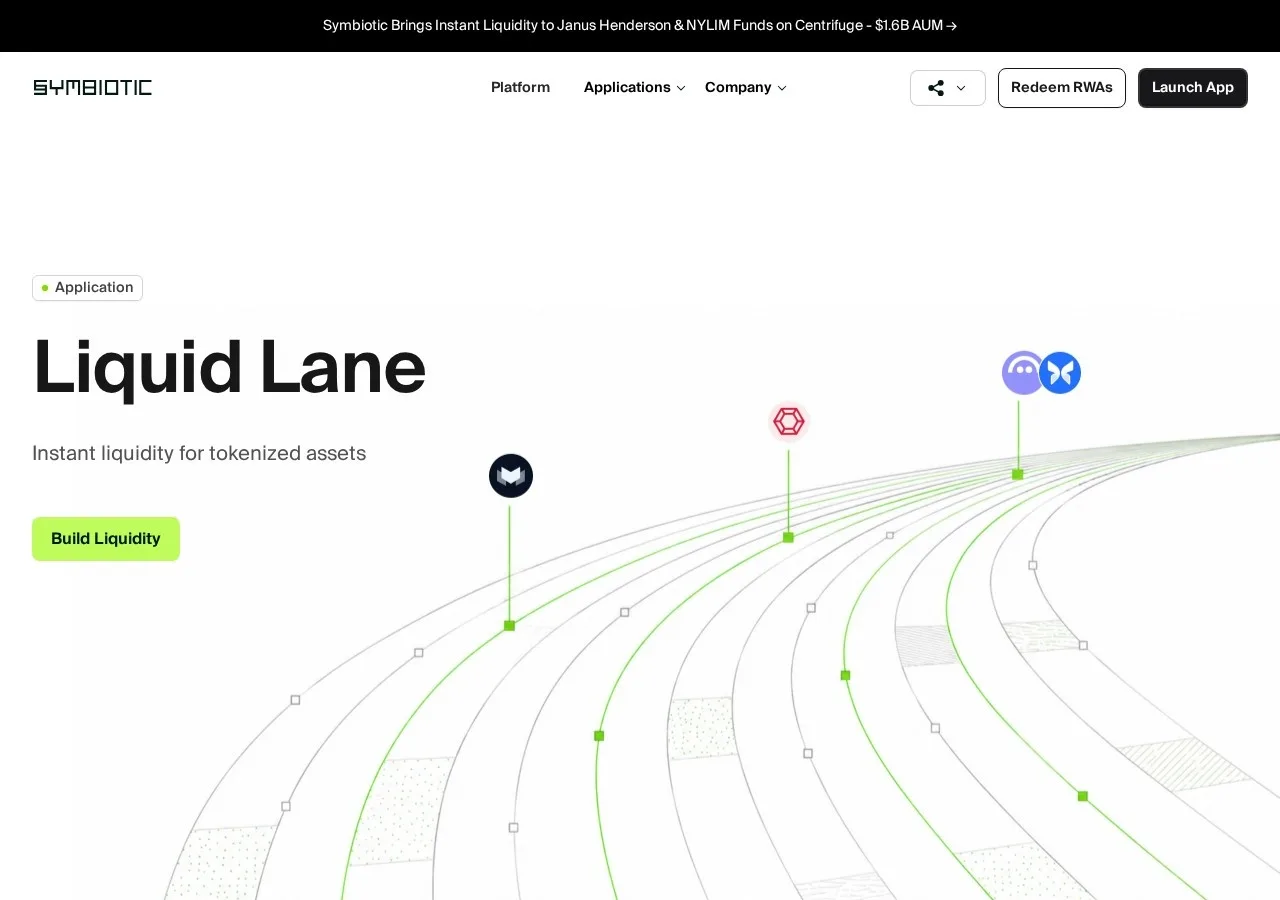
An atomic, T+0 settlement layer enabling instant USDC redemptions for real-world assets, tokenized funds, and private credit products.
Credit
Shared collateral pools for underwritten loans where borrowers draw working capital and code-defined defaults trigger collateral liquidation.
Insurance
Underwriting infrastructure backed by committed vault capital that pays out protocol claims automatically when predefined loss conditions are met.
Symbiotic screenshots
User reviews
No user reviews yet. Have you used Symbiotic? Share your experience below.
Funding and investors
$34.8MTotal raised
3Rounds
4Investors
-
Series A Apr 2025 $29M
-
Seed Jun 2024 $5.8M
-
Seed Jun 2024 $5.8MSource
FAQ
Who founded Symbiotic?
Symbiotic was founded by Misha Putiatin and Algys Ievlev. The Cayman Islands-based team launched the protocol in 2024 with backing from Paradigm, cyber•Fund, and Pantera Capital.
What assets can you restake on Symbiotic?
Symbiotic supports a variety of ERC-20 assets rather than restricting deposits to ETH. Supported collateral includes liquid staking tokens like stETH as well as synthetic assets like ENA and sUSDe across over 100 vaults.
Which blockchains does Symbiotic support?
Symbiotic operates exclusively on Ethereum mainnet. All smart contracts and collateral vaults are deployed directly on Ethereum.
Has Symbiotic been audited?
Yes, Symbiotic has completed security audits for its core collateral framework. Its audit reports are publicly accessible in the official GitHub collateral repository.
What is Symbiotic Liquid Lane?
Liquid Lane is an RFQ-based settlement layer that provides atomic, T+0 stablecoin redemptions for tokenized real-world assets. It allows fund holders on platforms like Centrifuge to exit into USDC without waiting through traditional redemption queues.
Latest from Symbiotic on X
Tokenized but illiquid is still just idle capital onchain
On Nov 3, @0xhenrique_d from our team joins @chainlink, @MidasRWA, @Brickken & @RWA_xyz in the @CryptoRank_io & @theorem_markets Space on what it takes to build deep RWA markets👇
On Nov 3, @0xhenrique_d from our team joins @chainlink, @MidasRWA, @Brickken & @RWA_xyz in the @CryptoRank_io & @theorem_markets Space on what it takes to build deep RWA markets👇
mGLO (issued by @MidasRWA) redemption windows per year: 12
mGLO exit windows on Liquid Lane through @kpk_io vault: ~2.6M (one every @Ethereum block)
Still fine to wait for redemption. But if you’d rather not → https://t.co/5xLeU89p90 https://t.co/EsleJG8k2d
mGLO exit windows on Liquid Lane through @kpk_io vault: ~2.6M (one every @Ethereum block)
Still fine to wait for redemption. But if you’d rather not → https://t.co/5xLeU89p90 https://t.co/EsleJG8k2d

DTCC’s Tokenization Service is now live.
In a recent interview with @FintechTvGlobal, @Psalom explained what changes with actual ownership on-chain: institutions using stock portfolios as collateral can get 25 credit offers in one transaction, in seconds.
Check the full conversation: https://t.co/k1sxDnnIvM
In a recent interview with @FintechTvGlobal, @Psalom explained what changes with actual ownership on-chain: institutions using stock portfolios as collateral can get 25 credit offers in one transaction, in seconds.
Check the full conversation: https://t.co/k1sxDnnIvM
Good news if you hate queues.
@theorem_markets has plugged in Symbiotic Liquid Lane, so investors on Theorem-built venues can turn mHYPER into USDC on the spot. https://t.co/f123OKQAPw
@theorem_markets has plugged in Symbiotic Liquid Lane, so investors on Theorem-built venues can turn mHYPER into USDC on the spot. https://t.co/f123OKQAPw

Recent public posts from @symbioticfi, shown as published. Not reviewed or endorsed by CryptoReview.
Latest from Symbiotic on Telegram

Symbiotic Announcements
Join
@symbioticannouncements · 80.9K subscribers
Misha joined Schwab Network live from the floor of the NYSE to discuss why traditional finance is moving onchain, what’s driving institutional adoption, and the role Symbiotic is playing in that shift.
https://x.com/symbioticfi/status/2095617017202229415?s=20
https://x.com/symbioticfi/status/2095617017202229415?s=20
1.3K View on Telegram
Symbiotic Brings Instant Liquidity to Janus Henderson and NYLIM Funds on Centrifuge Representing $1.6B AUM
https://x.com/symbioticfi/status/2090048459248189514
https://x.com/symbioticfi/status/2090048459248189514
2.3K View on Telegram
https://x.com/symbioticfi/status/2085372508589506726?s=46&t=QxQr-0kt4Z0P332_2Y5Srg
2.9K View on Telegram
Asset Issuer’s Guide to Instant Liquidity.
This report looks beyond the headline promise of "instant redemption" to examine the economics, risks, scalability, and integration potential of leading liquidity models.
https://x.com/symbioticfi/status/2084613083171889487
This report looks beyond the headline promise of "instant redemption" to examine the economics, risks, scalability, and integration potential of leading liquidity models.
https://x.com/symbioticfi/status/2084613083171889487
2.8K View on Telegram
Recent posts from the official Telegram channel @symbioticannouncements, shown as published. Not reviewed or endorsed by CryptoReview.
Alternatives to Symbiotic

Solana liquid staking infrastructure powering over 1,300 custom LSTs with pooled liquidity
Liquid stakingSolanaAudited

Solana liquid and native staking protocol automating delegation across validators since 2021
No KYCLiquid staking · Native stakingSolanaAudited

Solana liquid staking protocol capturing MEV rewards with over $1B in TVL
No KYCLiquid stakingSolanaAudited

Decentralized Ethereum liquid staking backed by permissionless node operators and a 0.01 ETH minimum
No KYCLiquid stakingEthereumAudited

Liquid staking protocol on Hyperliquid issuing kHYPE with over $860M in TVL
No KYCLiquid stakingHyperliquidAudited

Ethereum liquid staking with 600+ node operators and a 10% rewards fee
Liquid stakingEthereumAudited