

Worth saying for stakers: delegated SOL stays in your own stake account, and a compromised validator server can't move it. The real cost is downtime and missed rewards until the fix lands.

Marinade
Solana liquid and native staking protocol automating delegation across validators since 2021
4.3/ 5
Our score
Very good
Type
Liquid stakingNative staking
Receipt token
mSOL
Audited
Yes
What is Marinade?
Marinade is a non-custodial staking protocol on the Solana blockchain. Launched in 2021, it introduced the network's first liquid staking token, mSOL, and lets users allocate SOL through liquid staking or automated native delegation across a broad set of validators.
Team and background
Marinade was co-founded by Chief Executive Officer Michael Repetný. The protocol is maintained by Marinade Labs, an organization headquartered in New York with European offices, including operations in Prague. The team operates with an estimated headcount between 21 and 50 employees, and protocol governance is directed by holders of the MNDE token.
Staking mechanics and architecture
The protocol offers two primary staking routes on Solana. Liquid staking delegates SOL across an automated scoring system and returns mSOL, an yield-bearing receipt token that accumulates staking rewards and can be deployed across Solana DeFi. Native staking allows users to delegate SOL using standard Solana stake accounts without converting funds into an SPL receipt tokenand avoids smart contract custody exposure. Both strategies run through a stake auction marketplace where validators bid yield above network benchmarks to receive protocol delegation. Marinade also offers Marinade Borrow to take out SOL or USDC loans backed by existing stake accounts or mSOL.
Fees and access
Marinade operates as a non-custodial protocol accessible through Web3 wallets without identity verification or KYC requirements. Institutional offerings, such as Marinade Select, integrate with qualified custodians including BitGo, Copper, and Zodia Custody. The protocol captures value through its validator stake auction marketplace, which charges an auction clearance fee on validator bids above the network benchmark.
Track record and protocol safety
In October 2026, Marinade held approximately 7.94 million SOL in total stake, with TVL at $236M and over 150,000 token holders. The protocol code has been audited by security firms Neodyme, Ackee Blockchain, and Kudelski Security.
Key risks and trade-offs
Using mSOL liquid staking involves smart contract exposure and the risk of receipt-token market price deviation from its underlying SOL redemption value during high market volatility. While native staking mitigates smart contract custody risk, all Solana staking remains subject to network downtime, validator performance variances, and epoch unbonding delays for standard withdrawals.
Founders
Michael RepetnýCo-Founder and CEO
Best for:Solana DeFi liquidity providersUsers avoiding smart contract riskInstitutions using qualified custodiansSOL holders seeking automated delegation
Pros and cons
Pros
- Supports native staking without smart contract custody exposure
- Liquid staking via mSOL is widely integrated across Solana DeFi
- Smart contracts audited by Neodyme, Ackee Blockchain, and Kudelski Security
- No identity verification or KYC required for retail staking
- Stake auction marketplace generates yields above the network average
Cons
- Limited entirely to the Solana blockchain
- mSOL trades at market rates and can temporarily depeg from redemption value
- Instant unstaking requires secondary market liquidity or pool reserves
- Standard native unstaking remains subject to Solana epoch withdrawal delays
Our review
4.3/5
Very good
Marinade provides automated multi-validator Solana staking via liquid mSOL and non-custodial native delegation, though liquidity remains confined to the Solana network.
Marinade launched in 2021 as the first liquid staking protocol on Solana, co-founded by CEO Michael Repetný. Operating from New York and Prague, the protocol holds over 7.94M SOL in total stake across liquid and native pools, representing roughly $236M in total value locked in October 2026. The protocol addresses Solana staking through two parallel models: traditional liquid staking via the mSOL receipt token and Marinade Native, which distributes SOL across a broad set of independent validators using native stake accounts without smart contract custody.
The primary advantage of Marinade is its delegation engine and risk distribution. Instead of concentrating stake into a handful of institutional nodes, Marinade routes assets through an automated Stake Auction Marketplace where validators bid on delegation, boosting yields beyond the network baseline while reallocating stake when validators experience downtime. Stakers using Marinade Native retain direct ownership of their stake accounts, removing smart contract vulnerability. Security credentials include published smart contract audits from Neodyme, Ackee Blockchain, and Kudelski Security. The protocol also integrates with institutional custodians such as BitGo, Copper, and Zodia Custody.
Trade-offs center on ecosystem exposure and liquidity constraints. Marinade supports only Solana. Multichain stakers must manage other networks elsewhere. Holding mSOL carries depeg risk on decentralized exchanges if market liquidity thins during sharp network contractions. Instant unstaking through the protocol incurs an automated swap fee, whereas standard unstaking requires waiting out the regular Solana epoch unbonding period.
Marinade suits Solana holders and institutions seeking automated validator diversification without locking their capital into a single operator. Users seeking multichain staking under a unified interface or zero-exposure native cold storage should look at single-validator direct staking or multichain providers.
Specs
| KYC required ⓘ | No · unverified |
|---|---|
| Type | Liquid staking, Native staking |
| Stakeable assets | SOL |
| Receipt token | mSOL |
| Chains | Solana |
| Node operators | Automated delegation across hundreds of Solana validators via Stake Auction Marketplace · unverified |
| Audited | Yes |
| Restaking | No · unverified |
| Typical reward rate ⓘ | 5.04% - 7.6% · unverified |
Not disclosed by the provider: Protocol fee, Minimum stake, Withdrawal time, Slashing cover.
Data from the provider's website and public sources. Fees and availability change; confirm on the official site before you sign up.
Key features
mSOL liquid staking
Stakes SOL into a validator pool and issues mSOL receipt tokens that accrue staking rewards and trade across Solana DeFi.
Automated native delegation
Distributes SOL directly across high-performing Solana validators using native stake accounts without smart contract custody.
Stake auction marketplace
Runs daily validator auctions where node operators bid additional yield to win protocol delegations.
Marinade Borrow
Allows users to borrow USDC or SOL against active stake accounts or mSOL collateral without unstaking.
MNDE governance
Enables token holders to vote on treasury allocation, protocol upgrades, and stake delegation parameters.
Institutional custody integration
Supports institutional native staking workflows connected to custodians including Zodia Custody, BitGo, and Copper.
Inside Marinade
Marinade Liquid Staking
Mints mSOL in exchange for deposited SOL. Holders earn protocol staking rewards and can deploy the liquid tokens across Solana DeFi applications.
Marinade Native
Automates delegation across dozens of Solana validators directly via non-custodial stake accounts without smart contract risk.
Marinade Borrow
Allows users to borrow USDC or SOL against their existing stake accounts or mSOL balances without unstaking or sacrificing reward accumulation.
Marinade Select
Provides institutions with a curated delegation pool composed exclusively of KYB-verified, MEV-free Solana validators.
Explore
Acts as an interactive directory and monitoring interface to inspect Solana validator performance, commission rates, and uptime.
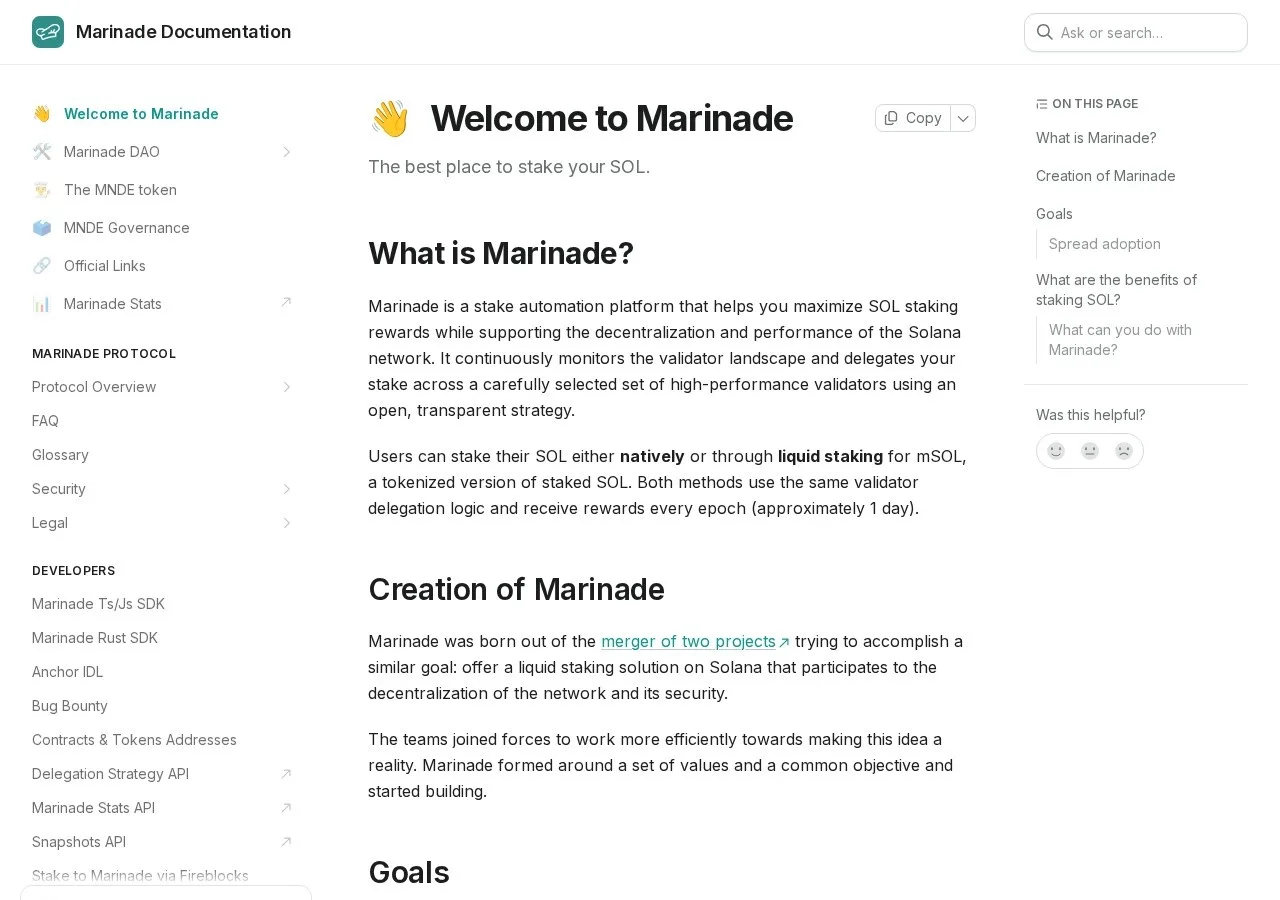
Marinade screenshots

What users say about Marinade
User feedback regarding Marinade is very limited in this dataset. Mentions primarily touch on staking options and reward tracking issues without establishing repeated themes.
Based on 4 Reddit posts and comments from the last 12 months, checked Oct 20, 2026. These are posts by users on other sites, not reviews submitted on CryptoReview.
User reviews
No user reviews yet. Have you used Marinade? Share your experience below.
FAQ
Who founded Marinade?
Marinade was co-founded in 2021 by CEO Michael Repetný. The core development organization, Marinade Labs, maintains operations in New York and the European Union.
What is the difference between Marinade Native and mSOL?
Marinade Native delegates SOL across top-performing validators using native Solana stake accounts with zero smart contract custody. mSOL is a liquid staking token received when depositing SOL into the liquidity pool. Users can trade, borrow, or participate in DeFi while continuing to accrue staking rewards.
Does Marinade require KYC verification?
No identity verification or KYC is required to use the standard non-custodial web application. Institutional users accessing curated pools through custodial partners such as Zodia or BitGo may undergo partner-specific verification.
Has Marinade undergone security audits?
Yes, Marinade's smart contracts have been audited by Neodyme, Ackee Blockchain, and Kudelski Security. Users who choose Marinade Native bypass smart contract exposure by delegating through Solana native stake accounts.
Does Marinade have a native token?
Yes, Marinade uses MNDE as its governance token. Holders lock MNDE to vote on stake delegation strategies, manage treasury allocations, and earn active staking rewards.
What assets and chains does Marinade support?
Marinade operates exclusively on the Solana blockchain and supports staking for native SOL.
Latest from Marinade on X
Staking is serious business. The carnival isn't.
See you at Breakpoint with @EcosystemCall 🎪
See you at Breakpoint with @EcosystemCall 🎪
A validator bond now only counts in Marinade's Stake Auction Marketplace (SAM) if it can actually pay stakers.
A bond's last stake account has to keep about 1 SOL in it, and that floor can never be charged. A bond holding only the floor looked bonded but could never cover a missed reward.
Since the epoch 1072 auction, SAM treats it as no bond. The validator gets no SAM stake and is first in line to be unstaked.
With Marinade Native, those rewards land in stake accounts you hold yourself. Your SOL never leaves your wallet, and the daily cadence shows up right in your balance.
https://t.co/4ojd7T6JGl
https://t.co/4ojd7T6JGl
Solana epochs now take about a day.
Epoch 1070 closed after 25 hours 34 minutes. Before 200ms slots, an epoch took about two days.
That changes two things for stakers. Rewards are paid at every epoch boundary, so they now arrive roughly daily. And unstaking waits for the next boundary, so it's usually a day at most, not two.
Epoch 1070 closed after 25 hours 34 minutes. Before 200ms slots, an epoch took about two days.
That changes two things for stakers. Rewards are paid at every epoch boundary, so they now arrive roughly daily. And unstaking waits for the next boundary, so it's usually a day at most, not two.
Recent public posts from @MarinadeFinance, shown as published. Not reviewed or endorsed by CryptoReview.
Alternatives to Marinade

Solana liquid staking infrastructure powering over 1,300 custom LSTs with pooled liquidity
Liquid stakingSolanaAudited

Solana liquid staking protocol capturing MEV rewards with over $1B in TVL
No KYCLiquid stakingSolanaAudited

Decentralized Ethereum liquid staking backed by permissionless node operators and a 0.01 ETH minimum
No KYCLiquid stakingEthereumAudited

Liquid staking protocol on Hyperliquid issuing kHYPE with over $860M in TVL
No KYCLiquid stakingHyperliquidAudited

Ethereum liquid staking with 600+ node operators and a 10% rewards fee
Liquid stakingEthereumAudited

Distributed validator protocol securing over 7 million ETH across 120,000 active validators
Staking poolEthereumAudited