

A new consensus client on Ethereum.
Silver by @gattacahq is open-source, in alpha, and already pushing forward performance 👏

P2P.org
Non-custodial staking and validator infrastructure securing over $10B across 40+ proof-of-stake networks
3.9/ 5
Our score
Good
Type
Native stakingRestaking
Minimum stake
32 ETH for Ethereum validator
Audited
Yes
What is P2P.org?
P2P.org is a non-custodial staking and validator infrastructure provider that operates nodes across more than 40 proof-of-stake networks. The platform secures over $10 billion in assets under validation for more than 130 institutional clients, delivering validator-as-a-service, unified staking APIs, and native restaking integrations.
Team and corporate background
Founded in 2018, P2P.org is led by founder and CEO Konstantin Lomashuk, who also founded blockchain investment firm Cyber.Fund, alongside Co-CEO Konstantin Zaitcev, the former co-founder and CEO of dRPC.org. The organization operates globally with a team of more than 250 people, of which roughly 80% are engineers. P2P.org has raised $23 million in total funding and previously incubated projects such as Lido through its investment arm.
How staking and integrations work
The platform runs non-custodial validator nodes, meaning stakers retain complete ownership and custody of their private keys while delegating validation power. Users can spin up dedicated Ethereum validators using increments of 32 ETH, participate in Distributed Validator Technology (DVT) setups to split validator duties across multiple operators, or access EigenLayer native restaking. Beyond Ethereum, P2P.org maintains active validators across Solana, Polkadot, Cosmos, Aptos, Sui, TRON, Cardano, Near, Tezos, and Hyperliquid. Institutions and application developers connect using white-label staking APIs and the Lambda Portfolio dashboard, which monitors staking positions and yields in real time.
Security track record and compliance
P2P.org has maintained a zero-slashing track record since launch in 2018. The platform achieved SOC 2 Type I and SOC 2 Type II compliance through independent audits conducted by KirkpatrickPrice, assessing system availability and data processing integrity. Its proprietary smart contract deployments are audited by MixBytes. In 2025, the provider delivered $300 million in cumulative rewards to delegators.
Risks and structural trade-offs
Stakers face standard network-level trade-offs across individual chains, including protocol unbonding periods during withdrawals where staked assets remain locked without yielding rewards. While P2P.org uses distributed architecture and has avoided penalties to date, delegating to proof-of-stake validators always involves inherent slashing risk if hardware faults or protocol bugs cause downtime or equivocation. Staking via EigenLayer introduces smart contract dependencies and additional slashing conditions tied to actively validated services.
Founders
Konstantin LomashukFounder & CEO
Founder of Cyber.Fund, an investment firm focused on blockchain infrastructure and protocol development.
Best for:Institutional digital asset treasuriesCustodians and wallet developersDelegators seeking SOC 2-audited nodesHigh-net-worth native ETH stakers
Pros and cons
Pros
- Over $10B in assets under validation across 40+ proof-of-stake networks
- Independent SOC 2 Type II certification verified by KirkpatrickPrice
- Zero slashing incidents recorded across seven years of validator operations
- MixBytes-audited smart contract infrastructure for institutional integrations
- Non-custodial architecture keeps private key custody entirely with the delegator
Cons
- Native Ethereum validator setup requires a minimum of 32 ETH
- Withdrawal timing remains subject to native chain unbonding rules and network queues
- EigenLayer restaking adds smart-contract risk and protocol-specific slashing conditions
- Primary API products and sales support cater to institutional and intermediary clients
Our review
3.9/5
Good
P2.org offers SOC 2-audited non-custodial staking across 40+ chains and focuses on institutional and intermediary clients.
P2P.org is an institutional validator and non-custodial staking infrastructure provider founded in 2018. Operating over $10B in assets under validation across more than 40 blockchain networks, the platform serves over 130 institutional clients, including custodians, asset managers, and wallet builders. Staking options span native validator deployment, distributed validator technology (DVT), and EigenLayer restaking, alongside transaction tooling like Syncro Sender for Solana.
Key strengths include its security certifications and historical track record. P2P.org completed independent SOC 2 Type I and Type II audits conducted by KirkpatrickPrice, along with smart contract audits by MixBytes. It maintains an unblemished zero-slashing record over seven years of operation. The platform also offers white-label APIs and real-time portfolio tracking via Lambda Portfolio, letting intermediaries embed native staking without custodying client private keys.
The trade-offs stem directly from its enterprise focus:
- Direct Ethereum validator activations require a 32 ETH threshold, making independent native setups impractical for smaller capital allocations.
- Yield performance remains tied to underlying network conditions, with lockups dictated strictly by each network's native rules.
P2P.org suits asset managers, institutional treasuries, and crypto custodians needing audited staking infrastructure across chains like Ethereum, Solana, Polkadot, and Cosmos.
Specs
| Type | Native staking, Restaking · unverified |
|---|---|
| Stakeable assets | ETH, SOL, DOT, ATOM, XTZ, GRAM, TRX, ADA, APT, POL, TIA, HYPE, NEAR, SEI, SUI, MON · unverified |
| Minimum stake | 32 ETH for Ethereum validator · unverified |
| Chains | Ethereum, Bitcoin, Solana, Polygon, Sui, Aptos, Tron, Hyperliquid, Cosmos, Other · unverified |
| Node operators | P2P.org validator infrastructure · unverified |
| Audited | Yes · unverified |
| Restaking | Yes · unverified |
| Typical reward rate ⓘ | 2.2% - 20.69% · unverified |
Not disclosed by the provider: KYC required, Receipt token, Protocol fee, Withdrawal time, Slashing cover.
Data from the provider's website and public sources. Fees and availability change; confirm on the official site before you sign up.
Key features
Dedicated Ethereum validator deployment
Stakers can activate full Ethereum validator nodes in 32 ETH increments with direct rewards distributed to their designated withdrawal addresses.
EigenLayer native restaking
Supports direct Ethereum restaking through EigenLayer infrastructure, generating supplementary reward streams without transferring token custody.
Distributed validator technology
Integrates DVT frameworks to split node signing responsibilities across decentralized clusters, decreasing single-operator failure risks.
Unified Staking API
Provides REST endpoints and SDKs that let wallets, custodians, and exchanges integrate non-custodial staking and query epoch yields across 40+ networks.
Syncro low-latency routing
Routes transactions directly to active block producers on Solana using validator-native connections and multi-path relays via Syncro Sender.
Lambda Portfolio tracking
Tracks cross-chain staking rewards, delegator distributions, and portfolio balances through an enterprise monitoring dashboard.
Inside P2P.org
ETH Staking
Enables direct non-custodial staking on the Ethereum network, including the activation of dedicated 32 ETH validators with automated reward distribution.
EigenLayer restaking
Provides infrastructure for native Ethereum restaking. Validators allocate restaked ETH to secure actively validated services on EigenLayer.
DVT staking
Integrates distributed validator technology across clusters to minimize single points of failure and improve validator fault tolerance.
Staking Data API
Supplies unified endpoints for programmatic access to validator performance, network APR, supply dynamics, and delegator metrics across multiple blockchains.
Lambda Portfolio
Delivers real-time analytics for monitoring staking positions, accumulated protocol rewards, and portfolio performance across PoS networks.
Syncro Sender
Routes transactions through staked validator infrastructure to achieve faster block inclusion on high-throughput networks like Solana.
Stablecoin Activation
Offers curated on-chain stablecoin yield strategies and ready-to-deploy widgets for platforms looking to earn returns on stablecoin balances.
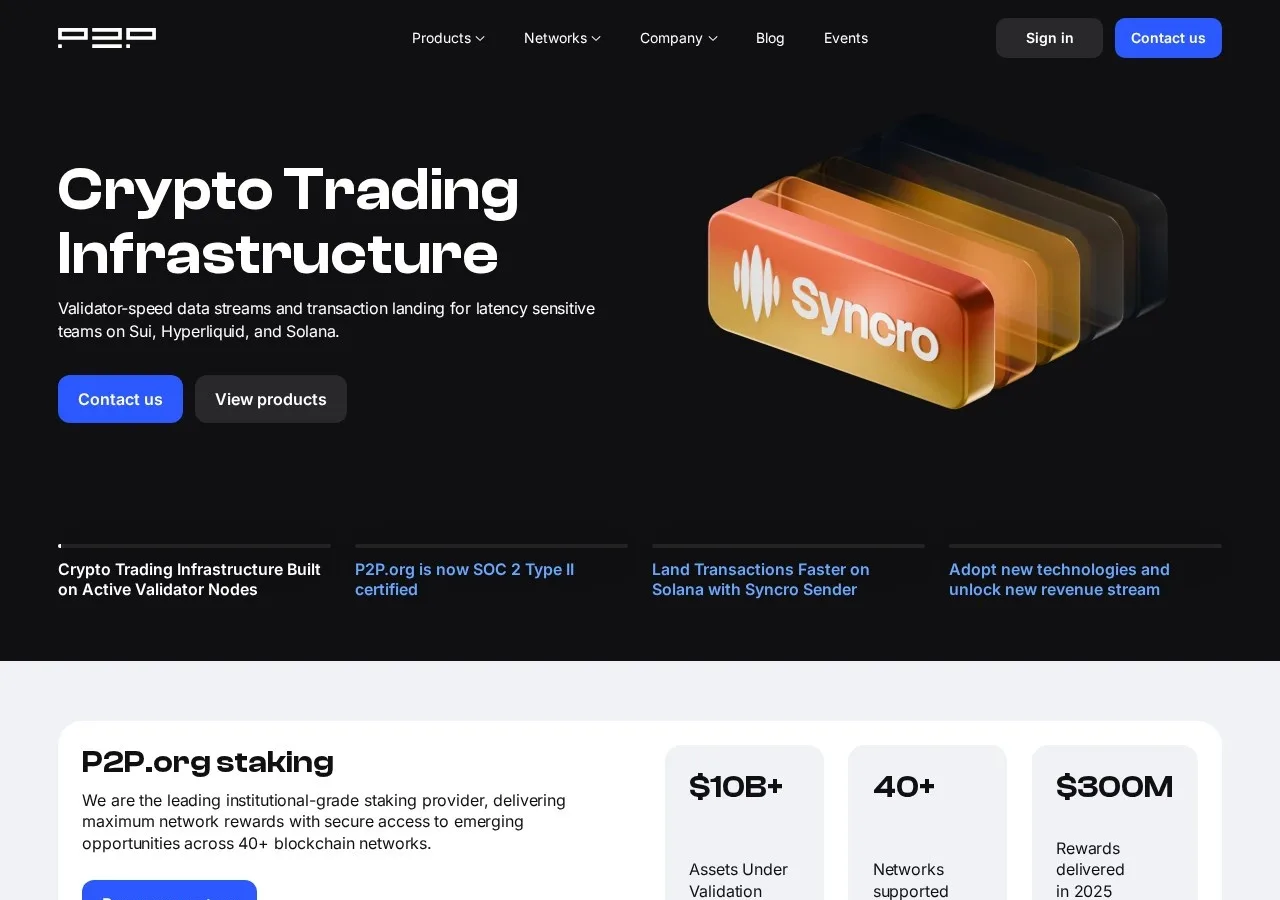
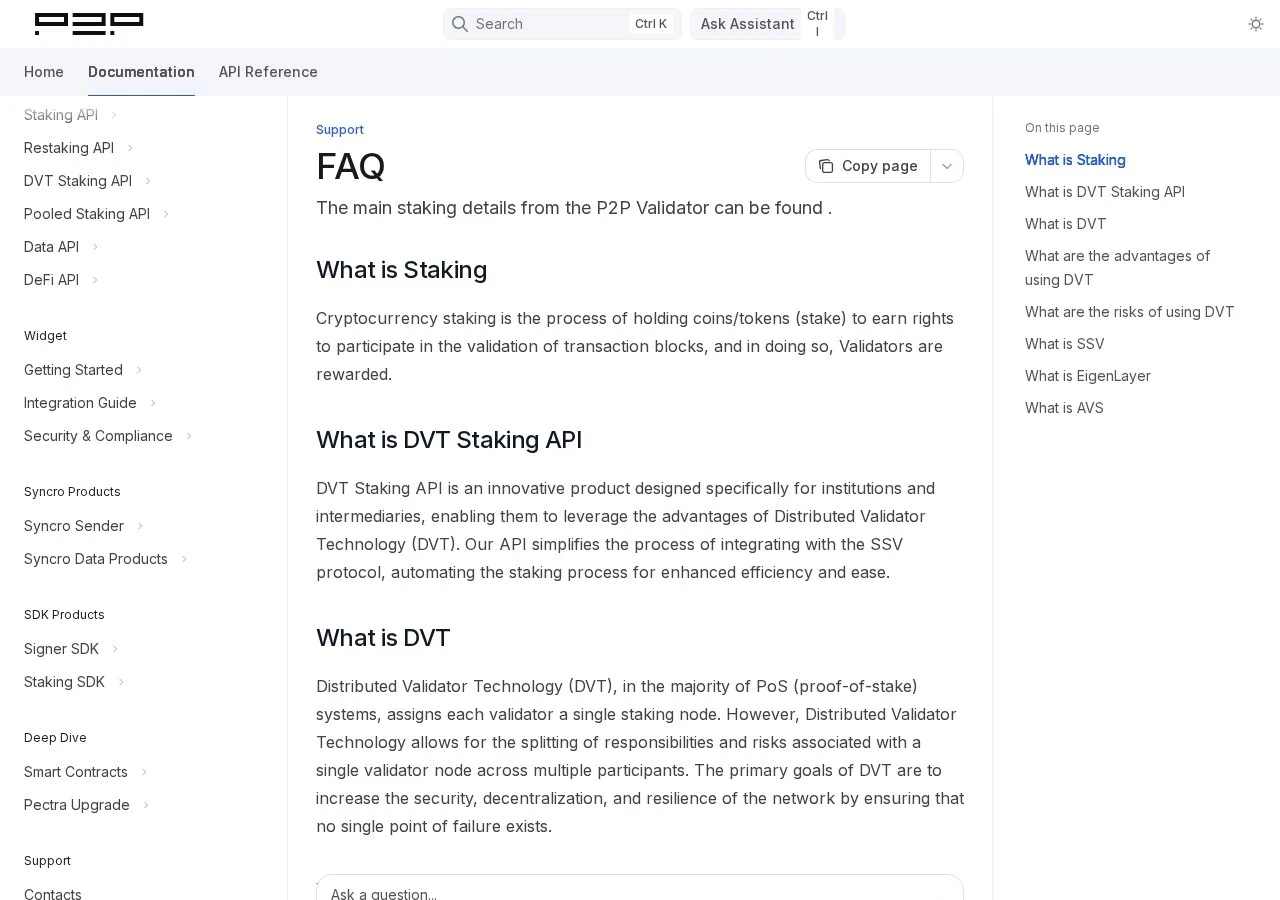
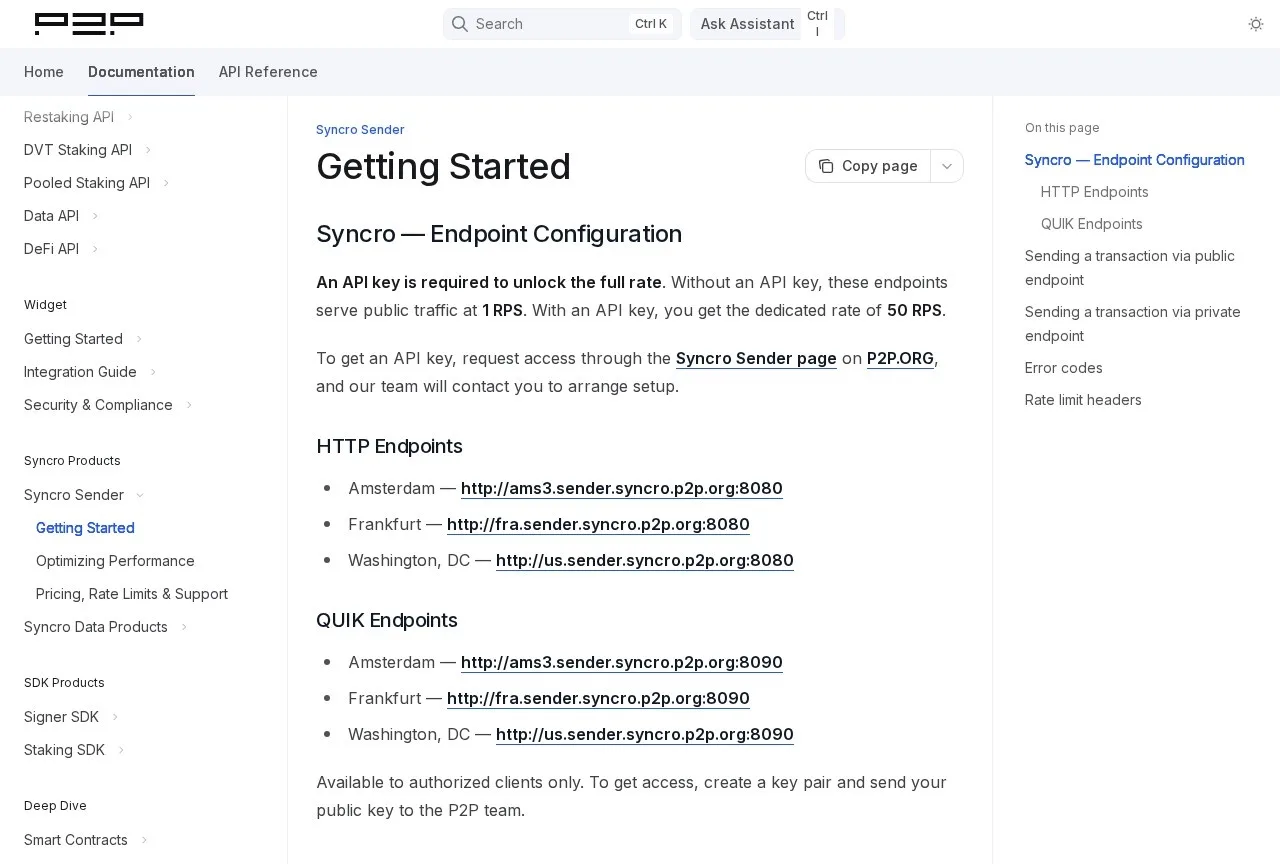
P2P.org screenshots
What users say about P2P.org
User feedback regarding P2P.org is limited and primarily focuses on its integration with Ledger and wallet apps. While users acknowledge the non-custodial nature of native staking, several express confusion or frustration over staked balances and positions failing to display properly in wallet interfaces.
In their own words
“p2p.org staked eth isn't contributing to total balance I stake eth through the ledger wallet, using both figment and p2p.org - the staked eth on p2p does not get factored into 'total balance'. Before the kiln issue several months ago, that contributed to the overall balance just fine.”
“Staking through P2P I staked through P2P.org in ledger, and nothing is showing in EARN. The activity shows it was sent, but I have no info or presentation of it. Is this normal?”
Based on 47 Reddit posts and comments from the last 12 months, checked Oct 21, 2026. These are posts by users on other sites, not reviews submitted on CryptoReview.
User reviews
No user reviews yet. Have you used P2P.org? Share your experience below.
FAQ
Who founded P2P.org?
P2P.org was founded in 2018 by Konstantin Lomashuk, who serves as CEO alongside Co-CEO Konstantin Zaitcev.
Is P2P.org non-custodial?
Yes, P2P.org operates on a non-custodial basis, allowing users and institutions to retain ownership and custody of their private keys while delegating validator rights.
What blockchains does P2P.org support?
P2P.org supports over 40 proof-of-stake networks, including Ethereum, Solana, Polkadot, Cosmos, Aptos, Sui, TRON, and Cardano.
Has P2P.org undergone independent security audits?
Yes, P2P.org holds SOC 2 Type I and Type II certifications audited by KirkpatrickPrice and smart contract audits by MixBytes.
Does P2P.org offer Ethereum restaking?
Yes, P2P.org provides native Ethereum restaking integration using EigenLayer to earn additional yield on staked ETH.
What is the minimum stake on P2P.org?
Direct validator activation on Ethereum requires the standard network minimum of 32 ETH, while delegation limits on other supported PoS chains depend on each network's native rules.
Latest from P2P.org on X
AMINA Bank AG and https://t.co/YjE3JpL8As have signed an MoU to co-develop next-generation institutional-grade digital asset products.
https://t.co/YjE3JpL8As is now integrated into @AMINABankGlobal's staking offering, strengthening its multi-network staking capabilities for professional and institutional investor clients.
The longer-term direction: co-developing products that bring advanced digital asset strategies into a regulated, custodial framework.
Full announcement → https://t.co/U8FGlcLWj4

We’re onboarding as Orbinum’s first institution-grade validator 🤝
Orbinum is a privacy L1 where holders control disclosure and validators never touch shielded data, which is the kind of design institutions can actually build around.
It starts on testnet, with the path to mainnet worked out alongside the team.
dRPC is also coming to provide RPC access for builders.
Alpenglow is live on Solana mainnet.
Finality now targets ~150 ms, and validators pay 0.8 SOL per epoch to vote.
Here’s what it means for institutions staking SOL. https://t.co/1PSmviqRqu
Finality now targets ~150 ms, and validators pay 0.8 SOL per epoch to vote.
Here’s what it means for institutions staking SOL. https://t.co/1PSmviqRqu
Staking and portfolio tracking have mostly lived in separate places: one app to see what you hold, and another to put it to work.
That changes today for @KryptosConnect users.
Here's what's new: https://t.co/JARMxuLRHL
That changes today for @KryptosConnect users.
Here's what's new: https://t.co/JARMxuLRHL
Recent public posts from @p2pvalidator, shown as published. Not reviewed or endorsed by CryptoReview.
Alternatives to P2P.org

Solana liquid staking infrastructure powering over 1,300 custom LSTs with pooled liquidity
Liquid stakingSolanaAudited

Solana liquid and native staking protocol automating delegation across validators since 2021
No KYCLiquid staking · Native stakingSolanaAudited

Solana liquid staking protocol capturing MEV rewards with over $1B in TVL
No KYCLiquid stakingSolanaAudited

Decentralized Ethereum liquid staking backed by permissionless node operators and a 0.01 ETH minimum
No KYCLiquid stakingEthereumAudited

Liquid staking protocol on Hyperliquid issuing kHYPE with over $860M in TVL
No KYCLiquid stakingHyperliquidAudited

Ethereum liquid staking with 600+ node operators and a 10% rewards fee
Liquid stakingEthereumAudited