


Solana liquid staking infrastructure powering over 1,300 custom LSTs with pooled liquidity
Liquid stakingSolanaAudited

Distributed validator infrastructure splitting Ethereum validation across multi-operator clusters
Obol is a decentralized staking infrastructure protocol that brings Distributed Validator Technology (DVT) to Ethereum. By breaking individual validator keys into distributed key shares across independent nodes, the protocol lets multiple node operators co-run an Ethereum validator cluster, eliminating single points of failure in hardware, client software, or network connectivity.
Obol was founded in 2021 by Collin Myers, Chris Battenfield, and Oisín Kyne. The project raised an $18.8 million Series A funding round in January 2023 led by Pantera Capital and Archetype Ventures, with participation from Coinbase Ventures, Nascent, BlockTower Capital, Spartan Group, and Placeholder. In March 2025, the project conducted a $3 million public token sale for the OBOL token.
Obol uses a middleware client named Charon alongside the Obol Launchpad. Charon sits between an Ethereum consensus client and a validator client. Through distributed key generation and threshold signing protocols, Charon clusters sign attestations and propose blocks only when a quorum of nodes agrees. This architecture supports client diversity within a single validator. Clusters remain active and avoid slashing even if an individual operator goes offline or experiences client bugs.
The network coordinates node incentives through its native token, OBOL, and its Obol Economic Engine. In May 2025, governance proposal OIP #1 introduced stOBOL, a liquid staking governance token that allows OBOL holders to earn rewards without giving up voting power. stOBOL holders can redeem back to OBOL at any time without waiting periods or exit penalties.
As of October 2026, Obol reported securing $616M in total value locked. The infrastructure serves solo home stakers, liquid staking protocols, and institutional operators. In April 2026, Lido V3 integrated Obol as a day-one infrastructure partner for its stVaults, debuting the Ethereum Client Team Vault co-operated by Sigma Prime, Nethermind, ChainSafe, and Develp. Charon reached version 1.9.0 with support for cluster mutability, backed by security audits from Trail of Bits, Nethermind Security, and Zach Obront.
Operating a distributed validator introduces distinct trade-offs. Clusters require continuous peer-to-peer communication among distributed nodes. This requirement leaves nodes sensitive to latency and peer connectivity disruptions. Coordinating threshold signing across disparate operators adds technical complexity compared to standard single-node validators. Stakers also remain exposed to smart contract bugs within Obol Splits contracts and potential client vulnerabilities in Charon middleware.
Obol eliminates single points of failure for Ethereum validators through distributed clusters, though deploying and managing multi-operator middleware requires technical coordination.
Obol builds distributed validator technology for Ethereum, letting multiple node operators run a single validator together via its Charon middleware client. Founded in 2021 by Collin Myers, Chris Battenfield, and Oisín Kyne, the protocol splits validator private keys using distributed key generation and threshold signing. This architecture provides fault tolerance. Validator clusters remain online and attest correctly even if individual nodes go offline or experience client bugs.
The protocol secures substantial value on Ethereum, with total value locked reported at $616M on its official site and topping $1B in staking pool tracking as of October 2026. Obol is a core infrastructure provider rather than a direct consumer staking app. For example, Lido selected Obol as an infrastructure partner for Lido V3, deploying the multi-operator Ethereum Client Team Vault alongside teams like Sigma Prime, ChainSafe, Nethermind, and Develp. Institutional backing includes a Series A led by Pantera Capital and Archetype Ventures.
For independent node operators, home stakers, and staking protocols, Obol delivers key operational strengths:
The primary trade-off stems from operational complexity. Setting up and managing distributed validator clusters requires coordinated ceremony setups, ongoing node maintenance, and inter-operator communication that typical pooled retail stakers do not face. Stakers who want simple one-click deposits with automated yield generation will prefer traditional liquid staking protocols, whereas node operators and institutions seeking high validator uptime and fault tolerance are well matched to Obol.
| Type | Staking pool |
|---|---|
| Stakeable assets | ETH |
| Receipt token | stOBOL · unverified |
| Chains | Ethereum |
| Node operators | Distributed validator clusters |
| Audited | Yes |
Not disclosed by the provider: KYC required, Protocol fee, Minimum stake, Withdrawal time, Restaking, Slashing cover, Typical reward rate.
Data from the provider's website and public sources. Fees and availability change; confirm on the official site before you sign up.
Charon intercepts validator duties and implements threshold signing across multiple nodes so clusters achieve quorum before submitting blocks or attestations.
Splits validator keys into private key shares during setup without a central party ever assembling the complete private key.
Provides an interface for node operators and home stakers to configure, coordinate, and deploy distributed validator clusters.
Enables OBOL token holders to earn protocol staking rewards while retaining delegation and voting rights with no unbonding waiting periods.
Powers multi-operator institutional vault setups like the Ethereum Client Team Vault within Lido V3 modules.
Directs staking yield and execution rewards programmatically across cluster members via audited smart contracts using Miga Labs indexing.
Middleware client that enables multi-operator validator clusters using distributed key generation and threshold signing to eliminate single-node failure risks.
A foundational infrastructure suite supporting decentralized applications, multi-operator network services, and autonomous on-chain agents across the Ethereum ecosystem.
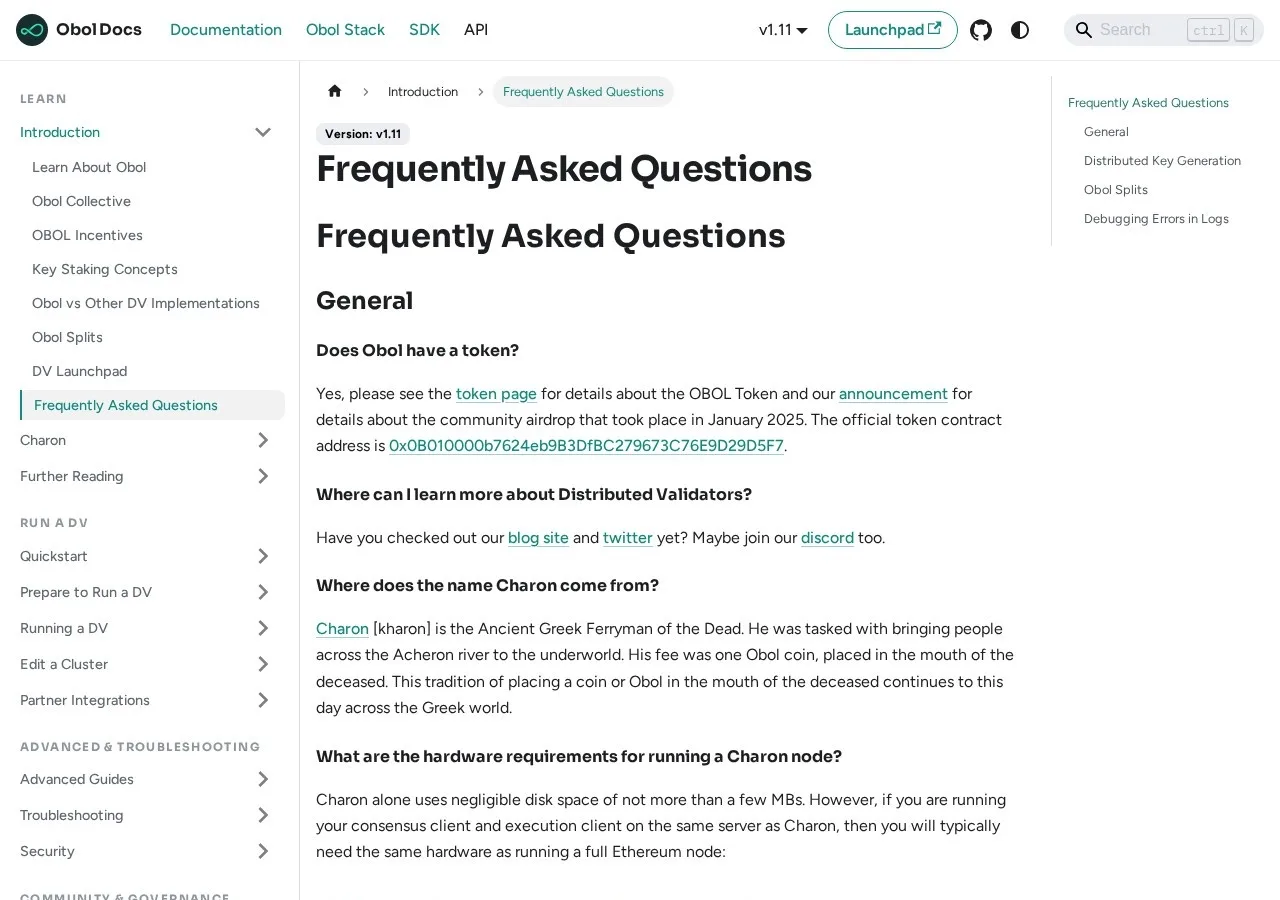
A web interface providing step-by-step cluster creation, key generation ceremony tooling, and operator configuration for running distributed validators.
A liquid staking governance token that allows OBOL holders to earn protocol rewards while maintaining voting power, featuring immediate redemptions without lockup periods.
No user reviews yet. Have you used Obol? Share your experience below.
 Pantera CapitalVenture capital
Lead
BC BlockTower CapitalHedge fund
BL Blockscape LabVenture capital
 Coinbase VenturesExchange ventures arm
CO CosmostationVenture capital
DS DSRVVenture capital
 Ethereal VenturesVenture capital
IE IEXVenture capital
KG Kukis GlobalVenture capital
NA NascentVenture capital
 PlaceholderVenture capital
 Spartan GroupVenture capital
SV Stakely.vcVenture capital
SS Swiss StakingVenture capital
AV a41 VenturesVenture capital
Collin Myers, Chris Battenfield, and Oisín Kyne founded Obol in 2021 to develop distributed validator infrastructure for Ethereum.
Yes, Obol has the OBOL token, which coordinates governance and incentives through the Obol Economic Engine, along with stOBOL for liquid token staking.
Obol operates on Ethereum, where its distributed validator technology secures ETH validation clusters.
Yes, Obol has been audited by Trail of Bits, Nethermind Security, and Zach Obront, and runs a public bug bounty program covering its Charon middleware.
A distributed validator runs across multiple nodes in an operator cluster using threshold cryptography, allowing the validator to attest even if a minority of nodes go offline.
Solana liquid staking infrastructure powering over 1,300 custom LSTs with pooled liquidity
Solana liquid and native staking protocol automating delegation across validators since 2021
Solana liquid staking protocol capturing MEV rewards with over $1B in TVL
Decentralized Ethereum liquid staking backed by permissionless node operators and a 0.01 ETH minimum
Liquid staking protocol on Hyperliquid issuing kHYPE with over $860M in TVL
Ethereum liquid staking with 600+ node operators and a 10% rewards fee
Type at least two characters. Press ↵ to see all results.