


Proud to have Liquid Collective join 100+ ecosystem participants supporting Ethereum Institutional.
Accelerating institutional adoption requires trusted infrastructure, clear standards, and coordinated engagement across the ecosystem. We’re excited to contribute to that work and help bring more assets and market infrastructure onchain.

Liquid Collective
Institutional liquid staking protocol on Ethereum and Solana with built-in slashing coverage
3.6/ 5
Our score
Good
Type
Liquid staking
Protocol fee
10%
Receipt token
LsETH
Audited
Yes
What is Liquid Collective?
Liquid Collective is a non-custodial liquid staking protocol built specifically for enterprise and institutional requirements. It issues liquid receipt tokens, including Liquid Staked ETH (LsETH) and Liquid Staked SOL (LsSOL), that allow participants to earn proof of stake network rewards while retaining liquidity across decentralized finance and custody integrations. By October 2026, the protocol held over $663M in total value locked.
Governance and development
The protocol is governed by The Liquid Foundation. Galaxy acquired Alluvial Finance in December 2025 and assumed the development company role for the protocol. In December 2025, digital asset firm Galaxy partnered with Liquid Collective and acquired Alluvial Finance, assuming the active development company role for the protocol.
Staking architecture and integration
Unlike permissionless retail protocols, Liquid Collective integrates directly with institutional custodians, exchanges, and prime brokers such as Coinbase, BitGo, Figment, Kraken, FalconX, and Bitcoin Suisse. Staked ETH deposits pass through the non-custodial River contract directly into Ethereum validator deposit contracts. The protocol routes delegations across allowlisted institutional node operators, including Coinbase, Blockdaemon, Figment, and Galaxy, distributing stake in a round-robin rotation to minimize validator concentration. Rewards automatically compound into the receipt token's conversion rate, removing the need for manual claiming. Slashing protection is integrated across deposits through Nexus Mutual coverage.
Fees and compliance access
Liquid Collective charges a protocol service fee of 10% taken directly from earned network rewards. Direct minting and redemption of receipt tokens require KYC and AML verification through participating platform partners. Unverified retail stakers can trade or hold LsETH and LsSOL through secondary decentralized markets such as Uniswap, Aerodrome, and Orca, but cannot directly interact with primary deposit and redemption contracts without passing compliance checks.
Security and operating risks
The protocol's smart contracts have undergone audits by Spearbit, Halborn, Quantstamp, and OtterSec, with Spearbit reviewing withdrawal and redemption code. Slashing events, although cushioned by insurance cover, present risk; losses exceeding coverage limits are socialized pro rata across stakers, beginning with unredeemed rewards. Users also face smart contract vulnerabilities, validator counterparty exposure, oracle reporting dependencies, and potential receipt-token depegs on decentralized exchanges during periods of liquidity strain.
Best for:Institutions requiring KYC-compliant liquid stakingEnterprises wanting built-in slashing coverageInstitutional clients of Coinbase or FalconX
Pros and cons
Pros
- Slashing coverage from Nexus Mutual is built into the protocol
- Contracts audited by Spearbit, Halborn, Quantstamp, and OtterSec
- Node operators include enterprise providers such as Coinbase, Figment, and Blockdaemon
- TVL exceeded $663M as of October 2026
Cons
- Mandatory KYC and AML checks for direct minting and burning
- Takes a 10% protocol service fee from staking rewards
- Slashing losses exceeding insurance are socialized across token holders
- Only supports Ethereum and Solana assets
Our review
3.6/5
Good
Liquid Collective provides enterprise-grade liquid staking with built-in slashing coverage, but access requires KYC through institutional platforms.
Liquid Collective is a non-custodial liquid staking protocol developed under The Liquid Foundation, targeting institutions and enterprises that require compliance guardrails. In December 2025, Galaxy acquired development company Alluvial Finance to steer protocol development. The protocol issues receipt tokens representing staked assets plus accrued rewards, primarily LsETH on Ethereum and LsSOL on Solana, with total value locked reaching approximately $664M in October 2026.
Unlike permissionless alternatives, direct minting and burning require mandatory KYC and AML verification through participating platforms such as Coinbase, Figment, Kraken, and FalconX. Staked deposits are distributed across allowlisted node operators including Blockdaemon, Coinbase, Figment, and Galaxy. To counter validator failure risks, Liquid Collective embeds built-in slashing coverage backed by Nexus Mutual, alongside SOC 2 Type 1 compliant API infrastructure from Alluvial.
Liquid Collective charges a 10% protocol fee deducted from staking rewards. Rewards and execution-layer fees auto-compound into the value of the receipt token rather than rebasing. Halborn, Quantstamp, and Spearbit have audited protocol contracts, with Spearbit specifically reviewing validator withdrawal and redemption flows. Deposited ETH resides in Ethereum deposit contracts rather than application-layer lending pools.
Trade-offs center on accessibility and operator concentration. Permissionless crypto users cannot mint LsETH directly without going through allowlisted partners, limiting retail autonomy. While node operators are established institutional infrastructure providers using multi-region setups, the curated validator set lacks the permissionless decentralization found in alternative staking models. The protocol suits institutional treasuries and asset managers prioritizing legal compliance and slashing insurance, whereas retail stakers seeking anonymous or permissionless staking should look elsewhere.
Sources (2)
Specs
| KYC required ⓘ | Yes · unverified |
|---|---|
| Type | Liquid staking |
| Stakeable assets | ETH |
| Receipt token | LsETH |
| Protocol fee | 10% · unverified |
| Chains | Ethereum |
| Node operators | Allowlisted institutional operators |
| Audited | Yes |
| Slashing cover | Yes · unverified |
Not disclosed by the provider: Minimum stake, Withdrawal time, Restaking, Typical reward rate.
Data from the provider's website and public sources. Fees and availability change; confirm on the official site before you sign up.
Key features
Institutional node routing
Distributes stake across allowlisted enterprise operators, including Coinbase, Figment, and Blockdaemon, via round-robin allocation.
Automatic reward compounding
Accumulates consensus and execution rewards, including MEV, directly into the value of receipt tokens like LsETH.
Built-in slashing protection
Integrates native slashing coverage through Nexus Mutual across all protocol validator deposits.
LsSOL staking integration
Supports liquid staking for Solana, providing liquidity and institutional custody through venues like Orca and Coinbase Prime.
Non-custodial smart contracts
Routes deposits directly through audited River and Withdrawal contracts without protocol custody of underlying validator keys.
Inside Liquid Collective
LsETH
Liquid Staked ETH represents staked Ether and accumulated network rewards, featuring automatic reward compounding and embedded slashing coverage.
LsSOL
Liquid Staked SOL provides liquid staking access for Solana, supported across decentralized exchanges like Orca and institutional custody platforms.
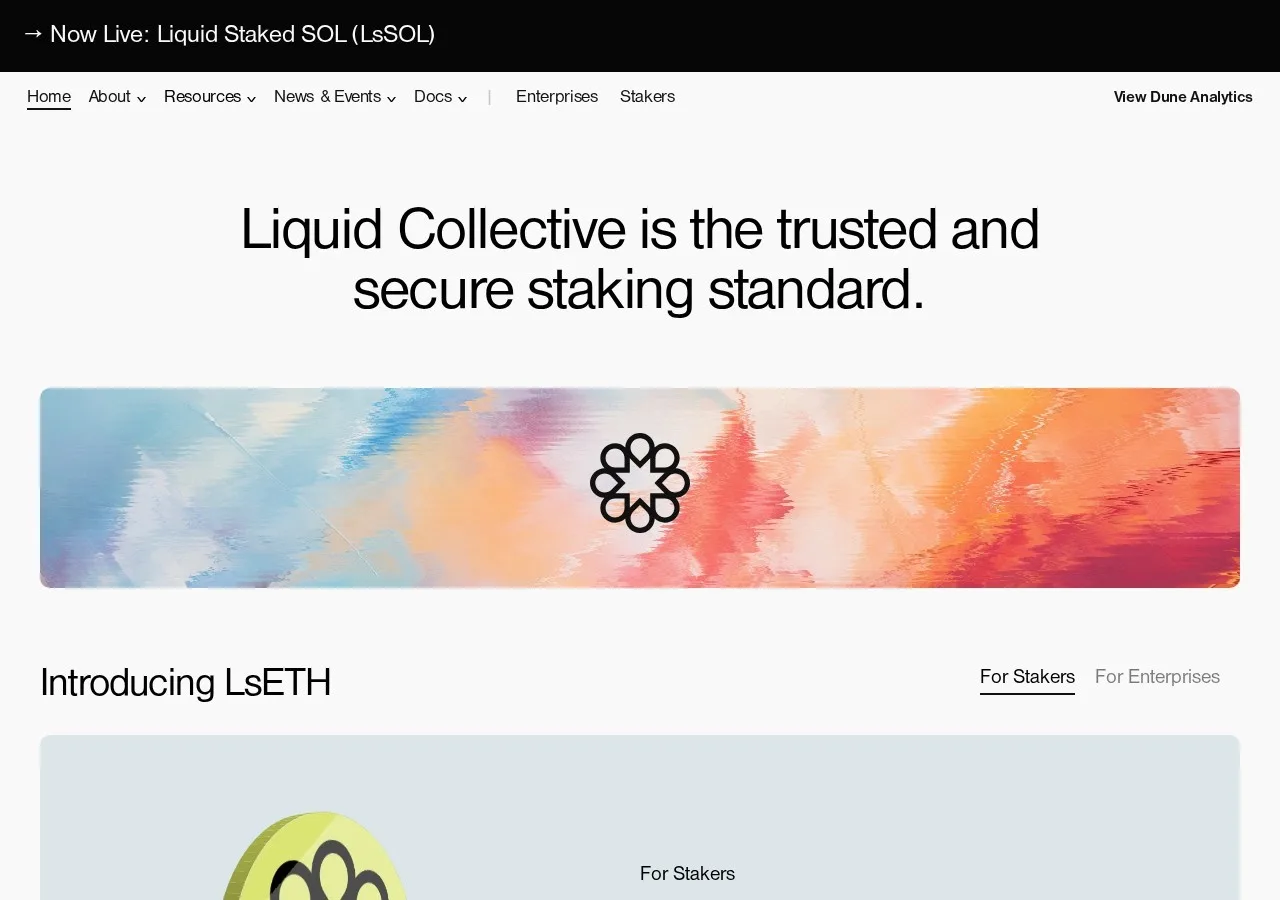
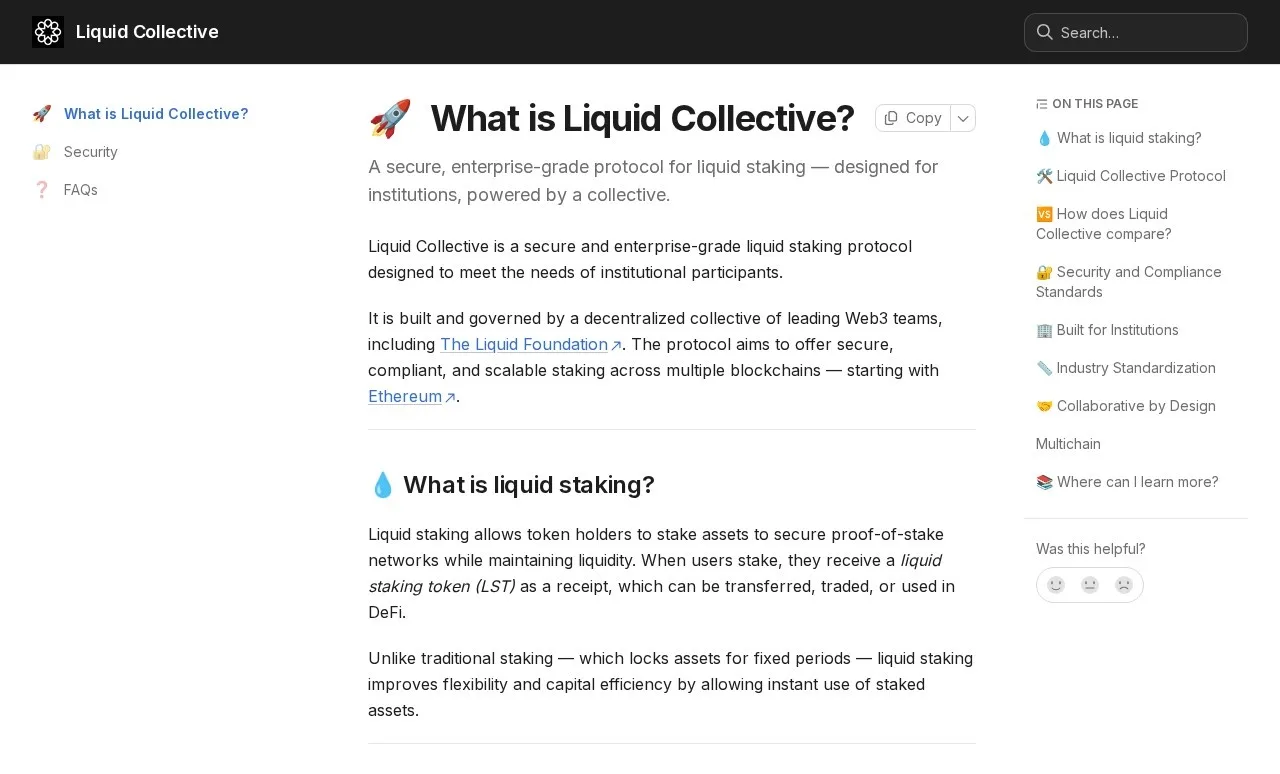
Liquid Collective screenshots
What users say about Liquid Collective
There is insufficient user feedback to evaluate Liquid Collective, as available discussion is limited to sharing educational documentation rather than firsthand product experiences.
Based on 1 Reddit posts and comments from the last 12 months, checked Oct 20, 2026. These are posts by users on other sites, not reviews submitted on CryptoReview.
User reviews
No user reviews yet. Have you used Liquid Collective? Share your experience below.
Funding and investors
1Round
1Investor
-
Funding round Amount undisclosed
FAQ
Who operates and develops Liquid Collective?
The Liquid Foundation governs Liquid Collective, and Galaxy is the development company following its acquisition of Alluvial Finance in December 2025.
What fee does Liquid Collective charge?
The protocol charges a 10% service fee taken directly from earned network staking rewards.
Is KYC required to use Liquid Collective?
Yes. Minting and burning actions require mandatory KYC and AML compliance through integrated platforms such as Coinbase, Kraken, FalconX, and Figment.
Has Liquid Collective been audited?
Liquid Collective smart contracts have undergone security audits by independent firms including Spearbit, Halborn, and Quantstamp.
What assets and chains does Liquid Collective support?
Liquid Collective supports Ethereum (minting LsETH) and Solana (minting LsSOL), with assets accessible across Ethereum, Solana, and Base.
How does Liquid Collective protect against slashing?
Liquid Collective incorporates built-in slashing coverage, including coverage from Nexus Mutual, alongside multi-region node infrastructure.
Latest from Liquid Collective on X
Come grab a drink with us next week in NYC !
Congratulations to @Figment_io, the latest entity to achieve Node Operator Risk Standard (NORS) Certification!
Learn more in the announcement: https://t.co/24tdu0l13x
Learn more in the announcement: https://t.co/24tdu0l13x
1/ Today marks an important milestone for Liquid Collective: @galaxyhq has acquired @alluvialfinance, and will now assume the role as the Development Company for the protocol. https://t.co/6Y3SgIHstt

🚀 NORS just expanded.
Introducing NORS Entry — a new certification tier making enterprise-grade staking security accessible to all node operators.
NORS also now supports Solana, bringing consistent, peer-reviewed security standards across the industry’s leading PoS networks.
Read More: https://t.co/NoObGqWgwh
Introducing NORS Entry — a new certification tier making enterprise-grade staking security accessible to all node operators.
NORS also now supports Solana, bringing consistent, peer-reviewed security standards across the industry’s leading PoS networks.
Read More: https://t.co/NoObGqWgwh
Recent public posts from @liquid_col, shown as published. Not reviewed or endorsed by CryptoReview.
Alternatives to Liquid Collective

Solana liquid staking infrastructure powering over 1,300 custom LSTs with pooled liquidity
Liquid stakingSolanaAudited

Solana liquid and native staking protocol automating delegation across validators since 2021
No KYCLiquid staking · Native stakingSolanaAudited

Solana liquid staking protocol capturing MEV rewards with over $1B in TVL
No KYCLiquid stakingSolanaAudited

Decentralized Ethereum liquid staking backed by permissionless node operators and a 0.01 ETH minimum
No KYCLiquid stakingEthereumAudited

Liquid staking protocol on Hyperliquid issuing kHYPE with over $860M in TVL
No KYCLiquid stakingHyperliquidAudited

Ethereum liquid staking with 600+ node operators and a 10% rewards fee
Liquid stakingEthereumAudited