







Babylon Bitcoin Orange https://t.co/abR6510ySF


Self-custodial Bitcoin staking protocol securing PoS chains with over $3.3B TVL and no bridging
Babylon is a decentralized Bitcoin staking and collateral protocol that lets native BTC holders earn yield by securing proof-of-stake networks without wrapping, bridging, or giving up custody. Its total value locked stood at about $3.32B in October 2026, with over 100,000 native Bitcoin activated across its infrastructure.
Babylon Labs was founded in 2022 and is based in Palo Alto, California. The project was co-founded by Stanford University professor David Tse and consensus protocol researcher Fisher Yu, whose foundational research on Bitcoin security was presented at the 2023 IEEE Symposium on Security and Privacy. The company employs between 51 and 200 staff members. Babylon has raised more than $111M in total funding across several rounds, including an $18M Series A in December 2023 led by Polychain Capital and Hack VC, a $70M round led by Paradigm in May 2024, and a $15M investment from a16z crypto in January 2026 through a purchase of BABY tokens. Additional backers include Binance Labs.
The protocol operates through self-custodial Bitcoin scripts directly on the Bitcoin network. Users lock their native BTC inside Trustless Bitcoin Vaults (TBV) on-chain rather than handing custody to a multi-signature bridge or centralized custodian. This locked Bitcoin grants staking rights to secure external proof-of-stake networks. Through its TBV architecture, Babylon also supports cross-chain collateralization. On public testnet, borrowers can post native Bitcoin to take out loans on Ethereum through Aave v4 without introducing wrapped token counterparties. In addition to staking, the system implements Bitcoin timestamping and data availability to extend Bitcoin's base-layer security to external networks.
Users worldwide can interact directly through self-custodial Web3 wallets. The protocol launched public testnet integrations for native Bitcoin borrowing on Aave v4 in October 2026. The team maintains a public bug bounty program.
Stakers face primary operational risks tied to slashing, where validator misbehavior or double-signing on a connected proof-of-stake network can trigger programmatic penalties against locked native collateral. Native custody avoids reliance on bridge counterparties. However, depositors remain exposed to unbonding lockup periods and smart contract bugs when using vaults as borrowing collateral on external virtual machines.
Stanford University professor and consensus protocol researcher who co-authored seminal research on Bitcoin security.
Consensus protocol researcher and co-author of foundational research papers on Bitcoin security.
Babylon lets holders stake native Bitcoin without bridging or wrapping to secure proof-of-stake chains, but restaking exposes deposited capital to slashing and unbonding lockups.
Babylon enables holders to stake native BTC to secure proof-of-stake networks without wrapping tokens or transferring custody to a cross-chain bridge. Stakers lock their Bitcoin directly on the Bitcoin network using self-custodial scripts, retaining sovereign control of their underlying keys while earning validation yields from external consensus systems.
The protocol addresses the counterparty risks inherent in traditional wrapped assets. Instead of trusting centralized custodians or multisig bridge contracts, deposits are secured directly by native Bitcoin script mechanisms. By October 2026, total value locked stood at approximately $3.32B, with more than 100,000 native BTC activated across Babylon's architecture. Alongside native staking, Babylon introduced Trustless Bitcoin Vaults (TBV) to supply native Bitcoin collateral to decentralized lending protocols, starting with an Aave v4 integration on public testnet.
Key structural trade-offs center on restaking risk and capital liquidity:
Palo Alto-based Babylon Labs was founded in 2022 by Stanford professor David Tse and consensus researcher Fisher Yu. The team has raised over $111M from investors including Paradigm, Polychain Capital, Hack VC, and a16z crypto, supported by foundational research accepted at the IEEE Symposium on Security and Privacy. Babylon suits long-term Bitcoin holders seeking self-custodial yield who accept slashing and withdrawal delays.
| Type | Native staking |
|---|---|
| Stakeable assets | BTC |
| Chains | Bitcoin |
| Audited | Yes |
| Restaking | Yes · unverified |
Not disclosed by the provider: KYC required, Receipt token, Protocol fee, Minimum stake, Withdrawal time, Node operators, Slashing cover, Typical reward rate.
Data from the provider's website and public sources. Fees and availability change; confirm on the official site before you sign up.
Locks BTC directly on the Bitcoin network in self-custodial scripts without wrapping tokens or relying on third-party custodians.
Enables native Bitcoin to serve as on-chain collateral for cross-chain borrowing, including integrations with Aave v4 on Ethereum.
Directs native Bitcoin economic security to validate external PoS chains in exchange for network rewards.
Provides immutable timestamping services derived from Bitcoin blocks to improve the security of PoS networks.
Utilizes base-layer Bitcoin infrastructure to supply decentralized data availability services to connected chains.
Allows users to lock native Bitcoin in self-custodial vaults to provide economic security to proof-of-stake networks in exchange for staking rewards.
Collateral infrastructure that lets native Bitcoin be used across decentralized finance applications without wrapping, bridging, or centralized intermediaries.
A DeFi lending application allowing users to post native Bitcoin collateral to borrow stablecoins, deployed on public testnet in partnership with Aave v4.
A security service that submits cryptographic timestamps of external proof-of-stake transactions onto the Bitcoin blockchain.
An infrastructure solution using Bitcoin network capacity to provide decentralized data availability guarantees for external rollups and blockchains.
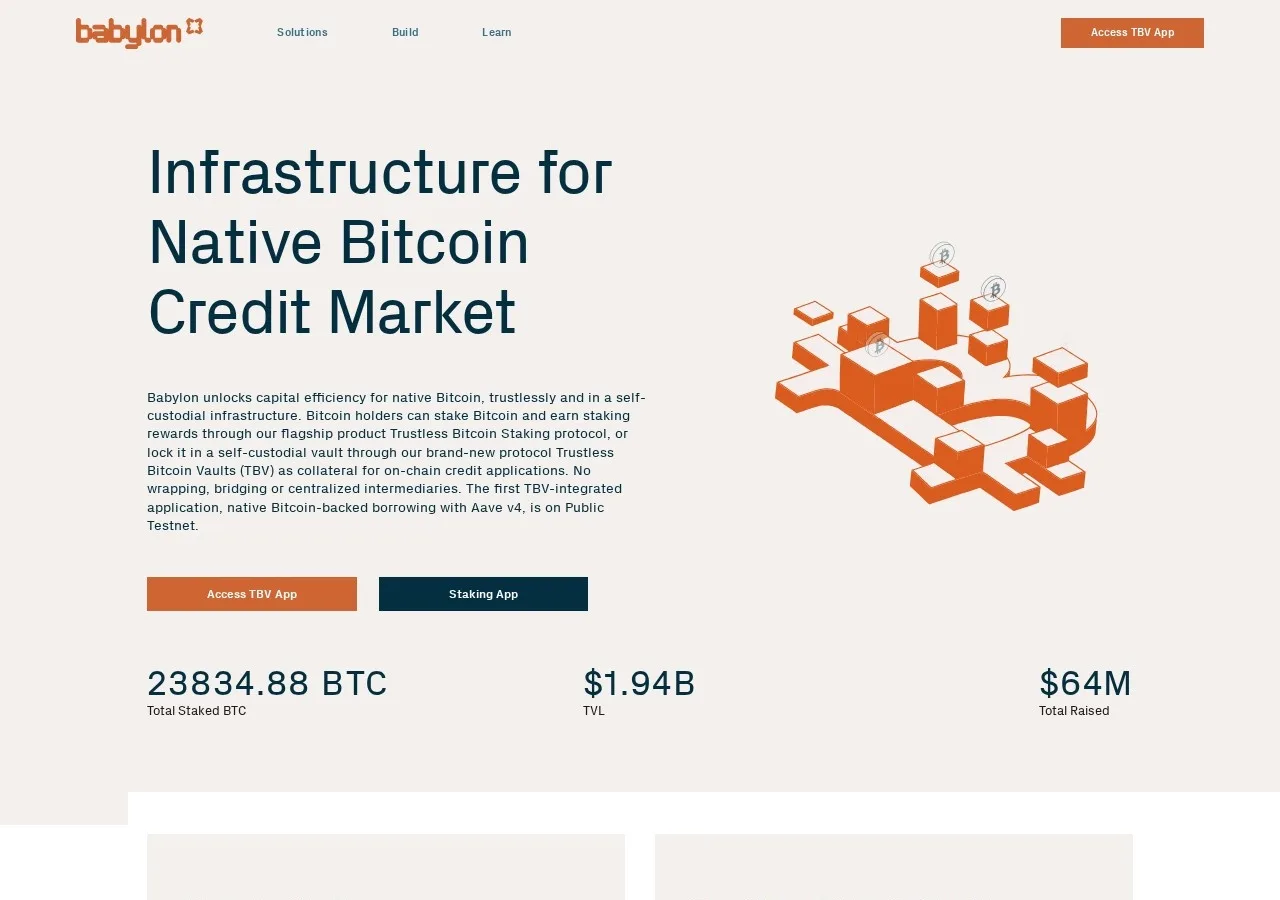
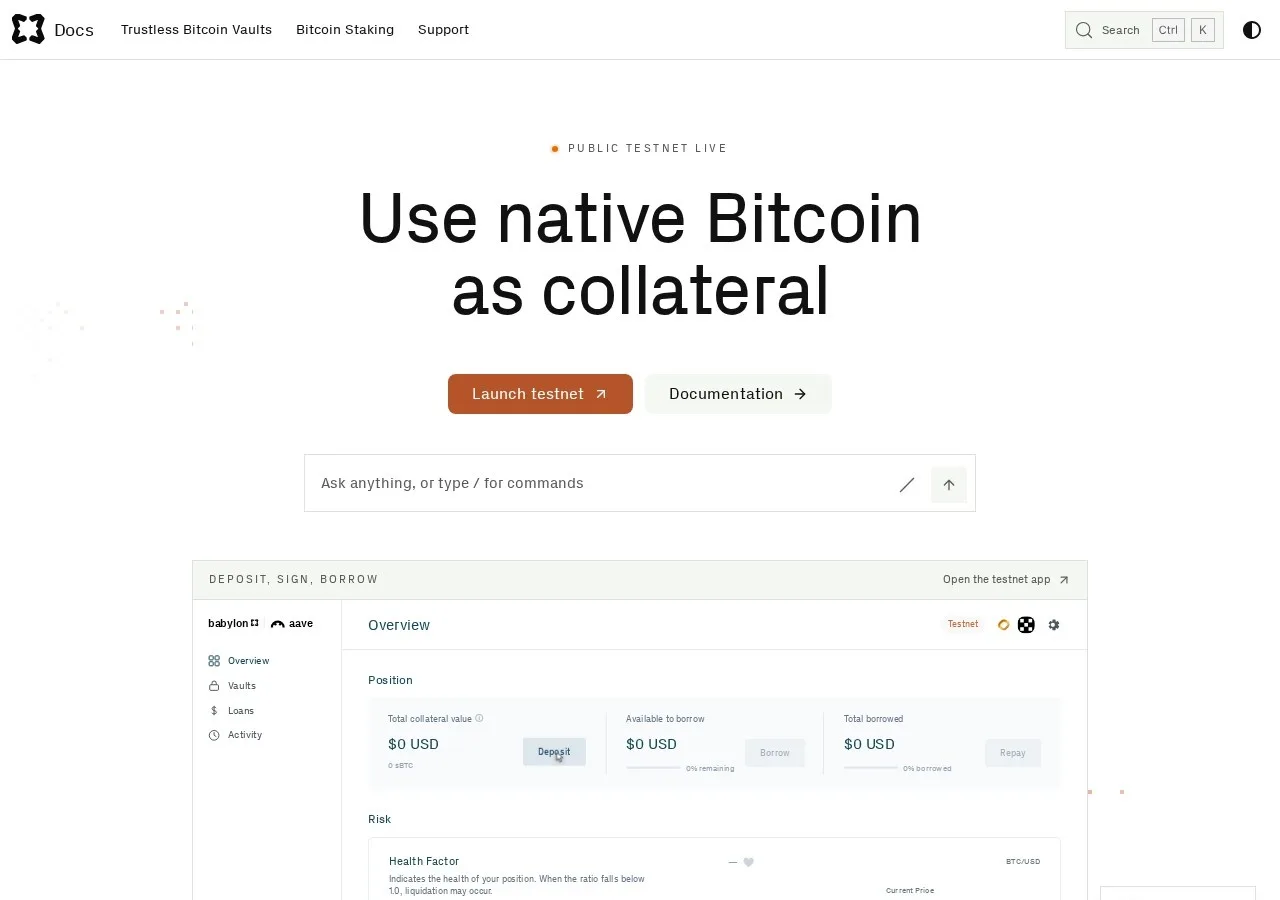
The protocol offers a self-custodial and trustless approach to Bitcoin staking and borrowing without bridging or wrapping.
“Bitcoin Borrowing, Repriced Bitcoin borrowing, repriced. Trustless Bitcoin Vaults allow native Bitcoin to access on-chain liquidity without wrapping, bridging or intermediaries. Your Bitcoin stays on the Bitcoin network. You keep custody.”
“You might already be wondering which projects are fixing this.. heres what i found: **1. MIDL** A Bitcoin DeFi platform building natively on Bitcoin's security model — no wrapping, no bridging, no unnecessary trust assumptions. MIDL lets you put your BTC to work directly on Bitcoin rails.”
Based on 5 Reddit posts and comments from the last 12 months, checked Oct 20, 2026. These are posts by users on other sites, not reviews submitted on CryptoReview.
No user reviews yet. Have you used Babylon? Share your experience below.
Babylon Labs was founded in 2022 by Stanford University professor David Tse and consensus researcher Fisher Yu. The project emerged from academic research on Bitcoin security co-authored with EigenLayer founder Sreeram Kannan.
The protocol operates in a self-custodial manner and is accessible globally through standard Web3 wallets.
Babylon avoids bridge and wrapping dependencies by locking native BTC in self-custodial scripts on the Bitcoin network. However, stakers remain exposed to programmatic slashing risks if delegated validators act maliciously on connected networks.
Babylon supports native Bitcoin (BTC) on the Bitcoin blockchain. It connects to external proof-of-stake chains and DeFi environments, including borrowing testnet integrations on Ethereum.
Yes, Babylon utilizes the BABY token. Venture firm a16z crypto purchased $15M worth of BABY tokens in January 2026 to support the development of Trustless Bitcoin Vaults.
Holders lock native BTC into Bitcoin scripts directly within their own wallets without transferring ownership to an intermediary. These locked balances grant rights to help validate external networks and receive protocol rewards.


Recent public posts from @babylonlabs_io, shown as published. Not reviewed or endorsed by CryptoReview.
Solana liquid staking infrastructure powering over 1,300 custom LSTs with pooled liquidity
Solana liquid and native staking protocol automating delegation across validators since 2021
Solana liquid staking protocol capturing MEV rewards with over $1B in TVL
Decentralized Ethereum liquid staking backed by permissionless node operators and a 0.01 ETH minimum
Liquid staking protocol on Hyperliquid issuing kHYPE with over $860M in TVL
Ethereum liquid staking with 600+ node operators and a 10% rewards fee
Type at least two characters. Press ↵ to see all results.