



23 hours → 7 minutes 36 seconds.
The same Uniswap v4 data on Ethereum, indexed with Substreams on 75 parallel workers.
Amazing work as always by the @streamingfastio team.
The Graph
Decentralized blockchain indexing and GraphQL queries across 60+ networks
4.2/ 5
Our score
Very good
Services
Indexing
Chains supported
60
Free tier
Yes
Pricing from
$20 per million queries
Token
GRT
What is The Graph?
The Graph is a decentralized data indexing and query protocol that enables developers to organize on-chain data and retrieve it using GraphQL. By coordinating a network of independent node operators rather than relying on centralized database servers, the protocol powers data access for decentralized applications across DeFi, NFTs, and governance.
Founding and financial backing
Founded in 2018, the project is stewarded by The Graph Foundation, which directly oversees core protocol operations, the Gateway, and developer tools. The protocol raised $5.1M in June 2020, followed by a $12M public sale in October 2020. Additional funding includes a $50M private token sale led by Tiger Global in January 2022 and a $205M ecosystem fund raised in February 2022 with backing from Multicoin Capital, Reciprocal Ventures, and Digital Currency Group.
Protocol mechanics and supported networks
Developers build custom data extraction schemas known as subgraphs, which define how raw smart contract events are transformed into queryable database models. High-throughput pipelines can also stream real-time data using Substreams. Indexers run nodes to process and answer these requests, while Delegators stake GRT tokens to secure network participants. The protocol supports more than 60 networks, including Ethereum, Arbitrum, Avalanche, Polygon, Base, BNB Smart Chain, Celo, and NEAR.
Query pricing and free tiers
Developer onboarding begins through Subgraph Studio, which offers 100,000 free queries per month. Queries above this allotment cost $2 per 100,000 requests. On the decentralized mainnet, queries average approximately $20 per million requests ($0.00002 per query). Developers can pay query fees in GRT or fiat via credit card. In addition, automated services can meter payments in USDC on Base through HTTP 402 endpoints.
Track record and operational risks
Since inception, the protocol has served over 1.27 trillion queries across more than 75,000 projects, supported by over 100 independent indexer nodes. In October 2026, production query traffic for BNB Chain and Polygon completed full migration from centralized staging endpoints directly onto the decentralized network. Operational trade-offs include indexer sync latency during heavy blockchain reorgs, exposure to the GRT token economic model for query settlement and indexing incentives, and the engineering overhead required to debug complex subgraph mapping scripts.
Founders
Yaniv TalCo-founder
Studied electrical engineering and previously worked as software engineer and tech entrepreneur.
Jannis PohlmannCo-founder
Software architect with experience in distributed systems and developer tooling.
Brandon RamirezCo-founder and Research Lead
Studied electrical engineering and focused on protocol architecture and token economics.
Best for:Dapp frontend developersDeFi protocol data teamsCross-chain analytics platforms
Pros and cons
Pros
- Indexes smart contract data across more than 60 blockchain networks
- Generous free tier provides 100,000 queries per month in Subgraph Studio
- Decentralized network sustained by over 100 independent indexer nodes
- Low production query costs averaging $20 per million queries
- Supports pay-per-query settlement using fiat cards, GRT, or USDC
Cons
- Query fee pricing and node staking remain dependent on GRT market dynamics
- Complex subgraphs require dedicated AssemblyScript debugging and historical sync time
- Indexing latency can lag during heavy chain reorganizations or network congestion
Our review
4.2/5
Very good
The Graph delivers mature, open-source decentralized indexing across more than 60 blockchains, though production deployments depend on coordinating with decentralized indexers and managing GRT or usage-based billing.
The Graph functions as an established decentralized data indexing protocol, serving open GraphQL APIs known as subgraphs. Founded in 2018, it has processed more than 1.27 trillion queries across 75,000 projects, backed by investors like Multicoin Capital, Tiger Global, and DCG. By replacing custom data servers with an open network of indexers and delegators, it avoids the single points of failure typical of centralized RPC node providers.
For developers, indexing coverage spans over 60 networks, including Ethereum, Arbitrum, Base, Polygon, Avalanche, and BNB Chain. Subgraphs filter and transform raw smart contract logs into queryable schemas, while Substreams handles high-throughput block streaming for complex data sinks. Pricing is straightforward: Subgraph Studio provides a free tier of 100,000 monthly queries, after which queries cost $2 per 100,000. On the decentralized network, average querying runs around $20 per million queries (roughly $0.00002 each), payable in GRT token or credit card.
Network reliability differs from centralized alternatives because the distributed indexer architecture delivers 99.9%+ uptime without relying on a single infrastructure vendor. The protocol's components remain open source, giving developers the option to inspect the indexing logic or run local graph-node environments.
The trade-offs stem from protocol mechanics and complexity. While simple applications can prototype quickly, production workloads require deploying onto The Graph Network, where traffic relies on independent indexers. In October 2026, production staging endpoints for Polygon and BNB Chain were migrated fully off centralized Studio servers, requiring teams to handle active network billing. Indexing times for massive historical contracts can also lag during heavy reorganizations or re-indexes.
The Graph suits decentralized applications and analytics platforms needing reliable, queryable blockchain states without hosting proprietary database clusters. Teams requiring sub-second, real-time raw transaction simulation or specialized proprietary oracles should look elsewhere.
Specs
| Services | Indexing |
|---|---|
| Chains supported | 60 · unverified |
| Free tier | Yes · unverified |
| Pricing from | $20 per million queries · unverified |
| Open source | Yes |
| Token | GRT |
| Uptime SLA | 99.99% · unverified |
| Free tier limits | 100,000 queries per month · unverified |
Not disclosed by the provider: Enterprise SLA, Server regions.
Data from the provider's website and public sources. Fees and availability change; confirm on the official site before you sign up.
Key features
GraphQL data indexing
Developers deploy subgraphs to parse raw smart contract event logs into structured entities queryable via GraphQL.
Substreams real-time data
Substreams process block data into custom sink pipelines using parallelized streaming and extended block models.
Decentralized indexer network
More than 100 independent indexer nodes serve production queries with 99.9%+ protocol uptime.
Multichain network coverage
The protocol indexes smart contract data across more than 60 blockchains and Layer 2 rollups.
Developer free tier
Subgraph Studio includes 100,000 free monthly queries before metering at $2 per 100,000 queries.
Token API integration
A pre-indexed, turnkey REST interface provides standardized token metrics across 10 supported networks.
Inside The Graph
Subgraphs
Open APIs that transform and index raw smart contract data into structured schemas queryable via GraphQL.
Substreams
High-throughput streaming engines that process blockchain data and stream state changes directly into custom sinks.
Subgraph Studio
The developer workstation for building, testing, deploying, and managing API keys and billing for subgraphs.
The Graph Network
The decentralized coordination network of independent Indexers, Curators, and Delegators that serves production queries.
Token API
A pre-indexed, turnkey API that serves standard token balances, prices, and transfer histories across supported chains.
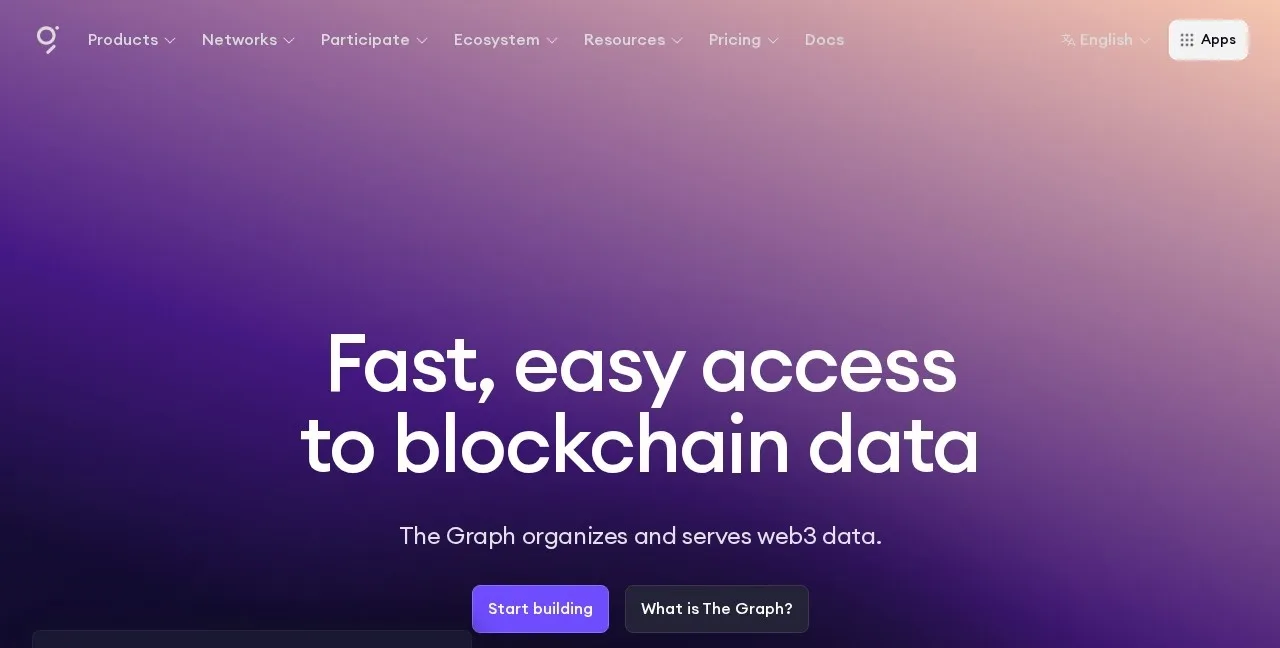
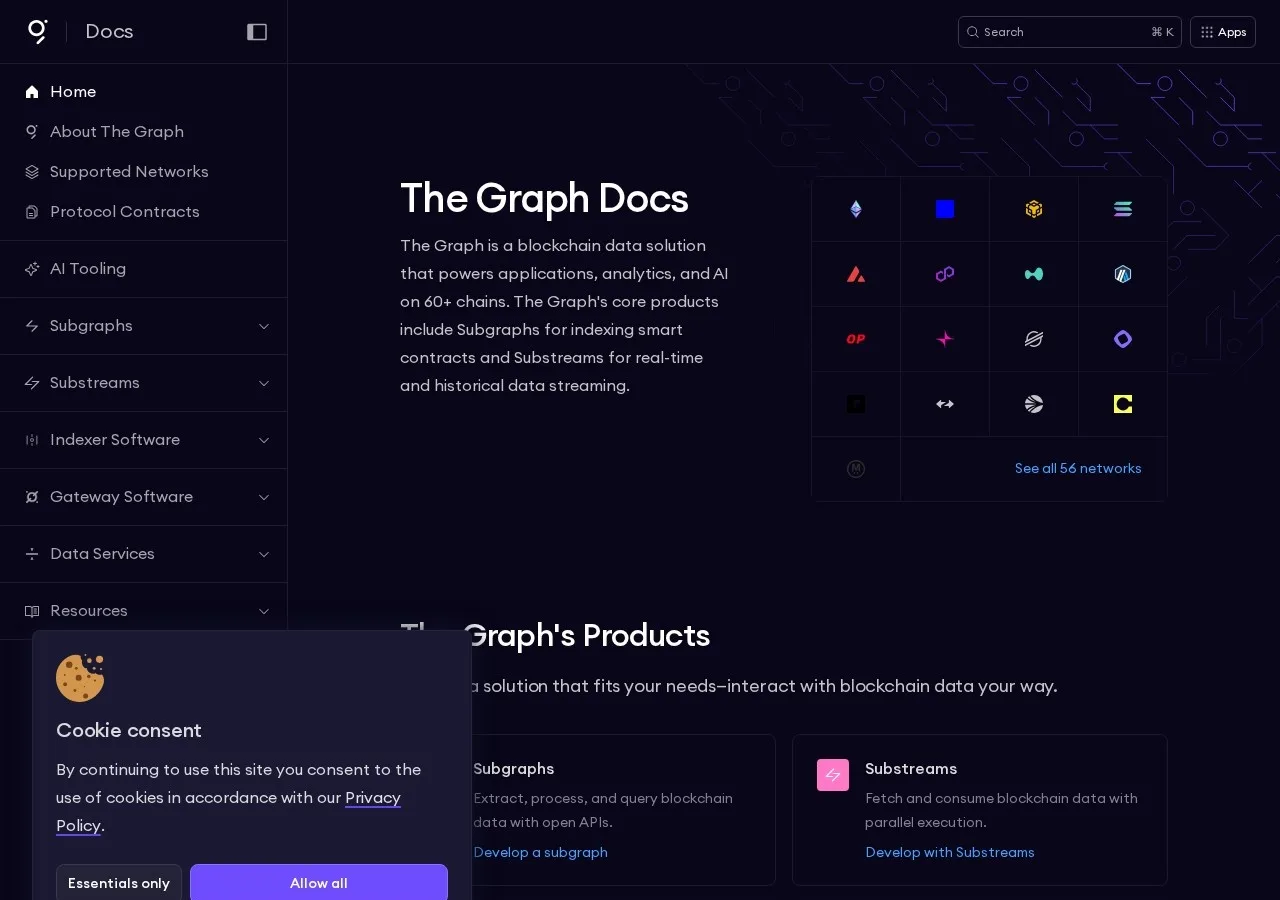
The Graph screenshots
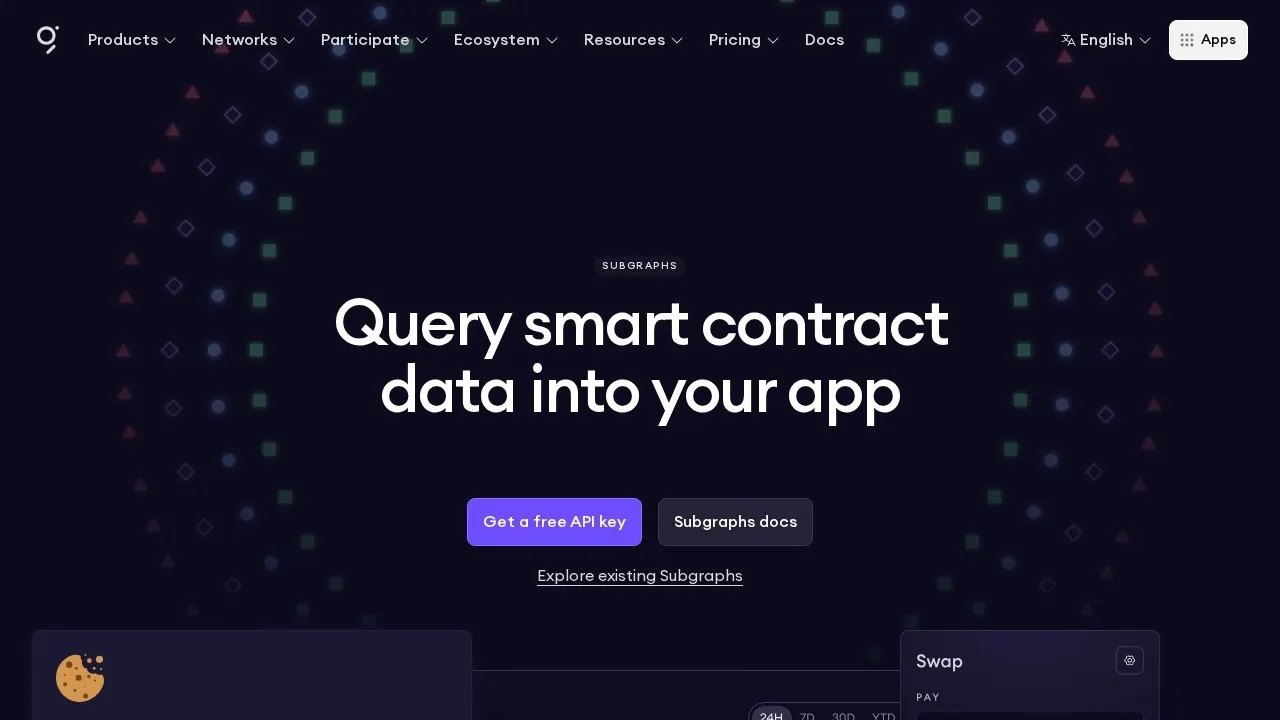
What users say about The Graph
Developers praise The Graph as essential web3 data infrastructure, particularly welcoming new AI agent tools, Substreams speed improvements, and developer utilities. However, users experience friction with network indexer reliability errors.
Top goods
In their own words
“The Graph provides an excellent service. Most of the top products in crypto use it. Opensea is a good example (although nfts feel a bit dead tbf). As with many though there is that issue of "does it actually need a token". Exactly the same with chainlink.”
“This is such a clean "agent-shaped" payment flow. Per-query settlement + no long-lived creds is basically the missing piece for a lot of autonomous workloads. Discovery still feels like the hard part like you said.”
“Subgraph Dev Mode: A faster way to build with The Graph If you work with Subgraphs, this will matter: The Graph just released Subgraph Dev Mode, a local development setup that removes the need to constantly redeploy after every change.”
“started a place to get actual answers when something in the graph breaks if youve queried a subgraph on the network youve probably seen this come back at some point and had no idea what to do with it bad indexers: {0x1b7e...: BadResponse(unattestable response: The skip argument must be between 0…”
“Graph Explorer error: “bad indexers / failed to get indexing progress” (FND subgraph) Hi everyone, I’m running into an issue querying the FND (Foundation) subgraph in Graph Explorer as I'm working on a Research Project at my University.”
“Unrealized Rewards Question \-Delegated 198.90K to Streamingfast. \-They changed to 0 rewards so undelegated max \-I was only able to undelegate 202.6K rewards \-There is still 57.18k in unrealized rewards column \-Why is there unrealized rewards? Is this an error?”
Based on 200 Reddit posts and comments from the last 12 months, checked Oct 20, 2026. These are posts by users on other sites, not reviews submitted on CryptoReview.
User reviews
No user reviews yet. Have you used The Graph? Share your experience below.
Funding and investors
$272.1MTotal raised
6Rounds
19Investors
-
Ecosystem Foundation raise Feb 2022 $205M
-
Private token sale Jan 2022 $50M
-
ICO Oct 2020 $12M
-
Funding round Jun 2020 $5.1MAC AU21 CapitalVenture capital CC CoinIX CapitalVenture capital
 Coinbase VenturesExchange ventures arm
DC DTC CapitalVenture capital
 Digital Currency GroupCorporate VC
 Fabric VenturesVenture capital
 Framework VenturesVenture capital
JC JD CapitalVenture capital
LE LemniscapVenture capital
 ParaFi CapitalVenture capital
SC Sustany CapitalVenture capital
TC Tally CapitalVenture capital
-
Seed Jun 2020 $5.1MSource Coinbase VenturesExchange ventures arm
Framework VenturesVenture capital
ParaFi CapitalVenture capital
-
Funding round Amount undisclosed
FAQ
Who founded and runs The Graph?
The Graph was founded in 2018, and its ongoing governance, core infrastructure, and product roadmap are directed by The Graph Foundation alongside independent ecosystem contributors.
What are the fees for querying The Graph?
Subgraph Studio includes 100,000 free queries per month, costing $2 per 100,000 queries thereafter. On the decentralized network, queries average $20 per million, payable by credit card or GRT.
Does The Graph have a native token?
Yes, The Graph uses GRT, an ERC-20 utility token used to pay for queries, stake on indexer nodes, and curate subgraph data.
Which blockchain networks does The Graph support?
The Graph supports more than 60 networks, including Ethereum, Arbitrum, Avalanche, Polygon, Base, BNB Chain, Celo, and NEAR.
What is the difference between Subgraphs and Substreams?
Subgraphs extract and organize smart contract data into queryable GraphQL endpoints for frontends. Substreams process raw block data at high speed to stream changes into custom databases or data sinks.
Latest from The Graph on X
Tokenization just moved from pilot to production inside core U.S. market infrastructure.
@The_DTCC's Tokenization Service is live: DTC-held securities, backed 1:1, moving 24/7 between registered wallets on Canton and Besu.
Congratulations to the DTCC. They continue to innovate, building the foundation to bring the U.S. settlement market on-chain.
@The_DTCC's Tokenization Service is live: DTC-held securities, backed 1:1, moving 24/7 between registered wallets on Canton and Besu.
Congratulations to the DTCC. They continue to innovate, building the foundation to bring the U.S. settlement market on-chain.
📺 Graph Office Hours #281 is up
✅ REO now requires 10 qualifying Subgraphs
✅ BSC/Polygon move from Studio to Network is complete
✅ Studio v1.6.0, Explorer v1.2.0, Docs v2.1.10
➕ Many more updates from The Graph ecosystem
✅ REO now requires 10 qualifying Subgraphs
✅ BSC/Polygon move from Studio to Network is complete
✅ Studio v1.6.0, Explorer v1.2.0, Docs v2.1.10
➕ Many more updates from The Graph ecosystem
Congratulations to @ensdomains on the launch of ENSv2!
The Graph has used ENS for years, including ENS names in Subgraph Studio and Graph Explorer.
Amazing to see the next iteration of the ENS protocol.
The Graph has used ENS for years, including ENS names in Subgraph Studio and Graph Explorer.
Amazing to see the next iteration of the ENS protocol.
graphprotocol.isv2ready.eth https://t.co/yin1Waaqmk

Recent public posts from @graphprotocol, shown as published. Not reviewed or endorsed by CryptoReview.
Alternatives to The Graph
Open-source smart contract libraries and enterprise security tooling backing over $38T in transfers
Developer toolingFree tier10 chains supported
Blockchain infrastructure platform supporting 100+ chains with a free 30M-compute-unit tier
RPC / nodes · Data APIs +3Free tier100 chains supported
Managed blockchain infrastructure across 70+ chains with a free 3M-request monthly tier
RPC / nodes · IndexingFree tier70 chains supported
EVM development and simulation platform supporting transaction debugging and testing across 50+ chains
Developer toolingFree tier50 chains supported
Open-source distributed ledger foundation hosting Fabric, Besu, and Cacti under the Linux Foundation
RPC / nodes · Developer toolingFree tier2 chains supported
Blockchain infrastructure platform providing RPC nodes and data streams across 76 networks
RPC / nodes · Data APIsFree tier76 chains supported