

We're excited to be supporting @EFDevcon 8 🇮🇳
Find us at the booth to talk all things smart contracts with our engineers.
The team will also be on stage with talks and workshops throughout the week.

OpenZeppelin
Open-source smart contract libraries and enterprise security tooling backing over $38T in transfers
4.5/ 5
Our score
Excellent
Services
Developer tooling
Chains supported
10
Free tier
Yes
Pricing from
Free for open-source tools
Enterprise SLA
Yes
What is OpenZeppelin?
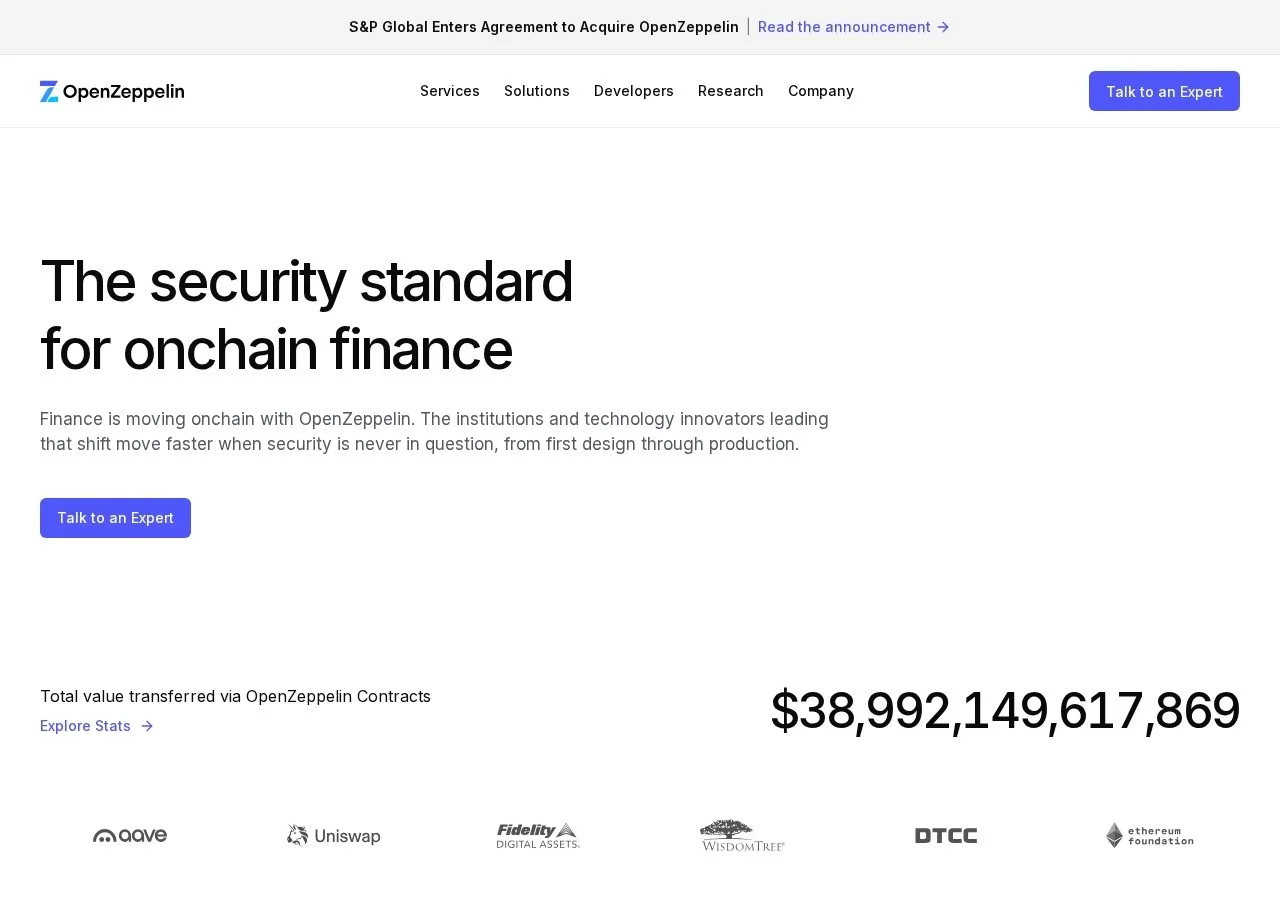
OpenZeppelin provides open-source smart contract libraries, security advisory services, and operational developer tooling for decentralized protocols and financial institutions. Its audited code standards have secured over $38 trillion in cumulative transferred value as of October 2026, and they form the foundational codebase for 9 of the top 10 stablecoins and all top 10 tokenized money market funds by market cap.
Corporate background and acquisition
Founded in 2015, the firm built the industry's standard open-source library for Ethereum and EVM-compatible contracts. In 2026, S&P Global entered into an agreement to acquire OpenZeppelin, integrating its security services and smart contract infrastructure into institutional market workflows. Teams contribute directly to standards bodies like ISO and the Enterprise Ethereum Alliance.
Core products and infrastructure architecture
OpenZeppelin maintains multiple modular developer products. The core OpenZeppelin Contracts library provides audited implementations of ERC standards, access control, and upgrade mechanisms. In addition to EVM environments like Arbitrum, Base, Linea, and OP Mainnet, the organization supports non-EVM environments including Solana, Stellar, TRON, Canton, and Midnight. Operational tools include open-source Relayer and Monitor systems released under the AGPL-3.0 license, which handle automated transaction execution without private key leakage and supply real-time contract visibility.
Pricing and operational sunset
The contract libraries and standalone Relayer and Monitor engines are free and open source. The hosted software-as-a-service platform, OpenZeppelin Defender, is undergoing a phased sunset: new registrations closed on June 30, 2025, and the hosted SaaS will officially shut down on July 1, 2026. Teams deploying automated transaction infrastructure must migrate to self-hosted, open-source AGPL-3.0 instances before that date.
Auditing track record and operational risks
OpenZeppelin delivers institutional code reviews through its Continuous Security Program, having conducted audits for systems including Uniswap v4, Matter Labs, and the Ethereum Foundation's EIP-4337 account abstraction specifications. Its enterprise services comply with SOC 2 Type II, CCSS, GDPR, and CCPA standards. Relying on self-hosted Relayer and Monitor instances introduces self-managed infrastructure overhead, where improper server maintenance or configuration can result in stuck transactions or unmonitored contract events.
Founders
Demian BrenerCo-founder
Previously co-founded Zeppelin and worked in financial technology and software development.
Manuel AraozCo-founder
Pioneered early smart contract security standards and created the Proof of Existence project.
Best for:Smart contract developers deploying standard tokensInstitutions building regulated stablecoins and fundsTeams needing automated, self-hosted transaction relaying
Pros and cons
Pros
- Core contract libraries and tooling are free and open source
- Used by 9 of the top 10 stablecoins and top 10 tokenized funds
- Supports EVM networks along with Solana, Stellar, and TRON
- Holds SOC 2 Type II and CCSS institutional security compliance
Cons
- Hosted Defender SaaS shuts down permanently on July 1, 2026
- Self-hosting Relayer and Monitor creates internal devops maintenance overhead
- Custom security audit and Continuous Security advisory fees require institutional quotes
Our review
4.5/5
Excellent
OpenZeppelin sets the industry standard for smart contract libraries and audit services, though teams must manage their own infrastructure following the sunset of its hosted Defender SaaS platform.
OpenZeppelin provides fundamental developer tooling, smart contract libraries, and institutional security services for onchain applications. Founded in 2015, the firm agreed to be acquired by S&P Global in 2026. Its foundational open-source library, OpenZeppelin Contracts, is the standard template across the EVM ecosystem and has facilitated more than $38 trillion in total value transferred. As of October 2026, the codebase forms the foundation for 9 of the top 10 stablecoins and all 10 leading tokenized money market funds by market capitalization.
The product suite has shifted away from managed cloud hosting toward self-hosted, open-source infrastructure under the AGPL-3.0 license. In June 2025, OpenZeppelin disabled new sign-ups for its hosted Defender SaaS platform, setting full retirement for July 1, 2026. In its place, the firm released self-hosted versions of Relayer and Monitor. While hosted Defender supported only select EVM networks, these open-source utilities support any EVM network, Solana, and Stellar, alongside custom private testnets and Layer 2 chains.
The primary advantage of OpenZeppelin is security rigor and established code standards. Its audit team uncovered critical vulnerabilities in high-profile codebases, including Account Abstraction's EIP-4337, Uniswap v4, and the Scroll ZK bus-mapping architecture. Its advisory arm satisfies institutional compliance standards such as SOC 2 Type II, CCSS, GDPR, and CCPA, assisting banks like CACEIS Bank with euro stablecoin EURXT deployments under MiCA.
However, the operational model presents trade-offs. OpenZeppelin does not operate public RPC nodes, indexing layers, or generalized oracles. Relying on its infrastructure tooling requires engineering teams to self-host and monitor the Relayer and Monitor stacks themselves. Advisory and audit engagements also require custom enterprise agreements without transparent public pricing tiers.
This ecosystem suits protocol teams and EVM engineers requiring audited smart contract primitives and self-hosted transaction infrastructure. Developers looking for turn-key hosted RPC endpoints or managed node providers should consider alternative infrastructure services.
Specs
| Services | Developer tooling |
|---|---|
| Chains supported | 10 · unverified |
| Free tier | Yes · unverified |
| Pricing from | Free for open-source tools · unverified |
| Enterprise SLA | Yes · unverified |
| Open source | Yes |
| Free tier limits | Open-source contracts, Relayer, and Monitor under AGPL-3.0 and MIT licenses · unverified |
Not disclosed by the provider: Token, Uptime SLA, Server regions.
Data from the provider's website and public sources. Fees and availability change; confirm on the official site before you sign up.
Key features
OpenZeppelin Contracts library
Audited smart contract modules and token standards for EVM networks, Stellar, and Solana, free under open-source distribution.
Open-source Relayer
Self-hosted, AGPL-3.0 licensed transaction pipeline that dispatches onchain transactions across EVM and non-EVM chains without manual private key management.
Open-source Monitor
Configurable monitoring engine tracking real-time smart contract events, operational status, and transactions across public networks and private EVM subnets.
Contract Wizard
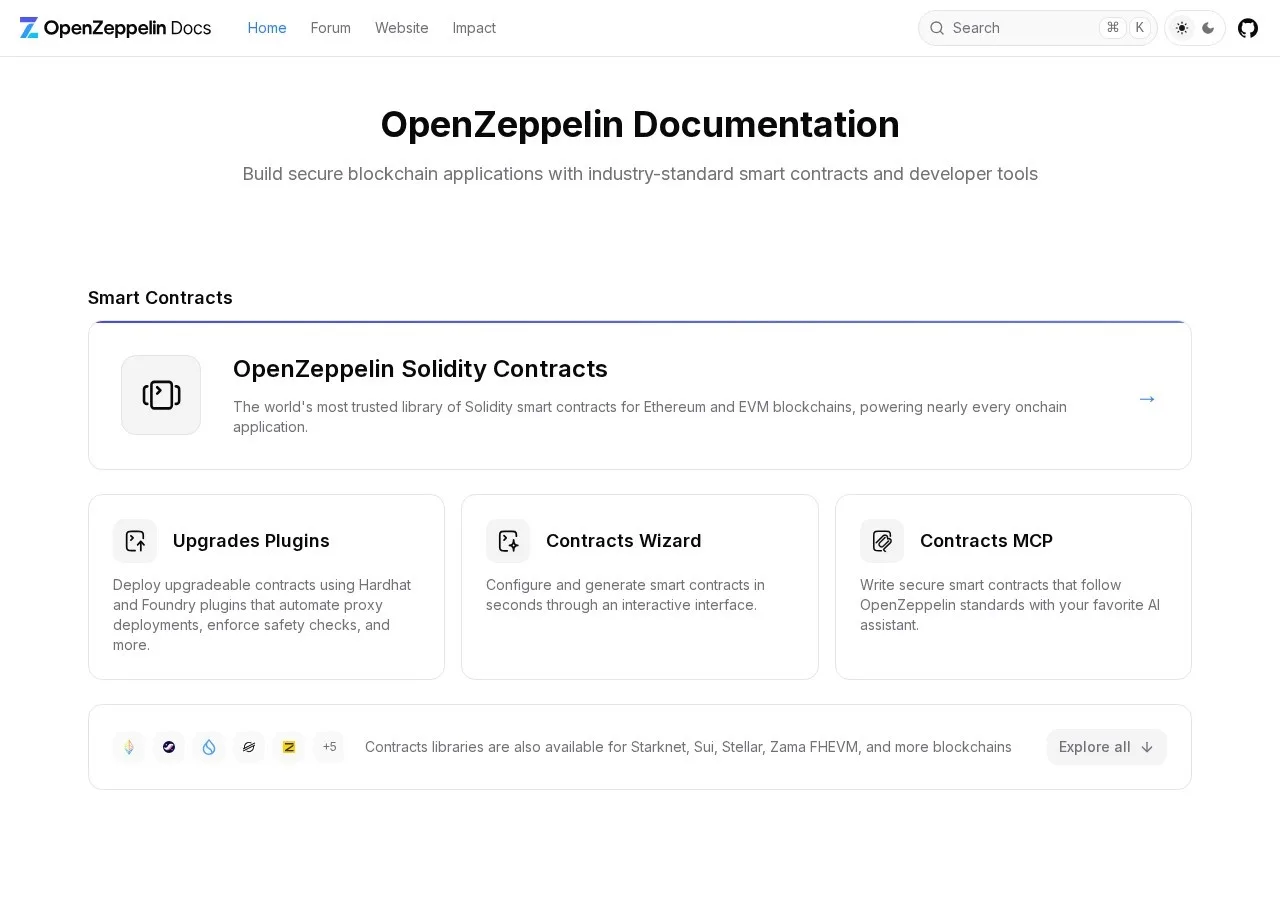
Interactive code generator for custom ERC-20, ERC-721, and ERC-1155 tokens with configurable access controls, governance, and minting rules.
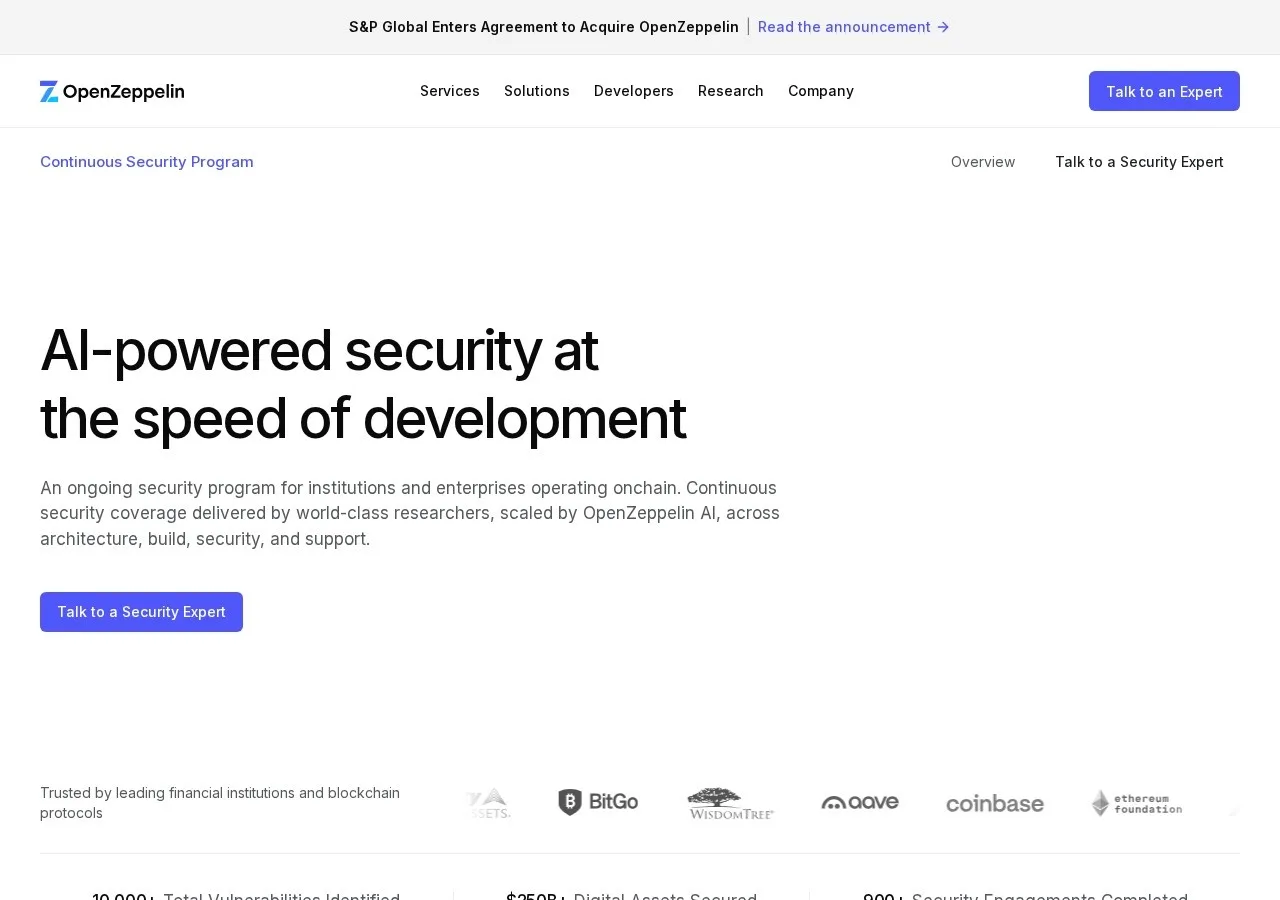
Continuous security program
End-to-end security advisory covering protocol architecture, code audits, and operational risk mitigation for protocols and institutions.
Ethernaut security war game
Interactive educational tool using Solidity contracts to teach onchain vulnerability identification and smart contract security concepts.
Inside OpenZeppelin
OpenZeppelin Contracts
The open-source smart contract library providing standard implementations of ERC standards, access control, and security primitives for EVM-compatible networks.
Continuous Security Program
An institutional advisory service providing protocol architecture reviews, code audits, and operational risk guidance before and after mainnet deployment.
Open Source Relayer & Monitor
AGPL-3.0 licensed developer tooling for automated transaction dispatching and real-time smart contract monitoring across EVM networks, Solana, and Stellar.
OpenZeppelin Defender
A hosted operations, monitoring, and transaction automation SaaS platform scheduled for full retirement on July 1, 2026.
Ethernaut
A free Web3 security war game that teaches smart contract security fundamentals through interactive hacking challenges.
OpenZeppelin screenshots
What users say about OpenZeppelin
There is currently no user feedback available to assess praise or complaints regarding the platform.
Based on 1 Reddit posts and comments from the last 12 months, checked Oct 20, 2026. These are posts by users on other sites, not reviews submitted on CryptoReview.
User reviews
No user reviews yet. Have you used OpenZeppelin? Share your experience below.
FAQ
Who owns OpenZeppelin?
S&P Global entered into an agreement to acquire OpenZeppelin in 2026. The security firm was founded in 2015 and operated independently prior to the acquisition.
How much does OpenZeppelin cost?
OpenZeppelin Contracts and the self-hosted Relayer and Monitor tools are free under open-source licenses, including AGPL-3.0. Institutional audit engagements and the Continuous Security Program use custom enterprise pricing.
What happened to the hosted OpenZeppelin Defender platform?
OpenZeppelin disabled new sign-ups for the hosted Defender SaaS platform on June 30, 2025, and scheduled its complete retirement for July 1, 2026. The hosted service is replaced by self-hosted, open-source Relayer and Monitor applications.
Which blockchains does OpenZeppelin support?
OpenZeppelin supports all EVM networks, Arbitrum, Base, Linea, OP Mainnet, TRON, Solana, and Stellar. The open-source tooling can also be configured for custom private EVM networks and Layer 3 chains.
Does OpenZeppelin have a native cryptocurrency token?
No, OpenZeppelin does not have a native token. The company provides open-source software, developer tools, and institutional security services without issuing crypto assets.
What security certifications does OpenZeppelin hold?
OpenZeppelin holds SOC 2 Type II and Cryptocurrency Security Standard (CCSS) certifications. Its processes are also structured to meet GDPR and CCPA regulatory compliance.
Latest from OpenZeppelin on X
OpenZeppelin is proud to support @summit_defi again this year 🔒
The more value moves onchain, the clearer it is that advancing open security research is fundamental, and gatherings like DSS keep that work moving.
Meet our team and join our talks in Mumbai, Nov 1–2 🇮🇳
The more value moves onchain, the clearer it is that advancing open security research is fundamental, and gatherings like DSS keep that work moving.
Meet our team and join our talks in Mumbai, Nov 1–2 🇮🇳
Post-quantum security is becoming a real design concern for onchain systems.
We're glad to support @Starknet and @StarkWareLtd on an open challenge advancing post-quantum signature verification, open to people and AI agents alike 🔒
We're glad to support @Starknet and @StarkWareLtd on an open challenge advancing post-quantum signature verification, open to people and AI agents alike 🔒
To operate onchain, organizations need privacy and shared control, without handing over the keys.
OpenZeppelin and @0xMiden designed Guardian to that end: the first non-custodial Private State Manager.
Now live as Miden opens to its early partners.
Read the story ↓
https://t.co/aD51pvDU4D
OpenZeppelin and @0xMiden designed Guardian to that end: the first non-custodial Private State Manager.
Now live as Miden opens to its early partners.
Read the story ↓
https://t.co/aD51pvDU4D
OpenZeppelin is now officially a part of S&P Global.
The acquisition we announced in September is finalized. OpenZeppelin’s decade of securing and building the infrastructure onchain finance runs on now meets @SPGlobal's more than a century of helping markets understand risk. Together, we can help institutions and builders move onchain with greater confidence.
To our clients and to all the users of OpenZeppelin open source tools:
• OpenZeppelin Contracts and all our open source applications and tools remain open source, free and publicly maintained on GitHub.
• Security audits, secure development work and ecosystem programs continue with the same team, brand, quality and customer experience, now backed by S&P Global’s research capacity, market data and institutional reach.
For the last decade, OpenZeppelin has set the security standard for onchain finance. Now we take it to the scale of global finance.
Read the full announcement: https://t.co/1hQt9YXhLc

Recent public posts from @OpenZeppelin, shown as published. Not reviewed or endorsed by CryptoReview.
Alternatives to OpenZeppelin

Blockchain infrastructure platform supporting 100+ chains with a free 30M-compute-unit tier
RPC / nodes · Data APIs +3Free tier100 chains supported

Managed blockchain infrastructure across 70+ chains with a free 3M-request monthly tier
RPC / nodes · IndexingFree tier70 chains supported

EVM development and simulation platform supporting transaction debugging and testing across 50+ chains
Developer toolingFree tier50 chains supported
Open-source distributed ledger foundation hosting Fabric, Besu, and Cacti under the Linux Foundation
RPC / nodes · Developer toolingFree tier2 chains supported

Blockchain infrastructure platform providing RPC nodes and data streams across 76 networks
RPC / nodes · Data APIsFree tier76 chains supported

Decentralized blockchain indexing and GraphQL queries across 60+ networks
IndexingFree tier60 chains supported