

We just built an API that returns Stock Tokens on the @RobinhoodCrypto chain in shares, with splits and dividends already applied.
Get balances, read corporate actions, and check finality, all from one API.
5 new JSON-RPC methods 👇 https://t.co/FnxBf14Ftx

Quicknode
Blockchain infrastructure platform providing RPC nodes and data streams across 76 networks
4.2/ 5
Our score
Very good
Services
RPC / nodesData APIs
Chains supported
76
Free tier
Yes
Enterprise SLA
Yes
What is Quicknode?
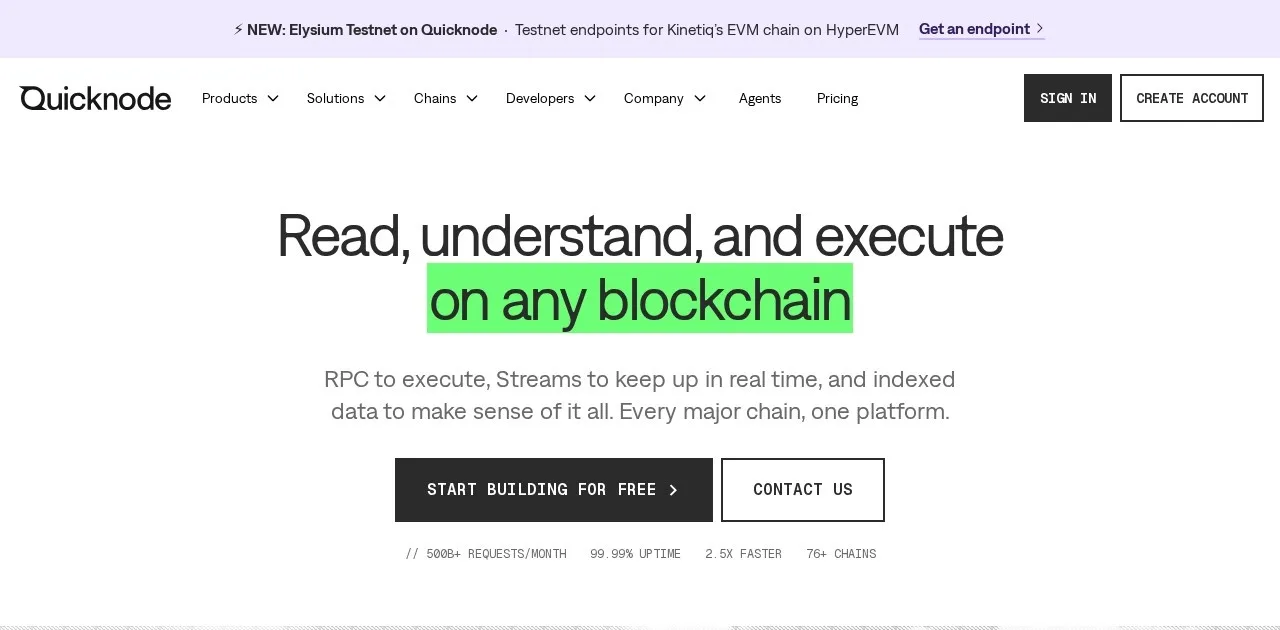
Quicknode is a managed blockchain infrastructure platform providing remote procedure call (RPC) endpoints, dedicated node clusters, and real-time indexing tools across more than 76 blockchain networks. Founded in 2017, the platform processes over 500 billion API requests monthly as of October 2026, serving decentralized applications, trading desks, and Web3 developers.
Company and backing
Based in Miami, United States, Quicknode was co-founded by Alexander Nabutovsky (CEO), Dmitry Shklovsky, Auston Bunsen, and Manuel Kreutz. Nabutovsky previously served as CEO at managed hosting provider ISPrime. The company went through Y Combinator's W21 batch in January 2021 before raising a seed round backed by Seven Seven Six and SoftBank. In October 2021, Quicknode secured a $35M Series A round led by Tiger Global Management, followed by a $60M Series B in January 2023 led by 10T Holdings that valued the business at $800M.
Core infrastructure and mechanics
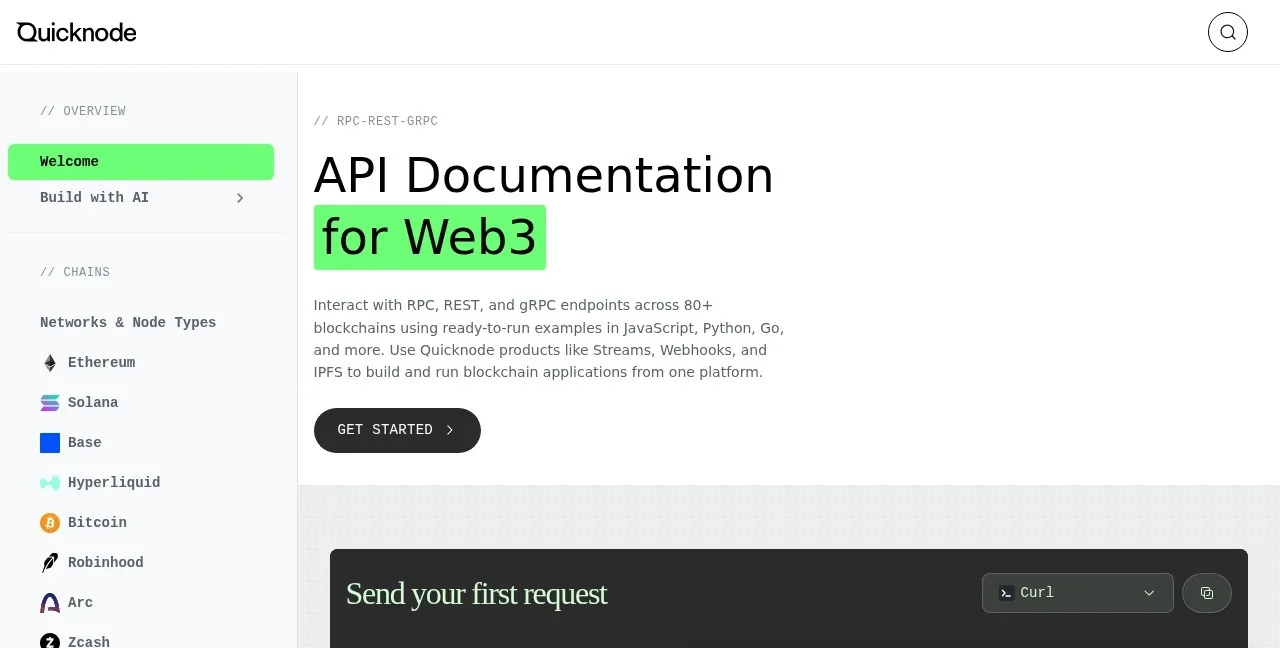
Quicknode routes client requests through globally distributed node infrastructure covering chains such as Ethereum, Solana, Base, Polygon, Hyperliquid, BNB Smart Chain, Optimism, and TRON. Developers connect using standard JSON-RPC, WebSocket, or gRPC interfaces, including dedicated orderbook streams via HyperCore. Beyond core RPC endpoints, the platform offers Quicknode Streams, which applies JavaScript filters at the node level to deliver real-time data pipelines to databases and webhooks. Additional services include dedicated node clusters, IPFS pinning, Validator as a Service for chains like Solana and Monad, and ChainKit for launching custom blockchain rollups. In 2026, the company introduced x402 pay-per-request billing, allowing developers to pay on Base or Solana while routing calls to any supported network.
Compliance and security
The company maintains enterprise security compliance through independent audits, holding active SOC 1 Type 2, SOC 2 Type 2, and ISO 27001 certifications recertified in 2026. For enterprise tiers, Quicknode provides an uptime service level agreement of 99.99% along with dedicated support channels and private endpoint logging.
Trade-offs and risks
Relying on managed infrastructure introduces centralization risks, as third-party RPC outages or failover latency can disrupt connected applications. High-volume workloads require paid tiers or enterprise custom pricing once baseline usage limits are exceeded. Developers also face operational vendor lock-in when integrating custom proprietary tooling like Quicknode Streams or specialized gRPC feeds into their production backends.
Founders
Dmitry ShklovskyCo-Founder
Infrastructure and distributed systems engineer in Web3.
Alexander NabutovskyCEO & Co-Founder
Previously served as Chief Executive Officer at ISPrime, a managed hosting solutions provider.
Auston BunsenCo-Founder
Manuel KreutzCo-Founder
Best for:Web3 developers needing high-throughput RPC endpointsTeams building real-time data pipelines with node filteringEnterprises requiring SOC 2 certified node operationsSolana and Hyperliquid algorithmic trading systems
Pros and cons
Pros
- Processes over 500 billion requests monthly across 76 supported networks
- Offers a 99.99% uptime SLA for enterprise infrastructure
- Maintains SOC 1 Type 2, SOC 2 Type 2, and ISO 27001 certifications
- Provides a free tier for early development and testing
- Streams feature filters blockchain data directly at the node layer
Cons
- Reliance on centralized RPC nodes introduces counterparty infrastructure dependencies
- Proprietary filtering and pipeline tools can create vendor lock-in
- High-throughput enterprise deployments require custom pricing agreements
Our review
4.2/5
Very good
Quicknode delivers low-latency multichain RPC endpoints and data streaming across 76 chains, though relying on managed cloud infrastructure introduces centralization risks and potential vendor lock-in.
Quicknode is a managed blockchain infrastructure provider supporting more than 76 networks, including Ethereum, Solana, Base, Polygon, and Hyperliquid. Operating since 2017, the platform processes over 500 billion requests monthly and targets teams needing high-throughput RPC endpoints without managing physical hardware. Security credentials are among its clearest strengths, backed by independently audited SOC 1 Type 2, SOC 2 Type 2, and ISO 27001 certifications.
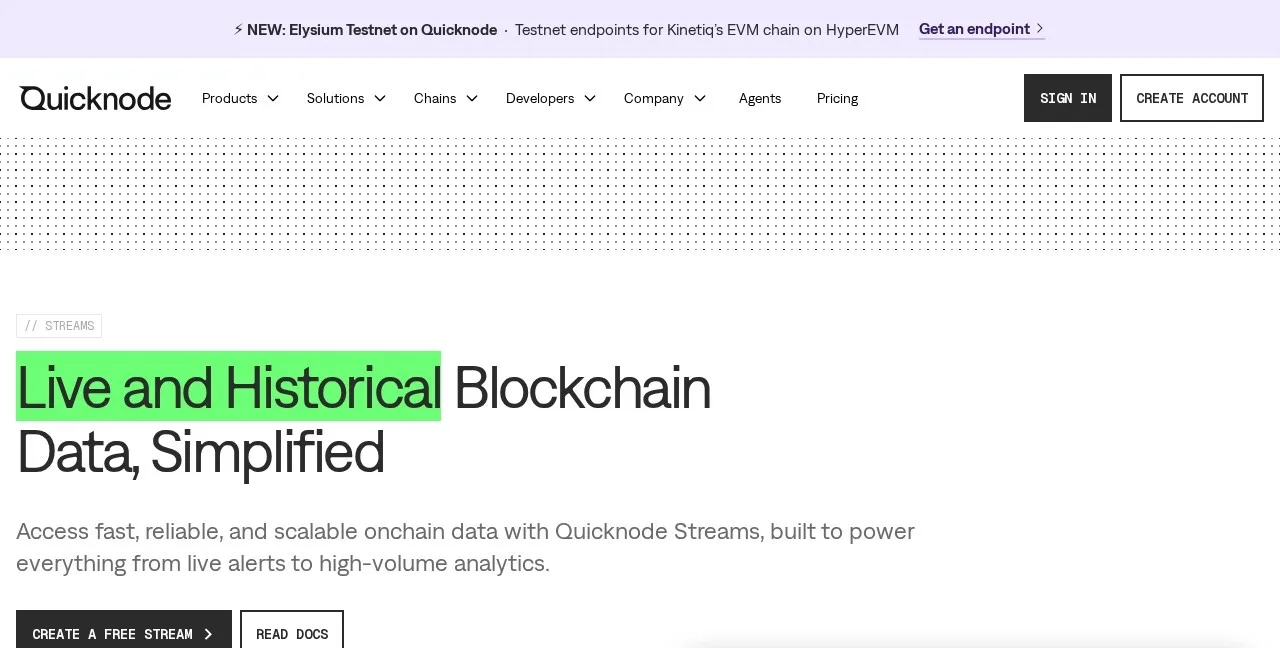
The product suite covers standard Core RPC APIs, real-time data streaming via Streams, custom blockchain deployment through ChainKit, and dedicated clusters. Streams runs custom JavaScript filters directly at the node layer, enabling automated transaction monitoring and exploit alerts before data hits client databases. Developers also have access to specialized tooling, including Hyperliquid HyperCore orderbook streaming via gRPC and decentralized storage through IPFS gateways. A free tier is available, alongside alpha pay-per-request billing via the x402 protocol, which decouples payment chains from queried networks.
Centralization remains the principal structural trade-off. Routing high-volume production traffic through a proprietary third-party RPC network creates reliance on hosted backends, where unexpected downtime can halt user-facing decentralized applications. Teams that migrate custom pipelines to proprietary products like Streams also face vendor lock-in, as retooling ingest pipelines to open-source indexers or self-hosted nodes requires significant refactoring. While the service backs enterprise clients with a 99.99% uptime SLA, regional outages or upstream routing hiccups can still impact dApp availability.
The company behind the platform raised a $60M Series B round in January 2023 at an $800M valuation led by 10T Holdings, following backing from Seven Seven Six, SoftBank, and Tiger Global. Quicknode suits production decentralized applications, trading desks needing sub-second node access, and developers requiring turnkey multichain support. Projects committed to complete infrastructure sovereignty or zero third-party dependencies should run their own bare-metal client nodes instead.
Sources (1)
Specs
| Services | RPC / nodes, Data APIs |
|---|---|
| Chains supported | 76 · unverified |
| Free tier | Yes |
| Enterprise SLA | Yes · unverified |
| Uptime SLA | 99.99% · unverified |
Not disclosed by the provider: Pricing from, Open source, Token, Free tier limits, Server regions.
Data from the provider's website and public sources. Fees and availability change; confirm on the official site before you sign up.
Key features
Multi-chain RPC endpoints
Supports JSON-RPC and WebSocket connections across more than 76 blockchains including Ethereum, Solana, Base, and Hyperliquid.
Streams data filtering
Executes custom JavaScript filters directly at the node level to deliver real-time blockchain event streams into Postgres and webhooks.
HyperCore gRPC streaming
Delivers low-latency orderbook streaming for Hyperliquid through specialized L2 and L4 gRPC endpoints.
Validator as a Service
Hosts institutional staking and validator node operations across networks such as Solana and Monad.
x402 agentic billing
Enables pay-per-request RPC access funded via Base or Solana while querying any supported network.
Enterprise node clusters
Provides dedicated node infrastructure and endpoint logs backed by a 99.99% uptime service level agreement.
Inside Quicknode
Core RPC API
Provides low-latency RPC endpoints supporting read and write operations across more than 76 blockchain networks.
Streams
Delivers real-time blockchain event streaming with custom JavaScript filters executing directly on node infrastructure.
Dedicated Clusters
Supplies isolated, dedicated blockchain node infrastructure designed to handle enterprise-level request volumes.
Validator as a Service
Provides managed validator node infrastructure across supported networks such as Solana and Monad.
ChainKit
Offers modular infrastructure tooling to deploy, configure, and operate custom blockchain networks.
IPFS
Provides dedicated IPFS pinning services and decentralized storage gateways for web3 media and metadata.
Quicknode screenshots
What users say about Quicknode
There is minimal user discussion available, consisting almost entirely of team announcements and promotional posts. A single mention highlights competitive RPC speeds, with no complaints reported.
In their own words
“For Quicknode (generally faster for RPC than Helius), log in at to set uo manually or use the API at setting templateArgs to monitor the accounts you care about”
Based on 5 Reddit posts and comments from the last 12 months, checked Oct 20, 2026. These are posts by users on other sites, not reviews submitted on CryptoReview.
User reviews
No user reviews yet. Have you used Quicknode? Share your experience below.
Funding and investors
$95MTotal raised
3Rounds
4Investors
FAQ
Who founded Quicknode?
Quicknode was founded in 2017 by Dmitry Shklovsky, Alexander Nabutovsky, Auston Bunsen, and Manuel Kreutz. Alexander Nabutovsky serves as the company's CEO.
Does Quicknode have a token?
No, Quicknode does not have a native token. The company operates as a traditional managed infrastructure provider funded by venture capital.
Which blockchain networks does Quicknode support?
Quicknode supports more than 76 blockchain networks. Supported chains include Ethereum, Solana, Base, Polygon, Hyperliquid, BNB Smart Chain, Optimism, and TRON.
What security certifications does Quicknode hold?
Quicknode maintains AICPA SOC 1 Type 2 and SOC 2 Type 2 reports, as well as an ISO 27001 certification. These independent audits verify the security, operational integrity, and data protection practices of its platform.
What is Quicknode Streams?
Quicknode Streams is a real-time blockchain data streaming service that applies custom JavaScript filters directly at the node level. It pushes filtered blockchain events and decoded data directly to webhooks or databases without requiring manual polling.
Latest from Quicknode on X
Applying to @ycombinator this cycle? Build your stablecoin, trading, or agent startup on Quicknode across 70+ chains.
YC founders get $15K in credits: apply at https://t.co/hQMeYDbDmX to unlock the deal⚡️
YC founders get $15K in credits: apply at https://t.co/hQMeYDbDmX to unlock the deal⚡️
Interesting
A @circle CCTP burn is a receipt with the arrival torn off.
The @USDC is already gone. That still does not mean it settled on @arc, and the burn will not show the fee.
This guide puts both halves into a single Postgres table👇 https://t.co/rJIGJfafuh
The @USDC is already gone. That still does not mean it settled on @arc, and the burn will not show the fee.
This guide puts both halves into a single Postgres table👇 https://t.co/rJIGJfafuh

🤝
Recent public posts from @quicknode, shown as published. Not reviewed or endorsed by CryptoReview.
Alternatives to Quicknode

Open-source smart contract libraries and enterprise security tooling backing over $38T in transfers
Developer toolingFree tier10 chains supported

Blockchain infrastructure platform supporting 100+ chains with a free 30M-compute-unit tier
RPC / nodes · Data APIs +3Free tier100 chains supported

Managed blockchain infrastructure across 70+ chains with a free 3M-request monthly tier
RPC / nodes · IndexingFree tier70 chains supported

EVM development and simulation platform supporting transaction debugging and testing across 50+ chains
Developer toolingFree tier50 chains supported

Open-source distributed ledger foundation hosting Fabric, Besu, and Cacti under the Linux Foundation
RPC / nodes · Developer toolingFree tier2 chains supported

Decentralized blockchain indexing and GraphQL queries across 60+ networks
IndexingFree tier60 chains supported