

Please visit https://t.co/00tUniaghp for further updates!

Hyperledger
Open-source distributed ledger foundation hosting Fabric, Besu, and Cacti under the Linux Foundation
4.2/ 5
Our score
Very good
Services
RPC / nodesDeveloper tooling
Chains supported
2
Free tier
Yes
Pricing from
Free
What is Hyperledger?
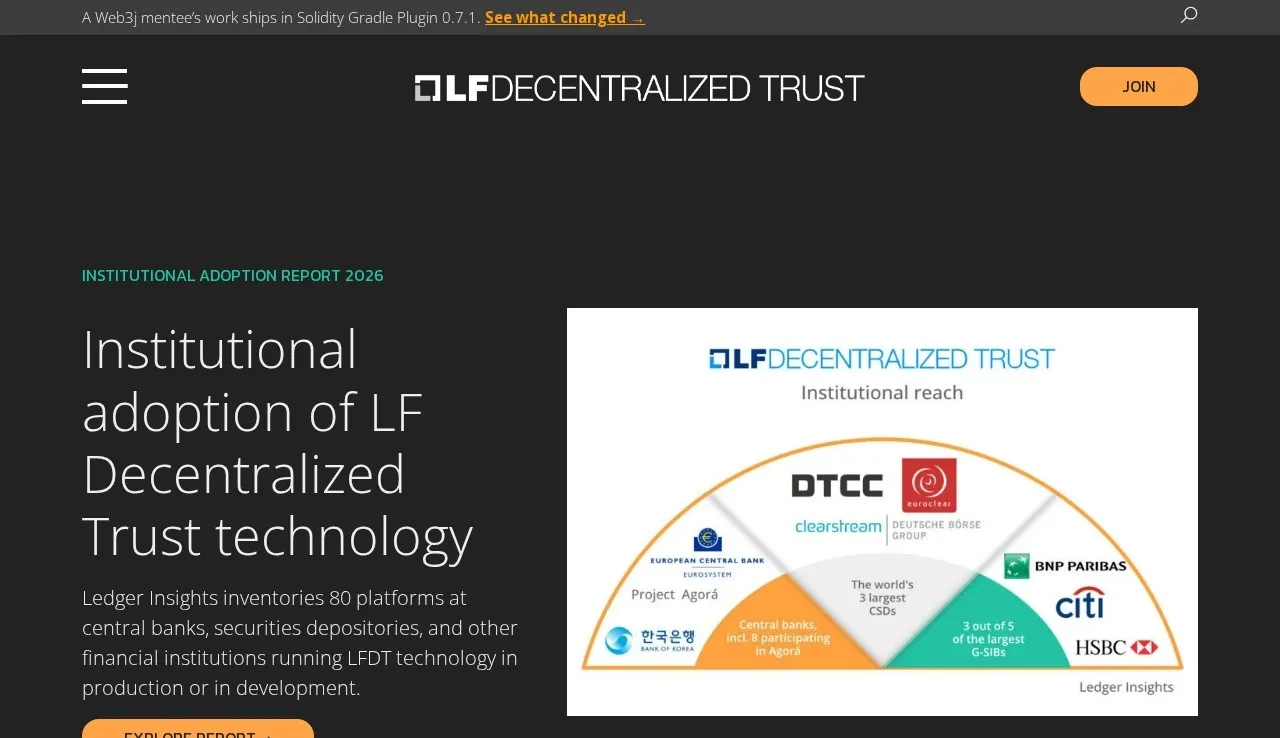
Hyperledger, operating under the Linux Foundation as LF Decentralized Trust, is an open-source collaborative umbrella for distributed ledger frameworks, smart contract engines, and interoperability tools. As of 2026, 80 institutional platforms across central banks, securities depositories, and financial institutions run in production or development on its codebases.
Governance and contributors
The foundation is headquartered in San Francisco and operates under the Linux Foundation. Daniela Barbosa leads the organization as Executive Director and General Manager of Decentralized Technologies, succeeding initial leadership from Brian Behlendorf. The project relies on open-source contributions from enterprises and research bodies, including maintainers from IBM Research such as Senthil Natarajan, Angelo De Caro, and Kaoutar El Khiyaoui. Member organizations include Citi, Deutsche Telekom, Partior, Swift, and Wells Fargo.
Core frameworks and architecture
Rather than providing a hosted RPC node service or operating a single public blockchain, the foundation stewards modular, self-hosted software stacks. Hyperledger Fabric provides a modular permissioned distributed ledger architecture featuring private channels and endorsement policies. Hyperledger Besu is an enterprise-grade execution client for Ethereum, supporting public networks like Ethereum mainnet and testnets alongside private consortium environments using Proof of Authority algorithms such as IBFT 2.0, QBFT, and Clique. Additional graduated frameworks include Hyperledger Cacti for cross-chain ledger integration, Hyperledger Indy for decentralized identity, and Hyperledger FireFly for multiparty enterprise data flows.
Licensing and operational costs
All core software repositories are open-source and free to deploy under Apache-2.0 and Linux Foundation governance. The project charges no software subscription fees and requires no mandatory native utility tokens to operate the code. Organizations cover their own hosting and hardware costs, or contract commercial vendors for enterprise support agreements.
Track record and technical trade-offs
In 2024, the Linux Foundation expanded Hyperledger's charter into LF Decentralized Trust. In September 2026, the ecosystem released Hyperledger Cacti 3.0 to expand cross-chain interoperability. Because these technologies are self-hosted frameworks rather than managed infrastructure APIs, deploying multi-organization networks requires significant technical overhead. Node operators do not receive managed vendor SLAs directly from the foundation and must manage their own network validation and access control policies to prevent system downtime.
Founders
Brian BehlendorfExecutive Director
David BoswellDirector of Ecosystem
Best for:Financial institutions building private consortiumsEnterprises running private Ethereum networksDevelopers deploying self-hosted identity infrastructure
Pros and cons
Pros
- Core codebase is free and open-source under the Apache-2.0 license
- Used across 80 institutional platforms at central banks and financial firms
- No native token required to deploy or operate private consortium networks
- Besu supports both public Ethereum networks and private Proof of Authority deployments
Cons
- Self-hosted frameworks lack managed RPC endpoints and uptime service level agreements
- Requires internal DevOps teams to manage node deployments, upgrades, and consensus
- Consortium setups introduce operational coordination friction across independent enterprise partners
Our review
4.2/5
Very good
LF Decentralized Trust provides mature, open-source enterprise infrastructure for institutional consortia, but requires self-managed hosting and lacks managed hosted node SLAs.
Hyperledger, reorganized in 2024 as LF Decentralized Trust under the Linux Foundation, is an umbrella organization for open-source enterprise distributed ledger frameworks and tooling. Rather than operating as a cloud-hosted RPC vendor or proprietary data provider, the project publishes open-source software codebases under permissive licensing. Institutional adoption reached 80 platforms in production or development across central banks and securities depositories by 2026, backed by members including Citi, Deutsche Telekom, Swift, and Wells Fargo.
The foundation hosts multiple mature distributed ledger implementations. Hyperledger Besu is an enterprise-grade execution client for Ethereum, compatible with public networks and private consortium chains via IBFT 2.0, QBFT, and Clique proof-of-authority consensus. Hyperledger Fabric provides modular permissioned ledger capabilities with access-controlled channels and private data collections. Additional graduated and incubating frameworks include Hyperledger Cacti for cross-chain interoperability, Hyperledger FireFly for multiparty business flows, Hyperledger Indy for decentralized identity, and Panurus for token management.
Key strengths include code transparency, zero software licensing fees, and broad institutional backing led by Executive Director Daniela Barbosa. Organizations deploying these frameworks avoid vendor lock-in and obtain full control over consensus and node architecture. However, deploying Hyperledger technologies carries operational trade-offs:
- Node uptime and system availability depend entirely on internal platform teams or certified third-party service providers rather than a centralized provider SLA.
- The codebases do not offer public consumer RPC endpoints or managed indexing APIs out of the box.
- Frameworks like Fabric introduce operational complexity around membership service providers and chaincode endorsement policies.
LF Decentralized Trust suits enterprises and development teams constructing private permissioned networks or running sovereign Ethereum execution clients. Developers looking for managed API endpoints should choose commercial RPC node services instead.
Specs
| Services | RPC / nodes, Developer tooling · unverified |
|---|---|
| Chains supported | 2 · unverified |
| Free tier | Yes · unverified |
| Pricing from | Free · unverified |
| Open source | Yes · unverified |
| Free tier limits | Open source codebases under Apache-2.0 license · unverified |
Not disclosed by the provider: Enterprise SLA, Token, Uptime SLA, Server regions.
Data from the provider's website and public sources. Fees and availability change; confirm on the official site before you sign up.
Key features
Enterprise Ethereum execution
Hyperledger Besu operates as an open-source Ethereum client supporting public networks as well as private consortium configurations with QBFT and IBFT 2.0 consensus.
Modular permissioned ledgers
Hyperledger Fabric provides private data collections, pluggable consensus mechanisms, and granular membership service provider access controls.
Cross-chain interoperability
Hyperledger Cacti allows teams to route transactions and integrate state verification across multiple disparate distributed ledgers.
Multiparty data orchestration
Hyperledger FireFly abstracts low-level blockchain mechanics to bridge legacy enterprise APIs and business systems with decentralized ledgers.
Decentralized identity tools
Hyperledger Indy delivers purpose-built libraries and verifiable credential components that operate across isolated administrative silos.
Tokenization infrastructure
Incubating frameworks like Panurus provide platform-neutral token toolkits designed for asset tokenization and central bank digital currency architectures.
Inside Hyperledger
Hyperledger Fabric
An enterprise-grade permissioned distributed ledger framework offering a modular architecture with plug-and-play consensus and private data channels.
Hyperledger Besu
An open-source Java-based Ethereum client designed for public networks as well as private permissioned deployments with proof-of-authority consensus algorithms.
Hyperledger Cacti
A decentralized interoperability framework that connects diverse blockchain networks and enables cross-chain transactions.
Hyperledger FireFly
A complete multiparty system for enterprise data flows that bridges core distributed ledgers with existing off-chain business applications and user interfaces.
Hiero
The open-source distributed ledger codebase used to power the Hedera network, including hashgraph consensus, core services, and associated tooling.
Hyperledger Indy
A framework providing tools, reusable libraries, and decentralized components built specifically for verifiable digital identity management.
Panurus
A platform-neutral token infrastructure project built for tokenized asset management and compliant digital currency deployments.
Hyperledger screenshots
User reviews
No user reviews yet. Have you used Hyperledger? Share your experience below.
FAQ
Who runs Hyperledger?
Hyperledger operates under the Linux Foundation as LF Decentralized Trust, led by Executive Director Daniela Barbosa. Brian Behlendorf previously served as Executive Director during its initial formation.
How much does Hyperledger software cost?
The software is completely free. All frameworks and libraries are distributed as open-source software under the LF Decentralized Trust umbrella.
Does Hyperledger have a token?
No, Hyperledger and LF Decentralized Trust do not have a native token. The organization produces open-source software frameworks rather than running a public tokenized blockchain.
What blockchains and distributed ledgers does Hyperledger support?
It develops dedicated ledgers including Hyperledger Fabric and Hyperledger Iroha, the Hyperledger Besu execution client for Ethereum networks, and the Hiero codebase for Hedera. Cross-chain integrations are handled via Hyperledger Cacti.
Does Hyperledger provide hosted RPC node services or uptime SLAs?
No, LF Decentralized Trust produces open-source software rather than managed cloud node hosting. Teams deploy and manage their own nodes or contract with external certified service providers to meet uptime requirements.
Latest from Hyperledger on X
Recent public posts from @hyperledger, shown as published. Not reviewed or endorsed by CryptoReview.
Alternatives to Hyperledger

Open-source smart contract libraries and enterprise security tooling backing over $38T in transfers
Developer toolingFree tier10 chains supported

Blockchain infrastructure platform supporting 100+ chains with a free 30M-compute-unit tier
RPC / nodes · Data APIs +3Free tier100 chains supported

Managed blockchain infrastructure across 70+ chains with a free 3M-request monthly tier
RPC / nodes · IndexingFree tier70 chains supported

EVM development and simulation platform supporting transaction debugging and testing across 50+ chains
Developer toolingFree tier50 chains supported

Blockchain infrastructure platform providing RPC nodes and data streams across 76 networks
RPC / nodes · Data APIsFree tier76 chains supported

Decentralized blockchain indexing and GraphQL queries across 60+ networks
IndexingFree tier60 chains supported