


The names that move Japan 🇯🇵
Toyota. Sony. Nintendo. Tokyo Electron.
Access real-time prices for 21 Japanese equities through Pyth Pro. https://t.co/RuITUBv7PE

3.8/ 5
Our score
Good
Services
Oracle
Chains supported
100
Free tier
Yes
Pricing from
$0/month
Token
PYTH
What is Pyth Network?
Pyth Network is a pull-based oracle and market-data infrastructure provider. It publishes first-party prices from institutional data publishers and trading firms, with 500+ price feeds across more than 100 blockchains. Coverage includes crypto, equities, foreign exchange, commodities, rates and other markets.
Products and network
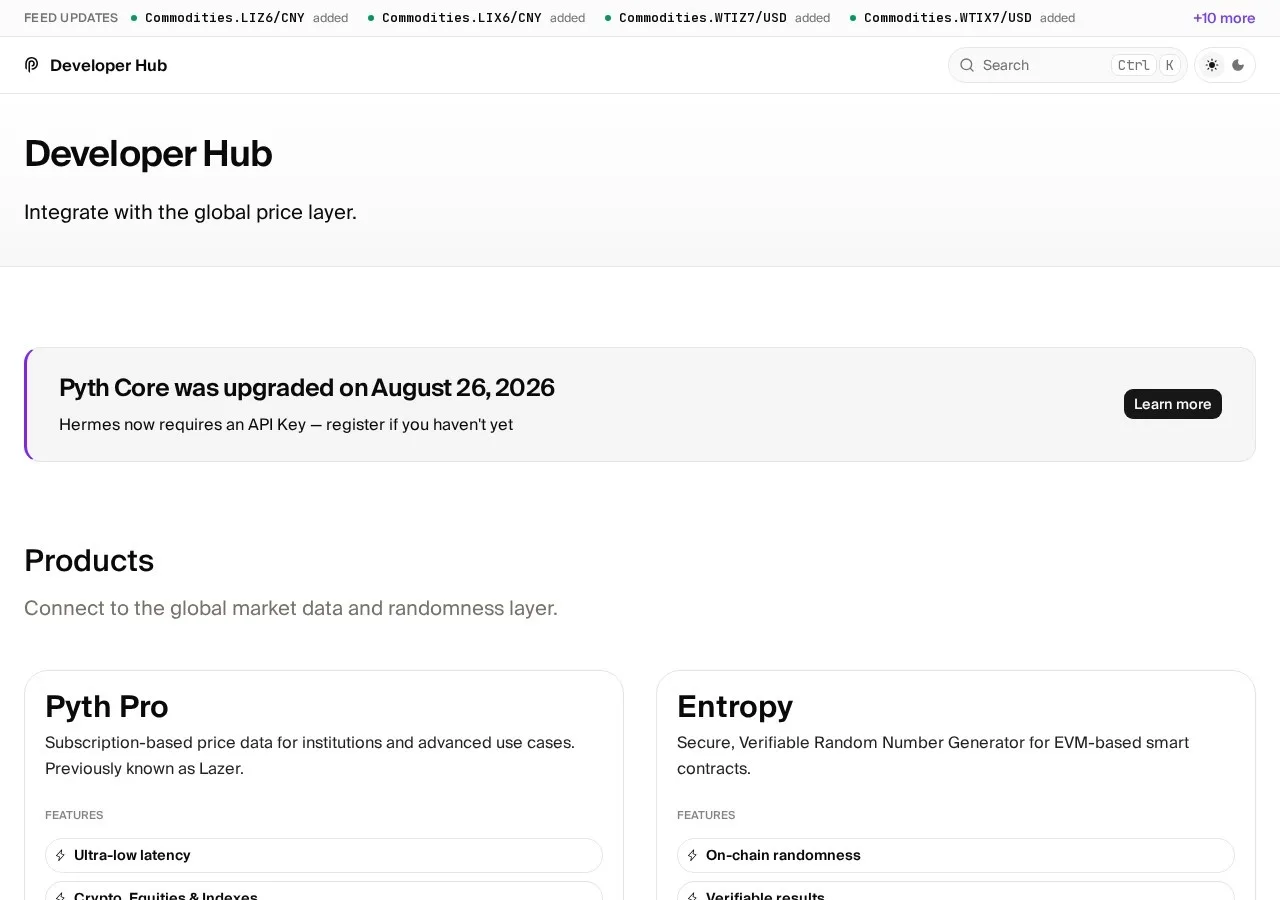
Applications fetch signed prices from Hermes and verify them on-chain in one transaction with Pyth Price Feeds. Pyth Core supports Ethereum, Solana, Sui and EVM-compatible chains. Other ecosystems can access data through the Hermes API, which requires a Pyth API Key, a requirement introduced on August 26, 2026.
Pyth Pro delivers low-latency market data through APIs and delivery channels for institutions, trading venues, applications and AI systems. Pyth Terminal provides a market-data interface with view-only and API-access plans. Pyth Indices supplies continuous benchmarks, including 24/7 coverage for markets that do not trade around the clock.
Fees and access
On-chain price data has full display rights and zero licensing fees. Pyth Terminal has a $0/month Free plan. The Starter plan costs $500/month plus applicable tax, while the Pro plan starts at $2,500/month plus applicable tax. Pyth Indices pricing is set with the team. Pyth Core subscription plans started at $500 per month after the July 31, 2026 infrastructure upgrade.
Track record
As of September 2026, the network reported 138+ data publishers, 720+ data consumers, 3,600+ live price feeds and more than $5 trillion in transaction volume. It also reported $11.5 million in annual recurring revenue, more than 3,811 Pyth Pro symbols and 61 continuous indices that month. Pyth Terminal had 129,265 monthly active users and 276 paying accounts in September 2026. The service status report recorded 99.97% uptime for two components and 100% uptime for other components during May to August 2026.
Risks and limitations
Applications depend on the accuracy and availability of publisher data and delivery services. Incorrect or manipulated prices can affect liquidations and settlement. The API key requirement adds a service dependency, while Pyth Pro and Terminal use commercial plans. PYTH governance and token economics can also affect network incentives and product revenue decisions.
Best for:DeFi lending and derivativesMulti-chain application developersInstitutional market-data teamsPrediction-market infrastructure
Pros and cons
Pros
- 500+ feeds across more than 100 blockchains
- Supports Ethereum, Solana, Sui and EVM-compatible chains
- Permissionless on-chain contracts
- Free Terminal plan at $0/month
- Covers crypto and traditional asset classes
- Reported 3,600+ live feeds in September 2026
Cons
- Hermes API access requires a Pyth API Key
- Pyth Pro Starter costs $500/month plus applicable tax
- Oracle users depend on publisher data accuracy
- Incorrect prices can affect liquidations and settlement
Our review
3.8/5
Good
Pyth offers broad, low-latency market data across more than 100 blockchains, but commercial plans and reliance on publisher infrastructure add cost and concentration risk.
Pyth combines an on-chain oracle with commercial market-data products. Pyth Core provides 500+ price feeds with 400-millisecond updates across more than 100 blockchains, while Pyth Pro covers crypto, equities, foreign exchange, commodities, rates and other asset classes. Teams outside EVM chains, Solana and Sui rely on the Hermes API.
Coverage is a clear strength. The network reported 138+ data publishers, 720+ data consumers and 3,600+ live price feeds in September 2026, with more than $5 trillion in transaction volume. It also reported 3,811+ Pyth Pro symbols and 61 continuous indices. The publisher set includes market-data firms and trading venues, and named integrations include Nasdaq, Coinbase, Kraken, Tradeweb and Polymarket. These figures show Pyth's reported asset and customer coverage, but they do not remove oracle manipulation or risks related to publisher data.
Developers get permissionless on-chain contracts and signed prices fetched from Hermes, with support for EVM chains, Solana and Sui. The trade-off is that Hermes requires a Pyth API key since August 26, 2026. Pyth's website advertises 24/7 coverage, full display rights and zero licensing fees for its price data, while Pyth Terminal has a free plan. Paid access starts at $500 per month for Terminal Starter and $2,500 per month for Terminal Pro.
The status record reported full operation from July through October 2026, with component uptime figures of 99.97% and 100% for the May to August 2026 period. The 2026 Pyth Core upgrade replaced legacy infrastructure, reduced latency and expanded coverage. The network is open source according to its listing attributes, and its on-chain contracts are permissionless. Still, applications depend on publisher quality, API availability and token-linked governance. PYTH is also affected by token economics, including the October 2026 policy directing eligible product revenue to open-market buybacks.
Pyth suits DeFi, derivatives and institutional-data teams that need many assets across several chains.
Specs
| Services | Oracle |
|---|---|
| Chains supported | 100 · unverified |
| Free tier | Yes · unverified |
| Pricing from | $0/month · unverified |
| Open source | Yes |
| Token | PYTH |
| Uptime SLA | 99.97% · unverified |
Not disclosed by the provider: Enterprise SLA, Free tier limits, Server regions.
Data from the provider's website and public sources. Fees and availability change; confirm on the official site before you sign up.
Key features
Pull-based price feeds
Applications fetch signed prices from Hermes and verify them on-chain in one transaction.
Multi-chain coverage
Pyth Core supports Ethereum, Solana, Sui and EVM-compatible chains, with access through Hermes for other ecosystems.
Institutional data APIs
Pyth Pro delivers low-latency data for crypto, equities, foreign exchange, commodities, rates and other markets.
Continuous indices
Pyth Indices provides 24/7 benchmark data, including markets whose underlying venues do not trade continuously.
Developer access
The on-chain contracts are permissionless, while Hermes API access requires a Pyth API Key since August 26, 2026.
Market-data terminal
Pyth Terminal offers view-only and API-access plans, including a $0/month Free plan and paid upgrades.
First-party publishing
Prices come from institutional data publishers and trading firms rather than a single external aggregation source.
Inside Pyth Network
Pyth Pro
Pyth Pro provides low-latency market data to institutions, trading venues, applications and AI systems. It covers crypto, equities, foreign exchange, commodities and other asset classes through APIs and delivery channels, with 3,811+ symbols reported in September 2026.
Pyth Terminal
Pyth Terminal is the interface for exploring price feeds, comparing plans, managing API keys and accessing real-time market data. It has a free plan, with Starter at $500 per month plus applicable tax and Pro starting at $2,500 per month plus applicable tax.
Pyth Indices
Pyth Indices provides index feeds across crypto, equities and macro markets, including 24/7 pricing with weekend coverage. The network reported 61 continuous indices in September 2026 and 59 live indices on October 15, 2026.
Pyth Core
Pyth Core is the pull-based oracle infrastructure for on-chain applications. It provides 500+ feeds with 400-millisecond updates across more than 100 blockchains. Applications fetch signed prices from Hermes and verify them on-chain.
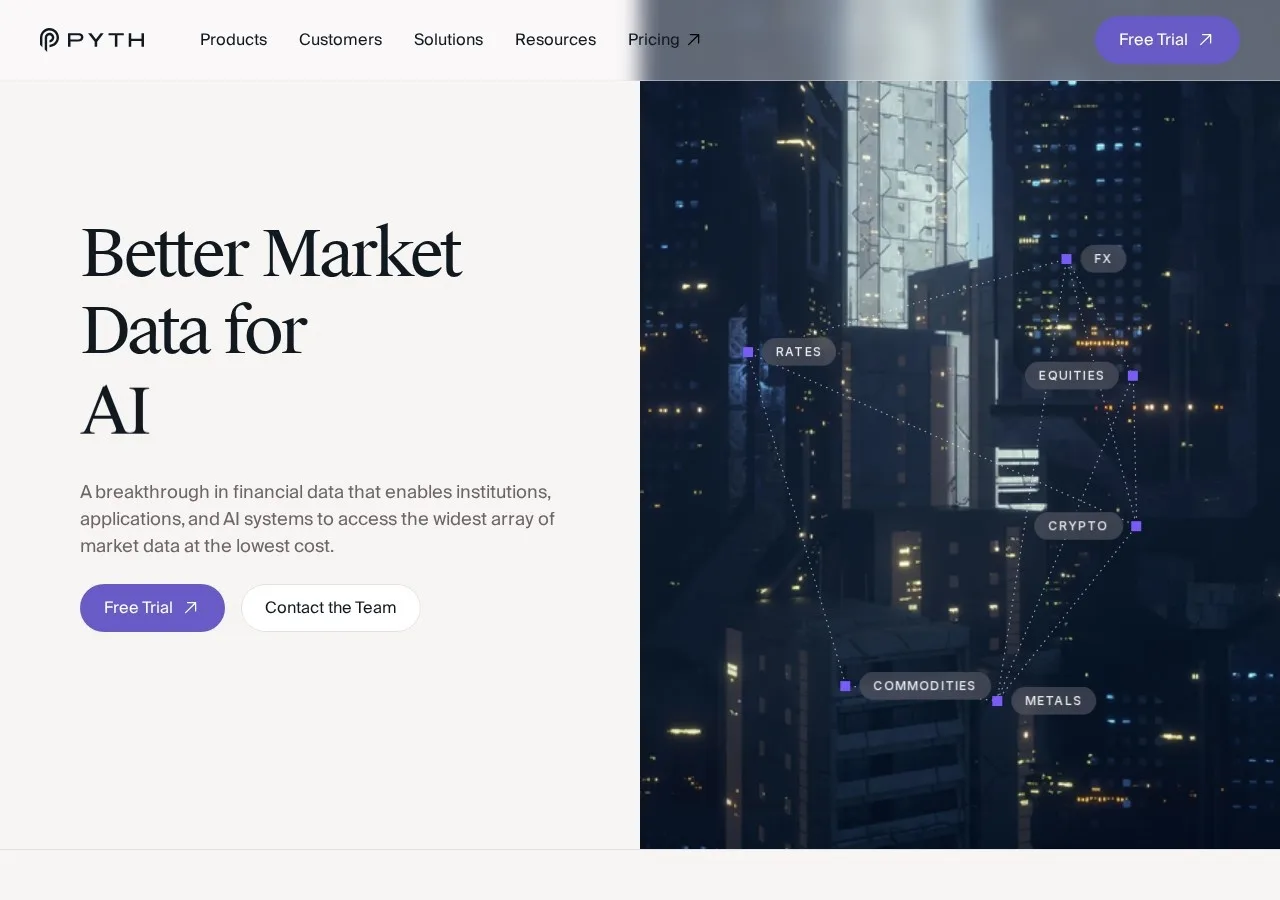
Pyth Network screenshots
User reviews
No user reviews yet. Have you used Pyth Network? Share your experience below.
Funding and investors
2Rounds
10Investors
-
Strategic Dec 2023 Amount undisclosedBV Bodhi VenturesVenture capital
 Borderless CapitalVenture capital
 CMT DigitalCorporate VC
 Castle Island VenturesVenture capital
DD Delphi DigitalVenture capital
DG Distributed GlobalVenture capital
GV Gate VenturesExchange ventures arm
 Multicoin CapitalHedge fund
WV Wintermute VenturesVenture capital
-
Funding round Amount undisclosed
FAQ
What is Pyth Network used for?
Pyth Network supplies market data to blockchain applications and institutional systems. Its products cover on-chain price feeds, commercial APIs, indices and market-data access across crypto and equities.
How much does Pyth Network cost?
Pyth Terminal has a free plan at $0 per month, while Starter costs $500 per month plus applicable tax and Pro starts at $2,500 per month plus applicable tax. Pyth Indices pricing is set with the team.
Which blockchains does Pyth support?
Pyth Core supports major EVM chains, Solana and Sui by default, and the documentation describes coverage across more than 100 blockchains. Other ecosystems can access price data through the Hermes API.
Does Pyth Network have a token?
Yes. The network token is PYTH. In October 2026, the Pyth DAO approved a policy directing 100% of eligible product revenue toward open-market PYTH buybacks.
How does Pyth Network provide oracle data?
Pyth collects market data from institutional and trading-firm publishers, then lets applications fetch signed prices from Hermes and verify them on-chain. Its pull-based Pyth Core feeds report 400-millisecond updates.
Is Pyth Network suitable for institutional market data?
Pyth Pro is designed for institutions, trading venues, applications and AI systems, with more than 3,811 symbols reported for September 2026. Pyth Terminal also provides view-only and API access plans across multiple asset classes.
Latest from Pyth Network on X
More of the world's markets are now covered on Pyth Pro:
- Expanded China equity coverage
- Additional Japanese equities
- More energy commodity futures
- VIX futures
Global market data. One subscription 🌐 https://t.co/1hhRQqYCnp
- Expanded China equity coverage
- Additional Japanese equities
- More energy commodity futures
- VIX futures
Global market data. One subscription 🌐 https://t.co/1hhRQqYCnp
The world’s largest energy markets are watching the rise of perpetuals.
On ICE’s Q3 earnings call, Chair and CEO Jeff Sprecher cited Pyth data on oil perpetuals while discussing how these markets complement traditional futures.
Pyth data is becoming part of finance’s defining conversations.
On ICE’s Q3 earnings call, Chair and CEO Jeff Sprecher cited Pyth data on oil perpetuals while discussing how these markets complement traditional futures.
Pyth data is becoming part of finance’s defining conversations.

The US Treasury par curve, now in real time.
14 constant-maturity indices are live on Pyth: par yields and discount factors for 2Y, 3Y, 5Y, 7Y, 10Y, 20Y and 30Y. https://t.co/QHNWv9Hcbe
14 constant-maturity indices are live on Pyth: par yields and discount factors for 2Y, 3Y, 5Y, 7Y, 10Y, 20Y and 30Y. https://t.co/QHNWv9Hcbe

Hyperliquid.
Recent public posts from @PythNetwork, shown as published. Not reviewed or endorsed by CryptoReview.
Alternatives to Pyth Network

Open-source smart contract libraries and enterprise security tooling backing over $38T in transfers
Developer toolingFree tier10 chains supported

Blockchain infrastructure platform supporting 100+ chains with a free 30M-compute-unit tier
RPC / nodes · Data APIs +3Free tier100 chains supported

Managed blockchain infrastructure across 70+ chains with a free 3M-request monthly tier
RPC / nodes · IndexingFree tier70 chains supported

EVM development and simulation platform supporting transaction debugging and testing across 50+ chains
Developer toolingFree tier50 chains supported

Open-source distributed ledger foundation hosting Fabric, Besu, and Cacti under the Linux Foundation
RPC / nodes · Developer toolingFree tier2 chains supported

Blockchain infrastructure platform providing RPC nodes and data streams across 76 networks
RPC / nodes · Data APIsFree tier76 chains supported