

A new medium severity advisory has been posted: https://t.co/92x4W9R9Su

Bitcoin Core
Open-source Bitcoin node and wallet, first released in 2009 under Satoshi Nakamoto
3.3/ 5
Our score
Fair
Services
RPC / nodesDeveloper tooling
Chains supported
1
Free tier
Yes
Pricing from
Free
Enterprise SLA
No
Token
BTC
What is Bitcoin Core?
Bitcoin Core is open-source software for running a fully validating Bitcoin full node and an integrated wallet on the Bitcoin network. It is a direct descendant of the original Bitcoin client released by Satoshi Nakamoto in 2009. The software also includes an RPC interface for applications and maintains the libsecp256k1 cryptography library.
Who maintains Bitcoin Core
Satoshi Nakamoto is the original author and creator of Bitcoin and initially published the software. Bitcoin Core has no CEO, parent company, or formal governance body. A group of maintainers has commit access to the code repository, while contributors propose patches, review code, test releases, and maintain documentation. Bitcoin Core development is supported by grants and donations from crypto organisations and research initiatives.
How the software works
Operators run the software on supported systems such as Linux, Windows, macOS, and other desktop platforms. A full node downloads and validates the Bitcoin blockchain, checks transactions against consensus rules, and relays them across peers while exposing RPC methods for connected applications. The integrated wallet can create and manage Bitcoin transactions. Its opt-in Replace-by-Fee system lets marked transactions be replaced with a higher-fee version before confirmation. Bitcoin Core supports Bitcoin only.
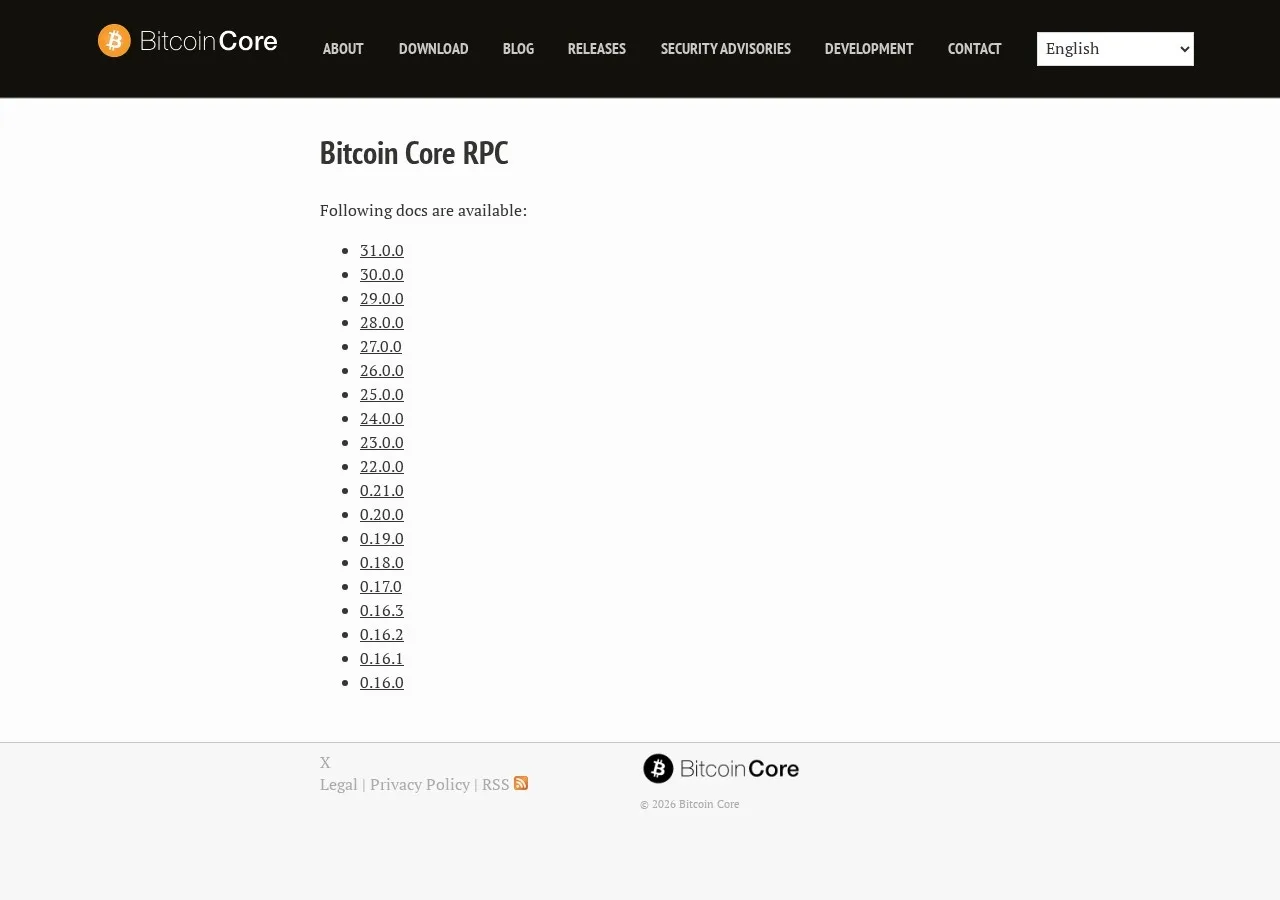
Running a node requires local storage for the growing blockchain. The full ledger was larger than 608.9 GB in October 2024. The project publishes RPC documentation for releases from 0.16.0 through 31.0.0, alongside release notes and downloadable binaries.
Fees and availability
Bitcoin Core is free software under the MIT licence, so there is no subscription or software licence fee. Operators still pay for hardware and operational costs such as electricity, storage, bandwidth, and any transaction fees attached to wallet payments. The software is available globally for the supported desktop operating systems and does not require account onboarding for node operation.
Track record and risks
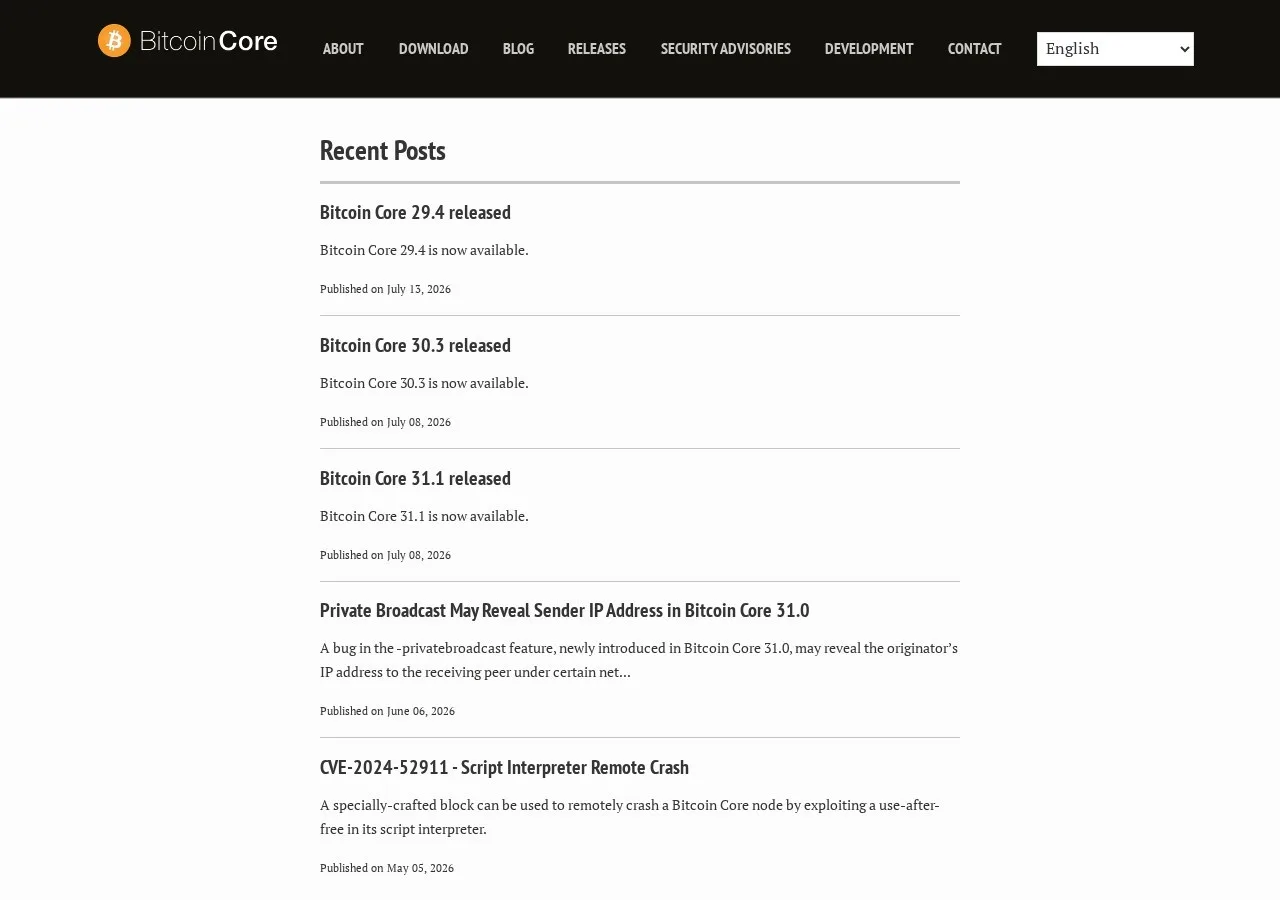
The first Bitcoin software client was released in January 2009. Wladimir J. van der Laan became lead maintainer in April 2014 and stepped down in August 2022 without naming a successor, after which maintenance moved to a group of developers with commit access. Bitcoin Core 29.4, 30.3, and 31.1 were released in July 2026. A remote crash vulnerability, CVE-2024-52911, was disclosed on May 5, 2026. A bug in the 31.0 private broadcast feature that could expose an originator’s IP address was disclosed on June 6, 2026, with a fix scheduled for 31.1.
The main trade-off is operational responsibility. Each operator manages uptime, updates, local backups, and storage rather than relying on a hosted RPC provider. A local node reduces dependence on a central infrastructure vendor, but a single node can still fail or fall behind. Unconfirmed transactions remain unsafe, and opt-in RBF transactions can be replaced before confirmation.
Founders
Satoshi NakamotoOriginal Author & Creator
Pseudonymous creator of Bitcoin and author of the Bitcoin whitepaper.
Best for:Bitcoin node operatorsSelf-hosted RPC applicationsBitcoin wallet developersLocal chain validation
Pros and cons
Pros
- Free MIT-licensed software
- Validates the Bitcoin chain locally
- Includes wallet and RPC access
- Open contributor and public review model
- Available for Linux, Windows, and macOS
Cons
- Bitcoin-only chain support
- Full ledger exceeded 608.9 GB in October 2024
- Operators manage storage, bandwidth, upgrades, and uptime
- A June 2026 bug could expose private broadcast IP addresses
- CVE-2024-52911 allowed crafted blocks to crash nodes
Our review
3.3/5
Fair
Bitcoin Core provides the definitive open-source reference client for independent validation, but it demands self-managed hardware and supports only the Bitcoin network.
Bitcoin Core is the open-source reference software client for the Bitcoin network. It combines a fully validating node, an RPC server interface, and a local wallet. Originally released in 2009 by Satoshi Nakamoto, the project has operated without a corporate entity, CEO, or centralized headquarters, relying on volunteer and grant-funded maintainers with GitHub commit access. Operators download the software under the MIT license, verifying binaries via GPG signatures and SHA-256 checksums.
For infrastructure operators and developers, the software is the reference implementation for independent consensus validation. It operates without commercial tiers or managed RPC throttling. Users retain full sovereign custody over transaction processing and local mempool policies, including opt-in Replace-by-Fee (RBF) signaling. The project also maintains core cryptography modules like libsecp256k1. Applications use this library to perform high-performance signature validation across the ecosystem.
Running Bitcoin Core brings distinct operational trade-offs compared to managed infrastructure providers:
- It validates and exposes RPC endpoints solely for the Bitcoin blockchain.
- Storage demands are substantial, requiring hundreds of gigabytes of disk space to sync the full unpruned ledger, which exceeded 608.9 GB by late 2024.
- No enterprise service-level agreements, dedicated uptimes, or 24/7 technical helpdesks exist.
Security issues require active administration. In May 2026, maintainers disclosed CVE-2024-52911, a remote crash flaw in the script interpreter triggered by specially crafted blocks. In June 2026, a privacy bug in the newly introduced private broadcast feature of version 31.0 risked revealing node IP addresses, which was addressed in release 31.1. Bitcoin Core suits engineers and institutions requiring trustless, self-hosted verification of Bitcoin state. Teams seeking multi-chain indexing or hosted endpoints should consider commercial node services instead.
Specs
| Services | RPC / nodes, Developer tooling · unverified |
|---|---|
| Chains supported | 1 · unverified |
| Free tier | Yes · unverified |
| Pricing from | Free · unverified |
| Enterprise SLA | No · unverified |
| Open source | Yes · unverified |
| Token | BTC · unverified |
| Free tier limits | Unlimited self-hosted use · unverified |
| Server regions | Global · unverified |
Not disclosed by the provider: Uptime SLA.
Data from the provider's website and public sources. Fees and availability change; confirm on the official site before you sign up.
Key features
Full node validation
The software downloads and validates the Bitcoin blockchain, checks consensus rules, and relays transactions without relying on a hosted node.
Bitcoin RPC interface
Applications can connect through the documented Bitcoin Core RPC interface, with documentation available for releases from 0.16.0 through 31.0.0.
Integrated wallet
Bitcoin Core includes a wallet for creating and managing Bitcoin transactions alongside the full-node software.
Opt-in transaction replacement
Opt-in Replace-by-Fee allows marked transactions to be replaced with a higher-fee version before confirmation.
Cryptography library
The project maintains libsecp256k1, an optimised library for ECDSA operations on the secp256k1 curve.
Public code contribution
Anyone can propose patches, review pull requests, test releases, or contribute documentation and translations.
Inside Bitcoin Core
Full Node
Validates blocks and transactions against consensus rules and relays valid data across the peer-to-peer network.
Bitcoin Core RPC
Provides programmatic JSON-RPC interfaces to manage node operations, inspect blockchain state, and handle raw transactions.
Wallet
Stores keys locally, constructs payments, and supports transaction fee management like opt-in Replace-by-Fee.
libsecp256k1
Optimized C library maintained by the project for cryptographic ECDSA operations on the secp256k1 curve.
Bitcoin Core screenshots
What users say about Bitcoin Core
Bitcoin Core is praised as the authoritative reference client for running a full node and maximizing sovereignty without trusting third parties. However, community discussions highlight serious concerns regarding software bugs that risk data loss, along with high storage requirements for operating an unpruned node.
In their own words
“On trusting third parties: Bitcoin core vs hardware wallets vs other software wallets. I'm sorry for all the people that have lost their BTC with the Cold card low entropy hack.”
“Download from Follow instructions here Don't use those other packages. They are difficult to debug when something goes wrong, because they put all the files in the wrong places Core is simple, 9 binary files. Installation is simple, put the binary files into a bin directory or folder”
“Bitcoin core wallet migration bug can delete your wallet directory resulting in loss of funds **Bitcoin Core wallet migration bug**: Bitcoin Core posted a notice of a bug in the legacy wallet migration feature in versions 30.0 and 30.1.”
“You don't necessarily need "invest" anything, you can just download Bitcoin Core and allow it to sync up with the network: A regular laptop/desktop is usually enough, although the storage space requirements are pretty high (about 1tb free disk space).”
Based on 44 Reddit posts and comments from the last 12 months, checked Oct 21, 2026. These are posts by users on other sites, not reviews submitted on CryptoReview.
User reviews
No user reviews yet. Have you used Bitcoin Core? Share your experience below.
FAQ
Who founded Bitcoin Core?
Satoshi Nakamoto created the original software client in 2009. The codebase is maintained today by a decentralized group of open-source contributors and maintainers without a CEO or corporate owner.
How much does Bitcoin Core cost to use?
Bitcoin Core is free. It is distributed as open-source software under the MIT license, requiring no subscription or usage fees.
What chains does Bitcoin Core support?
Bitcoin Core only supports the Bitcoin network. It does not validate or index external blockchains.
Does Bitcoin Core have a native token?
No, Bitcoin Core does not issue a token. It is solely client software used to validate and transact on the Bitcoin network.
What security incidents have affected Bitcoin Core?
Maintainers disclosed CVE-2024-52911 in May 2026, an interpreter vulnerability where a crafted block could crash a node via a use-after-free bug. In June 2026, an IP address exposure flaw was documented in the private broadcast feature of version 31.0 and addressed in minor releases.
Does Bitcoin Core provide an enterprise uptime SLA?
No, Bitcoin Core does not offer service-level agreements or hosted infrastructure. Node uptime and operational reliability depend entirely on the host running the software.
Latest from Bitcoin Core on X
A new medium severity advisory has been posted: https://t.co/zBoT5bBQVZ
A new Low severity advisory has been posted: https://t.co/zguvTaoKmF
A new release candidate of Bitcoin Core, v32.0rc4, is available for testing.
This is a new major release, and follows v31.1.
Work-in-progress release notes are here: https://t.co/e1LU4i99Uk
Binaries are available here: https://t.co/ZI2uCSPHg2
This is a new major release, and follows v31.1.
Work-in-progress release notes are here: https://t.co/e1LU4i99Uk
Binaries are available here: https://t.co/ZI2uCSPHg2
A new release candidate of Bitcoin Core, v32.0rc3, is available for testing.
This is a new major release, and follows v31.1.
Work-in-progress release notes are here: https://t.co/e1LU4i99Uk
Binaries are available here: https://t.co/ROntCSo4HH
This is a new major release, and follows v31.1.
Work-in-progress release notes are here: https://t.co/e1LU4i99Uk
Binaries are available here: https://t.co/ROntCSo4HH
Recent public posts from @bitcoincoreorg, shown as published. Not reviewed or endorsed by CryptoReview.
Alternatives to Bitcoin Core

Open-source smart contract libraries and enterprise security tooling backing over $38T in transfers
Developer toolingFree tier10 chains supported

Blockchain infrastructure platform supporting 100+ chains with a free 30M-compute-unit tier
RPC / nodes · Data APIs +3Free tier100 chains supported

Managed blockchain infrastructure across 70+ chains with a free 3M-request monthly tier
RPC / nodes · IndexingFree tier70 chains supported

EVM development and simulation platform supporting transaction debugging and testing across 50+ chains
Developer toolingFree tier50 chains supported

Open-source distributed ledger foundation hosting Fabric, Besu, and Cacti under the Linux Foundation
RPC / nodes · Developer toolingFree tier2 chains supported

Blockchain infrastructure platform providing RPC nodes and data streams across 76 networks
RPC / nodes · Data APIsFree tier76 chains supported