

The final epoch for Zeta is here!
As we evolve into @bulletxyz and prepare for Bullet's mainnet we will be winding down the Zeta Markets platform on the 1st of May.
The final epoch features 1M $ZEX in rewards. https://t.co/2nvCXHu8TF


Solana perpetual futures exchange with an on-chain order book that operated from 2021 to 2025
Zeta Markets was a decentralized perpetual futures exchange on Solana. Launched in 2021, the protocol brought traditional central limit order book mechanics directly on-chain. Traders could open leveraged long and short positions on major crypto assets with up to 100x leverage.
The protocol was founded in 2021 by Tristan Frizza. In December 2021, the project raised an $8.5 million seed round led by Jump Capital, Race Capital, and Electric Capital.
Unlike automated market makers, Zeta Markets used a central limit order book with settlement and data availability secured through zero-knowledge proofs on Solana. Users connected self-custody Solana wallets to trade perpetual contracts on assets such as BTC, ETH, and SOL. The platform supported advanced order types, including limit orders, trigger orders, take-profit, and stop-loss instructions. Its collateral system allowed users to deposit major tokens, earn yield, and post margin simultaneously.
Base trading fees began at 2 basis points (0.02%) for makers and 10 basis points (0.10%) for takers. Active traders could reduce these fees down to 1 bps maker and 5 bps taker based on 30-day volume or by holding gZEX, a non-transferable governance metric earned through vote-escrow locking of the native ZEX token. The protocol launched ZEX in June 2024, distributing allocations to approximately 80,000 eligible users.
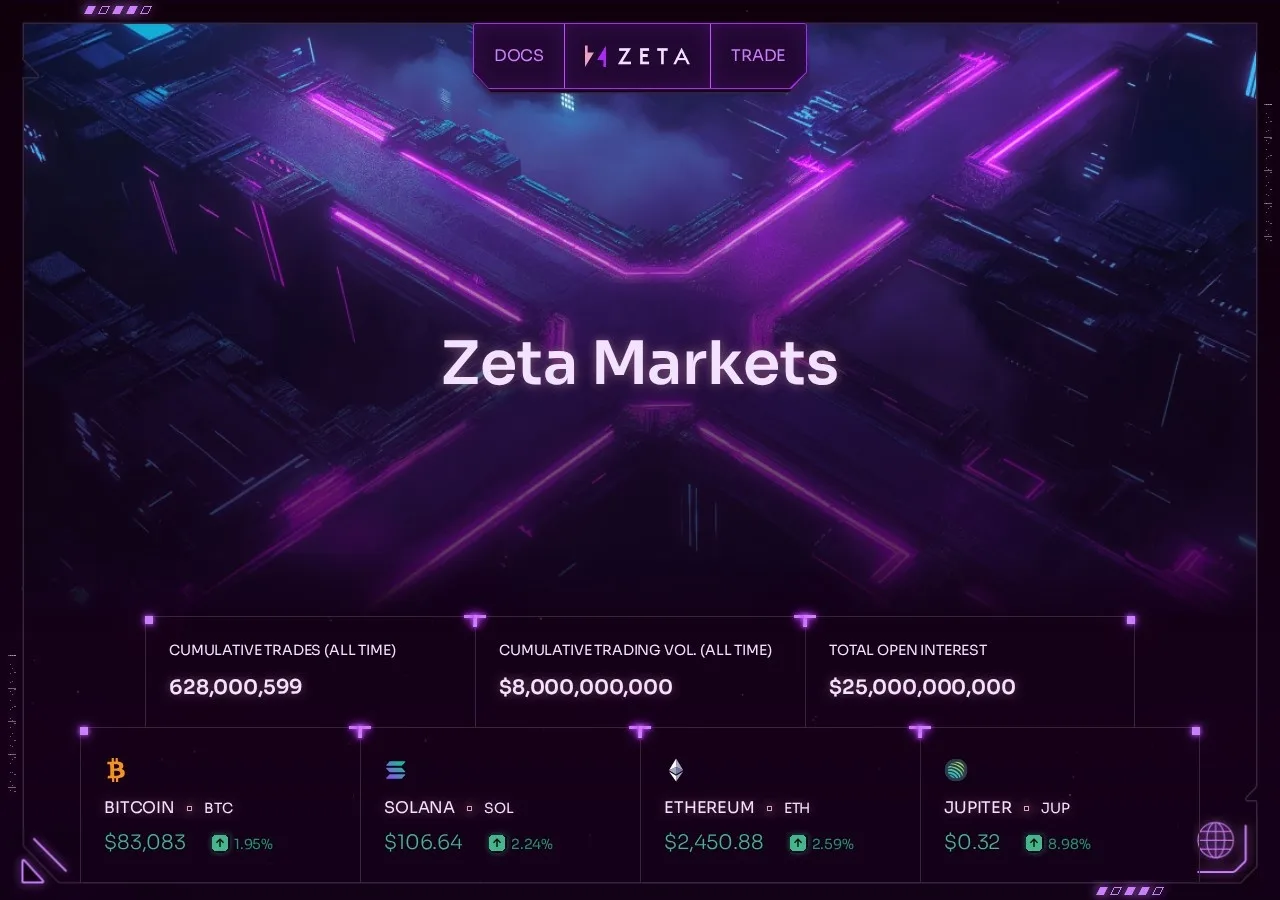
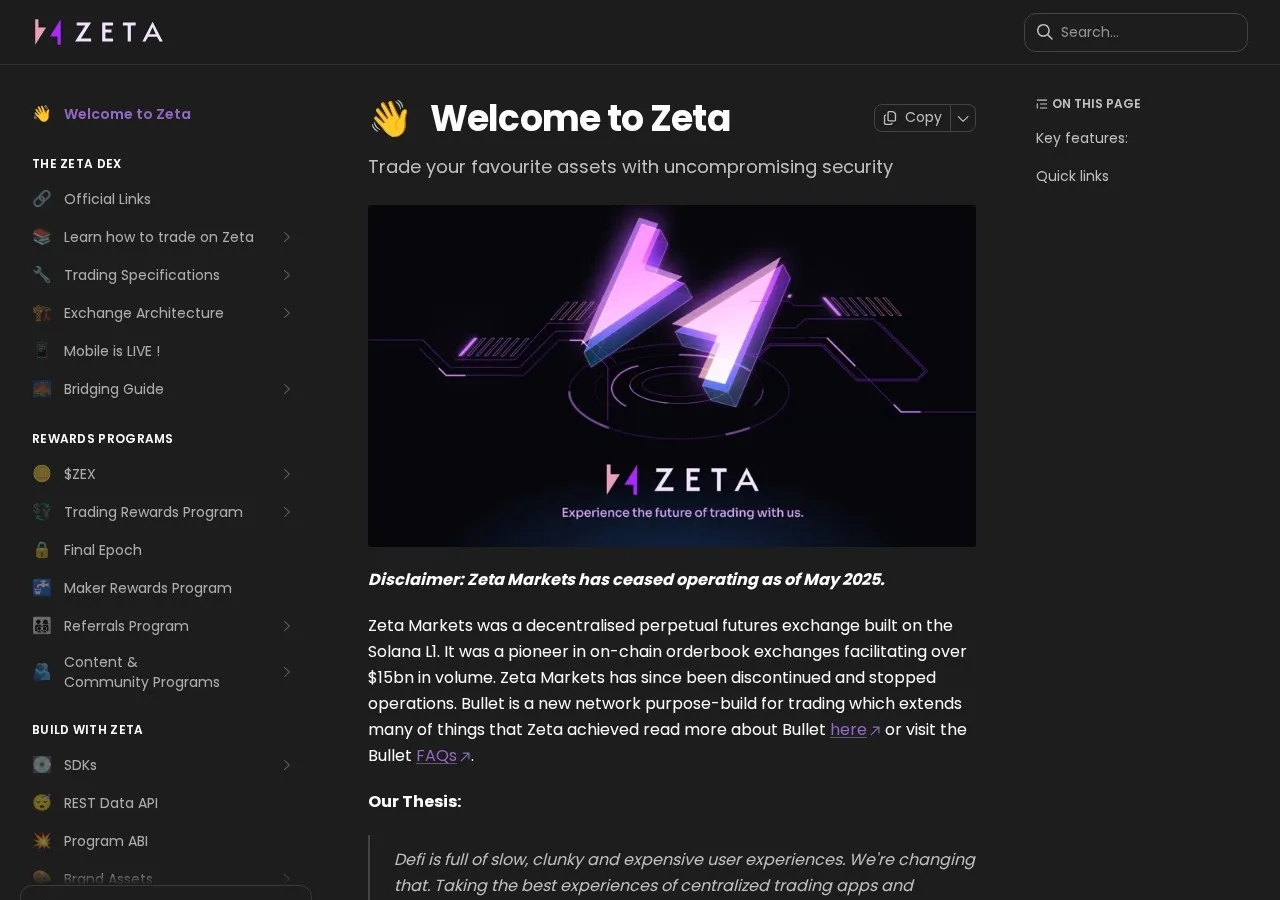
Over its lifetime, Zeta Markets recorded 628,000,599 cumulative trades and processed over $8 billion in trading volume across more than three years without a security exploit. In May 2025, the team formally wound down and discontinued Zeta Markets to focus core development on Bullet, a trading layer for Solana.
Because the platform is discontinued, traders can no longer open positions or interact with the order book. When operational, the platform exposed users to the volatility risks of high leverage, reliance on Solana network uptime, and protocol smart contract risk.
Zeta Markets delivered low-latency perpetual futures with up to 100x leverage on Solana, but the exchange permanently ceased operations in May 2025.
Founded in 2021 by Tristan Frizza, Zeta Markets operated as a decentralized perpetual futures exchange built natively on Solana. The platform processed over 628 million cumulative trades and $8 billion in trading volume by matching orders on-chain. Traders could access up to 100x leverage across core assets such as SOL, BTC, ETH, and JUP. The project raised an $8.5 million seed round led by investors including Jump Capital, Race Capital, and Electric Capital, and the team ran the protocol exploit-free across more than three years of operation.
Trading architecture relied on a central limit order book with settlement and data availability secured through zero-knowledge proofs on Solana. Default trading fees were set at 0.02% (2 bps) for makers and 0.10% (10 bps) for takers. Active participants could reduce these costs down to 0.01% maker and 0.05% taker fees through rolling 30-day volume tiers or by staking the native ZEX governance token to earn non-transferable gZEX scores.
Zeta Markets had these limitations:
| Type | Order book, Perpetuals · unverified |
|---|---|
| Chains | Solana · unverified |
| Swap fee | 0.02% maker / 0.10% taker · unverified |
| Limit orders | Yes · unverified |
| Cross-chain swaps | No · unverified |
| Governance token | ZEX · unverified |
| Perpetual futures | Yes · unverified |
| Max leverage (x) | 100 · unverified |
| Routes across other DEXs | No · unverified |
| Mobile app | Yes · unverified |
| Points or rewards program | Yes · unverified |
Not disclosed by the provider: KYC required, Audited, Open source, MEV protection.
Data from the provider's website and public sources. Fees and availability change; confirm on the official site before you sign up.
Executes trades via a central limit order book matching engine with settlement anchored directly to Solana.
Offered up to 100x leverage on perpetual futures across major markets like BTC, ETH, and SOL.
Supported limit orders, market orders, and automated trigger orders for take-profit and stop-loss executions.
Default rates of 0.02% maker and 0.10% taker scaled down to 0.01% and 0.05% via trading volume or gZEX staking.
Allowed users to lock ZEX tokens for up to 4 years to accrue non-transferable gZEX for fee tiers and governance.
Allowed multiple major Solana-based assets to serve as margin while generating yield in the background.
Executes on-chain limit orders, market orders, and trigger orders against a central orderbook architecture with low-latency matching.
Describes the margin system, liquidations, and insurance fund used by the protocol.
Allows holders to lock ZEX tokens for up to four years to generate gZEX scores, which confer governance voting rights and fee tier discounts.
Provides tutorials for bridging collateral into Solana from networks such as Ethereum and Polygon.
No user reviews yet. Have you used Zeta Markets? Share your experience below.
Zeta Markets was founded in 2021 by Tristan Frizza.
No, Zeta Markets ceased operations in May 2025 as the development team shifted focus to the Bullet network.
Default baseline fees were 0.02% (2 bps) for makers and 0.10% (10 bps) for takers. Traders could lower these fees up to 50% based on 30-day trading volume or staked gZEX balances.
Zeta Markets operated exclusively on Solana, though users could bridge assets from Ethereum and Polygon to fund their accounts.
Yes, the protocol launched the ZEX governance token on Solana in June 2024, which could be locked into vote-escrow gZEX for governance power and trading discounts.
The platform supported up to 100x leverage on perpetual contracts across markets such as SOL, BTC, and ETH.

Recent public posts from @ZetaMarkets, shown as published. Not reviewed or endorsed by CryptoReview.
Decentralized AMM launched in 2018, with support across 16+ EVM mainnets
Cosmos appchain DEX and cross-chain AMM connecting over 100 ecosystems with IBC
Multichain AMM founded in 2020, with about $1.56B locked on October 17, 2026
Cross-chain liquidity and stablecoin activation stack settling transfers across 30+ blockchains
Perpetual and spot DEX with 50.1M reported users and a native 50ms Layer 1
DEX aggregator routing swaps across 18+ networks, including Ethereum and Solana
Type at least two characters. Press ↵ to see all results.