



Knock knock. Trick or treat? 🍬
Jupiter is handing out candy for next 3 days.
You just have to come to the door.
How to play:
1. Rip a $250 Trick or Treat Pack (not eligible for any other pack pull)
2. Quote tweet your pull replay
Some of you will get a treat. Some of you will get tricked.
Good pull or bad pull, nobody knows who gets what.
Worst case: a firm digital handshake and a “thanks for playing.”
Btw we're goin LIVE in 5mins with @solanagaming
Happy Halloween 🎃
Chains
Solana
Swap fee
0% to 0.5% in Ultra mode, depending on the pair; no Jupiter commission in Manual mode
Type
Aggregator
Perpetual futures
Yes
Audited
Yes
Governance token
JUP
What is Jupiter?
Jupiter is a Solana-based decentralized exchange aggregator and on-chain finance platform. Its swap engine routes trades across Solana liquidity sources, while the wider platform includes spot trading, limit orders, lending, yield vaults, leveraged strategies, prediction markets and perpetuals.
How Jupiter works
Jupiter’s products run as on-chain programs on Solana. Traders connect a wallet rather than opening a custodial exchange account, then choose between products such as Spot, Perps, Lend and Prediction Markets. Spot swaps can use Ultra mode, which selects a route and charges between 0% and 0.5% depending on the pair, or Manual mode, which carries no Jupiter commission. Limit orders and dollar-cost averaging are available for spot trading.
Perpetuals offer leveraged futures markets, with Jupiter’s Perps product advertising leverage of up to 250x. A separate YOLO product launched in beta in October 2026 and offers positions on SOL, BTC and ETH with up to 1,000x leverage. Lend provides lending and yield products, while Multiply creates leveraged yield loops.
Fees and token
Swap costs depend on the selected mode and trading pair. Manual mode has no Jupiter commission, while Ultra mode costs 0% to 0.5%. JUP is Jupiter’s governance token and is also used in staking-related rewards. Unstaking takes 7 days. The April to June 2026 Active Staking Rewards campaign allocated 50 million JUP, but that campaign has ended.
Track record and security
Jupiter’s domain was first archived in October 2021, and Jupiter launched in 2021. Independent audits cover its on-chain programs. Named audit firms include Offside Labs, Sec3, OtterSec, Certora, Code4rena, Mixbytes and Zenith. The JLP liquidity pool backing Perps is covered by the Perpetuals audits, and Jupiter lists a bug bounty program.
On February 6, 2025, Jupiter’s main X account was compromised and published malicious posts containing token contract addresses. Reports advised users not to click the links or copy the addresses. The incident affected the project’s communications account rather than establishing a failure of the on-chain programs.
Risks and limitations
Solana concentration creates chain-specific downtime and congestion risk. Aggregated routing can still produce slippage or failed transactions on thin pairs. MEV and oracle failures can affect trades. Perpetuals, YOLO and Multiply add liquidation exposure.
Best for:Solana spot tradersOn-chain perpetuals tradersJUP stakersDeFi yield strategists
Pros and cons
Pros
- Aggregates Solana liquidity for spot swaps
- Manual swaps carry no Jupiter commission
- Offers limit orders and dollar-cost averaging
- Independent audits cover Jupiter on-chain programs
- Combines swaps, lending and perpetuals in one platform
Cons
- Solana is the only supported chain
- Perpetuals and YOLO expose traders to liquidation risk
- Up to 1,000x YOLO leverage increases loss risk
- JUP rewards depend on token incentives
- Main X account compromise occurred in February 2025
Our review
3.6/5
Good
Jupiter combines Solana-wide swap routing with perps and lending, but its single-chain coverage and expanding product risk limit its scope.
Jupiter is an aggregator for Solana swaps, with additional onchain products for perpetuals, lending, prediction markets and tokenized stocks. That gives traders both automated pricing and a manual option with no Jupiter commission, although the final execution price still depends on pool depth, slippage and the route chosen.
Jupiter has limit orders, dollar-cost averaging, Perps, Lend, Lend Vaults and Multiply leveraged yield loops. Perps now include leverage up to 250x on the main product page, while the newer YOLO beta offers up to 1,000x leverage on SOL, BTC and ETH price movements. Those products add functionality, but also introduce liquidation, oracle, counterparty and strategy risks that do not apply to a simple spot swap.
Chain coverage is narrow. Jupiter runs on Solana, so it can provide access to that ecosystem but cannot serve traders who need native swaps across Ethereum or Base. Cross-chain execution is not a core strength. The platform also depends on Solana programs and external liquidity venues, leaving users exposed to smart contract exploits, pricing attacks and MEV on long-tail pairs.
Jupiter lists independent audits from Offside Labs, Sec3, OtterSec, Certora, Code4rena, Mixbytes and Zenith, and its security material includes a bug bounty. The main X account was compromised on February 6, 2025, and published malicious token addresses. That incident affected communications rather than the on-chain programs.
JUP is used for governance and staking-related rewards. The April to June 2026 Active Staking Rewards campaign distributed 50M JUP, and unstaking takes 7 days.
Specs
| Type | Aggregator |
|---|---|
| Chains | Solana |
| Swap fee | 0% to 0.5% in Ultra mode, depending on the pair; no Jupiter commission in Manual mode · unverified |
| Limit orders | Yes · unverified |
| Audited | Yes · unverified |
| Governance token | JUP · unverified |
| Perpetual futures | Yes · unverified |
| Max leverage (x) | 250 · unverified |
| Routes across other DEXs | Yes · unverified |
| Mobile app | Yes · unverified |
| Points or rewards program | Yes · unverified |
Not disclosed by the provider: KYC required, Cross-chain swaps, Open source, MEV protection.
Data from the provider's website and public sources. Fees and availability change; confirm on the official site before you sign up.
Key features
Aggregated spot swaps
Routes trades across Solana liquidity sources. Ultra mode charges 0% to 0.5% depending on the pair, while Manual mode has no Jupiter commission.
Limit orders and DCA
Supports limit orders and dollar-cost averaging for scheduled or price-triggered spot trades on Solana.
Perpetual futures
Jupiter Perps offers leveraged futures markets with leverage of up to 250x. The product is on-chain and carries liquidation risk.
YOLO markets
The beta YOLO product lets traders take directional positions on SOL, BTC and ETH with up to 1,000x leverage.
Lending and vaults
Lend provides lending products and yield vaults for supported assets. Multiply adds leveraged yield loops.
Prediction markets
Prediction Markets let users trade positions on event outcomes, with Clans for shared rankings and calls.
Token discovery
Token pages include watchlists, market activity, project information, tokenomics, news and holder labels.
JUP staking
JUP supports governance and staking-related rewards. Unstaking takes 7 days, and the April to June 2026 rewards campaign has ended.
Inside Jupiter
Spot
Spot provides token trading and swaps on Solana. Jupiter's Ultra mode routes trades across liquidity venues, while Manual mode carries no Jupiter commission.
Lend
Lend provides lending products for earning yield on stablecoins and other supported assets. The site advertises USDC lending at over 7% APY.
Lend Vaults
Lend Vaults provide yield strategies for supported assets. They are presented as a separate way to earn yield through Jupiter.
Multiply
Multiply provides leveraged yield loops built on Jupiter Lend. The strategy increases exposure to an underlying yield position and adds borrowing risk.
Perps
Perps provides perpetual futures trading on Solana. Jupiter's site advertises leverage up to 250x, while newer beta markets use a separate YOLO product.
Prediction Markets
Prediction Markets lets users trade positions on event outcomes. Jupiter also offers Clans, where participants can share calls and compete in group rankings.
Spot Stocks
Spot Stocks provides onchain trading of tokenized stocks. The product is listed alongside Jupiter's other spot and DeFi services.
Send
Send lets users send crypto to recipients through a link. The recipient can use the link to receive the transfer.
Jupiter screenshots
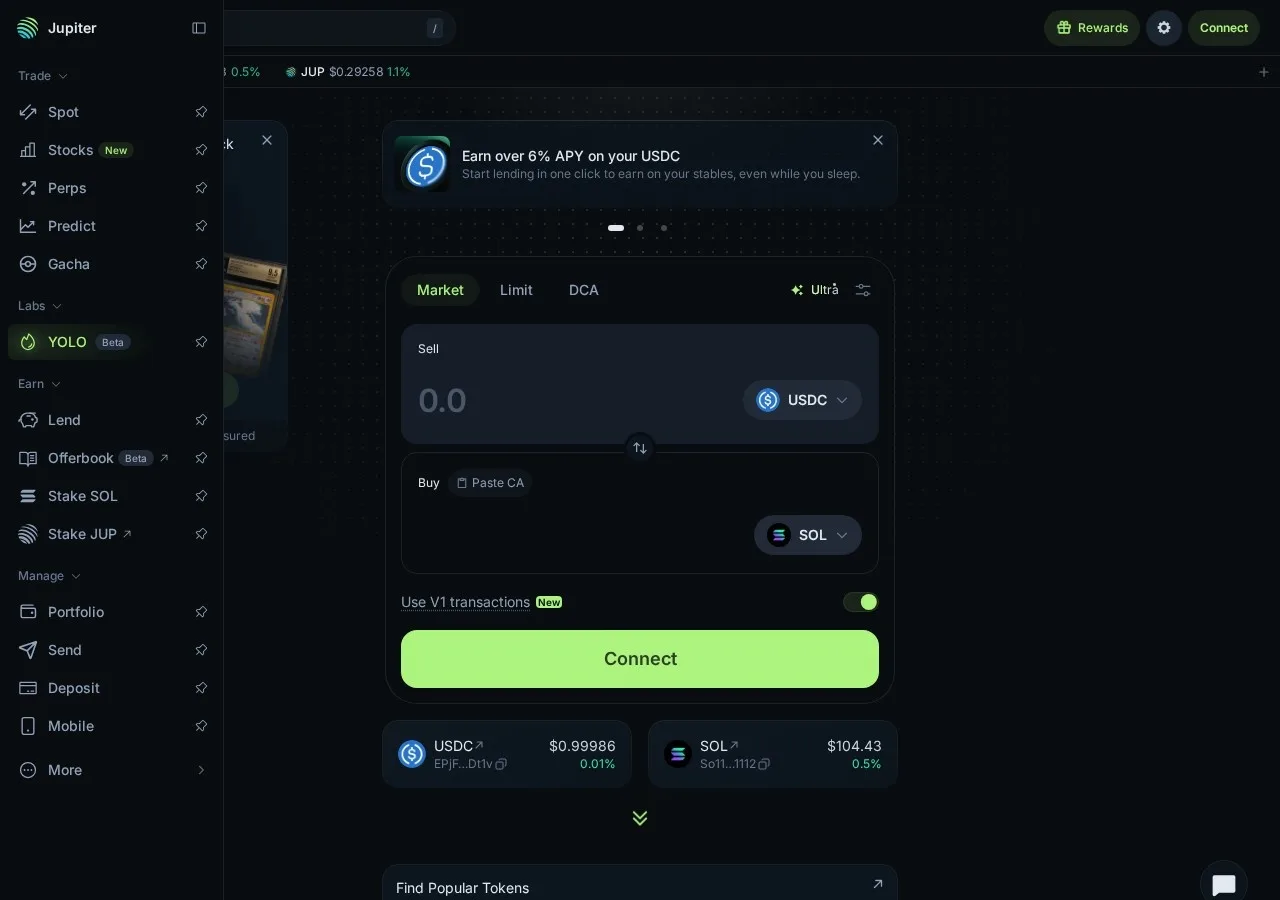
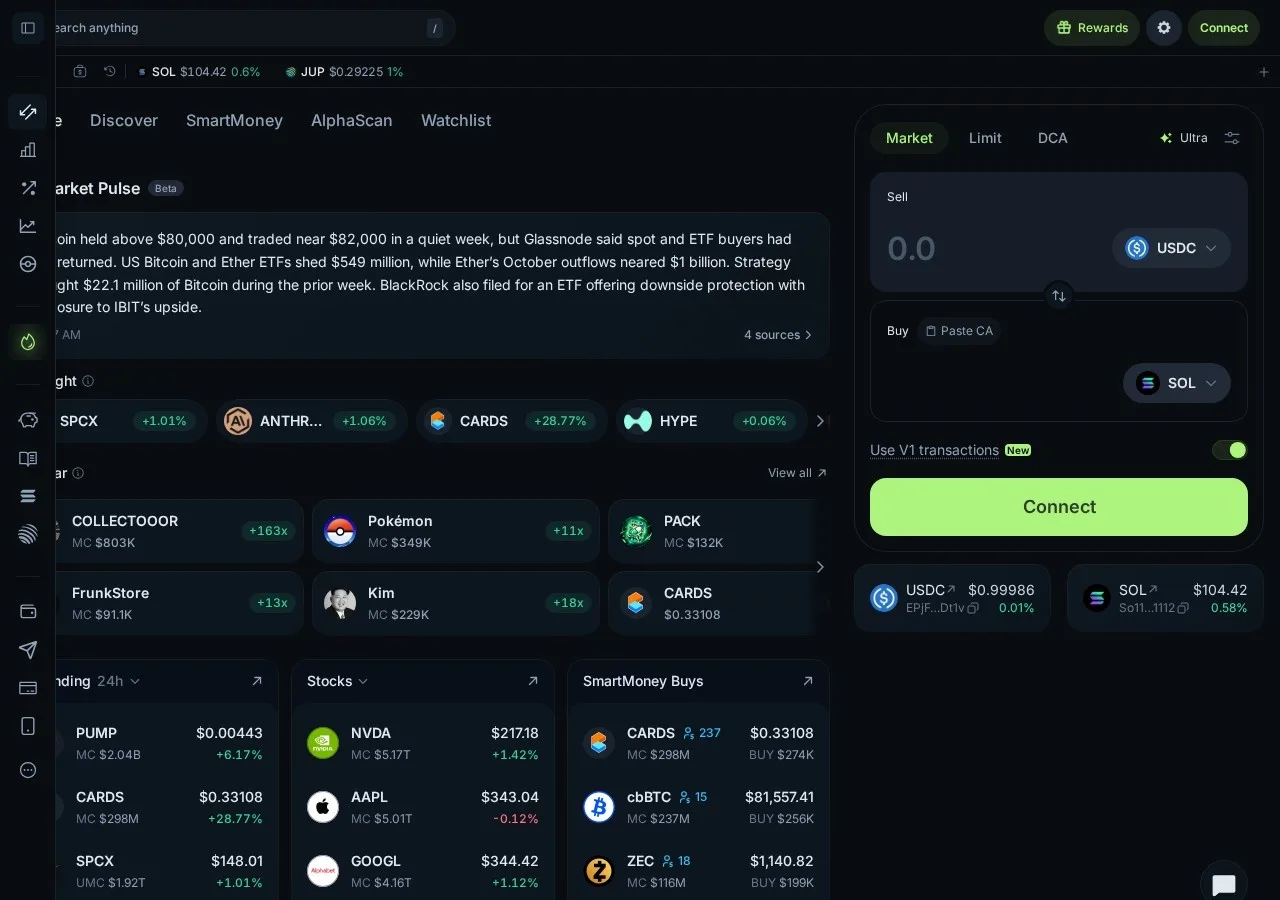
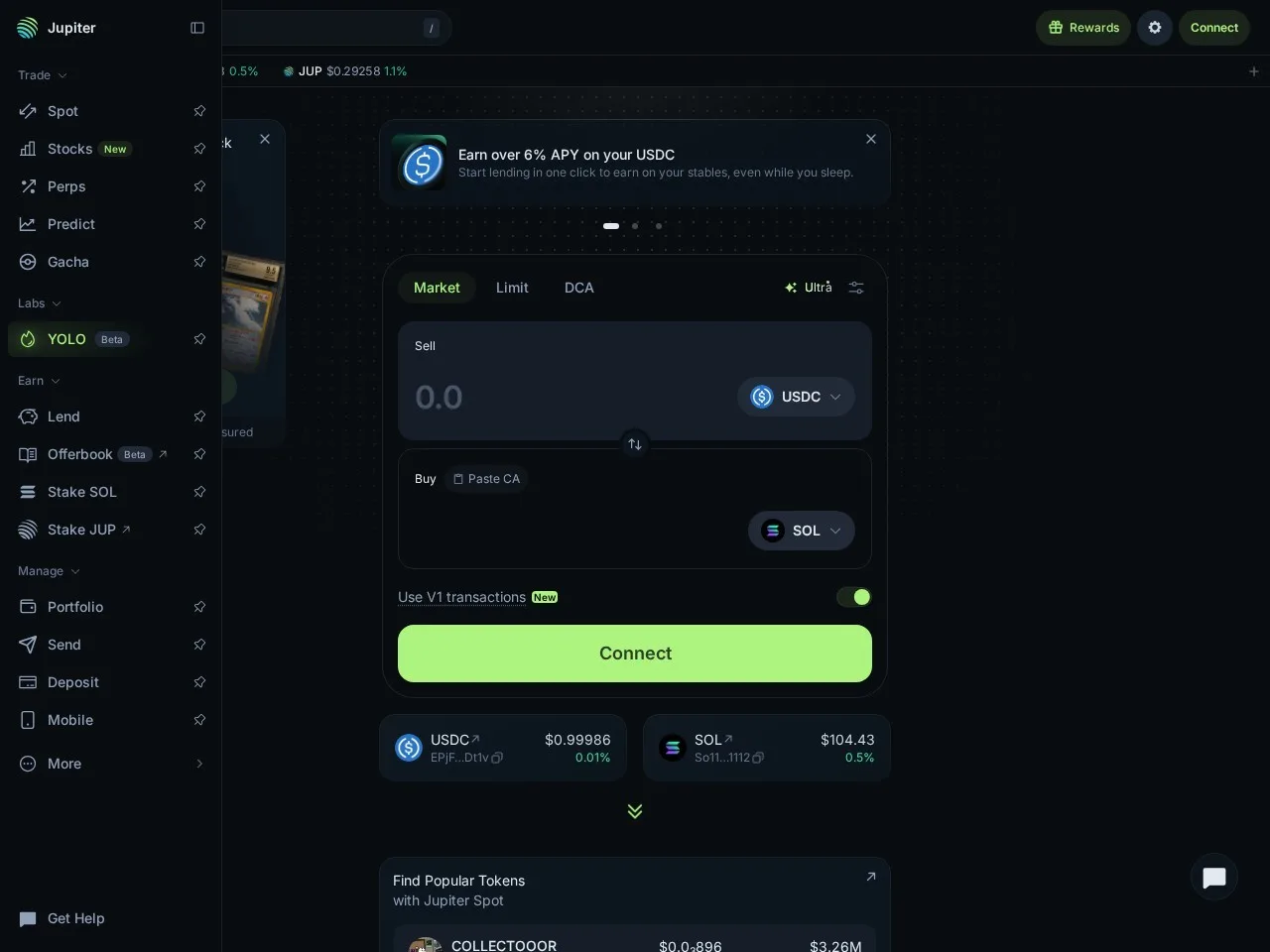
What users say about Jupiter
Users commonly praise Jupiter for its easy interface, fast swaps, broad functionality, and low fees. Complaints focus on laggy updates, failed transactions, missing funds, and slow or absent support.
Top goods
In their own words
“Beginner-Friendly and Powerful Ease of use is where this app shines. I came in with zero experience and an open mind, and within four hours I felt like I actually knew what I was doing. Buying, selling, and swapping all just make sense — the interface doesn’t fight you.”
“Crazy fast! Super easy onboarding and exposure to market”
“Amazing - I ❤️ it! simple interface, GREAT fee structures, fast & reliable”
“Why Ever since the updates it’s been hard to buy and sell with it saying transactions failed over and over”
“Funds stuck, support is dead Be careful with this app. I deposited USDC to the deposit address shown in the app — the same one I’d used for a long time — and the funds were never credited to my balance. Turns out the deposit address was changed on their side with zero notice.”
“'Unable to access vault' - infuriating 'bug' Some of my wallets allow me to access my vault, and I've accessed the vault on my main wallet before too. Sadly recently, I cannot ever access it, meaning I can't place limit orders at all.”
Scam warning: Phishing emails and fake websites can trick users into connecting wallets; use the known Jupiter site instead.
Based on 100 Reddit posts and comments, 46 App Store reviews from the last 12 months, checked Oct 18, 2026. These are posts by users on other sites, not reviews submitted on CryptoReview.
User reviews
No user reviews yet. Have you used Jupiter? Share your experience below.
Funding and investors
1Round
1Investor
-
Funding round Amount undisclosed
FAQ
What is Jupiter Exchange?
Jupiter is a Solana-based decentralized exchange aggregator and onchain finance platform. It offers spot swaps alongside perpetuals, lending, prediction markets and related products.
What are Jupiter's swap fees?
Ultra mode swaps cost 0% to 0.5%, depending on the pair. Manual mode swaps carry no Jupiter commission.
Which blockchain does Jupiter support?
Jupiter supports Solana. Its swap and other onchain programs run on the Solana network.
Does Jupiter have a token?
Yes, Jupiter's token is JUP. It is used for governance and staking-related rewards, and unstaking takes 7 days.
Is Jupiter audited?
Jupiter publishes independent audits for its onchain programs. Listed firms include Offside Labs, Sec3, OtterSec, Certora, Code4rena, Mixbytes and Zenith.
Does Jupiter offer perpetual futures?
Yes, Jupiter Perps offers perpetual futures with leverage up to 250x on the main product page. A separate YOLO beta offers up to 1,000x leverage on SOL, BTC and ETH price movements.
Latest from Jupiter on X
WE ARE LIVE 🎙️
We're excited to announce partnership with @BitGo to launch a validator built for institutions.
BitGo's institutional clients can now stake SOL with Jupiter, directly from their existing custody accounts.
Solana's leading DeFi platform, meet the custodian institutions trust.
BitGo's institutional clients can now stake SOL with Jupiter, directly from their existing custody accounts.
Solana's leading DeFi platform, meet the custodian institutions trust.

The validator behind the first North American Solana staking ETFs is now part of jupSOL.
Welcome to the jupSOL validator set, @twinstake_io
Institutions holding jupSOL can now stake with an operator they already know and trust. https://t.co/eRW1Sepsg6
Welcome to the jupSOL validator set, @twinstake_io
Institutions holding jupSOL can now stake with an operator they already know and trust. https://t.co/eRW1Sepsg6
Your favorite bridge doesn't always give you the best rate.
Introducing Jupiter Bridge, a bridge aggregator.
We compare @RelayProtocol, @mayan, @circle CCTP, @NEARProtocol and more, so you get the best rates in and out of Solana.
Try it now 👇 https://t.co/samrQMcDeZ
Introducing Jupiter Bridge, a bridge aggregator.
We compare @RelayProtocol, @mayan, @circle CCTP, @NEARProtocol and more, so you get the best rates in and out of Solana.
Try it now 👇 https://t.co/samrQMcDeZ
Recent public posts from @JupiterExchange, shown as published. Not reviewed or endorsed by CryptoReview.
Latest from Jupiter on Telegram

Jup Marketing Command Center
Join
@jup_marketing · 5.1K subscribers
Jupiter's New Staking Experience is now Live:
With options for both institutions and individual stakers
Including a suite of tools to project your earnings, and use your staked SOL across DeFi.
The home of onchain finance just became the home for staking on Solana
View the full announcement: https://x.com/JupiterExchange/status/2114724808390754422
Check out the page here: https://jup.ag/stake
650 View on Telegram
The Claynosaurz x Jupiter Card is here 🦖🪐
Our first-ever card built in partnership with a community just dropped, designed with Claynosaurz and loaded with exclusive perks.
A brand-new digital card design. Perks included:
• Full FX fee rebate (up to $100/month for your first 90 days)
• 2% flat cashback (up to $100/month)
• 10% off the Claynosaurz store when you pay with your card
• Extra rewards for loyal Claynosaurz holders
Claynosaurz is the first community we're partnering with to bring perks straight to their holders and physical cards are coming soon.
Get yours: https://jupiter.global/claynosaurz
1.8K View on Telegram
A new loop is live on Jupiter Lend.
Amplify the GPU-backed yield of sUSDai, currently up to 35% APY
More info: https://x.com/jupiter_earn/status/2103198313130664036
Check out the loop here: https://jup.ag/lend/borrow/multiply/101
Amplify the GPU-backed yield of sUSDai, currently up to 35% APY
More info: https://x.com/jupiter_earn/status/2103198313130664036
Check out the loop here: https://jup.ag/lend/borrow/multiply/101
1.9K View on Telegram
NEW JUPITER PERPS TRADING PAIRS ARE HERE!
Six new markets are live on Jupiter Perps: $HYPE, $ZEC, $SPCX, $SKHYNIX, $SNDK and $JUP: https://jup.ag/perps
$JUP Stakers get first access, so if you have at least 69 JUP staked, they are open to you right now.
It is still beta and more markets are coming, so drop the ones you want to see next in the comments under the announcement:
https://x.com/JupiterExchange/status/2102329616866160993
1.8K View on Telegram
Recent posts from the official Telegram channel @jup_marketing, shown as published. Not reviewed or endorsed by CryptoReview.
Alternatives to Jupiter

Decentralized AMM launched in 2018, with support across 16+ EVM mainnets
No KYCAMMEthereum · Base +3Limit orders

Cosmos appchain DEX and cross-chain AMM connecting over 100 ecosystems with IBC
No KYCAMM · Order bookOtherLimit orders

Multichain AMM founded in 2020, with about $1.56B locked on October 17, 2026
No KYCAMMBNB Chain · Ethereum +3Cross-chain swaps

Cross-chain liquidity and stablecoin activation stack settling transfers across 30+ blockchains
Ethereum · Bitcoin +10Cross-chain swapsAudited

Perpetual and spot DEX with 50.1M reported users and a native 50ms Layer 1
No KYCPerpetualsBNB Chain · Ethereum +3Limit orders

DEX aggregator routing swaps across 18+ networks, including Ethereum and Solana
AggregatorEthereum · BNB ChainCross-chain swaps