

Self-custodial Mastercard card with €0 issuance, monthly and FX fees
DebitMastercardVirtual · Physical
Crypto-to-fiat card with a $5,000 virtual limit and support for 9+ networks
SolCard is a crypto-to-fiat card platform operated by SC PAYMENTS LIMITED, a company incorporated in Hong Kong. When users pay through Visa or Mastercard, supported digital assets are converted into local currency. The Virtual tier has a $5,000 monthly spending limit. Platinum adds a physical card, mobile-wallet support and no monthly spending limit.
SC PAYMENTS LIMITED operates SolCard under Hong Kong Business Registration Number 78350827. The company lists Hong Kong as its base. Licensed issuing partners provide card services under Visa or Mastercard licences, depending on the card. SolCard is a financial technology product rather than a bank, and its digital assets are not government-insured bank deposits.
Users fund a card with supported assets such as SOL, USDC, USDT, ETH and BTC. Stablecoins are supported across 9+ networks, including Solana, Ethereum, Base, Polygon, Arbitrum, BNB Chain, Optimism, Avalanche and HyperEVM. When a purchase is made, the balance is converted to local currency and the merchant receives fiat. SolCard says funds can be added directly from a crypto wallet without a bank account or credit check, with balances appearing within minutes.
The Virtual tier is designed for online payments. Platinum adds an IRL card and support for Apple Pay and Google Pay. Every card has a permanent Bitcoin and Litecoin deposit address. After network confirmation, deposits are converted to dollars. SolCard Pay also lets users transfer funds between SolCard balances using an @tag.
Virtual top-ups carry a 5% fee. Platinum top-ups have a 0% fee, and each new card has a one-time $10 issuance fee. The annual fee is none. Virtual cards have a $5,000 monthly spending limit, while Platinum has no monthly spending limit. Foreign exchange spreads can apply when spending in currencies other than USD.
Cards work at merchants that accept Visa or Mastercard, but eligibility, fees and supported features vary by region. Identity verification can be skipped for a virtual card, while Platinum requires KYC. SolCard states that it does not offer an anonymous or untraceable product.
In August 2026, SolCard reported 13% month-over-month purchase growth from aggregated anonymized platform data. In September 2026, it launched SolCard Pay and added deposit options including USDT on Tron, EURC on Solana, and wrapped BTC and ETH on Solana. The company advertises 500,000+ users and 150M+ merchant locations.
The card depends on SolCard, its issuing partners and the Visa or Mastercard network. A foreign exchange spread may apply when spending in currencies other than USD, and digital assets remain exposed to price changes before conversion. The product has no cashback or rewards programme, so it does not offset those fees with card rewards.
SolCard combines broad crypto funding with Apple Pay and Google Pay on Platinum, but its 5% Virtual top-up fee and region-dependent terms reduce flexibility.
SolCard is a crypto-to-fiat card platform operated by SC PAYMENTS LIMITED, incorporated in Hong Kong. Cards are issued through licensed partners on Visa or Mastercard, depending on the card held. The company says it has more than 500,000 users and reported new card functions in September 2026, including SolCard Pay, USDT on Tron and further deposit options.
The Virtual card supports online spending with a $5,000 monthly limit and a 5% top-up fee. Platinum adds a physical card, Apple Pay, Google Pay, no monthly spending limit and 0% top-up fees. Both tiers have a one-time $10 issuance fee, while the published fee information lists no annual fee. There is no cashback or rewards program, so the product has no rebate on spending and does not require staking.
Funding covers SOL, USDC, USDT, ETH, BTC and assets across at least nine networks, including Solana, Ethereum, Base, Polygon, Arbitrum, BNB Chain, Optimism, Avalanche and HyperEVM. Bitcoin and Litecoin deposits have permanent addresses, with deposits converted to dollars after network confirmation. The balance converts to local currency when a purchase is made, and spending works wherever the relevant Visa or Mastercard is accepted.
A 5% Virtual top-up fee is high for regular use, while the Platinum tier requires identity verification. Availability and supported features vary by region. The service is a financial technology product rather than a bank, and digital assets are not government-insured deposits. The published materials also describe a possible foreign-exchange spread for spending outside USD.
SolCard suits users who want to spend supported crypto online or through mobile wallets and can meet Platinum eligibility requirements. The card still depends on its issuing partners and compliance decisions.
| Card type | Debit · unverified |
|---|---|
| Card format | Virtual, Physical · unverified |
| Max cashback ⓘ | 0% · unverified |
| Staking needed for top rewards | No · unverified |
| Card issuance fee | $10 · unverified |
| Annual fee | Free · unverified |
| Top-up fee | 5% for Virtual; 0% for Platinum · unverified |
| Crypto conversion spread | A foreign exchange spread may apply when spending outside USD · unverified |
| Available in | Global · unverified |
| Spendable assets | SOL, USDC, USDT, ETH, BTC · unverified |
| Top-up networks | Solana, Ethereum, Base, Polygon, Arbitrum, BNB Chain, Optimism, Avalanche, HyperEVM, Tron, Robinhood Chain · unverified |
| Spend stablecoins | Yes · unverified |
| Apple Pay | Yes · unverified |
| Google Pay | Yes · unverified |
| Good for | Everyday spending, Travel, Online shopping, Subscriptions & AI tools · unverified |
| Perks | Apple Pay and Google Pay for Platinum, Priority support for Platinum, No monthly spending limit for Platinum · unverified |
| Virtual card fee | $10 · unverified |
Not disclosed by the provider: Card network, Custody, KYC required, Business card, Rewards paid in, Welcome bonus, Monthly fee, Foreign exchange fee, ATM withdrawals, Daily spending limit, ATM withdrawal limit, Not available in, Card currencies, Card issuer, Referral program.
Data from the provider's website and public sources. Fees and availability change; confirm on the official site before you sign up.
The virtual card supports online spending with a $5,000 monthly limit and a 5% top-up fee.
Platinum adds a physical card, no monthly spending limit, 0% top-up fees and priority support.
Users can fund cards with assets including SOL, USDC, USDT, ETH and BTC without a bank account or credit check.
Supported networks include Solana, Ethereum, Base, Polygon, Arbitrum, BNB Chain, Optimism, Avalanche and HyperEVM.
Platinum cards can be added to Apple Pay and Google Pay for in-store payments.
Every card has permanent Bitcoin and Litecoin deposit addresses, with deposits converted to dollars after confirmation.
Users can send funds between SolCard balances using an @tag.
The Virtual tier is for online spending and can be funded with supported digital assets. It has a $5,000 monthly spending limit and a 5% top-up fee.
The Platinum tier adds an IRL card, Apple Pay and Google Pay support, priority support and no monthly spending limit. Identity verification is required, and top-ups are charged at 0%.
SolCard Pay lets users send money from one SolCard balance to another using an @tag.
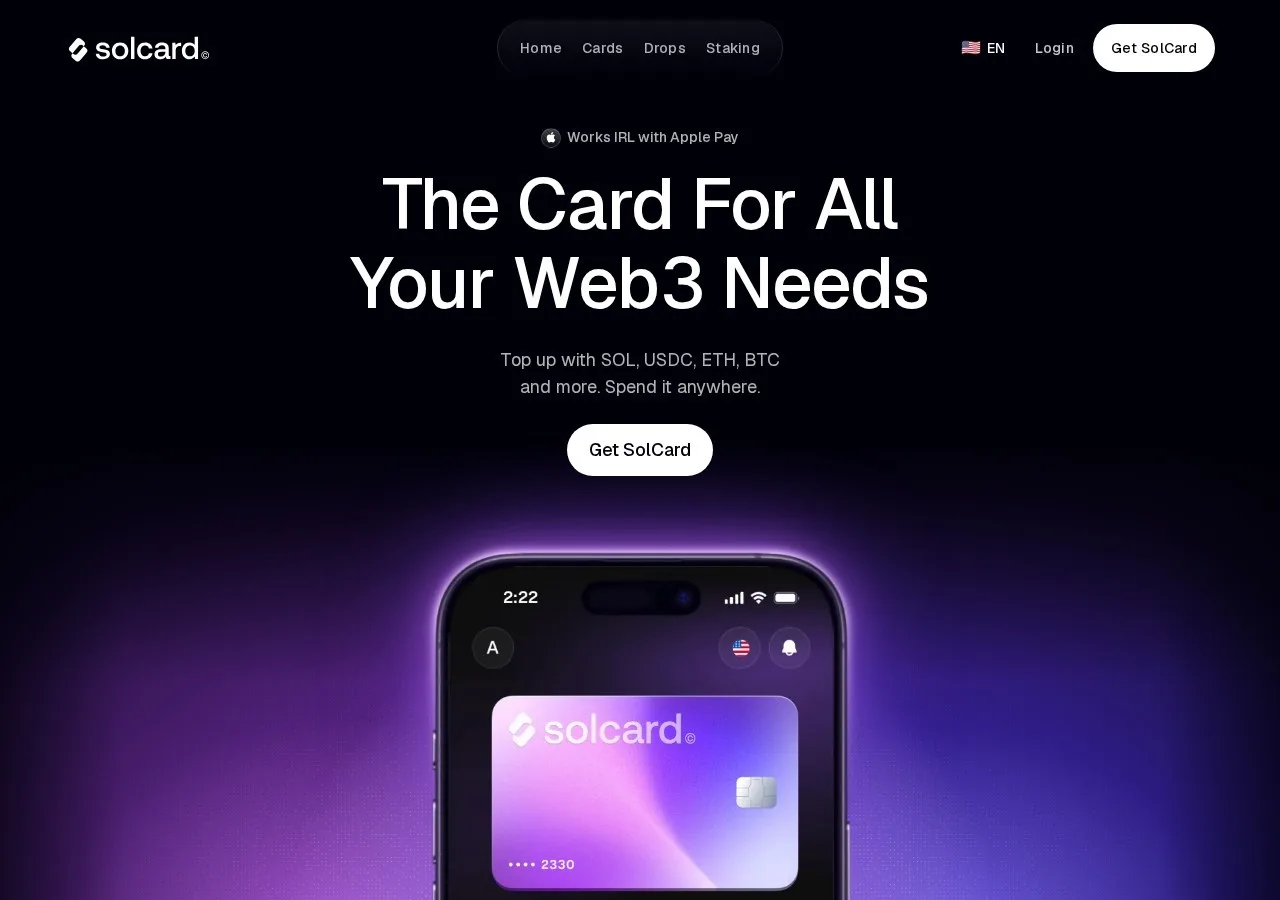
Users mainly praise SolCard for reliable use and non-KYC online spending, with Apple Pay and Google Pay also highlighted. Complaints are isolated, including one report of a refund not being credited and one mention of frozen cards and higher fees.
“Non-KYC crypto card with Apple Pay & Google Pay: Solcard Been seeing people ask about non-KYC crypto cards so figured I’d share what I’ve been using. Solcard has been around since 2024 and so far it’s been pretty reliable.”
“advantage: spending money without having to pay taxes disadvantage: frozen cards, card providers discontinuing, higher fees best non kyc card available is Solcard imo, have been using it for almost 2 years”
“Warning: SolCard (solcard.cc) — my 4,496 AED Qatar Airways refund was never credited [removed]”
Based on 14 Reddit posts and comments from the last 12 months, checked Oct 23, 2026. These are posts by users on other sites, not reviews submitted on CryptoReview.
No user reviews yet. Have you used SolCard? Share your experience below.
SolCard is operated by SC PAYMENTS LIMITED, a company incorporated in Hong Kong.
SolCard charges a one-time $10 issuance fee for each new card. Virtual top-ups cost 5%, Platinum top-ups cost 0%, and the published fee information lists no annual fee.
The Virtual card can be used without identity verification, while the Platinum tier requires KYC. Identity verification can also apply to certain features or spending limits.
SolCard supports assets including SOL, USDC, USDT, ETH and BTC across networks such as Solana, Ethereum, Base, Polygon, Arbitrum, BNB Chain, Optimism, Avalanche and HyperEVM. USDT on Tron, USDG on Robinhood Chain and EURC on Solana were added in September 2026.
SolCard converts supported digital assets to local currency at the point of sale and operates through licensed card issuing partners. The card balance is not a government-insured bank deposit.
SolCard has no cashback or rewards program. Its published card products describe payment tiers and supported crypto deposits rather than a SolCard token.
Self-custodial Mastercard card with €0 issuance, monthly and FX fees
Mastercard crypto debit card with 600+ spendable currencies and up to 2% cashback
Mastercard credit card paying up to 4% crypto rewards with no annual fee
Stablecoin Visa card with 1.4M users across 170+ countries
Mastercard stablecoin debit card with 0% transaction and FX fees
Crypto payment card with 2% assetback by default and up to 3% in selected assets
Type at least two characters. Press ↵ to see all results.