


We’ve been made aware of websites impersonating Hyperlane, so here’s a reminder:
>> Open roles are only listed at https://t.co/Y6s7Zrq9tJ
>> Official news only comes from @hyperlane and our official website: https://t.co/ViRkJ6d9KL
>> We do not have a Discord.
>> We’ll never DM you first, or ask for seed phrases, wallet access, verification codes, or software downloads.
If it didn’t come from us, it isn’t us.

Hyperlane
Permissionless cross-chain messaging and bridge framework connecting over 150 blockchains across 7 VMs
3.8/ 5
Our score
Good
Design
Messaging protocol
Chains supported
150
Security model
Configurable Interchain Security Modules (ISMs)
Audited
Yes
What is Hyperlane?
Hyperlane is an open-source, permissionless interoperability protocol designed to transmit arbitrary data and bridge tokens across blockchains. Operating across more than 150 networks and 7 virtual machine architectures, the protocol enables developers to deploy bridge contracts to any rollup, sovereign chain, or appchain without requiring permission or coordination from a core team.
Founding and financial backing
Hyperlane was founded in 2022 under the corporate entity Abacus Works Inc., based in Greenwich, Connecticut. The project was co-founded by Asa Oines, Nam Chu Hoai, and Jon Kol. Oines previously worked as a software engineer at Google and was an early protocol engineer at cLabs building Celo. Chu Hoai serves as chief technology officer, having also worked alongside Oines as an early engineer on the Celo protocol. Kol previously co-led Galaxy Digital's venture investment arm following an earlier career at Morgan Stanley. In September 2022, Hyperlane secured an $18.5 million seed financing round led by Variant, with participation from Circle, Galaxy Ventures, CoinFund, Kraken Ventures, Blockdaemon, and NFX.
Architecture and security model
Rather than relying on a static, globally shared validator set, Hyperlane separates message dispatch from verification through Interchain Security Modules. Developers configure their own security parameters for each route, choosing validator sets, multi-signature setups, or optimistic verification windows that match their specific security needs. Warp Routes serve as the token-bridging application layer built on top of this messaging foundation. Projects can deploy lock-and-mint or burn-and-mint bridge contracts using these routes. Relayers deliver the verified messages to the destination chain. For developers who prefer not to run their own infrastructure, the project offers Hyperlane-as-a-Service to manage validator and relayer infrastructure.
Deployment and usage milestones
Because Hyperlane is permissionless, developers can deploy contracts anywhere without identity verification or centralized onboarding. Over $10 billion in cumulative transfer volume has been routed through Hyperlane infrastructure, with the network validating more than 10,000 cross-chain messages daily. As of October 2026, protocol total value locked across monitored networks was about $75 million. The protocol has expanded across EVM chains, Solana, Cosmos, and TRON mainnet. It also introduced Metastable in July 2026 to coordinate 1:1 cross-chain clearing for stablecoins.
Risks and operational trade-offs
Decentralization in Hyperlane depends directly on the configuration of each individual Interchain Security Module. Weak validator thresholds chosen by route creators can expose specific bridges to validator collusion or signature compromise. Bridged assets on custom Warp Routes also carry wrapped-token counterparty risk and potential depeg exposure. In August 2026, the core team announced the phaseout of active relayer and validator support for more than 20 individual chains, requiring appchain teams to assume full operational responsibility for their own routing infrastructure.
Founders
Asa OinesCo-Founder
Early engineer at Celo building the Celo Protocol and former software engineer at Google.
Nam Chu HoaiCo-Founder & CTO
Early engineer at Celo building the Celo Protocol.
Jon KolCo-Founder
Former co-lead of Galaxy Digital's venture investment business and former Morgan Stanley professional.
Best for:Appchain and rollup developersProtocols managing multichain governanceDeFi teams needing custom routingCross-chain stablecoin issuers
Pros and cons
Pros
- Permissionless deployment to any chain without central governance approval
- Over 150 supported blockchains across 7 virtual machine architectures
- Customizable security models tailored per individual bridge route
- No mandatory KYC requirements to deploy or interact onchain
Cons
- Security depends on individual route configurations rather than a unified chain consensus
- Core team discontinued managed relayer support for over 20 networks in 2026
- Warp Routes expose users to wrapped-asset depeg and liquidity shortfall risks
Our review
3.8/5
Good
Hyperlane provides flexible, permissionless cross-chain messaging across 150 networks, but users must evaluate security on a per-deployment basis because security modules are configured individually by developers.
Hyperlane is an open cross-chain messaging protocol developed by Abacus Works Inc. that allows developers to deploy bridging and arbitrary data passing across more than 150 blockchains without centralized gatekeeping. Unlike canonical bridges locked to single networks, Hyperlane operates across seven virtual machine architectures, spanning the EVM, Solana, Cosmos, and TRON. As of October 2026, the protocol has processed more than $10B in cumulative transfers and secures $75M in total value locked.
The protocol's primary architectural strength is modularity. Applications configure their own validation rules using Interchain Security Modules (ISMs), picking between multisigs, optimistic fraud proofs, or custom hooks. For token transfers, developers deploy Warp Routes to bridge lock-and-mint or liquidity-backed tokens, with optional Predicate compliance hooks. However, this flexibility creates operational fragmentation: security guarantees vary between implementations, and end-users cannot rely on a single uniform trust model across routes.
Operational shifts also highlight infrastructure risks for smaller ecosystems. In August 2026, Hyperlane announced plans to wind down core validator and relayer infrastructure across 26 networks, requiring remaining projects to run their own relaying infrastructure or risk halted message delivery. When networks lose relayer support, transfers require manual handling or migration before processing stops completely.
The founding team combines deep engineering experience from early Celo protocol development, Google, and Morgan Stanley. Backed by an $18.5M seed round led by Variant, Circle, and CoinFund, Hyperlane suits developers building multichain apps and rollups requiring rapid, custom bridge deployment. Regular users seeking zero-configuration transfers backed by single immutable validator sets may prefer bridges with uniform security guarantees.
Specs
| KYC required ⓘ | No · unverified |
|---|---|
| Design | Messaging protocol |
| Chains | Ethereum, BNB Chain, Arbitrum, Base, Optimism, Polygon, Avalanche, Solana, Hyperliquid, Other |
| Chains supported | 150 · unverified |
| Security model | Configurable Interchain Security Modules (ISMs) |
| Audited | Yes |
| Token | HYPER |
| Native token transfers (no wrapped tokens) | Yes · unverified |
Not disclosed by the provider: Typical fee, Typical transfer time, Intent-based, Max transfer.
Data from the provider's website and public sources. Fees and availability change; confirm on the official site before you sign up.
Key features
Interchain security modules
Routes use modular verification rules, letting applications select their own validator sets, multi-signatures, or optimistic challenge windows.
Warp Routes
Developers deploy permissionless token bridges supporting native clearing, synthetic wrapped assets, and compliance hooks across chains.
Multichain VM support
Passes arbitrary messages and tokens across 7 virtual machine environments, including EVM, Solana, and Cosmos.
Metastable clearing
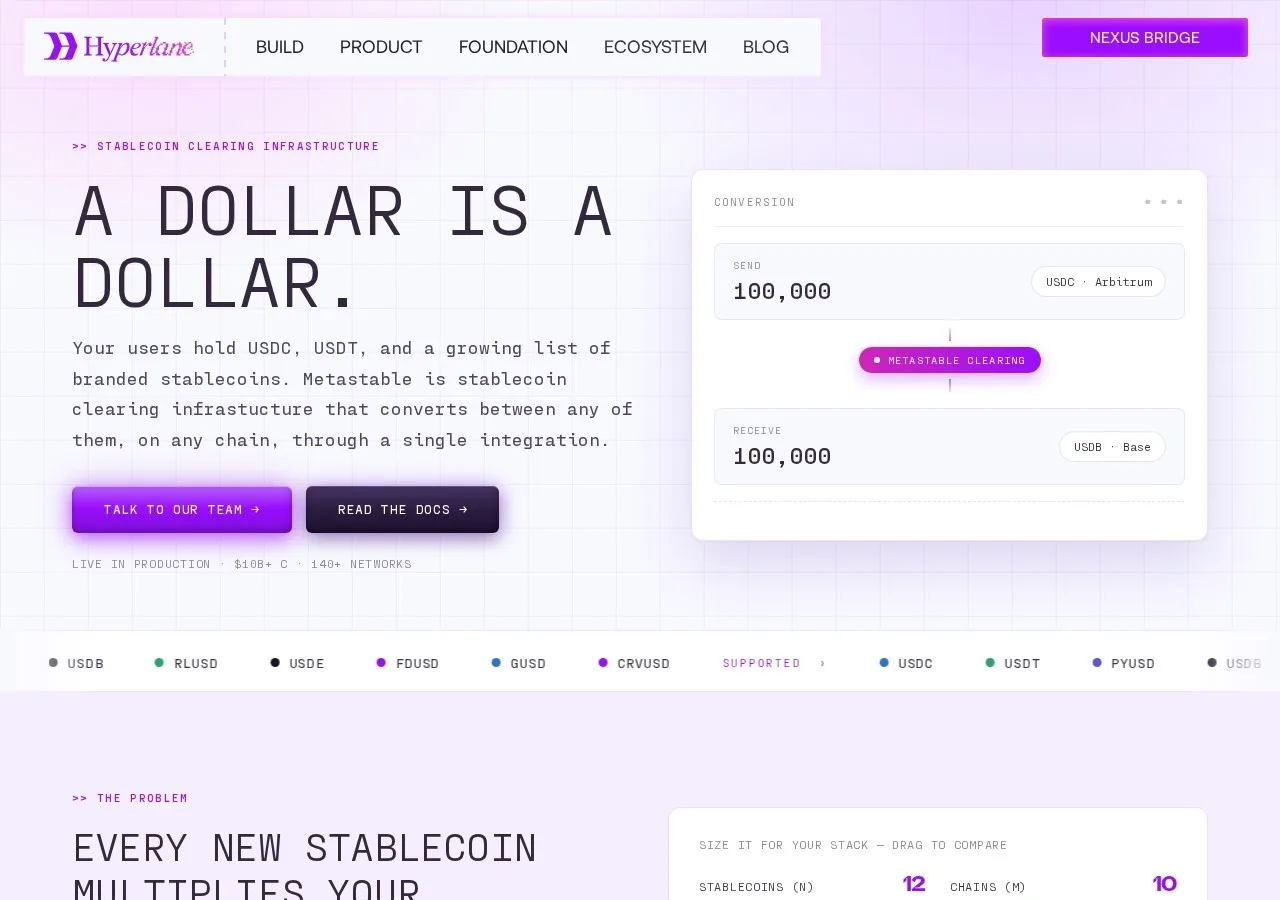
Enables 1:1 cross-chain clearing mechanisms tailored to handle conversions between different stablecoins.
Hyperlane-as-a-Service
Provides managed validator and relayer operational setups for development teams deploying custom rollups.
Inside Hyperlane
Hyperlane Interoperability Framework
The core messaging layer that passes arbitrary data, state calls, and governance payloads across more than 150 blockchains and 7 virtual machines.
Warp Routes
Permissionless token bridging contracts that let developers deploy wrapped, synthetic, or native asset routes with configurable security rules.
Nexus Bridge
A front-end interface powered by Hyperlane contracts that lets end-users move stablecoins and tokens across supported networks.
Metastable
A stablecoin clearing infrastructure designed to coordinate 1:1 asset conversions between different stablecoins across isolated blockchains.
Hyperlane-as-a-Service
A managed integration offering from the core team that handles relayer deployment, validator setups, and custom bridge launches for new networks.
Hyperlane screenshots
User reviews
No user reviews yet. Have you used Hyperlane? Share your experience below.
Funding and investors
$18.5MTotal raised
2Rounds
13Investors
-
Seed Sep 2022 $18.5MSource
 VariantVenture capital
Lead
AS AsymmetricVenture capital
BL BlockdaemonCorporate VC
CI CircleVenture capital
 CoinFundVenture capital
FI FigmentVenture capital
GD Galaxy DigitalCorporate VC
 Galaxy VenturesCorporate VC
GV Gate VenturesExchange ventures arm
HY HypersphereVenture capital
KV Kraken VenturesVenture capital
NF NFXVenture capital
-
Funding round Amount undisclosed
FAQ
Who founded Hyperlane?
Hyperlane was founded in 2022 by Asa Oines, Nam Chu Hoai, and Jon Kol under the parent company Abacus Works Inc. Oines and Chu Hoai were early core engineers at Celo, while Kol previously co-led venture investments at Galaxy Digital.
What chains does Hyperlane support?
Hyperlane connects over 150 blockchains across 7 virtual machine architectures. Supported environments include Ethereum, Solana, Arbitrum, Base, Avalanche, TRON, and various Cosmos chains.
Does Hyperlane require KYC verification?
No, Hyperlane is a permissionless, open-source protocol that does not collect personal information or enforce KYC checks. Individual applications deploying Warp Routes can implement their own compliance hooks if desired.
Does Hyperlane have a native token?
Yes, Hyperlane uses the token symbol HYPER. The token powers governance and economic alignment within the interoperability framework.
How does Hyperlane secure cross-chain transfers?
Hyperlane secures messages using modular Interchain Security Modules (ISMs). Developers configure specific verification rules for their contracts, choosing validator sets, multisigs, or optimistic windows rather than relying on a single monolithic network.
Latest from Hyperlane on X
On board 🫡
Metaswaps powered by Hyperlane.
Metaswaps powered by Hyperlane.
Hyperlane is now live on @Arc, connecting Circle's Economic OS to 80+ chains.
>> Deploy Warp Routes permissionlessly, no approval needed
>> Issue tokens that live natively on Arc and 80+ chains
>> Customize security per route with ISMs
Stablecoins accelerate with Hyperlane. https://t.co/fnSuApGYoI
>> Deploy Warp Routes permissionlessly, no approval needed
>> Issue tokens that live natively on Arc and 80+ chains
>> Customize security per route with ISMs
Stablecoins accelerate with Hyperlane. https://t.co/fnSuApGYoI

Shield Swap is integrating Hyperlane to bring ETH, SOL, and wBTC in from Ethereum and Solana.
Confidential trading accelerates with Hyperlane.
Get Early Access >> https://t.co/SUtwtAfBOD
Confidential trading accelerates with Hyperlane.
Get Early Access >> https://t.co/SUtwtAfBOD
Good news for any stragglers:
The deadline to bridge Hyperlane assets off SOON has been extended to August 28. Transfers will stop processing after that, so bridge back to Solana before then.
Last Call >> https://t.co/oB5d010YxY
The deadline to bridge Hyperlane assets off SOON has been extended to August 28. Transfers will stop processing after that, so bridge back to Solana before then.
Last Call >> https://t.co/oB5d010YxY
Recent public posts from @hyperlane, shown as published. Not reviewed or endorsed by CryptoReview.
Alternatives to Hyperlane

Cross-chain swap aggregator routing tokens across 100+ EVM and non-EVM blockchains
AggregatorEthereum · BNB Chain +7Audited

Intent-based cross-chain bridge using optimistic verification, processing over $40B in total volume
No KYCIntent-basedEthereum · Arbitrum +4Audited

Intent-based cross-chain bridge and payment network across more than 85 blockchains
No KYCIntent-basedEthereum · Base +9Audited

Intent-based cross-chain protocol settling transfers across 25+ networks without locked liquidity pools
No KYCIntent-basedEthereum · BNB Chain +7Audited

Cross-chain swap protocol using intent routing and CCTP across Solana, EVM chains, and Sui
No KYCIntent-basedSolana · Ethereum +9Audited

Cross-chain DEX and bridge aggregator routing swaps across more than 80 blockchains
No KYCAggregatorBitcoin · Ethereum +3Audited