

Hardened JavaScript and the Endo framework isolate contract execution at the language level.
The same isolation model is already in production use at enterprise scale: MetaMask's Snaps (30M+ users), Salesforce (5M developers).
Externally validated infrastructure 👍
Agoric
JavaScript-native Cosmos Layer 1 blockchain for cross-chain smart contract orchestration
3.6/ 5
Our score
Good
Layer
Layer 1
Consensus / design
Proof of Stake
Native token
BLD
EVM compatible
No
What is Agoric?
Agoric is a Cosmos-based Layer 1 blockchain engineered to run cross-chain smart contracts in hardened JavaScript. Built on CometBFT consensus, the platform provides an asynchronous, multi-block execution environment that lets developers coordinate assets, contracts, and timing triggers across multiple networks without manual bridging.
Team and background
Agoric Systems Operating Company was founded in 2018. Chief Executive Officer Dean Tribble previously designed early smart contracting protocols for the AMiX system. Chief Scientist Mark S. Miller authored seminal research on Agoric Open Systems and created the E programming language for secure, distributed computing. Co-founders include Brian Warner, who co-created the Tahoe-LAFS distributed storage network, and Bill Tulloh, an economist from the original Agorics Project. The company completed a seed funding round in May 2018 backed by Polychain Capital, Naval Ravikant, and the Zcash Company.
Architecture and core mechanics
The Agoric network relies on Proof of Stake consensus secured by its native BLD token. Instead of the Ethereum Virtual Machine, it uses Hardened JavaScript and an object-capability security framework powered by the Endo runtime. Its Zoe smart contract framework enforces offer safety, guaranteeing that contract interactions either settle terms successfully or return locked assets to their owners. Interoperability runs through the native Cosmos Inter-Blockchain Communication protocol, Axelar General Message Passing, and IBC-connected endpoints. Long-lived smart contracts can pause across multiple blocks, await remote cross-chain replies, and execute automated actions using on-chain timers.
Tokenomics and fee structure
The network operates a dual-token model. The BLD token handles staking, protocol governance, and consensus security, while also covering postage fees for complex cross-chain execution. Everyday transaction fees are paid in IST, an over-collateralized decentralized stable token used to pay network fees.
Track record and adoption
The project launched Mainnet Phase 0 in November 2021, establishing BLD distribution and governance. In 2025, the team expanded into a product-led roadmap focused on cross-chain orchestration, introducing Ymax, a non-custodial capital command center for multi-chain DeFi. By August 2026, Ymax reported more than $16M in assets deployed across its automated cross-chain strategies, while on-chain TVL tracked directly on the Agoric base chain remained around $116,000 in October 2026.
Risks and trade-offs
Agoric does not offer EVM compatibility, meaning Solidity smart contracts cannot be deployed directly without rewriting them in hardened JavaScript. Cross-chain operations depend on the continued availability and security of IBC channels and external messaging bridges such as Axelar. Base-chain on-chain liquidity remains relatively low, and complex multi-block contracts carry latency risks tied to confirmation times on counterparty blockchains.
Founders
E. Dean Tribble,CEO
Best for:JavaScript developers entering Web3Cross-chain DeFi yield automationComplex multi-network app workflowsCosmos ecosystem asset orchestration
Pros and cons
Pros
- Hardened JavaScript is used for smart contract development
- Zoe framework guarantees offer safety by refunding assets if a trade fails
- Multi-block execution coordinates workflows across IBC chains
- Transaction fees are paid in IST, while BLD covers cross-chain postage fees
- Endo object-capability architecture isolates contract permissions
Cons
- No EVM compatibility requires rewriting existing Solidity smart contracts
- Direct on-chain TVL is low at about $116,000 in October 2026
- Cross-chain execution depends on relayers, IBC endpoints, and third-party bridge infrastructure
- Asynchronous cross-chain settlement creates execution delay across remote chains
Our review
3.6/5
Good
Agoric pairs an expressive JavaScript development environment and cross-chain orchestration with strong security design, but its native on-chain ecosystem and total value locked remain modest.
Agoric operates as a Cosmos-based Layer 1 blockchain powered by CometBFT consensus and native Inter-Blockchain Communication (IBC). Developed by computer scientists Dean Tribble and Mark S. Miller, the chain addresses fragmented liquidity across networks through an asynchronous, multi-block smart contracting engine. Unlike standard smart contract platforms that rely on Solidity or Rust, Agoric lets developers write contracts in hardened JavaScript, applying an object-capability security model that restricts authority at the code level.
The network relies on a two-token economic architecture. BLD serves as the native Proof-of-Stake token for consensus, contract staking, and on-chain governance votes. Network fees are paid in IST, while BLD covers postage fees for multi-chain operations. Through its Zoe framework, the chain enforces escrow safety so that users cannot leave a trade without either getting what they offered or receiving their assets back. While its core engineering isolates contract state, total value locked on the native chain remains low, registering at about $116K in October 2026, though its flagship cross-chain yield command center Ymax managed over $16M in deployed capital by August 2026.
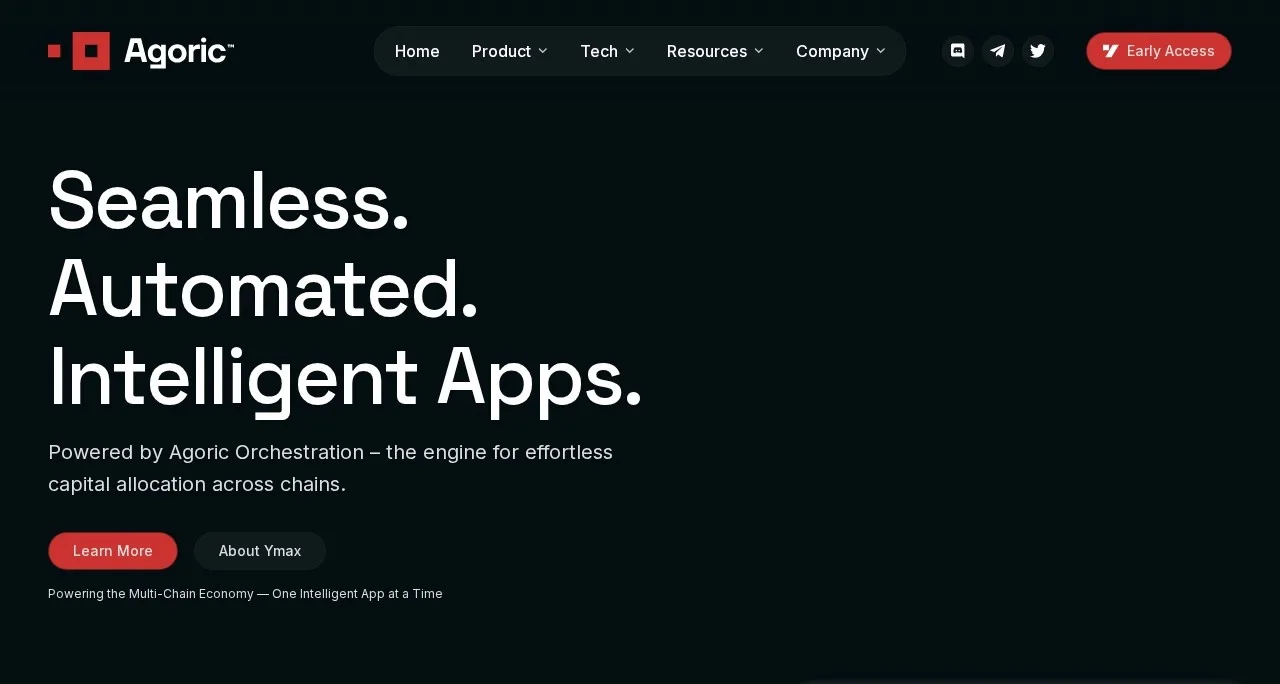
Agoric provides hardened JavaScript and automated multi-chain execution workflows without manual bridging.
Specs
| Layer | Layer 1 · unverified |
|---|---|
| Consensus / design | Proof of Stake · unverified |
| Native token | BLD |
| EVM compatible | No · unverified |
| Smart contract languages | JavaScript · unverified |
| Mainnet since | 2,021 · unverified |
| Sequencer | Not applicable · unverified |
| Gas paid in | IST · unverified |
Not disclosed by the provider: Block time, Typical transaction fee, Finality, Validators / sequencer, Throughput (TPS), Data availability.
Data from the provider's website and public sources. Fees and availability change; confirm on the official site before you sign up.
Key features
Hardened JavaScript contracts
Executes smart contracts in a secure JavaScript runtime using object capabilities to isolate permissions and prevent unauthorized state access.
Zoe offer safety
Protects transactions by guaranteeing that an escrowed exchange either completes the requested trade or refunds user assets.
Multi-block cross-chain orchestration
Allows contracts to initiate actions across IBC or Axelar, pause across blocks while awaiting confirmation, and resolve asynchronously.
Dual-token economic model
Separates staking and governance via BLD from transaction execution fees settled in the IST over-collateralized stable token.
On-chain scheduled timers
Enables native time-based actions directly within contracts to trigger recurring payments, loan repayments, and strategy rebalancing.
Ymax capital command center
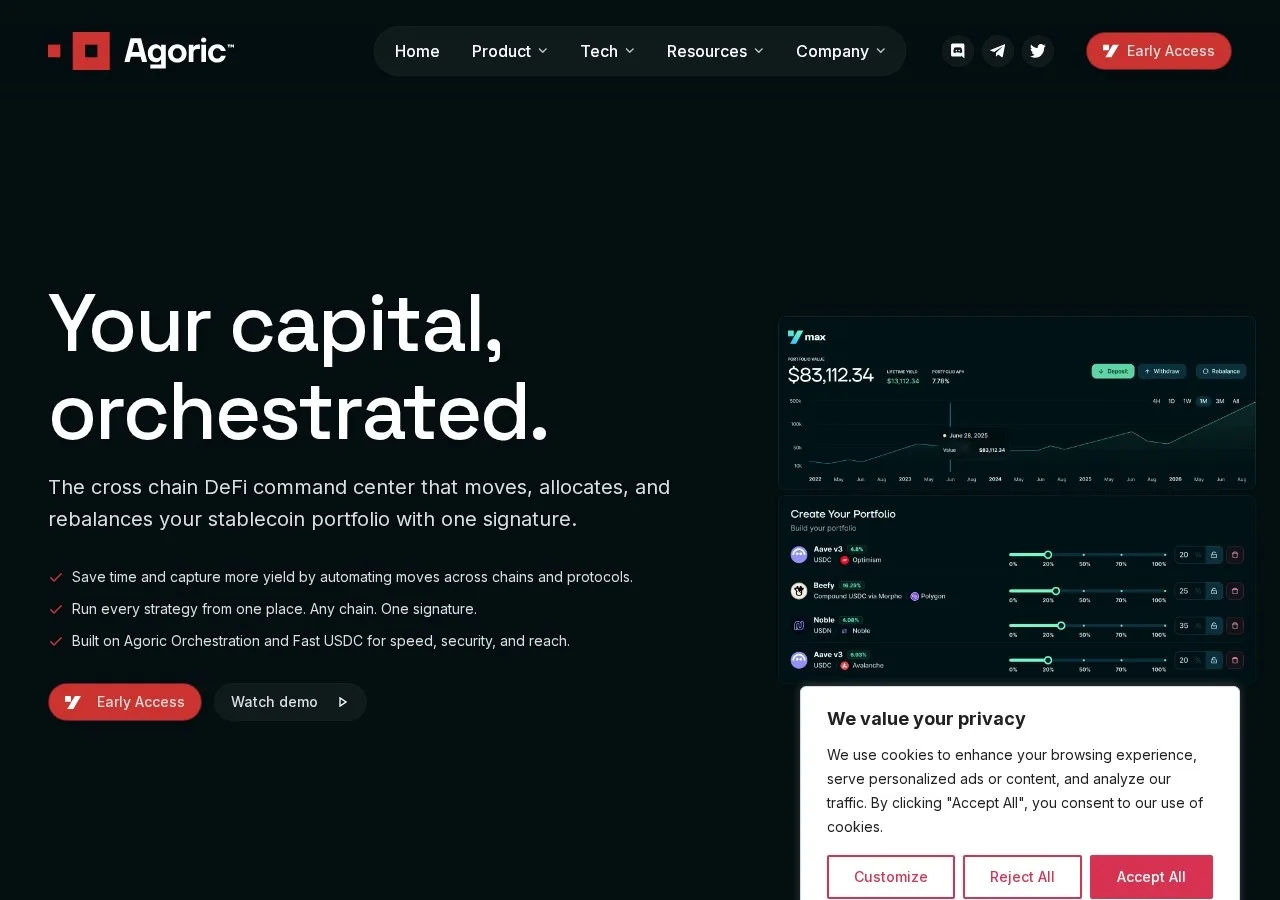
Automates yield allocation across multiple blockchains from a non-custodial dashboard using isolated remote accounts.
Inside Agoric
Agoric Orchestration
An automation layer and API designed to execute multi-block cross-chain operations and coordinate smart contracts across different blockchains.
Ymax
A cross-chain DeFi command center that automates portfolio capital allocation and yield strategies without requiring manual bridging.
Zoe
A smart contract framework providing built-in escrow services and offer safety guarantees for on-chain trades and asset exchanges.
BLD Token
The native token securing the network through Proof-of-Stake consensus, funding purses for contracts, and powering governance decisions.
IST Token
An over-collateralized stable token used across the Agoric ecosystem to pay network transaction fees.
Agoric screenshots
User reviews
No user reviews yet. Have you used Agoric? Share your experience below.
Funding and investors
1Round
3Investors
-
Seed May 2018 Amount undisclosedSource
FAQ
Who founded Agoric?
Agoric was founded in 2018 by Mark S. Miller, Dean Tribble, Brian Warner, and Bill Tulloh, drawing on decades of research in secure distributed computing and smart contracting.
Does Agoric have a native token?
Yes, BLD is the native token used for Proof-of-Stake consensus, governance voting, and multi-chain postage fees. The network also uses an over-collateralized stable token named IST for transaction gas fees.
What smart contract languages does Agoric use?
Agoric smart contracts are written in hardened JavaScript. This lets developers write contracts in JavaScript alongside an object-capability security model.
Is Agoric EVM compatible?
No, Agoric does not use the Ethereum Virtual Machine or the Cosmos EVM module. It runs smart contracts in an isolated JavaScript runtime using the Endo framework.
What chains can Agoric interact with?
Agoric interacts natively with other Cosmos networks using the Inter-Blockchain Communication (IBC) protocol. It can connect to external chains such as Avalanche via general message-passing protocols such as Axelar.
What is Ymax?
Ymax is a non-custodial cross-chain DeFi command center built on Agoric. It automates yield routing and capital allocation across chains while users retain custody of their keys.
Latest from Agoric on X
Give someone exactly what they need to do the job. Nothing more, just in case.
That's the Principle of Least Authority, a security idea older than crypto or AI agents.
It's a guiding rule in the control layer for agentic finance we're building with @Ymaxapp https://t.co/kuoR2H1nvs
That's the Principle of Least Authority, a security idea older than crypto or AI agents.
It's a guiding rule in the control layer for agentic finance we're building with @Ymaxapp https://t.co/kuoR2H1nvs

In software, everything is objects. Objects have capabilities, aka permissions or authorization.
But most systems hand out capabilities in bulk. Log in once, and you can touch almost everything that account is allowed to touch.
Object-capability security is different. https://t.co/QkYzsscalG
But most systems hand out capabilities in bulk. Log in once, and you can touch almost everything that account is allowed to touch.
Object-capability security is different. https://t.co/QkYzsscalG

On the Cosmos EVM incident affecting KiiChain, TAC, and MANTRA this week: the vulnerability lives in the shared Cosmos EVM module, a component the Agoric chain does not implement.
The Agoric chain has no exposure.
More detail from Cosmos Labs here:
https://t.co/9m5Xybq8aP
The Agoric chain has no exposure.
More detail from Cosmos Labs here:
https://t.co/9m5Xybq8aP
Welcome to Ymax, @y10kcapital!
Thrilled to have this institutional team putting real capital to work on the orchestration layer.
This is what programmable capital allocation looks like.
Thrilled to have this institutional team putting real capital to work on the orchestration layer.
This is what programmable capital allocation looks like.
Recent public posts from @agoric, shown as published. Not reviewed or endorsed by CryptoReview.
Alternatives to Agoric
Proof-of-stake layer-1 blockchain securing nearly $50B in DeFi value since 2015
Layer 1Proof of StakeEVM compatible

Ethereum optimistic rollup securing over $12B with ~0.25-second block times and Stylus Rust contracts
Layer 2Optimistic rollupEVM compatible

Sharded Layer-1 blockchain supporting 1.2s finality and cross-chain execution across 35+ networks
Layer 1Proof of StakeNEAR
EVM sidechain with sub-two-second settlement, $0.002 average fees, and over 8 billion processed transactions
SidechainProof of StakeEVM compatible
Proof-of-stake layer 1 with sub-second finality and customizable sovereign appchains
Layer 1Proof of StakeEVM compatible
Ethereum layer 2 built on the OP Stack and incubated by Coinbase
Layer 2Optimistic rollupEVM compatible