



From stablecoins on @solana to dollars in bank accounts around the world.
@john3gan on @FINTECHTVglobal https://t.co/0ljONDVkQ9

Polygon
EVM sidechain with sub-two-second settlement, $0.002 average fees, and over 8 billion processed transactions
4.1/ 5
Our score
Very good
Layer
Sidechain
Consensus / design
Proof of Stake
Native token
POL
Typical transaction fee
$0.002
EVM compatible
Yes
What is Polygon?
Polygon is an EVM-compatible Proof of Stake network designed for high-throughput smart contracts and stablecoin settlements. Operating alongside Ethereum, the network has processed more than 8 billion transactions with over $3.0 trillion in cumulative transfer volume, maintaining an average transaction fee of $0.002 and finality around 1.8 seconds.
Who is behind it
Originally established in 2017 as Matic Network in India by software engineers Jaynti Kanani, Sandeep Nailwal, Anurag Arjun, and Mihailo Bjelic, the project rebranded to Polygon Technology in February 2021. Polygon Labs steers network development. In February 2022, the project raised $450 million in a private token sale led by Sequoia Capital India, with participation from SoftBank Vision Fund 2, Galaxy Digital, Tiger Global, and Republic Capital. Polygon Labs adjusted its organization in February 2024, laying off 60 employees, or roughly 19% of its team.
How it works and fee architecture
Polygon PoS operates as a sidechain to Ethereum. Validators lock the network's native utility and governance token, POL, into smart contracts deployed directly on Ethereum mainnet. These validators produce blocks locally, validate transactions, and submit periodic Merkle checkpoints back to Ethereum for final security verification. Users pay gas fees in POL, with 100% of base fees burned under an EIP-1559 implementation. Developers write smart contracts in Solidity, deploying them with standard EVM tooling without rewriting codebases. Through the Polygon Open Money Stack (OMS) and Chain Development Kit (CDK), teams can also connect zero-knowledge rollups and custom chains via the AggLayer protocol.
Track record and milestones
Polygon expanded its zero-knowledge technology through acquisitions, purchasing Hermez Network for $250 million in August 2021 and Mir for 250 million MATIC in December 2021. In September 2024, Polygon executed a 1:1 token migration from its legacy MATIC token to POL. In October 2025, the Rio hard fork activated on mainnet to refine block production toward a 5,000 TPS capacity. By September 2025, stablecoin supply on Polygon PoS reached $2.98 billion, while decentralized finance TVL reached $1.18 billion.
Risks and incidents
Security and infrastructure risks remain tied to sidechain architecture and cross-chain bridging mechanisms. In December 2021, an exploit compromised 801,601 MATIC before a vulnerability was patched. While the Polygon PoS network maintained continuous uptime, the separate Polygon zkEVM sequencer suffered a temporary operational halt on July 1, 2026. Staking and state commitments remain dependent on contracts residing on Ethereum mainnet.
Founders
Jaynti KananiCo-founder
Software engineer
Sandeep NailwalCo-founder
Software engineer
Anurag ArjunFormer Co-founder
Software engineer and angel investor
Mihailo BjelicCo-founder
Software engineer
Best for:High-frequency stablecoin payment providersFintech developers seeking EVM compatibilityDeFi apps requiring sub-cent feesTeams launching modular application chains
Pros and cons
Pros
- Typical transaction fees average approximately $0.002 per transfer
- Settlement finality completes in roughly 1.8 seconds
- Full EVM execution environment supports standard Solidity tooling and libraries
- Processed over 8 billion transactions across more than $3.0 trillion in cumulative volume
- Over $2.9 billion in stablecoin liquidity settled across active payment corridors
Cons
- Relies on sidechain checkpoints rather than native Layer 2 zero-knowledge rollups
- Bridge smart contracts on Ethereum introduce third-party settlement and locking risks
- Past smart contract vulnerability resulted in the loss of 801,601 tokens in 2021
- Separate Polygon zkEVM sequencer suffered an operational halt in July 2026
Our review
4.1/5
Very good
Polygon PoS delivers sub-cent stablecoin settlement and deep liquidity, but relies on periodic Ethereum checkpointing rather than native rollup-level L1 security.
Polygon PoS operates as an EVM-compatible Proof of Stake sidechain anchored to Ethereum through periodic checkpoints. Originally founded in 2017 as Matic Network by Jaynti Kanani, Sandeep Nailwal, Anurag Arjun, and Mihailo Bjelic, the network rebranded in 2021 and shifted its native staking and gas token from MATIC to POL in September 2024. Across its history, Polygon has processed over 8 billion transactions, settling more than $3.0 trillion in cumulative volume.
Speed and cost represent Polygon's primary advantages. Average transaction fees hover around $0.002, with network finality settling in roughly 1.8 seconds. Following the October 2025 Rio upgrade, the chain restructured block production toward a target throughput of 5,000 TPS. Polygon has positioned itself heavily as a settlement rail for stablecoins and enterprise payments, complemented by the launch of the Polygon Open Money Stack (OMS) for programmatic payouts and foreign exchange routing. By late 2025, stablecoin balances on Polygon PoS reached $2.98 billion, supporting active deployments of major protocols like Aave and QuickSwap.
Security and architectural trade-offs remain its notable limitations. Unlike zero-knowledge or optimistic rollups, Polygon PoS functions as an independent validator set where stake contracts and checkpoints live on Ethereum, meaning users rely on the validator set rather than direct Ethereum consensus execution. Technical disruptions have occurred, including an exploit of 801,601 MATIC tokens in December 2021 before a patch was deployed, as well as an outage on the companion Polygon zkEVM sequencer in July 2026. The operating entity, Polygon Labs, also downsized its workforce by 19% in February 2024.
Polygon suits payment fintechs, marketplace platforms, and developers seeking predictable, sub-cent EVM transaction costs with high stablecoin liquidity. Projects that require strict layer-1 rollup fraud proofs or native zero-knowledge security guarantees should look toward dedicated rollups instead.
Specs
| Layer | Sidechain |
|---|---|
| Consensus / design | Proof of Stake |
| Native token | POL |
| EVM compatible | Yes |
| Smart contract languages | Solidity |
| Typical transaction fee | $0.002 · unverified |
| Finality | ~1.8 seconds · unverified |
| Mainnet since | 2,020 · unverified |
| Throughput (TPS) | 5,000 · unverified |
| Sequencer | Not applicable · unverified |
| Gas paid in | POL · unverified |
Not disclosed by the provider: Block time, Validators / sequencer, Data availability.
Data from the provider's website and public sources. Fees and availability change; confirm on the official site before you sign up.
Key features
EVM compatibility
Executes Solidity smart contracts natively. Developers can deploy Ethereum-based applications without modifying existing tooling.
Checkpoint settlement to Ethereum
Validators produce blocks on Polygon PoS and periodically submit signed Merkle checkpoints directly to Ethereum mainnet.
Sub-two-second finality
Transactions reach settlement finality in approximately 1.8 seconds at an average fee of $0.002.
POL multi-chain staking
Stakers lock native POL tokens on Ethereum to validate Polygon PoS blocks or secure connected ecosystem chains.
Polygon Open money stack
Provides an integrated REST API for merchant payins, virtual accounts, currency conversion, and global stablecoin payouts.
AggLayer interoperability
Connects CDK-built chains and rollups using zero-knowledge proofs to share unified liquidity across networks.
Inside Polygon
Polygon PoS
The primary Proof of Stake sidechain that processes high-volume EVM transactions, settling periodic state checkpoints onto Ethereum mainnet.
Polygon Open Money Stack (OMS)
A modular payments suite and API providing businesses with programmable payins, virtual accounts, foreign currency conversion, and automated stablecoin settlement.
AggLayer
An aggregation protocol designed to unify cross-chain liquidity and execute zero-knowledge proofs across connected layer-1 and layer-2 networks.
Polygon CDK
A chain development framework that allows developers to launch modular, customizable zero-knowledge layer-2 rollups.
Polygon screenshots
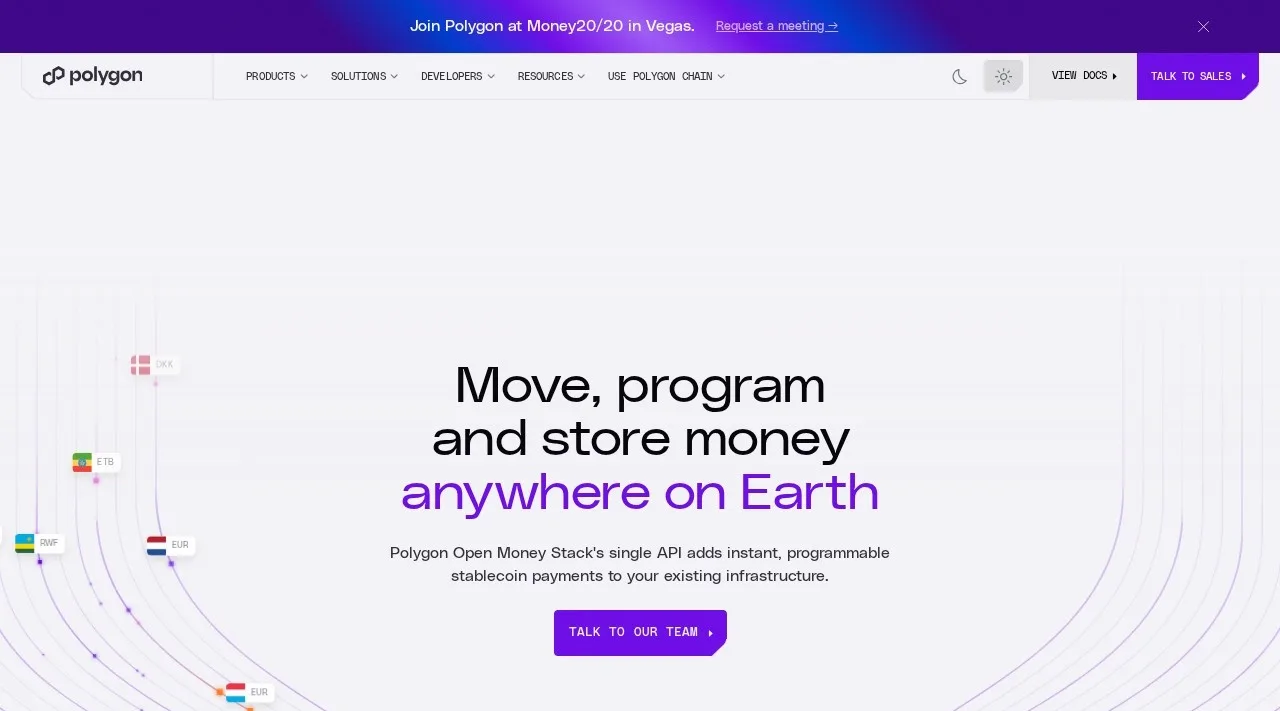
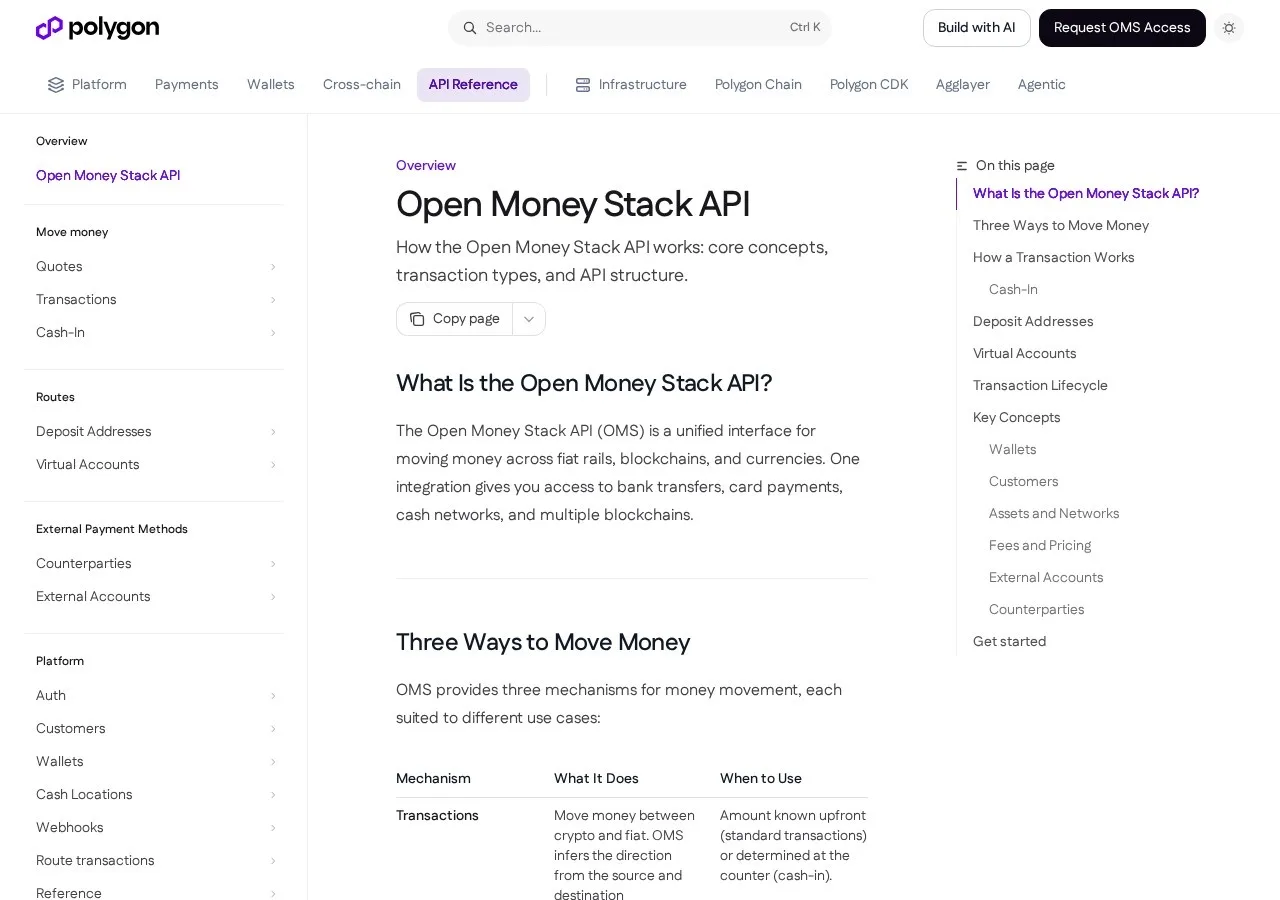
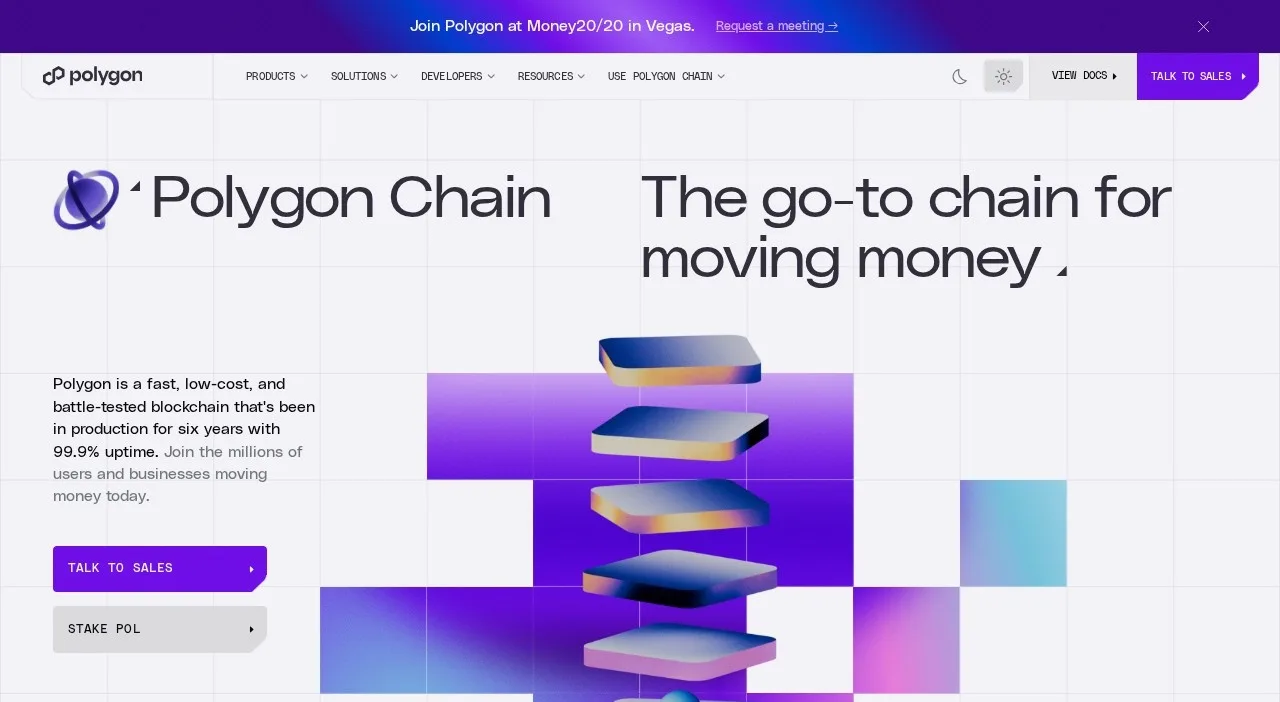
What users say about Polygon
Community sentiment shows appreciation for Polygon's extensive stablecoin adoption, institutional integrations, and low transaction costs for decentralized applications. However, users frequently voice frustration over getting stuck without gas tokens to move assets, as well as inflation concerns following the tokenomics shift to POL.
Top goods
In their own words
“my latest hobby project: playing Catan (and other online boardgames) for crypto (on Polygon) Maybe I'm just a degenerate gambler but I've been playing board games at BoardGameArena for years, and I always wished they would make it possible to play for money.”
“Stuck without gas on Polygon, need 0.05 POL to move USDC Anyone Help?”
“No that is a good thing. Idgaf about the tech. I want ROI on $POL. I've been holding long before they made the switch from $MATIC to $POL. I want the Hardcap back none of this Unlimited supply BS. Us retail Investors invested in something we expected to take off.”
“Transaction stuck, how to cancel it or speed it up? No idea how this happened, never happened before in any of the blockchains I've used, but my transaction of $20 USDT got stuck and doesn't move or cancel itself. Is there anything happening in the blockchain itself? Are the nodes up and running?”
Based on 200 Reddit posts and comments from the last 12 months, checked Oct 20, 2026. These are posts by users on other sites, not reviews submitted on CryptoReview.
User reviews
No user reviews yet. Have you used Polygon? Share your experience below.
Funding and investors
$450MTotal raised
2Rounds
8Investors
-
Private Token Sale Feb 2022 $450MPX Peak XV PartnersVenture capital Lead GD Galaxy DigitalCorporate VC RC Republic CapitalVenture capital SV SoftBank Vision Fund 2Corporate VC TG Tiger Global ManagementVenture capitalSource
-
Funding round Amount undisclosed
FAQ
Who founded Polygon?
Polygon was founded in 2017 as Matic Network by Jaynti Kanani, Sandeep Nailwal, Anurag Arjun, and Mihailo Bjelic. The development of the ecosystem is supported by Polygon Labs.
What token does Polygon use for gas fees?
Polygon uses POL as its native gas and staking token. The network completed the migration from MATIC to POL at a 1:1 ratio in September 2024.
What are the typical transaction fees on Polygon?
The average transaction fee on Polygon PoS is approximately $0.002. All base transaction fees are burned according to EIP-1559 mechanics.
Is Polygon a Layer 2 rollup or a sidechain?
Polygon PoS functions as an EVM-compatible Proof of Stake sidechain that periodically submits cryptographic state checkpoints to Ethereum. Polygon also develops Layer 2 zero-knowledge solutions through the Polygon CDK and AggLayer.
Has Polygon experienced any major security incidents?
In December 2021, Polygon fixed a smart contract vulnerability after an attacker stole 801,601 MATIC tokens. In July 2026, the Polygon zkEVM sequencer experienced a temporary halt while the core PoS chain remained functional.
Latest from Polygon on X
Welcome to Polygon, @RIFTHQ.
Integrate more ways to checkout with Polygon Open Money Stack
https://t.co/nlPzUIUeWe
ahhh https://t.co/6CUy7bDPOC

Recent public posts from @0xPolygon, shown as published. Not reviewed or endorsed by CryptoReview.
Alternatives to Polygon
Proof-of-stake layer-1 blockchain securing nearly $50B in DeFi value since 2015
Layer 1Proof of StakeEVM compatible

Ethereum optimistic rollup securing over $12B with ~0.25-second block times and Stylus Rust contracts
Layer 2Optimistic rollupEVM compatible

Sharded Layer-1 blockchain supporting 1.2s finality and cross-chain execution across 35+ networks
Layer 1Proof of StakeNEAR

Proof-of-stake layer 1 with sub-second finality and customizable sovereign appchains
Layer 1Proof of StakeEVM compatible

Ethereum layer 2 built on the OP Stack and incubated by Coinbase
Layer 2Optimistic rollupEVM compatible

Ethereum layer-2 optimistic rollup and modular framework powering the Superchain ecosystem
Layer 2Optimistic rollupEVM compatible