


Heading to @ethereuminsti in London on November 12?
Our team will be there to answer questions about launching, running, and scaling a chain on the OP Stack.

Optimism
Ethereum layer-2 optimistic rollup and modular framework powering the Superchain ecosystem
4.0/ 5
Our score
Very good
Layer
Layer 2
Consensus / design
Optimistic rollup
Native token
OP
EVM compatible
Yes
What is Optimism?
Optimism is an Ethereum layer-2 scaling protocol designed around optimistic rollup architecture to process transactions off-chain while anchoring security to the Ethereum base layer. It powers OP Mainnet, which held around $443M in total value locked in October 2026, and provides the architectural foundation for the broader Superchain network of interoperable chains.
Founding and organizational structure
Optimism was established by Jinglan Wang, Ben Jones, Karl Floersch, Mark Tyneway, Kelvin Fichter, and Kevin Ho. Floersch previously worked as a blockchain engineer at ConsenSys and researcher at the Ethereum Foundation. In 2022, the project split its operations into two distinct bodies: OP Labs PBC, which handles protocol engineering and core development, and the Optimism Foundation, which oversees governance and ecosystem growth. Wang is the foundation's executive director, and Jones is a director. The project is backed by venture firms including Paradigm, a16z crypto, and Coinbase Ventures, with foundation operations based in George Town, Cayman Islands.
Architecture and core mechanics
At the center of the network is OP Mainnet, an EVM-equivalent rollup where smart contracts execute using standard Ethereum tooling and Solidity. Transactions are batched off-chain and posted to Ethereum layer 1 for data availability. Users pay transaction fees in native ETH, while the network's governance token, OP, is used for voting in the Optimism Collective. For enterprise and custom rollups, the open-source OP Stack codebase and OP Enterprise enable teams to deploy dedicated layer-2 chains that share standard communication standards and security frameworks across the Superchain ecosystem.
Track record and ecosystem milestones
Since its launch in 2021, the network has grown into one of Ethereum's primary layer-2 ecosystems. The OP Stack code base has been adopted by major external platforms, including corporate testnets and financial applications across Asia. The underlying components of the OP Stack undergo third-party code security audits, with findings published in public technical documentation.
Network risks and trade-offs
Like many optimistic rollups, Optimism relies on a centralized sequencer operated by OP Labs to order and submit transaction batches, creating single-point-of-failure and liveness risks. Standard native bridge withdrawals back to Ethereum mainnet are subject to a seven-day challenge window inherent to optimistic fault-proof systems.
Founders
Jinglan WangCo-Founder & Executive Director
Former CEO of Optimism PBC before becoming CEO and executive director of the Optimism Foundation.
Ben JonesCo-Founder
Director at the Optimism Foundation.
Karl FloerschCo-Founder
Former blockchain engineer at ConsenSys and researcher at the Ethereum Foundation.
Kevin HoCo-Founder
Mark TynewayCo-Founder
Kelvin FichterCo-Founder
Best for:Ethereum developers deploying Solidity contractsUsers seeking low-cost DeFi transactionsInstitutions launching custom layer-2 chains
Pros and cons
Pros
- Full EVM equivalence allows straightforward migration of existing Solidity code
- Gas fees are paid directly in native ETH rather than secondary tokens
- Secured by transaction settlement and data posting directly to Ethereum layer 1
- Backed by established venture firms including Paradigm and a16z crypto
Cons
- Sequencing relies on a centralized operator to submit transaction batches
- Native bridge withdrawals to Ethereum require a standard seven-day challenge window
Our review
4.0/5
Very good
Optimism offers high-speed EVM execution and strong open-source modularity via the OP Stack, though its ecosystem remains reliant on centralized sequencer infrastructure and fraud-proof finality delays.
Optimism is an Ethereum layer-2 scaling network built on optimistic rollup architecture. By executing smart contracts offchain while posting transaction data directly to Ethereum, the platform delivers full EVM equivalence alongside significantly reduced gas expenses. Developers write contracts in standard Solidity, so existing Ethereum tooling and smart contract libraries deploy without architectural modifications.
Governance and protocol development are divided between two main entities: the Optimism Foundation, led by executive director Jinglan Wang alongside co-founder Ben Jones, and developer firm OP Labs PBC. The protocol was founded by Wang, Jones, Karl Floersch, Mark Tyneway, Kelvin Fichter, and Kevin Ho, drawing venture backing from firms including Paradigm, a16z crypto, and Coinbase Ventures.
A primary strength of the project is its modular architecture. The open-source OP Stack serves as the technical backbone for OP Mainnet and third-party networks across the wider Superchain framework. It enables deployment of interoperable layer-2 chains. The network maintained approximately $443M in total value locked on OP Mainnet as of October 2026, anchoring substantial decentralized finance activity.
Trade-offs center on operational centralization and settlement constraints:
- Sequencing remains centralized under a single operator, introducing potential censorship and temporary liveness concerns.
- Optimistic rollup mechanics require a challenge window for withdrawals settling back to Ethereum mainnet.
- Ecosystem fragmentation occurs as TVL splits across various independent rollups constructed on the OP Stack.
Optimism suits Ethereum developers and DeFi participants seeking standard EVM tooling with minimal gas overhead. Users requiring zero-knowledge finality or decentralized sequencing should evaluate alternative rollup architectures.
Specs
| Layer | Layer 2 |
|---|---|
| Consensus / design | Optimistic rollup |
| Native token | OP |
| EVM compatible | Yes |
| Smart contract languages | Solidity |
| Mainnet since | 2,021 · unverified |
| Sequencer | Centralized · unverified |
| Data availability | Ethereum · unverified |
| Gas paid in | ETH · unverified |
Not disclosed by the provider: Block time, Typical transaction fee, Finality, Validators / sequencer, Throughput (TPS).
Data from the provider's website and public sources. Fees and availability change; confirm on the official site before you sign up.
Key features
EVM equivalence
Executes standard Solidity smart contracts and supports identical developer tooling to Ethereum mainnet.
OP Stack framework
Provides an open-source, modular codebase for launching independent layer-2 rollups that share standard execution logic.
Ethereum layer-1 data availability
Batches transaction data and anchors final state settlement directly to Ethereum mainnet.
Native ETH gas settlement
Uses standard ETH for gas fees while OP serves as the network's governance token.
OP Enterprise deployment
Supplies managed infrastructure blueprints for institutional teams deploying custom OP Stack chains.
Inside Optimism
OP Mainnet
The flagship Ethereum layer-2 optimistic rollup designed for low-cost smart contract execution and fast transaction handling.
OP Stack
A standardized, open-source development architecture that allows developers to launch independent, interoperable layer-2 networks.
OP Enterprise
An enterprise deployment solution designed to assist institutions and fintech companies in launching blockchains on the OP Stack.
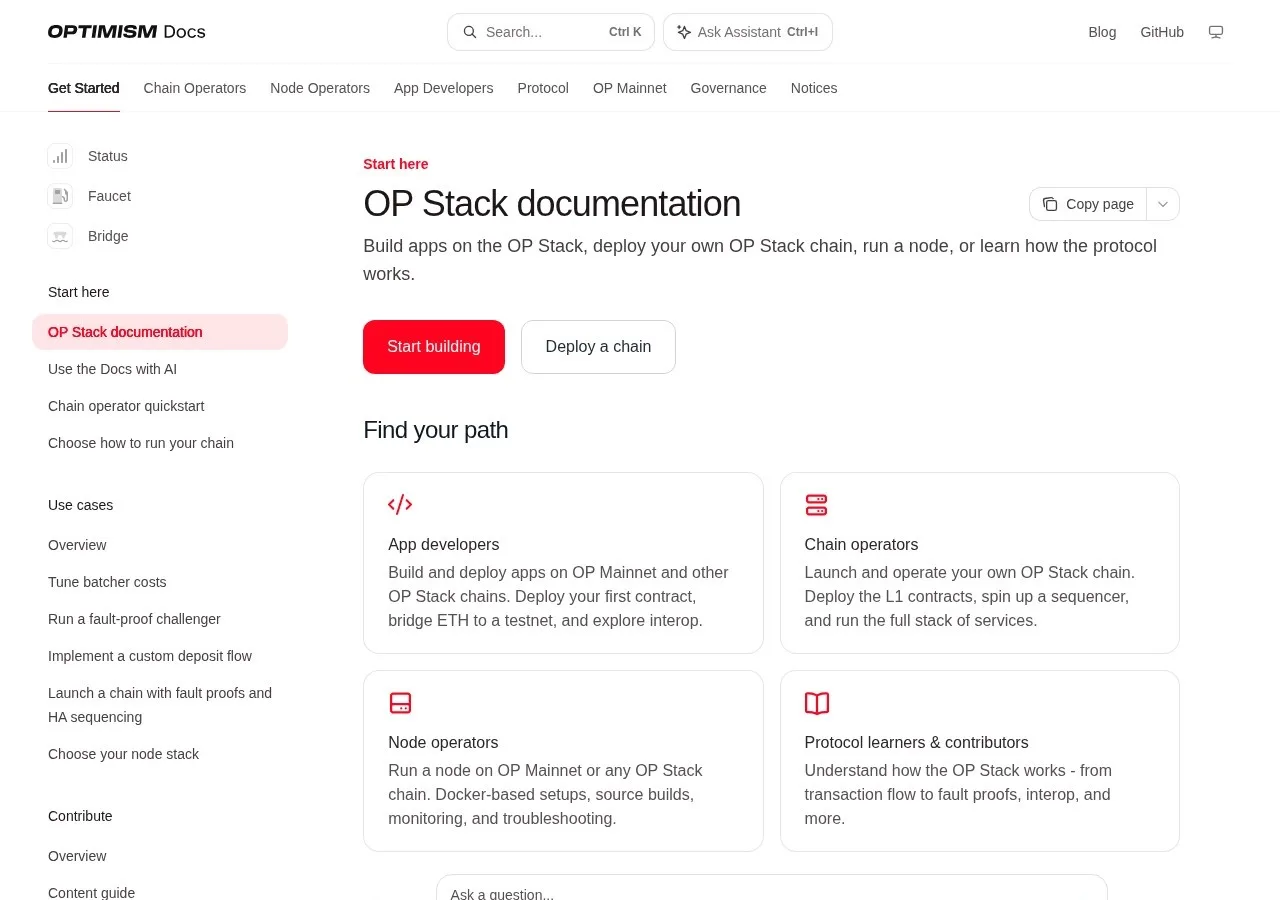
Optimism screenshots
What users say about Optimism
Recent updates focus on technical announcements and news, including clarifications regarding network governance and documentation on stablecoin and tokenization infrastructure for financial institutions.
Based on 3 Reddit posts and comments from the last 12 months, checked Oct 20, 2026. These are posts by users on other sites, not reviews submitted on CryptoReview.
User reviews
No user reviews yet. Have you used Optimism? Share your experience below.
Funding and investors
1Round
3Investors
-
Funding round Amount undisclosed
FAQ
Who founded Optimism?
Optimism was founded by Jinglan Wang, Ben Jones, Karl Floersch, Mark Tyneway, Kelvin Fichter, and Kevin Ho. The project split operations in 2022 between OP Labs PBC and the Optimism Foundation.
Does Optimism have a native token?
Yes, Optimism uses the OP token for governance through the Optimism Collective. Gas fees on OP Mainnet, however, are paid in ETH.
How does Optimism scale Ethereum?
Optimism uses an optimistic rollup design that runs transactions offchain and submits batched data to Ethereum. This preserves Ethereum base layer security while decreasing transaction fees.
What is the OP Stack?
The OP Stack is an open-source, modular codebase that powers OP Mainnet and enables teams to deploy custom, interoperable layer-2 blockchains within the Superchain network.
Has the OP Stack undergone security audits?
Yes, Optimism maintains documented audits across various OP Stack software components and protocol layers, with reports hosted in its official developer documentation.
Latest from Optimism on X
Every major technology shift eventually converges on a standard.
→ TCP/IP for networking.
→ HTML for the internet.
→ Bluetooth for device connectivity.
The standard that blockchains converge on will be Optimism. We’re already seeing it play out. https://t.co/ZT3AA3nlIM
→ TCP/IP for networking.
→ HTML for the internet.
→ Bluetooth for device connectivity.
The standard that blockchains converge on will be Optimism. We’re already seeing it play out. https://t.co/ZT3AA3nlIM

Another busy week full of launches, milestones, and events across the OP ecosystem.
Here’s what you might have missed 👇 https://t.co/42P0lZrTa3
Here’s what you might have missed 👇 https://t.co/42P0lZrTa3
Thanks to everyone who attended our VIP lunch hour at @mmerge_io.
We look forward to continuing to build with you 🫡 https://t.co/nCFdlL8jAA
We look forward to continuing to build with you 🫡 https://t.co/nCFdlL8jAA

Check out the new report from @SuccinctLabs on the state of ZK ⬇️
Recent public posts from @Optimism, shown as published. Not reviewed or endorsed by CryptoReview.
Alternatives to Optimism
Proof-of-stake layer-1 blockchain securing nearly $50B in DeFi value since 2015
Layer 1Proof of StakeEVM compatible

Ethereum optimistic rollup securing over $12B with ~0.25-second block times and Stylus Rust contracts
Layer 2Optimistic rollupEVM compatible

Sharded Layer-1 blockchain supporting 1.2s finality and cross-chain execution across 35+ networks
Layer 1Proof of StakeNEAR

EVM sidechain with sub-two-second settlement, $0.002 average fees, and over 8 billion processed transactions
SidechainProof of StakeEVM compatible

Proof-of-stake layer 1 with sub-second finality and customizable sovereign appchains
Layer 1Proof of StakeEVM compatible

Ethereum layer 2 built on the OP Stack and incubated by Coinbase
Layer 2Optimistic rollupEVM compatible