
Trick 👻 or Treat 🍬?
The scariest privacy tricks are the ones we've learned to accept. https://t.co/buqFw1YJew

Open-source self-custodial wallet pairing EVM assets with private peer-to-peer messaging
Status is an open-source, self-custodial cryptocurrency wallet integrated directly into a decentralized peer-to-peer messaging and community application. Developed by Status Research and Development GmbH and co-founded by Carl and Jarrad, the project operates as a community-governed ecosystem centered around the native SNT utility token.
The wallet operates under a self-custodial model where private keys are encrypted locally on the device using the user's password. It supports Ethereum Mainnet alongside Layer-2 ecosystems including Arbitrum, Base, Optimism, Linea, and Robinhood chain. Asset support focuses strictly on the EVM ecosystem, handling ETH, ERC-20 fungible tokens, and ERC-721 and ERC-1155 digital collectibles. Bitcoin and non-EVM chains are not supported. External hardware custody is available through integration with Keycard, a contactless smart card device.
Status includes an integrated Swap+ Bridge module designed to route trades and transfers across networks by assessing gas expenses and bridge tolls. Bridging between networks such as Ethereum, Arbitrum, and Optimism deducts network and route costs directly from the transferred amount, though bridging is restricted to tokens and excludes collectibles. Fiat onboarding is handled in-app via third-party providers using credit cards or Apple Pay. In higher app versions, dApp interactions occur via WalletConnect rather than an internal Web3 browser.
Unlike conventional software wallets, Status bundles its transaction interface with private communication channels protected by metadata privacy, end-to-end encryption, and perfect forward secrecy. Account setup requires no phone number, email address, or identity verification. In October 2026, Status launched version 2.39, expanding cross-chain routing tools, mobile incognito features, and support for Robinhood chain. The project also maintains a dedicated desktop client across macOS, Windows, and Linux, alongside a Chrome portfolio extension.
Because Status is self-custodial, users retain sole responsibility for securing their seed phrases, with no social recovery mechanisms offered. In-app bridging remains susceptible to smart contract dependencies across routing protocols, and native bridging does not extend to NFTs. Users needing multi-chain diversity beyond EVM environments must rely on separate applications for networks like Bitcoin or Solana.
Status delivers open-source self-custody paired with metadata-private messaging, but it restricts network coverage to Ethereum and EVM rollups without supporting non-EVM ecosystems like Bitcoin or Solana.
Status combines a self-custodial crypto wallet, an encrypted peer-to-peer messenger, and decentralized community tools in a single application. Available across macOS, Windows, Linux, iOS, Android, and as a Chrome portfolio extension, it focuses on digital sovereignty. The software is entirely open source, and keys are generated locally and encrypted using the user's password. For physical isolation, the application integrates directly with Keycard, a contactless hardware wallet.
The built-in wallet supports Ethereum Mainnet alongside Layer-2 networks including Arbitrum, Optimism, Base, Linea, and Robinhood chain. Users can hold, transfer, swap, and bridge ERC-20, ERC-721, and ERC-1155 tokens. The 2.39 release introduced an integrated Swap+ Bridge tool that routes assets across supported networks, automatically deducting bridge fees from transaction totals. Third-party on-ramps enable direct purchases via Apple Pay or credit cards. Web3 application access is handled through WalletConnect, alongside a private mobile browser equipped with incognito functionality.
However, the software presents distinct trade-offs:
Status suits EVM users and privacy-focused groups wanting integrated communications without sharing personal data such as phone numbers or email addresses. Traders requiring multi-ecosystem coverage across non-EVM blockchains should look elsewhere.
| KYC required ⓘ | No · unverified |
|---|---|
| Wallet type | Mobile, Browser extension, Desktop · unverified |
| Custody | Self-custodial · unverified |
| Chains | Ethereum, Arbitrum, Base, Optimism, Other · unverified |
| Platforms | iOS, Android, Chrome, Windows, macOS, Linux · unverified |
| Open source | Yes · unverified |
| Hardware wallet support | Yes · unverified |
| In-app swaps | Yes · unverified |
| NFT support | Yes · unverified |
| Buy crypto in app | Yes · unverified |
| WalletConnect | Yes · unverified |
| Security features | Keycard hardware wallet integration, Peer-to-peer messaging encryption, Local key storage, Device-level transaction confirmation · unverified |
| Recovery without a seed phrase | No · unverified |
| Built-in dApp browser | Yes · unverified |
| Perpetuals trading | No · unverified |
Not disclosed by the provider: Staking, Passkey login, Multisig, Swap fee.
Data from the provider's website and public sources. Fees and availability change; confirm on the official site before you sign up.
Executes cross-network transfers and token swaps across Ethereum, Arbitrum, Optimism, Base, Linea, and Robinhood chain with fees deducted from the bridged amount.
Pairs with contactless Keycard hardware cards to authorize transactions and secure account keys on mobile devices.
Stores, sends, and displays ETH, ERC-20 tokens, and ERC-721 and ERC-1155 collectibles indexed from OpenSea and decentralized marketplaces.
Combines wallet functions with end-to-end encrypted messaging, perfect forward secrecy, and token-gated community channels.
Connects mobile and desktop wallets directly to decentralized finance protocols using WalletConnect.
Provides real-time portfolio tracking and asset management through the Status Portfolio Wallet extension on Chrome.
A non-custodial multi-chain wallet that lets users store, send, swap, and bridge tokens across Ethereum and EVM Layer-2 networks, with built-in NFT management.
A decentralized peer-to-peer messaging system featuring metadata privacy, end-to-end encryption, and perfect forward secrecy without requiring contact identifiers.
A chat and social coordination platform that lets users run and join token-gated community channels powered by member nodes.
A Chrome browser extension that functions as a crypto wallet and real-time portfolio tracking tool.
A contactless, open-source hardware card that integrates with Status mobile and desktop apps to authorize transactions and secure account keys.
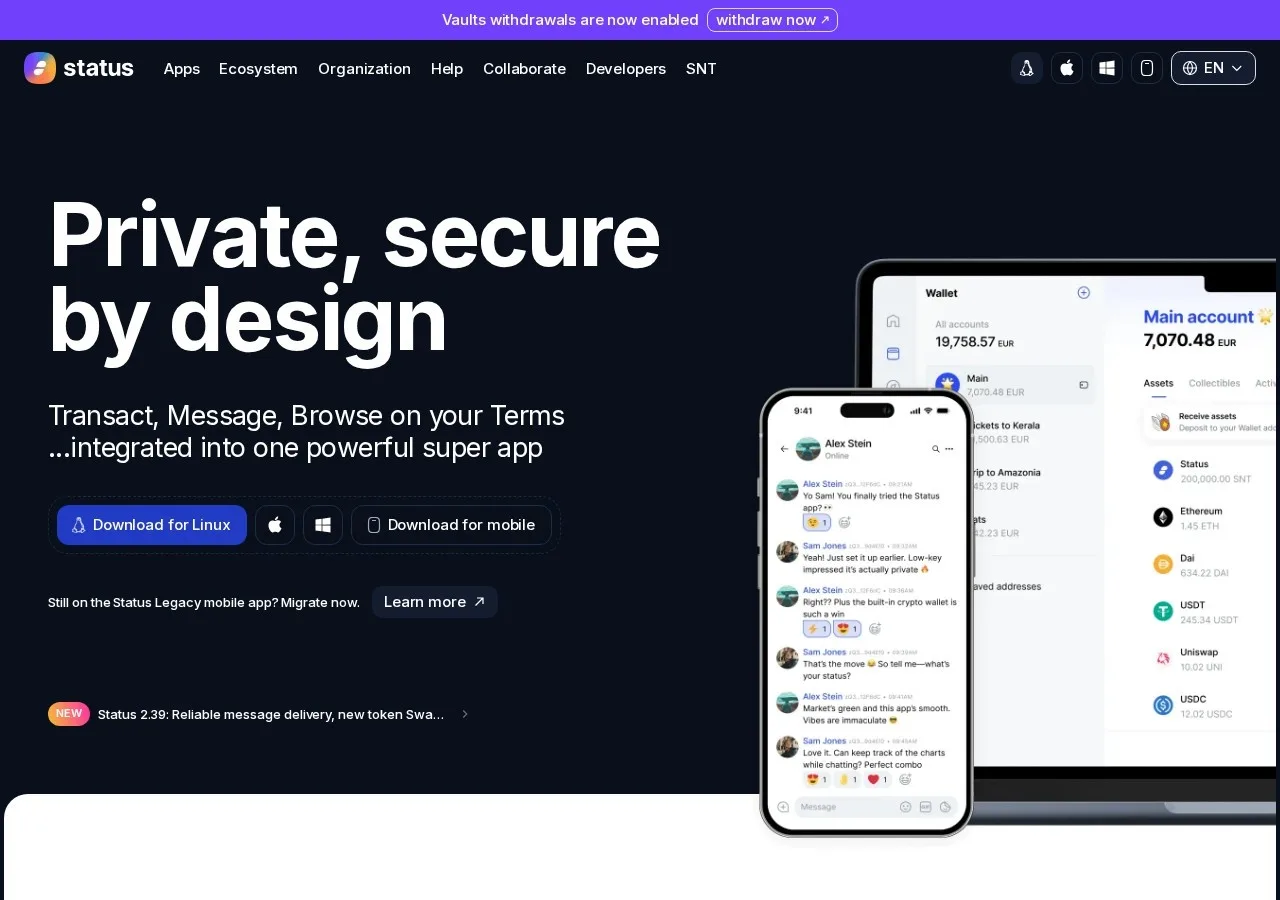
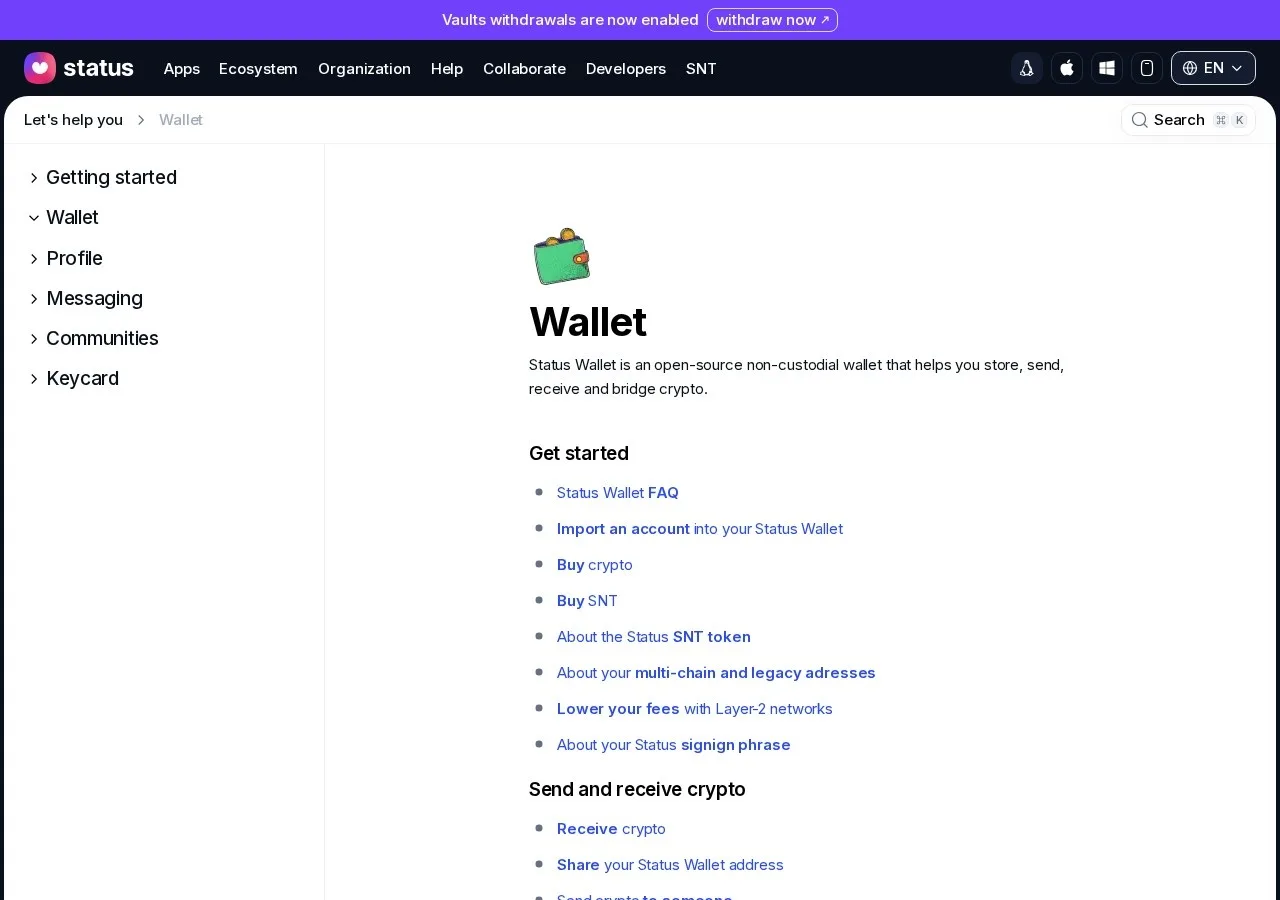
Status is occasionally recommended as a decentralized alternative and referenced for its Keycard hardware wallet integration.
“You can already do this - it's just not under our own name, which is fair enough as confusion goes Keycard works over NFC on both iOS and Android through the Status app - Tap the card to the your phone to sign you can find the setup details and what's supported here:”
Based on 10 Reddit posts and comments from the last 12 months, checked Oct 21, 2026. These are posts by users on other sites, not reviews submitted on CryptoReview.
No user reviews yet. Have you used Status? Share your experience below.
Status was co-founded by Carl and Jarrad under Status Research and Development GmbH. The team maintains an open-source development model supported by community contributors.
Status charges no software fees, subscription tiers, or ad fees to use the app. When bridging tokens, network gas and bridging service fees are automatically deducted from the bridged amount.
No identity verification, phone number, or email is required to create a wallet or use the messaging tools. KYC is only required if you choose to purchase crypto through third-party fiat on-ramp partners.
Status supports Ethereum Mainnet and Layer-2 networks including Arbitrum, Optimism, Base, Linea, and Robinhood chain. It does not support Bitcoin or non-EVM chains.
Yes, Status uses the Status Network Token (SNT) as its utility asset. SNT holders participate in community governance and can reserve ENS usernames.
Yes, Status is non-custodial. Private keys are encrypted locally on the user's device, and transactions must be confirmed locally before being broadcast to the network.
Recent public posts from @ethstatus, shown as published. Not reviewed or endorsed by CryptoReview.
Open-source, self-custodial mobile wallet supporting over 100 blockchains and built-in cross-chain swaps
Self-custodial mobile wallet with built-in DEX routing across more than 18 blockchains
Open-source, non-custodial multi-chain wallet with built-in Tor and privacy-preserving assets
Non-custodial DeFi wallet and multichain aggregator covering 10,000+ assets across 48+ networks
Self-custodial Cosmos wallet launched in 2021, now supporting almost 350 networks
Self-custodial multichain wallet from Kraken with passkey support and zero platform swap fees
Type at least two characters. Press ↵ to see all results.