

Talk about some great energy at our LABITCONF booth during the Lightning giveaway!⚡ https://t.co/xnvOZzgBUc

Cake Wallet
Open-source, non-custodial multi-chain wallet with built-in Tor and privacy-preserving assets
4.3/ 5
Our score
Very good
Custody
Self-custodial
Chains
BitcoinEthereumSolanaArbitrum+5
Platforms
iOSAndroidmacOSLinux
Open source
Yes
In-app swaps
Yes
Hardware wallet support
Yes
What is Cake Wallet?
Cake Wallet is a free, open-source, non-custodial multi-coin wallet designed around self-custody and personal privacy. Originally created in 2018 as the first Monero wallet for iOS, it has expanded to support major networks including Bitcoin, Ethereum, and Litecoin, reaching more than 2 million users worldwide.
Team and corporate background
The application is developed by Cake Labs LLC, founded by early crypto investor and entrepreneur Vikrant Sharma, who serves as founder and CEO. The project originated in June 2017 when Sharma identified a lack of mobile Monero storage on iOS. The codebase is distributed under the permissive MIT open-source license, and the team maintains a formal vulnerability disclosure process using PGP keys alongside GitHub security advisories.
Custody, network support, and core mechanics
Cake Wallet operates on a strictly non-custodial basis. Users retain their private keys and seed phrases, meaning Cake Labs cannot access, freeze, or recover user funds. Setup requires generating or importing a recovery phrase protected by a PIN. Supported networks include Bitcoin, Monero, Litecoin, Ethereum, Solana, Tron, Polygon, Arbitrum, Base, and BNB Smart Chain, alongside privacy chains like Zcash. The app incorporates advanced privacy options, such as Tor routing, dedicated Tor nodes for Bitcoin and Litecoin, and support for Bitcoin Silent Payments. Users can also connect hardware devices including Ledger, Trezor, BitBox, and COLDCARD, or pair with the Cupcake app to turn a spare smartphone into an air-gapped signer.
Fees and service costs
Cake Wallet charges no application download fees and adds no network markups for standard sends and receives; users pay only native network transaction fees, which can be manually adjusted via priority presets. For multi-chain management, an integrated bridge enables transfers of USDT between Ethereum, Polygon, and Arbitrum. In-app token swaps and fiat purchases are handled by integrated third-party liquidity providers, with their exchange margins and fees bundled directly into the quoted rate before confirmation.
Availability and operational trade-offs
The software is available globally on mobile and desktop platforms, covering iOS, Android, macOS, and Linux without identity verification requirements. Since launching in 2018, milestones include adding Litecoin MimbleWimble (MWEB) support in 2024, expanding cross-chain USDT bridging, and rolling out hardware wallet integrations. Because users retain full custody, they assume all responsibility for secure seed phrase storage. Integrated swap and fiat services rely entirely on external providers whose quotes include variable spreads, and bridging features remain limited to USDT across a narrow set of chains.
Founders
Vikrant SharmaFounder & CEO
Lifelong entrepreneur and early cryptocurrency investor since 2013 who founded Cake Labs in 2017.
Best for:Monero and privacy-focused asset holdersUsers routing transactions through TorMobile users pairing hardware walletsSelf-custody investors avoiding KYC registration
Pros and cons
Pros
- Fully open source under the MIT license
- Self-custodial design requires no user account creation or identity verification
- Built-in Tor routing conceals IP addresses when broadcasting transactions
- Integrates hardware signing devices alongside an air-gapped phone signing option
- Provides granular fee control and Replace-by-Fee capabilities on Bitcoin
Cons
- Native in-app bridging is restricted to USDT across Ethereum, Polygon, and Arbitrum
- In-app exchange rates and fiat purchases carry external third-party provider fees
- Fee customization and bumping tools are unavailable on Solana, Tron, and Arbitrum
- Requires users to manage seed phrase backups without automated social recovery
Our review
4.3/5
Very good
Cake Wallet combines open-source self-custody with strong privacy features like built-in Tor and Silent Payments, but in-app swap rates depend on third-party aggregators.
Cake Wallet is an open-source, non-custodial multi-chain wallet built by Cake Labs LLC. Launched in 2018 by founder Vikrant Sharma as the first iOS wallet for Monero, it has grown to serve over 2 million users across mobile (iOS, Android) and desktop (macOS, Linux) environments. Because Cake Wallet is strictly self-custodial, users retain sole control over their private keys and seed phrases.
The app includes transaction privacy features. Beyond supporting base privacy networks like Monero, Zcash, and Litecoin's MWEB, Cake Wallet integrates built-in Tor routing for broadcast nodes and Bitcoin Silent Payments to prevent address reuse. Hardware wallet integration includes physical devices from Ledger, Trezor, BitBox, and COLDCARD, as well as Cupcake, an in-house app that converts a spare mobile phone into an air-gapped signing device.
Asset and chain support spans major ecosystems including Bitcoin, Ethereum, Solana, Polygon, Arbitrum, Base, Tron, and BNB Smart Chain. Routine wallet transfers incur only standard network transaction fees, with detailed fee priority controls such as Replace-by-Fee on Bitcoin and custom gas adjustments on EVM networks. It also provides native USDT0 bridging across Ethereum, Polygon, and Arbitrum. However, cross-asset swaps and fiat purchases rely on third-party swap providers like ChangeNOW and MoonPay, which embed their own fees and spreads into trade quotes. The desktop client focuses on standalone execution rather than browser-extension dApp connectivity, and advanced decentralized finance tools like perpetuals are absent.
Cake Wallet suits self-custody advocates, privacy-conscious spenders using Cake Pay, and users handling both Bitcoin and privacy coins like Monero.
Specs
| KYC required ⓘ | No · unverified |
|---|---|
| Wallet type | Mobile, Desktop · unverified |
| Custody | Self-custodial · unverified |
| Chains | Bitcoin, Ethereum, Solana, Arbitrum, Base, Polygon, BNB Chain, Tron, Other · unverified |
| Platforms | iOS, Android, macOS, Linux · unverified |
| Open source | Yes · unverified |
| Hardware wallet support | Yes · unverified |
| In-app swaps | Yes · unverified |
| Buy crypto in app | Yes · unverified |
| Security features | PIN protection, Encrypted backups, Tor routing, Bitcoin Silent Payments, Coin control, Replace-by-Fee · unverified |
| Recovery without a seed phrase | No · unverified |
| Built-in dApp browser | No · unverified |
| Perpetuals trading | No · unverified |
Not disclosed by the provider: Staking, NFT support, WalletConnect, Passkey login, Multisig, Swap fee.
Data from the provider's website and public sources. Fees and availability change; confirm on the official site before you sign up.
Key features
Non-custodial private key management
Stores seed phrases and private keys locally on the device with PIN protection and encrypted backup options.
Native Tor routing
Routes network requests through integrated Tor nodes for Bitcoin, Litecoin, Monero, and Zcash to shield IP addresses.
Hardware wallet pairing
Connects to Ledger, Trezor, BitBox, and COLDCARD devices, or uses Cupcake to turn an old phone into an offline signer.
Adjustable transaction fees
Offers configurable fee priorities on Bitcoin, Monero, and EVM chains, including custom sat/byte inputs and Replace-by-Fee on Bitcoin.
USDT0 cross-chain bridge
Transfers native USDT between Ethereum, Polygon, and Arbitrum directly in the app within 2 to 30 minutes.
Privacy payment protocols
Supports Monero, Zcash, Litecoin MWEB, and Bitcoin Silent Payments to minimize transaction linkability on public chains.
Inside Cake Wallet
Cake Wallet
The primary non-custodial software application for sending, receiving, and managing digital assets across Bitcoin, Monero, EVM chains, and other networks.
Cake Pay
An integrated retail payment system that lets users spend cryptocurrency directly on everyday purchases and digital gift cards.
Bridge
A built-in bridge tool powered by USDT0 that moves native USDT across Ethereum, Polygon, and Arbitrum within 2 to 30 minutes.
Exchange
An in-app swap interface that enables trades across supported assets through external liquidity providers without balance limits.
Cupcake
A companion tool developed by Cake Labs that turns a secondary mobile device into an offline, air-gapped hardware signer.
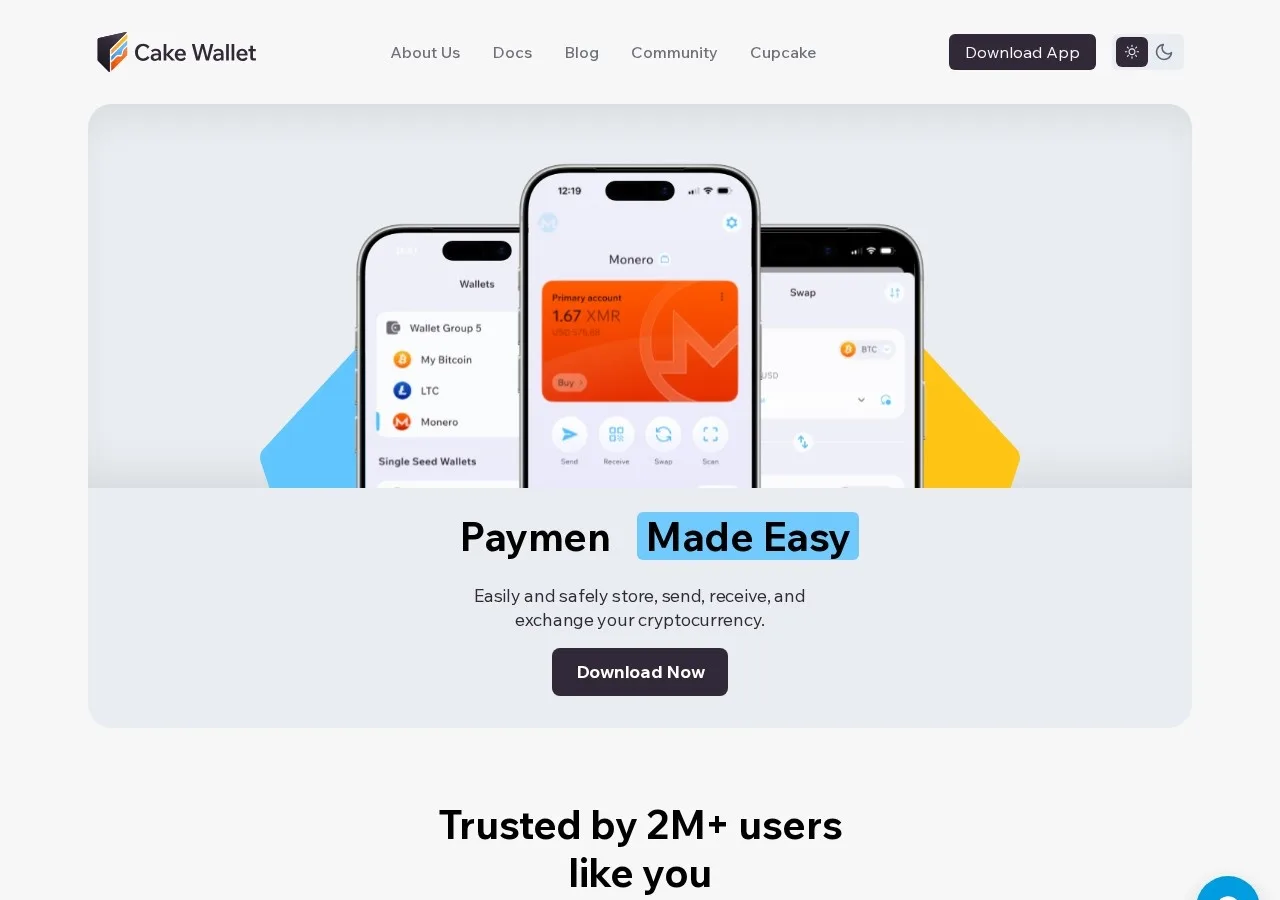
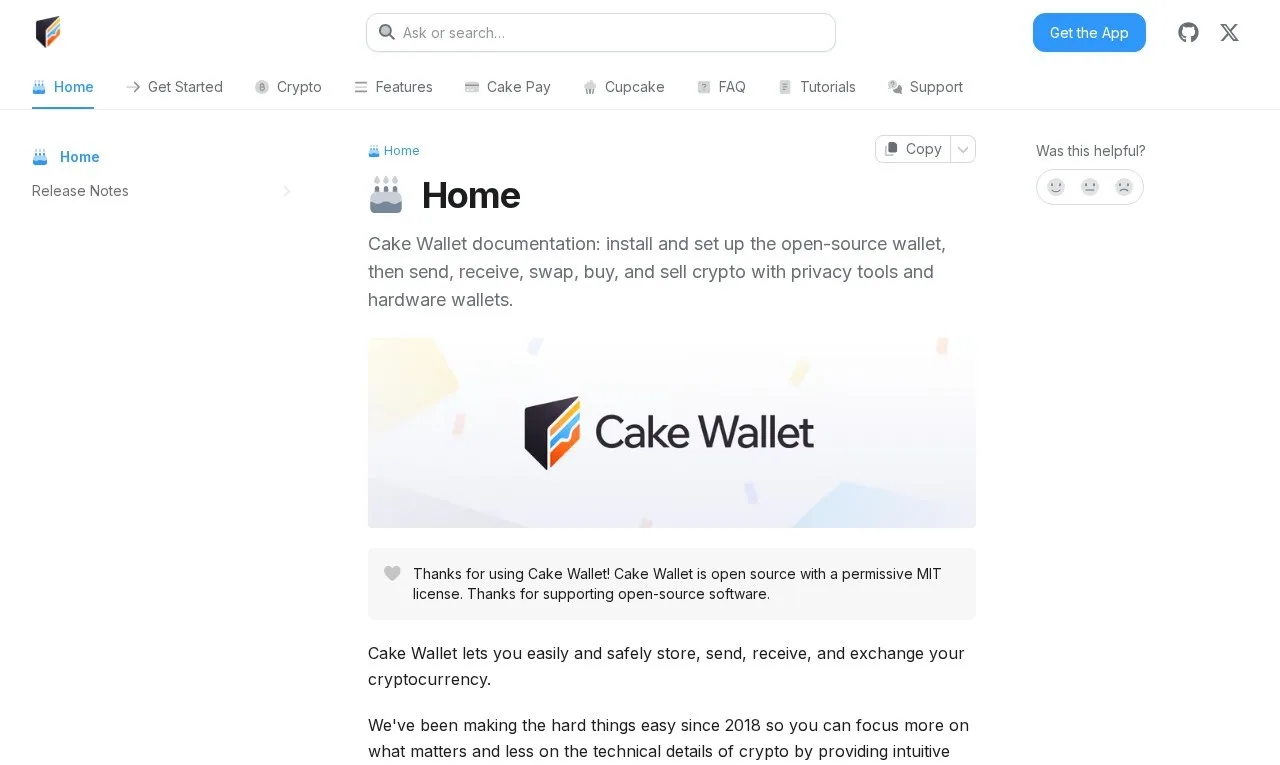
Cake Wallet screenshots
What users say about Cake Wallet
Cake Wallet is a non-custodial wallet that supports privacy coins such as Monero alongside features like Litecoin MWEB. Common user complaints focus on failed or delayed in-app swaps, sync disruptions, and problems restoring wallets from seed phrases.
In their own words
“Lame wallet. Use cakewallet.com or nexuswallet.com. These two are the best self-custodial mobile Litecoin wallets. They both offer private Litecoin (MWEB) as well!”
“Cake wallet gave platform error and I reinstalled it on android. I have 16 word seed Phrase made of bip39 words. but polyseed rejects it and shows red. How do I restore it?”
“swapped btc to xmr through cake wallet, funds left btc wallet but never arrived to xmr wallet [removed]”
“I've tried again, same process, but using the legacy 25 word seed and that HAS worked - so it's an issue with the 16 word seed but that's a bit concerning for anyone who's relying on it.”
Based on 200 Reddit posts and comments from the last 12 months, checked Oct 21, 2026. These are posts by users on other sites, not reviews submitted on CryptoReview.
User reviews
No user reviews yet. Have you used Cake Wallet? Share your experience below.
FAQ
Who founded Cake Wallet?
Cake Wallet was founded in 2018 by Vikrant Sharma, who serves as the CEO of Cake Labs LLC.
What fees does Cake Wallet charge?
The wallet application is completely free to download and Cake Wallet charges no added fees for sending or receiving crypto. Users pay standard blockchain network transaction fees, while in-app swaps and fiat on-ramps include third-party provider rates in their quotes.
Is Cake Wallet custodial or non-custodial?
Cake Wallet is non-custodial and open source under the MIT license. Private keys and recovery seed phrases remain exclusively on the user's device, meaning Cake Labs cannot access or freeze funds.
What cryptocurrencies and networks does Cake Wallet support?
Cake Wallet supports Bitcoin, Monero, Ethereum, Litecoin, Solana, Tron, Zcash, Dogecoin, Bitcoin Cash, Decred, Nano, and EVM chains like Arbitrum, Base, Polygon, and BNB Smart Chain.
Can you use hardware wallets with Cake Wallet?
Yes, Cake Wallet supports hardware devices including Ledger, Trezor, BitBox, and COLDCARD, as well as its Cupcake companion app for air-gapped signing on a second phone.
Latest from Cake Wallet on X
Okay, this Cake Wallet photo op at @thebitmela is NEXT LEVEL 😂 https://t.co/FooQ130DX7

The official Cake Wallet Gala at @thebitmela last night! ✨
India’s first Bitcoin festival is pulling out all the stops, and last night’s celebration was no exception. What a night! 🔥 https://t.co/V8NE0ifC9B
India’s first Bitcoin festival is pulling out all the stops, and last night’s celebration was no exception. What a night! 🔥 https://t.co/V8NE0ifC9B

A fun moment from the LABITCONF Bitcoin College! 📸
@escuelitabtc helped attendees get started with Cake Wallet and Lightning as part of a full day of free Bitcoin education! https://t.co/EPTlZDjAie
@escuelitabtc helped attendees get started with Cake Wallet and Lightning as part of a full day of free Bitcoin education! https://t.co/EPTlZDjAie

This week has been another reminder of why having options matters when it comes to securing your crypto.
One of those options is turning an old phone into an offline hardware wallet with Cupcake. No need to trust a third party with your personal information, funds, or the device you purchase.
https://t.co/tPslUu43dG
One of those options is turning an old phone into an offline hardware wallet with Cupcake. No need to trust a third party with your personal information, funds, or the device you purchase.
https://t.co/tPslUu43dG

Recent public posts from @cakewallet, shown as published. Not reviewed or endorsed by CryptoReview.
Alternatives to Cake Wallet

Open-source, self-custodial mobile wallet supporting over 100 blockchains and built-in cross-chain swaps
No KYCMobileSelf-custodialEthereum · Bitcoin +13

Self-custodial mobile wallet with built-in DEX routing across more than 18 blockchains
No KYCMobileSelf-custodialEthereum · BNB Chain +7

Non-custodial DeFi wallet and multichain aggregator covering 10,000+ assets across 48+ networks
No KYCMobile · WebSelf-custodialEthereum · Bitcoin +9

Self-custodial Cosmos wallet launched in 2021, now supporting almost 350 networks
Mobile · Browser extension +1Self-custodialEthereum · Bitcoin +4
Self-custodial multichain wallet from Kraken with passkey support and zero platform swap fees
No KYCMobile · WebSelf-custodialBitcoin · Ethereum +7
Self-custody MPC crypto wallet supporting over 60 blockchains without traditional seed phrases
Mobile · Browser extension +1MPC (shared)Ethereum · Bitcoin +10