

Lest we forget amidst the excitement of CS Academy news...
A big CONGRATS to our following $LTC giveaway winners!!!!! 🎊🎊🎊
@ANTAR_999
@vancova_heis
@0xWeb3DevRel
@stargirl_hills
@Bob_Starlins
Each winner will receive 1 LTC within 48 hours.
Thanks as always to everyone who participated this go around 🖤 Keep an eye out for more to come!

Stack Wallet
Open-source, non-custodial multicoin wallet with native Monero, Firo, and Epic Cash support
3.5/ 5
Our score
Good
Custody
Self-custodial
Chains
BitcoinOther
Platforms
iOSAndroidWindowsmacOS+1
Open source
Yes
In-app swaps
Yes
What is Stack Wallet?
Stack Wallet is an open-source, self-custodial software wallet created for privacy-focused cryptocurrencies and standard digital assets. The software operates under the GPL-3.0 license and supports native privacy protocols by default across both desktop and mobile platforms.
Development and governance
The application is maintained by Cypher Stack and operated through Stack Wallet LLC. Cypher Stack is primarily recognized for its engineering and privacy research within the Monero ecosystem. Development is publicly hosted on GitHub under cypherstack/stack_wallet, where version 2.6.0 shipped in June 2026 as part of regular software updates.
Custody and asset support
Stack Wallet uses a strictly non-custodial architecture where users hold their own seed phrases and private keys locally on their devices. The software supports nine standalone blockchains: Bitcoin, Monero, Bitcoin Cash, Firo, Epic Cash, Namecoin, Wownero, Litecoin, and Dogecoin. It includes automatic SegWit address generation for Bitcoin and implements Post technology for Mimblewimble-based assets like Epic Cash to simplify sending and receiving. Users can connect to public default remote nodes or point the application to their own self-hosted nodes for independent transaction broadcast.
Pricing and swap mechanics
Basic send and receive operations incur zero wallet-level fees, with users paying standard network miner fees. Stack Wallet charges an integrated fee on top of third-party exchange partner spreads when users initiate in-app cryptocurrency swaps. The swap function routes trades through external liquidity providers directly within the interface, meaning Stack Wallet itself never acts as the counterparty or liquidity pool.
Platform availability and security record
Stack Wallet is available worldwide without identity verification or registration. Clients are distributed for Android via Google Play, F-Droid, and standalone APK downloads, alongside iOS, Windows, macOS, and Linux builds. On Google Play, the client has accrued over 10,000 downloads. The codebase underwent a penetration test by cybersecurity firm Digilol, which disclosed a local-file-system vulnerability and a denial-of-service issue that were subsequently addressed. The application has recorded no key-generation incidents.
Key trade-offs
The application does not integrate Web3 smart contract networks such as Ethereum, Solana, or EVM layer-2 rollups. The proprietary Stack Wallet Backup format offers multi-wallet exports across separate assets, but this backup file is non-standard and cannot be imported directly into other multicoin wallets. Users must manage individual seed phrases for each asset to maintain recovery independence.
Best for:Monero and privacy-coin holdersUsers running their own full nodesDesktop and mobile self-custody without KYC
Pros and cons
Pros
- Fully open source under the GPL-3.0 license
- Rare multicoin support for Monero, Epic Cash, and Wownero
- No identity verification or account creation required
- Independent security audit conducted by Digilol
- Zero added fees on standard blockchain transfers
Cons
- No support for EVM chains, Solana, or smart contracts
- Integrated swaps carry third-party counterparty risk and additional markup fees
- Stack Wallet Backup files are incompatible with third-party multicoin wallets
- Lacks hardware wallet integrations like Ledger or Trezor
Our review
3.5/5
Good
Stack Wallet is a fully open-source, non-custodial wallet with native privacy coin support, though it lacks smart contract networks, hardware wallet connections, and dApp browsing.
Stack Wallet is a fully open-source, non-custodial software wallet created by Cypher Stack, a development and research firm known for work in the Monero ecosystem. Operating under the GPL-3.0 license, the wallet stores private keys locally across desktop and mobile platforms, including Android, iOS, Windows, macOS, and Linux, with distribution also available via F-Droid and standalone APKs.
Its primary strength lies in dedicated support for privacy-oriented cryptocurrencies. Alongside Bitcoin, Bitcoin Cash, Litecoin, and Dogecoin, Stack Wallet handles Monero, Firo, Epic Cash, Namecoin, and Wownero. Privacy technologies present in supported networks are enabled by default, and users can connect to custom remote nodes. For backups, the application offers an encrypted multicoin backup format alongside standard individual seed phrases. The project is actively maintained, shipping version 2.6.0 in June 2026, and has maintained a clean record without key-generation vulnerabilities, avoiding issues like the 2021 weak-key bug seen in Cake Wallet. An independent penetration test by Digilol identified a local file system flaw and a denial-of-service vulnerability, which the team addressed.
The trade-offs reflect its distinct focus on UTXO and privacy chains. Stack Wallet does not support Ethereum or Solana, nor does it offer Web3 features such as a dApp browser, WalletConnect, or hardware wallet integrations. In-app exchanges rely on third-party swap services, which introduce third-party counterparty exposure and additional provider fees on top of network transaction costs.
Stack Wallet suits cryptocurrency holders prioritizing self-custody and local privacy on Monero, Bitcoin, and Mimblewimble-based assets across mobile and desktop. Users needing DeFi connectivity, multichain smart contract support, or cold-storage hardware signing will need a general-purpose Web3 wallet instead.
Specs
| KYC required ⓘ | No · unverified |
|---|---|
| Wallet type | Mobile, Desktop · unverified |
| Custody | Self-custodial · unverified |
| Chains | Bitcoin, Other · unverified |
| Platforms | iOS, Android, Windows, macOS, Linux · unverified |
| Open source | Yes · unverified |
| In-app swaps | Yes · unverified |
| Security features | Encrypted local backup, Custom node connection, Smart sync, SegWit · unverified |
| Recovery without a seed phrase | No · unverified |
| Perpetuals trading | No · unverified |
Not disclosed by the provider: Hardware wallet support, Staking, NFT support, Buy crypto in app, WalletConnect, Passkey login, Multisig, Built-in dApp browser, Swap fee.
Data from the provider's website and public sources. Fees and availability change; confirm on the official site before you sign up.
Key features
Privacy coin integration
Supports native privacy chains including Monero, Firo, Epic Cash, and Wownero with on-chain privacy settings enabled by default.
Local key management
Stores private keys locally on the user's device and allows separate seed phrase generation for each individual wallet.
Third-party swap routing
Routes cross-chain asset trades through external non-custodial swap partners directly inside the interface.
Custom node connection
Lets users connect directly to their own private nodes or use default public remote nodes for every supported chain.
Post technology support
Applies Post technology to automate interactive Mimblewimble transactions for Epic Cash.
Cross-platform client availability
Runs on Android, iOS, Windows, macOS, and Linux, with Android binaries distributed via F-Droid, Google Play, direct APK downloads, and GitHub releases.
Inside Stack Wallet
My Stack
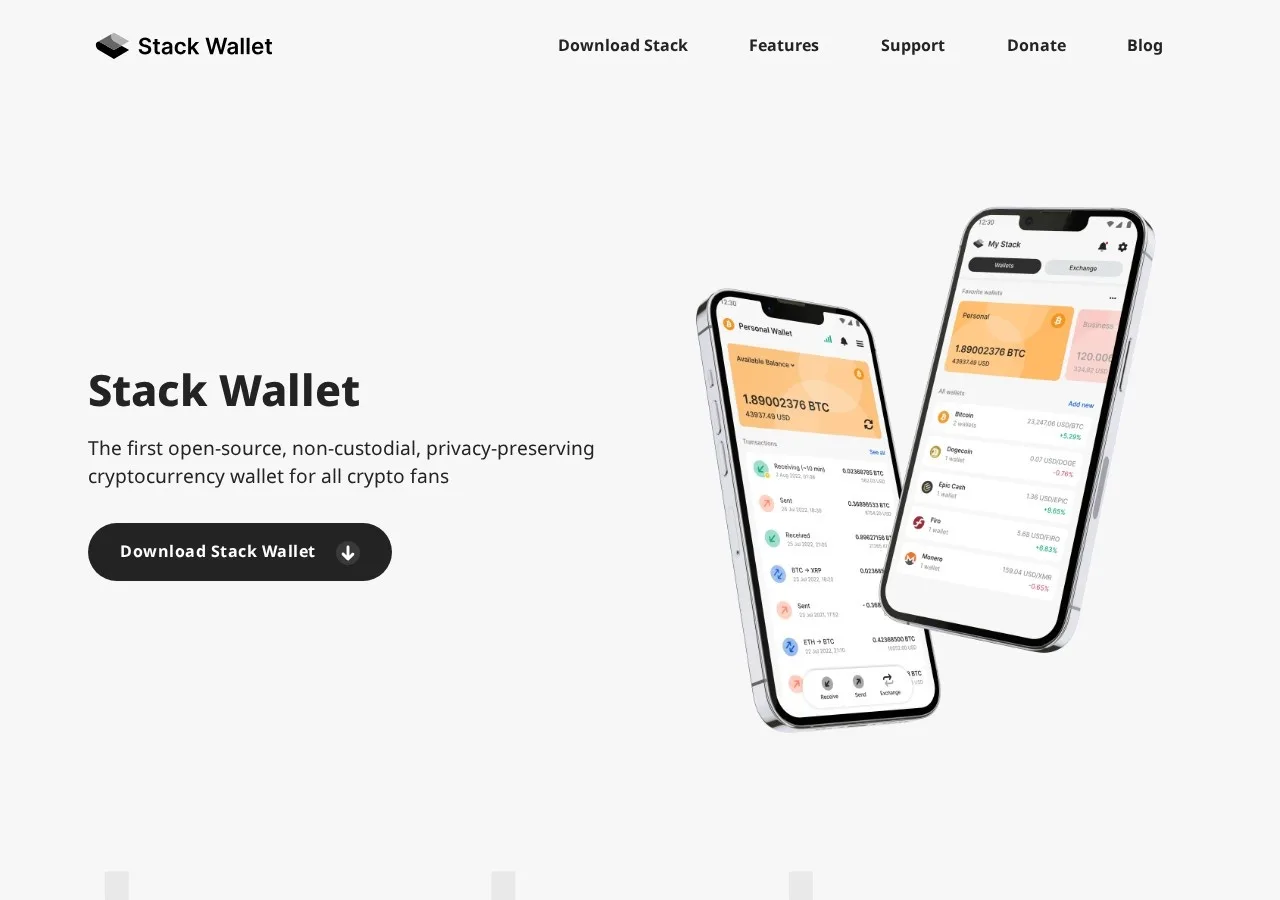
The primary management interface where users view wallet balances, organize accounts, mark favorites, and initiate wallet restoration.
Built-in Exchange
An integrated trading tool that routes swaps between supported and external cryptocurrencies through third-party exchange partners.
Stack Wallet Backup
A custom encrypted backup utility designed to export and restore all managed cryptocurrency accounts across devices in two steps.
Multiwallet Address Book
A contact registry that stores multiple cryptocurrency receiving addresses under single contact entries with customizable emoji tags.
Node Settings
A networking panel that allows users to toggle automatic remote node connections or manually specify custom nodes for each network.
Stack Wallet screenshots
What users say about Stack Wallet
Feedback for Stack Wallet highlights confusion regarding view-only mode and occasional technical hurdles with desktop packages and node syncing. Most user discussions center on troubleshooting specific wallet behaviors rather than widespread service praise.
In their own words
“Any plan for Electrum seeded wallets? Just curious, I have been using Electrum and Sparrow for some time now on desktop but I recently tried Cake wallet and Stack on my phone. Cake wallet does support Electrum seeded wallets even it was primarily a Monero wallet at first.”
“Flatpak support? Stack wallet is really nice, but it's a pain to get running, especially with the Monero libraries bundled in the Appimage that just hate my system; they either throw an error about executable stack or just segfault the entire program. Will a Flatpak ever be considered?”
“I need help please. I transfer cryptos on my wallet but on the "read only" mode. How can I do to retake possession of my cryptos. Thank you”
“I have a problem – probably after updating to 2.4.0 – the new launch works, but when I enable the Tor connection in the settings, after restarting, the software permanently freezes at startup, on the displayed logo! I have this on 3 smartphones running the latest Android!”
Scam warning: Recovery scammers on platforms like Instagram falsely claim they can trace and recover lost funds.
Based on 46 Reddit posts and comments from the last 12 months, checked Oct 21, 2026. These are posts by users on other sites, not reviews submitted on CryptoReview.
User reviews
No user reviews yet. Have you used Stack Wallet? Share your experience below.
FAQ
Who is behind Stack Wallet?
Stack Wallet is developed by Cypher Stack, a blockchain research and development firm active in the Monero community, and operated under Stack Wallet LLC.
Does Stack Wallet require KYC?
No, Stack Wallet requires no identity verification or account registration to download, create wallets, or manage assets. Verification may only be triggered if third-party exchange providers integrated for swaps require it.
What fees does Stack Wallet charge?
Standard on-chain transfers carry zero software fees, with users paying only the regular network miner fees. A small fee is included alongside partner rates when using the integrated third-party exchange service.
Has Stack Wallet been audited?
Stack Wallet underwent a security penetration test by Digilol, which reviewed the codebase and identified local file-system and denial-of-service vulnerabilities for remediation.
Which cryptocurrencies are supported on Stack Wallet?
Stack Wallet supports Monero, Bitcoin, Bitcoin Cash, Firo, Epic Cash, Namecoin, Wownero, Litecoin, and Dogecoin.
Does Stack Wallet support hardware wallets?
No, Stack Wallet is client-side software for desktop and mobile operating systems and does not support external hardware wallet signing.
Latest from Stack Wallet on X
👻 ~Happy Halloween from your friendly local Stack crew!~ 🐈⬛
Mischief-making aside, we've been hard at work getting the first few days of class all ready for CS Academy students! Hope to see you there at 12pm UTC on Nov 2nd (links to be posted before going live) 👀
Mischief-making aside, we've been hard at work getting the first few days of class all ready for CS Academy students! Hope to see you there at 12pm UTC on Nov 2nd (links to be posted before going live) 👀
📢 Have you heard the news...?
If you attended Monerotopia or visited the Cryptocurrency Village at DEFCON this year, you may remember our cryptographers presenting there on some of the math that they use on a daily basis. And if you weren't in attendance at either, worry not! This announcement is for you too.
The reception to these presentations was so positive that we left with the inspiration to design something larger based on what we'd put together: a curriculum that would extend the same learning experience to a wider audience, and allow us to dive deeper into the mathematics behind cryptography.
From then on, Cypher Stack Academy was officially in the works!
Now our first course kicks off soon, with lecture 1 streaming at 12:00 AM UTC on November 2nd (don't forget to convert to your local time!). Details and links will be posted here beforehand, and future communications will take place on the official CS Academy Discord.
Attendance is free, so we hope to see you there!
We’re always looking for ways to make Stack Wallet better.
What would *you* like to see more of?
Your feedback matters. Vote in the poll and tell us why your choice matters to you!
What would *you* like to see more of?
Your feedback matters. Vote in the poll and tell us why your choice matters to you!
🎁 5 LTC GIVEAWAY!!! 🚀
Let’s show some love for the coins we love to use!
🏆 5 LTC total up for grabs!
⏳ 96 HOURS (4 days) to enter
How to enter:
• Follow @stack_wallet
• Like & Repost this
• Create a new post about Stack Wallet featuring a screenshot of your Stack Wallet interface with your favorite coin (feel free to edit out all details!)
• Then drop the link to your post in the comments below!
You can feature @Bitcoin, @monero, @litecoin, @firo, @Dash, @EpicCash, or any other coin supported by Stack Wallet.
Show us your favorite coin and let’s spread the word!
Good luck, everyone!

Recent public posts from @stack_wallet, shown as published. Not reviewed or endorsed by CryptoReview.
Alternatives to Stack Wallet

Open-source, self-custodial mobile wallet supporting over 100 blockchains and built-in cross-chain swaps
No KYCMobileSelf-custodialEthereum · Bitcoin +13

Self-custodial mobile wallet with built-in DEX routing across more than 18 blockchains
No KYCMobileSelf-custodialEthereum · BNB Chain +7

Open-source, non-custodial multi-chain wallet with built-in Tor and privacy-preserving assets
No KYCMobile · DesktopSelf-custodialBitcoin · Ethereum +7

Non-custodial DeFi wallet and multichain aggregator covering 10,000+ assets across 48+ networks
No KYCMobile · WebSelf-custodialEthereum · Bitcoin +9

Self-custodial Cosmos wallet launched in 2021, now supporting almost 350 networks
Mobile · Browser extension +1Self-custodialEthereum · Bitcoin +4

Self-custodial multichain wallet from Kraken with passkey support and zero platform swap fees
No KYCMobile · WebSelf-custodialBitcoin · Ethereum +7