

We are moving forward and releasing yet another feature for our crypto-wallet!🛡🛡
Many of you wrote to us that you would like to sell cryptos right from the wallet, and we’ve brought you this feature now!💸💸
Read more https://t.co/RRnX2r9C6n
The Future is finally here! https://t.co/218qb6Pczp

Citowise
Non-custodial mobile wallet launched in 2017 with Ledger and Trezor hardware support
3.0/ 5
Our score
Fair
Custody
Self-custodial
Chains
EthereumBitcoinOther
Platforms
iOSAndroid
In-app swaps
Yes
Hardware wallet support
Yes
What is Citowise?
Citowise was a self-custodial mobile cryptocurrency wallet developed to handle major layer-1 networks alongside tens of thousands of ERC-20 tokens. Built for Android and iOS devices, the application combined client-side key storage, offline hardware wallet connectivity, and built-in payment requests.
Company background and team
The project began in 2016. Citowise Developments OÜ, an operating entity based in Tallinn, Estonia, ran the company. Co-founder and CEO Aleksandr Kents, who studied at Tallinn University of Technology (TalTech), initiated the project alongside co-founder and CTO Max Zab. The founders self-financed initial development after encountering personal crypto loss and usability friction across early mobile clients.
Key features and architecture
Citowise used local storage. Private keys remained on the user's mobile device, encrypted locally with password protection. The application supported networks including Bitcoin, Ethereum, Ethereum Classic, and Bitcoin Cash, and claimed compatibility with over 55,000 ERC-20 tokens. For users seeking cold storage security, the mobile app integrated with Ledger Nano S and Trezor hardware wallets. The interface allowed payment requests via customized QR codes or URLs containing specified settlement amounts. Fiat purchases were also added through payment processor Simplex.
Fees and operational history
The core wallet software was free to download and use, with network transaction fees paid directly to miners or validators on the respective blockchains. Following its initial Android release in 2017, the team incorporated stablecoin support in December 2018 and integrated Bitcoin Cash in October 2018. However, after experiencing mobile app store availability issues, operations ceased and the product was declared inactive in January 2021 when its primary web infrastructure went offline.
Risks and product status
Citowise is defunct. The mobile applications receive no maintenance or updates. Users attempting to interact with obsolete wallet software face seed-phrase exposure risks and unpatched vulnerabilities.
Founders
Aleksandr KentsCEO/CMO
Max ZabCEO/CTO
Best for:Historical wallet researchCold storage mobile pairingEarly ERC-20 token tracking
Pros and cons
Pros
- Non-custodial key storage on user devices without mandatory registration
- Direct integration with Trezor and Ledger Nano S hardware wallets
- Support for Bitcoin, Ethereum, Bitcoin Cash, and ERC-20 tokens
Cons
- Project has shut down and mobile apps are no longer maintained
- Past removal from the Google Play Store required manual APK installation
- No modern security features like MPC recovery or passkey authentication
Our review
3.0/5
Fair
Citowise offered self-custodial mobile storage with broad ERC-20 support, but the wallet was shut down and is no longer available.
Citowise was a non-custodial mobile wallet for Android and iOS, built by Citowise Developments OÜ in Tallinn, Estonia. The project began in 2016 and released its first Android product in 2017. Its main strength was local key management: the website said wallet data stayed on the device and could be decrypted with a password when sending transactions or exporting a wallet. That gives users control of private keys rather than placing balances with a hosted exchange.
Asset coverage was broad for an older mobile wallet. Citowise supported Bitcoin, Litecoin, Ethereum, Ethereum Classic, Bitcoin Cash, EOS, VeChain, TRON, Ontology and other named assets, along with ERC-20 tokens. The site claimed support for 55,000+ tokens. It also offered payment requests through a QR code or URL, an integrated exchange, a currency calculator and hardware-wallet integration with Ledger Nano S and Trezor.
Those features came with limits. Citowise was a mobile wallet only. The website described PIN protection and encrypted private channels. Self-custody also left seed-phrase and device-security risks with the holder, while the integrated exchange could add costs to the underlying conversion.
The company had a named operating entity and identified Aleksandr Kents as CEO and co-founder. Its public history includes the wallet launch and later payment and exchange features, but the service did not maintain a current product presence. The wallet was flagged as inactive after the website became inaccessible on January 19, 2021, and is now discontinued. That is the decisive weakness: existing users cannot treat the old download or feature claims as evidence of a working service.
Citowise suited its original target of mobile users who wanted local key control, ERC-20 support, payment requests and Ledger or Trezor connections in one app.
Specs
| KYC required ⓘ | No · unverified |
|---|---|
| Wallet type | Mobile · unverified |
| Custody | Self-custodial · unverified |
| Chains | Ethereum, Bitcoin, Other · unverified |
| Platforms | iOS, Android · unverified |
| Hardware wallet support | Yes · unverified |
| In-app swaps | Yes · unverified |
| Buy crypto in app | Yes · unverified |
| Security features | PIN protection, Encrypted local storage, Hardware wallet integration · unverified |
| Recovery without a seed phrase | No · unverified |
| Passkey login | No · unverified |
| Perpetuals trading | No · unverified |
Not disclosed by the provider: Open source, Staking, NFT support, WalletConnect, Multisig, Built-in dApp browser, Swap fee.
Data from the provider's website and public sources. Fees and availability change; confirm on the official site before you sign up.
Key features
Hardware wallet integration
Connects directly with Ledger Nano S and Trezor devices to sign transactions using offline private keys.
Multichain asset coverage
Supports base layer transactions for Bitcoin, Ethereum, Ethereum Classic, and Bitcoin Cash alongside custom Ethereum networks.
Local key management
Stores private keys directly on the user device protected by PIN and local password encryption without account registration.
Direct payment requests
Generates shareable URLs and QR codes specifying the exact receiving address and requested cryptocurrency amount.
Fiat onramp integration
Enabled direct purchases of supported cryptocurrencies via debit card and SEPA bank transfers using third-party provider Simplex.
Inside Citowise
Wallet
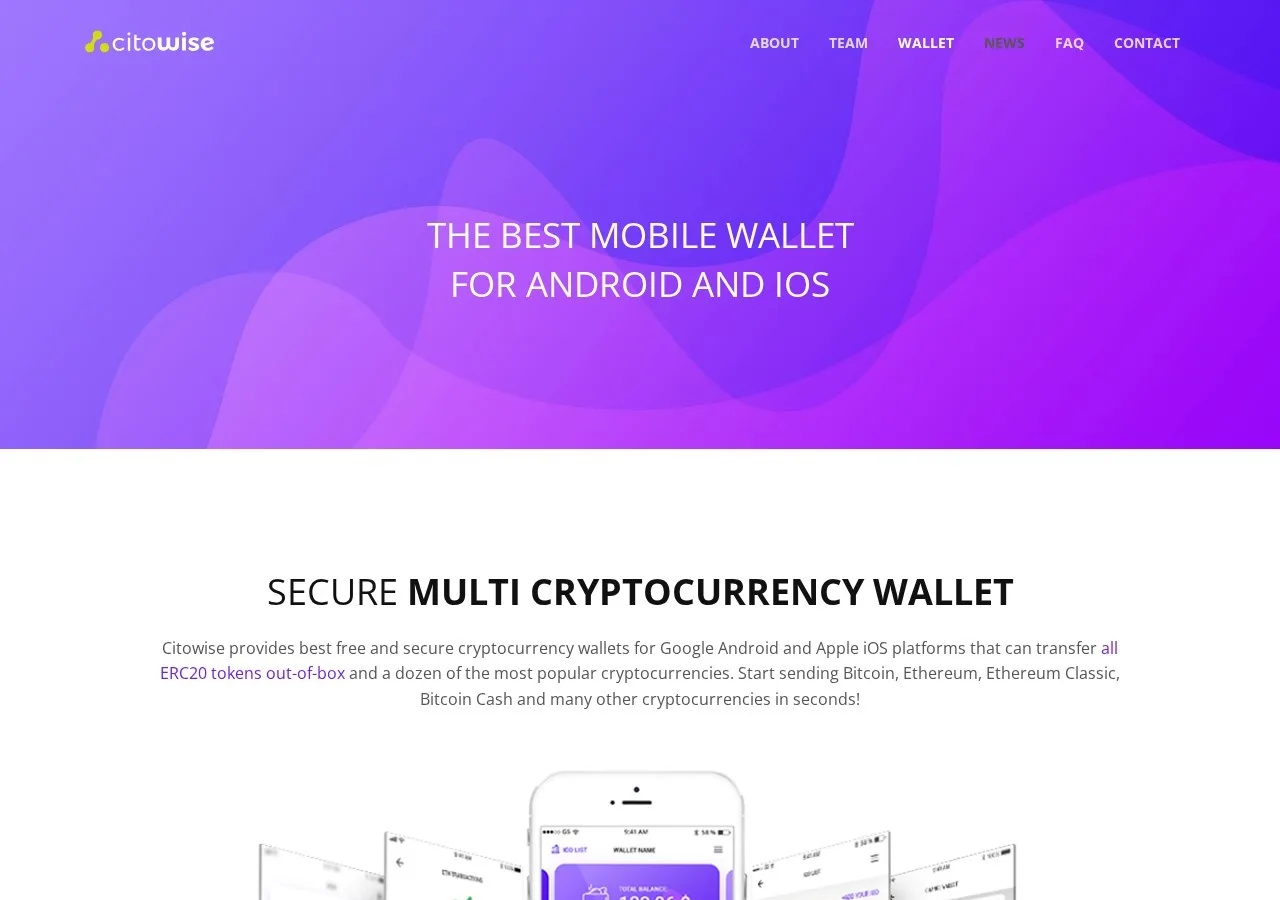
The mobile wallet let users send and receive cryptocurrencies, manage multiple wallets and hold ERC-20 tokens. The site described Android and iOS apps with local data storage.
Integrated exchange
This section let users exchange supported cryptocurrencies inside the wallet. The product also announced the ability to sell crypto from the wallet.
Request a payment
Users could create a payment request as a QR code or URL, specify a cryptocurrency and amount, and attach an invoice link or description.
ICO campaigns
Citowise displayed selected ICO campaigns inside the wallet and allowed users to participate by sending funds to a smart contract. The site placed responsibility for unlisted campaigns on the user.
Currency calculator
The calculator estimated conversions between currencies and supported a selected reference currency.
Citowise screenshots
User reviews
No user reviews yet. Have you used Citowise? Share your experience below.
FAQ
Who founded Citowise?
Citowise was founded in 2016 by Aleksandr Kents and other founders, with Kents identified as CEO and co-founder. The associated company was Citowise Developments OÜ in Tallinn, Estonia.
Is Citowise Wallet still available?
No. Citowise Wallet has been discontinued and was flagged as inactive after its website became inaccessible on January 19, 2021. The product was originally available for Android and iOS.
Did Citowise require KYC?
No registration was required for the wallet according to its website, and the wallet was designed for direct mobile use. The product is now discontinued.
Was Citowise Wallet self-custodial?
Yes. Citowise described local storage of wallet data and said users controlled their private keys. It also documented export and import functions and integration with Ledger and Trezor.
What cryptocurrencies did Citowise support?
Citowise supported Bitcoin, Litecoin, Ethereum, Ethereum Classic, Bitcoin Cash, EOS, VeChain, TRON, Ontology and other listed assets. Its website also claimed support for 55,000+ ERC-20 tokens.
Did Citowise charge wallet fees?
Wallet usage was listed as free.
Latest from Citowise on X
📣Citowise ranked one of the world’s most secure crypto wallets 🏆
We thank our users and crypto community for your continued trust and high opinion. User security has been and will always be our number one priority.
Read more https://t.co/Lp7SddhDbc
#blockchain#citowise#btc https://t.co/CR7tmCpI5t
We thank our users and crypto community for your continued trust and high opinion. User security has been and will always be our number one priority.
Read more https://t.co/Lp7SddhDbc
#blockchain#citowise#btc https://t.co/CR7tmCpI5t

Imagine what opportunities have now opened up. 🌏 You don’t need to fly to another country to set up a business or open a new company. Now, all of this can be done remotely, without leaving home while having paid for the service in BITCOIN. https://t.co/HT5atMZgJ1 #blockchain#BTC https://t.co/1cM4ShbUZt
📢 We are pleased to announce the launch of our new product ✔️
Buy ready-made company with 3 clicks 🛒 and
get crypto-friendly online bank account for FREE 💰💳
https://t.co/swHEsYqUM3
Read more https://t.co/THlt987GsM
The Future is finally here! #blockchain https://t.co/ilnrWEpnH1
Buy ready-made company with 3 clicks 🛒 and
get crypto-friendly online bank account for FREE 💰💳
https://t.co/swHEsYqUM3
Read more https://t.co/THlt987GsM
The Future is finally here! #blockchain https://t.co/ilnrWEpnH1

We truly believe that the cryptocurrency industry needs more projects like @circlepay and Citowise. We build infrastructure together and create new opportunities for the entire crypto community 🔰🚀
Read more https://t.co/YMkHqSv283
#blockchain#ethereum#cryptowallet#stablecoins https://t.co/MxTeVteQ6A
Read more https://t.co/YMkHqSv283
#blockchain#ethereum#cryptowallet#stablecoins https://t.co/MxTeVteQ6A

Recent public posts from @citowise, shown as published. Not reviewed or endorsed by CryptoReview.
Alternatives to Citowise

Open-source, self-custodial mobile wallet supporting over 100 blockchains and built-in cross-chain swaps
No KYCMobileSelf-custodialEthereum · Bitcoin +13

Self-custodial mobile wallet with built-in DEX routing across more than 18 blockchains
No KYCMobileSelf-custodialEthereum · BNB Chain +7

Open-source, non-custodial multi-chain wallet with built-in Tor and privacy-preserving assets
No KYCMobile · DesktopSelf-custodialBitcoin · Ethereum +7

Non-custodial DeFi wallet and multichain aggregator covering 10,000+ assets across 48+ networks
No KYCMobile · WebSelf-custodialEthereum · Bitcoin +9

Self-custodial Cosmos wallet launched in 2021, now supporting almost 350 networks
Mobile · Browser extension +1Self-custodialEthereum · Bitcoin +4

Self-custodial multichain wallet from Kraken with passkey support and zero platform swap fees
No KYCMobile · WebSelf-custodialBitcoin · Ethereum +7