
Not your keys, not your coins. https://t.co/STPTbD7iHO

3.5/ 5
Our score
Good
Custody
Self-custodial
Chains
BitcoinEthereum
Platforms
iOSAndroid
Hardware wallet support
Yes
What is Casa?
Casa is a self-custodial wallet platform built around multi-key vault architecture for long-term holders and organizations. By dividing signing authority across multiple hardware devices, a mobile phone, and an emergency recovery key held by Casa, the platform prevents single points of failure like seed-phrase theft or hardware damage.
Founding and background
Casa was founded in 2018 and is based in Denver, Colorado. Original founder Jeremy Welch launched the company before later taking an executive role at Kraken. CEO Nick Neuman, formerly Head of Product, leads the business alongside Co-Founder and CTO Jameson Lopp, a veteran cypherpunk and former BitGo engineer. Casa raised a $2.1 million seed round in 2018 backed by Boost VC, Lerer Hippeau, and Compound, followed by a Series A round with Stillmark.
How multi-key custody works
Casa operates on threshold multi-signature security for Bitcoin and smart contract multi-key architecture for Ethereum and USDC. In a 3-key setup, moving funds requires two signatures: typically one from a mobile device and one from a supported hardware wallet, such as Ledger or Coldcard. Casa holds an optional third recovery key to co-sign if a primary device is lost, but Casa cannot move funds independently. Premium configurations scale to 5-key vaults requiring three signatures, distributing keys across hardware wallets placed in distinct geographical locations. Users do not manage single seed phrases on paper, reducing exposure to phishing and physical extraction attacks.
Membership pricing and availability
The platform runs on an annual subscription model rather than per-transaction custody fees. The Standard plan costs $250 per year for a 3-key vault, built-in inheritance planning, and mobile signing. The Premium tier costs $2,100 per year, adding a 5-key vault, shipped hardware packages, and video verification. Private Client tiers cost $7,500 per year for custom 5-key or 6-key configurations and a dedicated advisor. Casa apps are available globally across more than 46 countries on iOS and Android. Setting up a vault requires no identity verification documents, but buying or selling bitcoin through in-app broker integrations relies on regional partner KYC.
Risks and considerations
Because Casa focuses squarely on cold storage, it lacks built-in decentralized application browsers and token swaps. Sovereign recovery requires retaining offline setup files in case Casa ceases operations. In addition, subscription renewals must be maintained to access Casa's co-signing server and inheritance execution services.
Founders
Jeremy WelchFounder
Jameson LoppCTO
Best for:Long-term Bitcoin and Ethereum holdersEstates needing guided crypto inheritanceOrganizations managing collaborative multi-key treasuries
Pros and cons
Pros
- Eliminates single seed-phrase points of failure through threshold multi-device signing
- Casa cannot move user funds unilaterally because it holds at most one key
- Hardware wallet diversity prevents single-vendor firmware supply chain compromises
- Integrated inheritance setup allows heirs to recover assets without seed technicalities
Cons
- Requires ongoing paid subscriptions starting at $250 per year
- Supports only Bitcoin, Ethereum, and stablecoins rather than broad crypto ecosystems
- Lacks in-app decentralized finance tools, cross-chain swaps, and dApp browsing
- Recovery using Casa's co-signing key depends on active platform account status
Our review
3.5/5
Good
Casa offers resilient multi-key self-custody and inheritance planning for Bitcoin and Ethereum, but requires ongoing subscription fees and supports very few blockchains.
Casa focuses on self-custodial multi-key security designed to eliminate single points of failure. Rather than relying on a single seed phrase or hardware signer, Casa distributes signing keys across multiple devices and environments. Its primary configurations use 2-of-3 or 3-of-5 threshold multisig setups where Casa holds only one co-signing key for emergency recovery. Because the company never controls a threshold quorum, users retain full self-custodial ownership of their assets.
Supported assets are intentionally restricted. The platform handles Bitcoin, Ethereum, and stablecoins like USDC, leaving out altcoins and general smart-contract ecosystems. Interaction occurs via mobile applications on iOS and Android, pairing directly with third-party hardware signers like Ledger and Coldcard. This multi-vendor approach safeguards funds against single-manufacturer supply-chain vulnerabilities, letting clients construct vaults using independent hardware brands.
The service model relies on annual subscriptions rather than free access. Pricing tiers include Standard at $250 per year for 3-key setups, Premium at $2,100 per year for 5-key architectures with included hardware packages, and Private Client at $7,500 per year with dedicated advisory support. A key differentiator is Casa Inheritance, an integrated protocol that coordinates vault access for beneficiaries without requiring technical estate setups or giving Casa asset control.
Casa suits long-term Bitcoin and Ethereum holders seeking institutional-grade resilience against hardware loss or physical coercion. Users seeking broad multi-chain support or free software wallets should look elsewhere.
Specs
| KYC required ⓘ | No · unverified |
|---|---|
| Wallet type | Mobile · unverified |
| Custody | Self-custodial · unverified |
| Chains | Bitcoin, Ethereum · unverified |
| Platforms | iOS, Android · unverified |
| Hardware wallet support | Yes · unverified |
| Staking | No · unverified |
| Buy crypto in app | Yes · unverified |
| Security features | Multisig, Hardware wallet support, Emergency lockdown, Sovereign recovery, Inheritance planning, Video verification · unverified |
| Recovery without a seed phrase | Yes · unverified |
| Multisig | Yes · unverified |
| Built-in dApp browser | No · unverified |
| Perpetuals trading | No · unverified |
Not disclosed by the provider: Open source, In-app swaps, NFT support, WalletConnect, Passkey login, Swap fee.
Data from the provider's website and public sources. Fees and availability change; confirm on the official site before you sign up.
Key features
3-key multisig vaults
Requires two of three keys to authorize transactions, combining a mobile signer, a hardware wallet, and a Casa co-signing key.
5-key vault protection
Distributes five keys across multiple hardware vendors and locations, requiring three signatures to approve outgoing transfers.
Integrated inheritance planning
Lets vault owners designate non-technical recipients who can access funds through guided protocol steps without disclosing seeds prematurely.
Multi-vendor hardware support
Coordinates signing across different hardware wallet manufacturers, including Ledger and Coldcard, to eliminate single-vendor firmware risks.
Emergency lockdown and delays
Provides account freezes and optional 72-hour holds with video verification to stop unauthorized co-signing attempts.
Ethereum and stablecoin storage
Extends multi-key smart contract vault protection to Ethereum and USDC alongside native Bitcoin multisig.
Inside Casa
Casa Vault
The core multi-key self-custody wallet using 3-key and 5-key multisig architectures to eliminate single points of failure.
Inheritance
A guided estate planning service integrated directly into vaults to safely transfer assets to designated beneficiaries.
Private Client
A high-tier service providing customized security architecture, dedicated client advisors, and emergency phone assistance.
Organizations
Collaborative multi-key custody setups tailored for business treasuries, institutional teams, and enterprises.
Casa screenshots
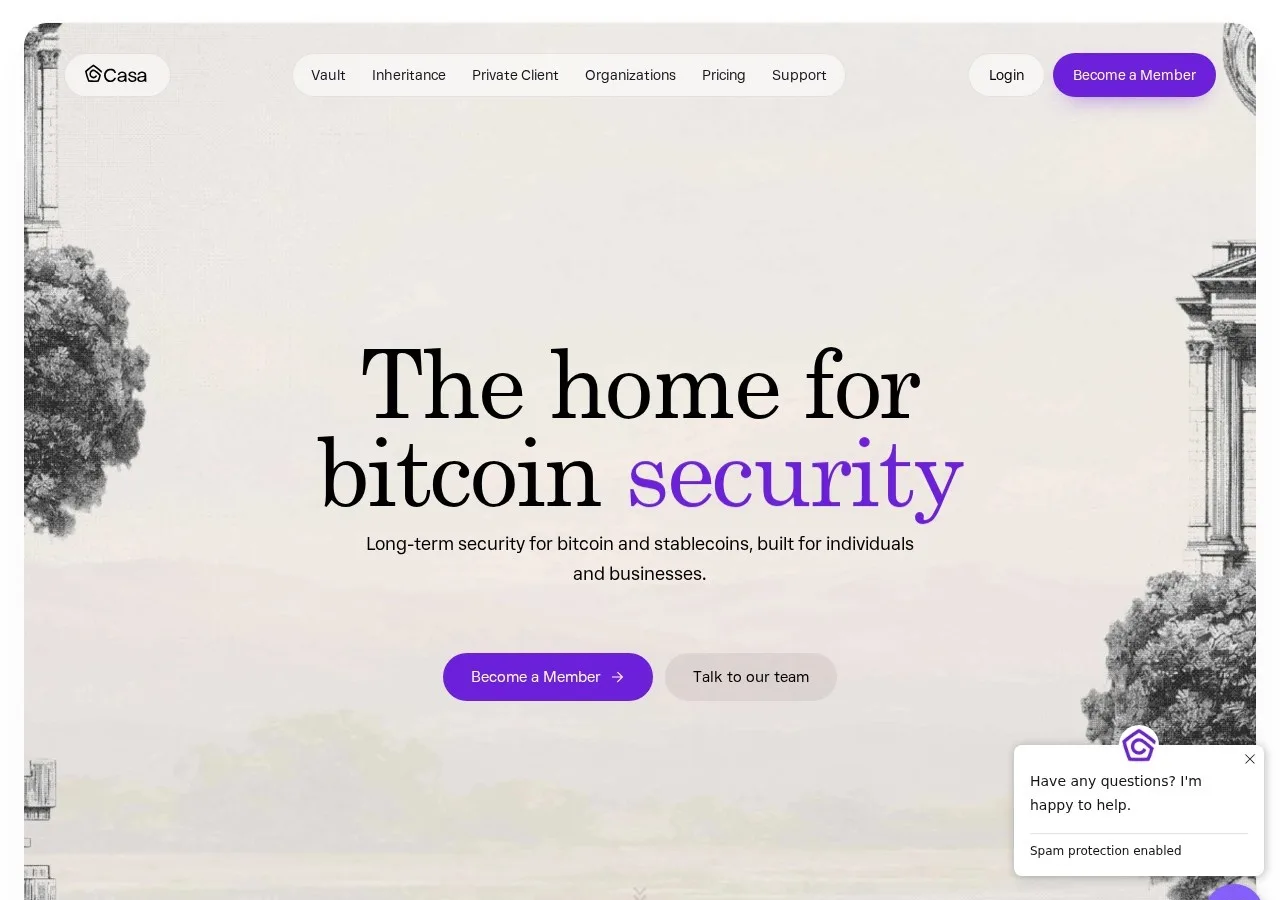
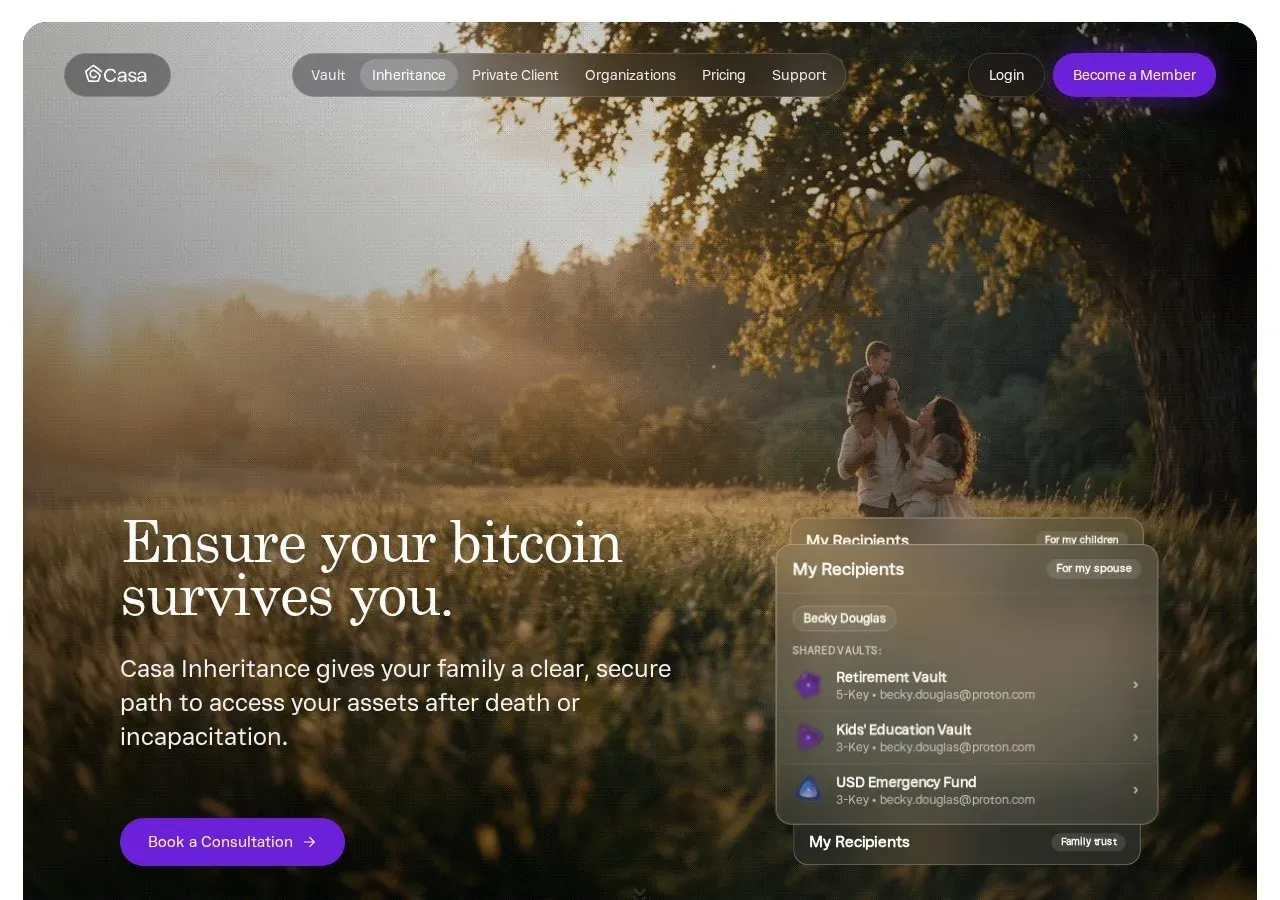

What users say about Casa
Casa offers multisig security and inheritance planning. App Store reviews mention subscription costs, refund refusals, privacy concerns, and device or update issues.
Top goods
In their own words
“Proper Bitcoin self-custody Casa is built for people who actually hold Bitcoin. True non-custodial multisig so no single key, phone, or company can move your coins. Hardware keys stay in your control, they only hold a recovery key that is useless by itself.”
“Self custody I love this service I feel like they held my head and walked me through the self custody process, took all the fear out of it”
“Great app Very easy and secure way to secure your bitcoin. We definitely recommend it. Customer support has been great and the price is reasonable.”
“No privacy Doesn’t work unless you give it your personal information like your email. So much for crypto privacy.”
“Can’t buy Bitcoin from the app no more The UI is great but it’s super expensive to use just a custodial wallet without the option of buying bitcoin within the app. I know it used to be why was it yanked off?”
“Not recommended can’t set up wallets No happy with this app, they charge me the whole subscription even if you can make it work or not,I got problems with my nano ledger S I can’t set it up,I cancel my subscription and now they said they cannot give me a refund,they just cancel the subscription…”
Based on 25 Reddit posts and comments, 36 App Store reviews from the last 12 months, checked Oct 20, 2026. These are posts by users on other sites, not reviews submitted on CryptoReview.
User reviews
No user reviews yet. Have you used Casa? Share your experience below.
Funding and investors
$2.1MTotal raised
2Rounds
4Investors
FAQ
Who founded Casa?
Casa was founded in 2018 by Jeremy Welch, with Jameson Lopp serving as Co-Founder and Chief Technology Officer, and Nick Neuman later taking the role of Chief Executive Officer.
Is Casa custodial or non-custodial?
Casa is non-custodial. The company holds at most one key in a multi-key setup, meaning it cannot access or move funds without your authorization.
How much does Casa cost?
Casa operates on an annual subscription model starting at $250 per year for the Standard plan, $2,100 per year for Premium, and $7,500 per year for Private Client.
Which cryptocurrencies does Casa support?
Casa supports Bitcoin, Ethereum, and select stablecoins such as USDC.
What is Casa Inheritance?
Casa Inheritance is an integrated estate transfer service that enables beneficiaries to recover vault assets securely without exposing private keys or giving Casa custody.
Latest from Casa on X
What do recent hardware wallet attacks and AI-driven exploits mean for your self-custody setup?
This Thursday, @lopp and the Casa team go live to break it down and walk through how to stay protected.
Set a reminder: https://t.co/hEP6b5MTDc
This Thursday, @lopp and the Casa team go live to break it down and walk through how to stay protected.
Set a reminder: https://t.co/hEP6b5MTDc
As attackers get more sophisticated, multi-vendor multisig reduces single points of failure and human error while leaving the keys with you.
Secure sovereignty comes from setups that assume things will go wrong, include a plan, and still leave you in control.
Secure sovereignty comes from setups that assume things will go wrong, include a plan, and still leave you in control.
Learn more about multi-vendor multisig and how to protect your bitcoin for the long term:
https://t.co/oadIZsZeh9
https://t.co/oadIZsZeh9
We are an official Ledger reseller and source the Ledgers that we provide to our clients directly from Ledger.
They are then stored in an access controlled location until being sent to Casa clients with the original Ledger packaging intact.
The Ledger supply chain incident is another reason why we designed Casa to integrate with many different hardware signers and vendors - to protect against vulnerabilities from any one device.
Recent public posts from @casahodl, shown as published. Not reviewed or endorsed by CryptoReview.
Alternatives to Casa

Open-source, self-custodial mobile wallet supporting over 100 blockchains and built-in cross-chain swaps
No KYCMobileSelf-custodialEthereum · Bitcoin +13

Self-custodial mobile wallet with built-in DEX routing across more than 18 blockchains
No KYCMobileSelf-custodialEthereum · BNB Chain +7

Open-source, non-custodial multi-chain wallet with built-in Tor and privacy-preserving assets
No KYCMobile · DesktopSelf-custodialBitcoin · Ethereum +7

Non-custodial DeFi wallet and multichain aggregator covering 10,000+ assets across 48+ networks
No KYCMobile · WebSelf-custodialEthereum · Bitcoin +9

Self-custodial Cosmos wallet launched in 2021, now supporting almost 350 networks
Mobile · Browser extension +1Self-custodialEthereum · Bitcoin +4
Self-custodial multichain wallet from Kraken with passkey support and zero platform swap fees
No KYCMobile · WebSelf-custodialBitcoin · Ethereum +7