

Somehow, every Monday feels like a new cycle https://t.co/f5R1IS7rLa

Tonstakers
Liquid staking protocol on The Open Network with over $189M locked and auto-compounding tsTON
3.8/ 5
Our score
Good
Type
Liquid staking
Minimum stake
1 GRAM
Withdrawal time
Minutes
Receipt token
tsTON
Audited
Yes
What is Tonstakers?
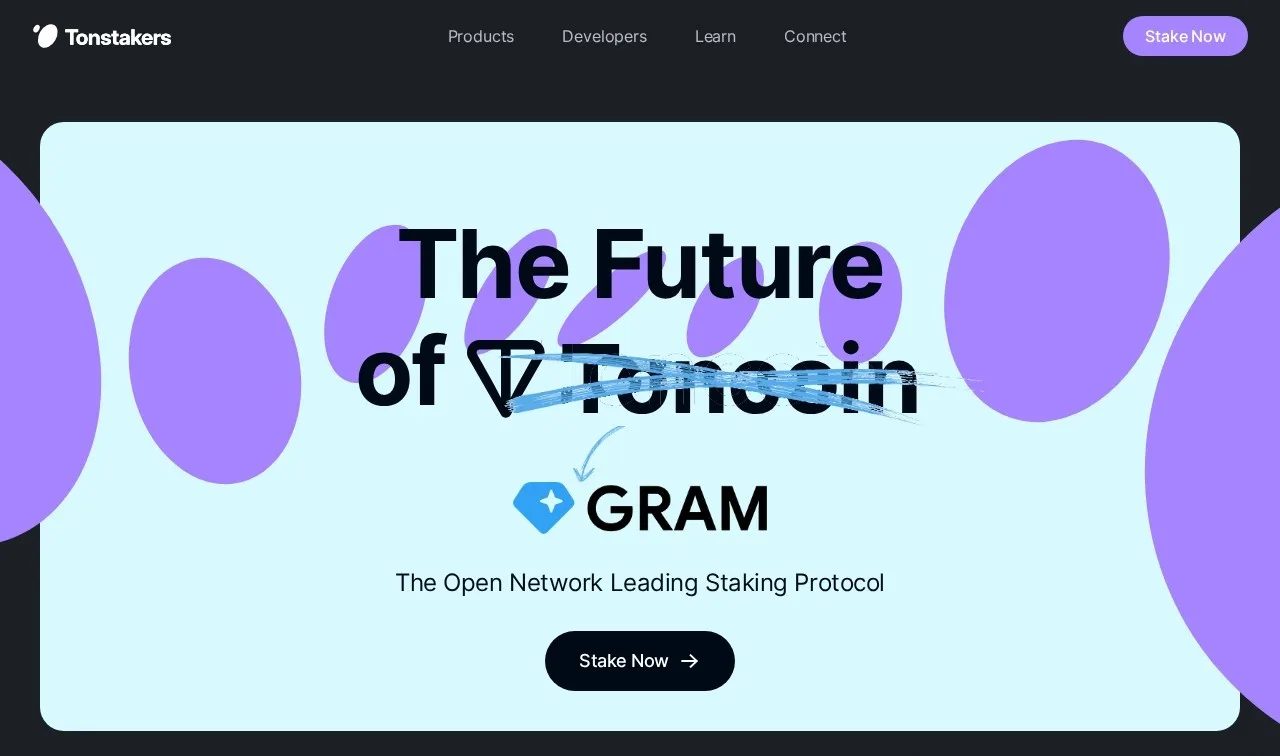
Tonstakers is a non-custodial liquid staking protocol built specifically for The Open Network (TON). Users deposit the network's native token (GRAM, formerly Toncoin) into smart contracts to receive tsTON, an auto-compounding receipt token that accumulates staking yield while remaining liquid for use across decentralized finance applications.
How staking and liquidity work
Depositing assets requires a minimum stake of 1 GRAM, with users holding an additional 1 GRAM to cover on-chain network transaction fees. Once deposited, the protocol distributes the funds across validator pools on The Open Network. Staking rewards distribute roughly every 18 hours, compounding approximately 487 times per year. The receipt token, tsTON, reflects these accumulated rewards directly. Instead of locking assets during validation rounds, holders can deploy tsTON as collateral in lending markets, provide liquidity in decentralized exchange pools, or execute leveraged staking strategies on TON-native platforms.
Access and availability
Tonstakers operates without identity verification (KYC) and provides non-custodial access directly through Web3 wallets and native Telegram integrations. The protocol serves users across more than 166 countries and offers non-custodial wallet connections that retain user control of private keys throughout deposits and withdrawals.
Track record and scale
The protocol domain was registered in April 2023, followed by protocol deployment on TON. By October 2026, Tonstakers reached more than $189M in total value locked, with over 100,000 active stakers on the platform. The underlying smart contracts have undergone third-party security audits to verify network safety and operational resilience.
Risks and trade-offs
Participating in Tonstakers involves trade-offs typical of decentralized liquid staking protocols. While the protocol uses non-custodial architecture, capital remains exposed to smart contract bugs and vulnerabilities within the TON validation layer. Receipt tokens carry depeg risk, where the open-market price of tsTON on secondary decentralized exchanges can fall below its underlying redemption value. Stakers who loop tsTON through lending protocols for leveraged yields also face liquidation risk if asset ratios fluctuate rapidly.
Best for:TON network token holdersDeFi liquidity providers on TONUsers staking via Telegram wallets
Pros and cons
Pros
- Over $189M in total value locked across TON as of October 2026
- Accessible 1 GRAM minimum deposit requirement
- Automated reward compounding every 18 hours
- Direct Telegram mini-app and TON wallet integrations without KYC
- Audited smart contracts for non-custodial staking operations
Cons
- Exposure to tsTON market price depeg risk on secondary DEXs
- Limited to The Open Network without multichain options
- Requires keeping 1 GRAM reserved solely for network gas fees
- Smart contract risk from underlying validator and staking pools
Our review
3.8/5
Good
Tonstakers offers deep liquid staking liquidity and auto-compounding on TON, but users remain exposed to smart contract risks and single-network concentration.
Tonstakers is the leading liquid staking protocol on The Open Network (TON), holding roughly $189M to $192M in total value locked as of October 2026. The platform allows users to stake GRAM (formerly Toncoin) with a minimum deposit of 1 GRAM to receive the tsTON liquid staking receipt token. Rewards compound automatically roughly every 18 hours, totaling about 487 distribution cycles per year.
The primary advantage of Tonstakers is tsTON liquidity and deep ecosystem integration. The token functions across decentralized exchanges, collateral lending markets, and leveraged staking strategies within TON. The dApp also features native Telegram wallet connectivity and a retroactive staking rewards history dashboard to simplify position tracking across external protocols.
However, staking through Tonstakers introduces trade-offs typical of liquid staking models:
- Smart contract exposure: Holding tsTON introduces protocol risk on top of baseline network consensus.
- Single-chain focus: Operations are restricted entirely to The Open Network, offering no multichain diversification.
- Depeg risk: Exiting positions quickly via decentralized exchange liquidity rather than waiting through unstaking cycles can lead to slippage against GRAM.
Tonstakers suits TON holders seeking auto-compounding yields and usable DeFi collateral without locking up assets in native validator pools. Stakers wanting multi-network flexibility or full native custody through their own direct validator setups should consider native staking alternatives instead.
Specs
| KYC required ⓘ | No · unverified |
|---|---|
| Type | Liquid staking |
| Stakeable assets | GRAM |
| Receipt token | tsTON |
| Minimum stake | 1 GRAM · unverified |
| Withdrawal time | Minutes · unverified |
| Chains | TON |
| Audited | Yes |
| Restaking | No · unverified |
| Typical reward rate ⓘ | Up to 21% APY · unverified |
Not disclosed by the provider: Protocol fee, Node operators, Slashing cover.
Data from the provider's website and public sources. Fees and availability change; confirm on the official site before you sign up.
Key features
Low staking threshold
Users can start staking with a minimum deposit of 1 GRAM, requiring 1 additional GRAM for network fees.
Frequent automated compounding
Staking rewards distribute every 18 hours, automatically compounding roughly 487 times each year.
tsTON receipt utility
The protocol issues tsTON against deposits so holders can borrow, lend, or provide DEX liquidity while earning validation yield.
Unstaking options
Participants can access instant unstaking via DEX liquidity pools or redeem underlying GRAM directly through protocol release cycles.
Full rewards history tracking
The dApp provides retroactive reporting of all past reward distributions, historical dates, and individual cycle yields.
Inside Tonstakers
Liquid Staking
Deposit GRAM starting from 1 GRAM to receive tsTON, an auto-compounding receipt token that accrues network staking rewards every 18 hours.
Earn
Access external TON DeFi integrations to deploy tsTON into decentralized exchange liquidity pools, collateralized lending, and leveraged staking loops.
Tonstakers screenshots
User reviews
No user reviews yet. Have you used Tonstakers? Share your experience below.
FAQ
What assets can you stake on Tonstakers?
You can stake GRAM (formerly Toncoin) on The Open Network. Stakers receive tsTON as a liquid receipt token.
What is the minimum stake on Tonstakers?
The minimum stake is 1 GRAM. You must also maintain at least 1 GRAM in your wallet to cover network transaction fees.
Is KYC required to use Tonstakers?
No, Tonstakers is a non-custodial smart contract protocol that connects directly to Web3 wallets without identity verification.
How often do staking rewards compound on Tonstakers?
Rewards compound approximately every 18 hours, which equals about 487 times per year. The resulting yield automatically accrues into the value of tsTON.
Has Tonstakers been audited?
Yes, Tonstakers has completed security audits for its liquid staking contracts on The Open Network.
Latest from Tonstakers on X
the yield is yielding 💎 https://t.co/cnSDMJuCnt

trick or treat? how about stake and earn. 🎃
🏆 UPD: Storm Trade NFT Results
The Tonstakers × @storm_trade_ton campaign has concluded. All 10 Market Makers NFTs have been sent to the winners. Congrats, and thanks to all who took part!
The Tonstakers × @storm_trade_ton campaign has concluded. All 10 Market Makers NFTs have been sent to the winners. Congrats, and thanks to all who took part!
This is gram reminder number 7 that “I'll stake tomorrow” is not a financial strategy https://t.co/3x00RxeAcF

Recent public posts from @tonstakers, shown as published. Not reviewed or endorsed by CryptoReview.
Latest from Tonstakers on Telegram

Tonstakers
Join
@thetonstakers · 860K subscribers
🏆 Win a Storm Trade NFT Tonstakers, together with Storm Trade, launch a special campaign for stakers and traders with 10 Market Makers NFTs up for grabs (current floor: 39 GRAM). Market Makers is the Storm Trade NFT collection with 5.6K items, 550 unique…
4.6K View on Telegram
🏆 Win a Storm Trade NFT
Tonstakers, together with Storm Trade, launch a special campaign for stakers and traders with 10 Market Makers NFTs up for grabs (current floor: 39 GRAM).
Market Makers is the Storm Trade NFT collection with 5.6K items, 550 unique owners, and 127K GRAM in trading volume.
How to participate:
1️⃣ Stake 20 GRAM or more and keep your stake active
2️⃣ Reach $10,000+ trading volume on Storm Trade
The campaign ends on October 22, 14:00 UTC. Winners will be selected randomly among all participants who complete both tasks.
Stake GRAM. Trade. Win.
🤩 Our links:
Community | MiniApp | Guide | X (ex-Twitter)

10.1K View on Telegram
🌍 Introducing Your Complete Staking Rewards History
We're excited to introduce the beta version of staking rewards history. You can now review every staking reward you've ever received in Tonstakers dApp.
Your complete staking rewards history is available retroactively, from the very beginning of your stake. Review every reward distribution, including the reward amount, distribution date, and APY for the specific round.
Your account now also displays tsTON in DeFi protocols. Staking rewards for tsTON held in DeFi are counted as well.
We're making staking more transparent and convenient. Tell us what you'd like to see next in our community. ❤️
🤩 Our links:
Community | MiniApp | Guide…

10.7K View on Telegram
💎 GRAM Staking with Tonstakers Is Now Available in SafePal Earn
GRAM staking, powered by Tonstakers, is now natively available in SafePal Earn, a dedicated yield product inside one of crypto's leading hardware wallet ecosystems.
SafePal Earn brings yield opportunities directly into the wallet experience. 30M+ users across 200+ regions and countries can now access GRAM staking yield in just a few taps, without leaving SafePal, including directly from hardware wallets.
Your keys. Your stake. Your yield.
🤩 Our links:
Community | MiniApp | Guide | X (ex-Twitter)

21.7K View on Telegram
Recent posts from the official Telegram channel @thetonstakers, shown as published. Not reviewed or endorsed by CryptoReview.
Alternatives to Tonstakers

Solana liquid staking infrastructure powering over 1,300 custom LSTs with pooled liquidity
Liquid stakingSolanaAudited
Solana liquid and native staking protocol automating delegation across validators since 2021
No KYCLiquid staking · Native stakingSolanaAudited

Solana liquid staking protocol capturing MEV rewards with over $1B in TVL
No KYCLiquid stakingSolanaAudited

Decentralized Ethereum liquid staking backed by permissionless node operators and a 0.01 ETH minimum
No KYCLiquid stakingEthereumAudited

Liquid staking protocol on Hyperliquid issuing kHYPE with over $860M in TVL
No KYCLiquid stakingHyperliquidAudited
Ethereum liquid staking with 600+ node operators and a 10% rewards fee
Liquid stakingEthereumAudited