

Redemptions change for NearX, BNBx and MaticX on 29 October 2026.
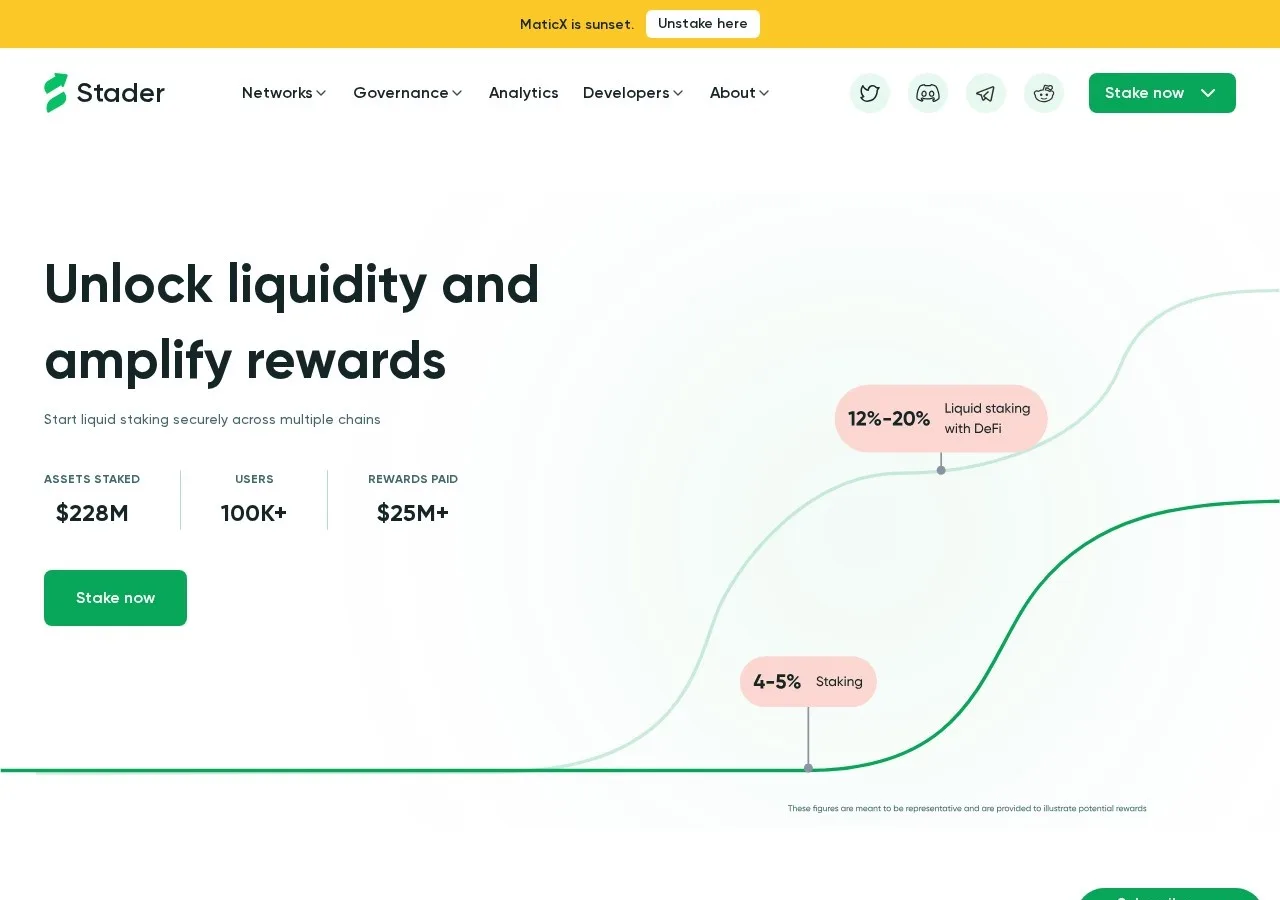
We are rolling out a few product updates for all sunset products - NearX, BNBx and MaticX on Oct 29, 2026:
NearX and BNBx move from on-chain withdrawals to a verified claims process. You can still withdraw through the contracts, with no fee, before 29 October.
MaticX withdrawals stay on-chain, and its exchange rate is fixed at 1.2002 POL per MaticX.
You can find more details about each of them in our blog post - https://t.co/bYOXWr8PkB

Stader Labs
Multichain liquid staking protocol behind ETHx with low-bond permissionless node operation
3.6/ 5
Our score
Good
Type
Liquid staking
Minimum stake
0
Receipt token
ETHx
Audited
Yes
What is Stader Labs?
Stader Labs is a non-custodial liquid staking platform that issues receipt tokens such as ETHx on Ethereum and HBARx on Hedera. Users earn consensus rewards while deploying capital across decentralized finance applications. As of October 2026, the protocol secures about $237M in total value locked.
Founding and team
Founded in April 2021, Stader Labs is based in Singapore with a core team of fewer than 10 members. The protocol was co-founded by Chief Executive Officer Amitej Gajjala, Chief Technology Officer Sidhartha Doddipalli, and Chief Protocol Officer Dheeraj Borra, all of whom bring over a decade of experience across technology architecture, scaling, and strategy consulting. The project has raised over $35M in funding, including a $4M seed round in October 2021 backed by Pantera Capital, Coinbase Ventures, and True Ventures, a $23M CoinList public sale in March 2022, and a $12.5M strategic sale.
How staking works
Users connect an unhosted Web3 wallet to deposit native assets directly into smart contracts without identity verification. In exchange for deposited ETH, users receive the liquid staking token ETHx, which accrues staking yield over time. The validator set blends permissioned institutional operators with permissionless solo validators. Under Stader's reduced-bond architecture, independent node operators can launch an Ethereum validator by bonding 4 ETH instead of the traditional 32 ETH, borrowing the remaining 28 ETH from pooled depositor balances. The native utility and governance token, SD, can be delegated to the SD Utility Pool to support operator bonding.
Track record and audits
Stader originally launched staking on the Terra blockchain in November 2021, where deposits exceeded $1B across 40,000 wallets prior to that network's collapse. The team expanded to Hedera, Fantom, and Polygon in early 2022, and later deployed on BNB Chain and NEAR. Stader has since narrowed its active footprint, discontinuing liquid staking pools on BNB Chain and Polygon. The protocol contracts have been audited by security firms including Halborn.
Risks and trade-offs
Staking through Stader Labs involves smart contract risks across complex multi-pool architectures. Depositors face slashing risk if validators misbehave or experience downtime. Liquidity in secondary trading pairs on decentralized exchanges can fluctuate, creating depeg risk between ETHx and underlying ETH during sudden market outflows.
Founders
Amitej GajjalaCEO & Co-Founder
Over 10 years of experience in strategy consulting and business management.
Sidhartha DoddipalliCTO & Co-Founder
Over 10 years of experience in building and scaling technology applications.
Dheeraj BorraChief Protocol Officer & Co-Founder
Over 10 years of experience in strategy consulting and technology.
Best for:Ethereum solo validators with limited capitalDeFi liquidity providers seeking ETHx yieldHedera holders looking for liquid staking
Pros and cons
Pros
- Node operators can spin up Ethereum validators with 4 ETH instead of 32 ETH
- Requires no KYC checks to stake assets or mint receipt tokens
- ETHx is integrated into 40 or more DeFi protocols
- Smart contracts audited by independent firms including Halborn
Cons
- Discontinued previous staking pools on BNB Chain and Polygon
- Receipt tokens carry depeg risk relative to underlying staked assets
- Depositors face smart contract vulnerabilities and node operator slashing risk
Our review
3.6/5
Good
Stader Labs provides non-custodial liquid staking with low capital requirements for Ethereum node operators and has discontinued support on Polygon and BNB Chain.
Founded in April 2021 by Amitej Gajjala, Sidhartha Doddipalli, and Dheeraj Borra, Stader Labs is a non-custodial liquid staking platform based in Singapore. Backed by investors including Pantera Capital, Coinbase Ventures, and True Ventures, the protocol launched on Terra before expanding across multiple networks. Stader has experienced shifts in product scope, having discontinued liquid staking support on Polygon and BNB Chain to focus primarily on Ethereum and Hedera.
On Ethereum, Stader issues ETHx, backed by a hybrid validator set of permissioned entities and permissionless home operators. The primary appeal for solo validators is its reduced bond structure, which allows running an Ethereum validator with a deposit of 4 ETH instead of the traditional 32 ETH, while borrowing the remainder from protocol depositors. Node operators also earn protocol SD token incentives on top of consensus rewards. For retail depositors, ETHx automatically accrues staking yield and integrates into over 40 external decentralized finance protocols, including pools on Curve and lending platforms.
The trade-offs center on liquidity depth and network focus. Stader had approximately $236.5M in total value locked in October 2026. Shutting down prior deployments on networks like BNB Chain illustrates the risk of changing chain support over time.
Specs
| KYC required ⓘ | No · unverified |
|---|---|
| Type | Liquid staking |
| Stakeable assets | ETH |
| Receipt token | ETHx |
| Minimum stake | 0 · unverified |
| Chains | Ethereum, Other |
| Node operators | Permissioned and permissionless |
| Audited | Yes |
| Restaking | No · unverified |
Not disclosed by the provider: Protocol fee, Withdrawal time, Slashing cover, Typical reward rate.
Data from the provider's website and public sources. Fees and availability change; confirm on the official site before you sign up.
Key features
ETHx liquid staking
Mints ETHx upon depositing ETH. Stakers earn consensus rewards while using the receipt token across 40 or more integrated DeFi venues.
Reduced-bond node operation
Enables permissionless node operators to run an Ethereum validator with a 4 ETH bond rather than the standard 32 ETH.
SD Utility Pool
Allows SD token holders to delegate tokens to support validator decentralization and earn protocol incentives.
Hedera staking
Supports non-custodial liquid staking for HBAR without native unbonding lock-up periods or native network slashing.
Decentralized governance
Conducts protocol upgrades, parameter adjustments, and validator policies through community Snapshot voting driven by SD holders.
Inside Stader Labs
Stader Networks
The core liquid staking portal where users deposit assets like ETH to mint yield-bearing receipt tokens such as ETHx.
SD Utility Pool
A delegation pool where SD token holders stake tokens to support validator decentralization and earn rewards.
Governance
The community governance hub enabling protocol decisions, discussions, and Snapshot voting for SD token holders.
Analytics
Dashboards providing on-chain metrics and protocol performance data across supported staking networks.
Stader Labs screenshots
What users say about Stader Labs
User feedback is extremely limited, with no recurring positive or negative themes identified.
Based on 2 Reddit posts and comments from the last 12 months, checked Oct 20, 2026. These are posts by users on other sites, not reviews submitted on CryptoReview.
User reviews
No user reviews yet. Have you used Stader Labs? Share your experience below.
Funding and investors
$39.5MTotal raised
4Rounds
27Investors
-
Public Sale Mar 2022 $23MCS CoinList sale participantsSource
-
Strategic Private Sale Jan 2022 $12.5MTA Three Arrows CapitalHedge fund Lead AC AccelVenture capital AC AccompliceVenture capital AG Amber GroupCorporate VC BC Blockchain.com VenturesExchange ventures arm DA DACMHedge fund FI FigmentVenture capital FR Fourth Revolution CapitalVenture capital GO GoldenTreeVenture capital MC Matt CantieriVenture capital PR Prabhakar ReddyVenture capital
-
Strategic Jan 2022 $12.5MTA Three Arrows CapitalHedge fund Lead AC AccompliceVenture capital BC Blockchain.com VenturesExchange ventures armSource
-
Seed Oct 2021 $4MAC AccompliceVenture capital AA Ahmed Al-BalaghiVenture capital
 Coinbase VenturesExchange ventures arm
DP Double Peak GroupVenture capital
HC Huobi CapitalVenture capital
JK Jaynti KananiVenture capital
 Jump CapitalVenture capital
LE LedgerPrimeVenture capital
NF NEAR FoundationVenture capital
ND Nemil DalalVenture capital
 Pantera CapitalVenture capital
SF Solana FoundationVenture capital
SG Sumit GuptaVenture capital
TE TerraVenture capital
TR TriblockVenture capital
TV True VenturesVenture capital
FAQ
Who founded Stader Labs?
Stader Labs was founded in April 2021 by Amitej Gajjala, Sidhartha Doddipalli, and Dheeraj Borra. The team is based in Singapore.
Does Stader Labs require KYC verification?
No, Stader Labs does not require KYC. Users interact directly with non-custodial smart contracts using self-custody Web3 wallets.
Which chains and assets does Stader Labs support?
Stader Labs focuses primarily on Ethereum (ETH) and Hedera (HBAR). Staking on Polygon and BNB Chain has been discontinued.
Is Stader Labs audited?
Yes, Stader Labs smart contracts have been audited by blockchain security firms, including Halborn.
Does Stader Labs have a native token?
Yes, Stader has a governance and utility token known as SD. Token holders can participate in Snapshot governance and delegate to the SD Utility Pool.
How does Stader's reduced bond validator program work?
Ethereum node operators can launch a validator by bonding 4 ETH instead of the full 32 ETH. The protocol pools the remaining 28 ETH from ETHx liquid staking depositors.
Latest from Stader Labs on X
Validator rewards on Ethereum are not paid evenly.
Every validator earns a small reward for attesting, once every epoch, and that is most of its income. Proposing a block pays far more at once, including the fees in that block.
Proposers are picked at random, weighted by stake. https://t.co/aCjbR4flED
Every validator earns a small reward for attesting, once every epoch, and that is most of its income. Proposing a block pays far more at once, including the fees in that block.
Proposers are picked at random, weighted by stake. https://t.co/aCjbR4flED

Staking on Hedera works differently from staking on most proof-of-stake networks. Staked HBAR never leaves the account, and there is no bonding, no lock-up and no slashing.
About 12.96 billion HBAR is staked today, roughly 29% of the released supply. https://t.co/YpvxXVMJaW
About 12.96 billion HBAR is staked today, roughly 29% of the released supply. https://t.co/YpvxXVMJaW

US spot ETH ETFs have been staking for a year. One fund has paid out more than $33 million in staking rewards since it started staking last October.
43.8 million ETH is now staked on Ethereum. That is 35.9% of the total supply, and the highest level on record.
More than 7.5 million ETH has been added since January, including roughly 500,000 in the past two weeks alone.
Every one of those ETH is securing the network. Held as ETHx, it also remains liquid and usable across DeFi while it earns.
$ETHx
https://t.co/YAJXxKRIu7
More than 7.5 million ETH has been added since January, including roughly 500,000 in the past two weeks alone.
Every one of those ETH is securing the network. Held as ETHx, it also remains liquid and usable across DeFi while it earns.
$ETHx
https://t.co/YAJXxKRIu7

Recent public posts from @staderlabs, shown as published. Not reviewed or endorsed by CryptoReview.
Alternatives to Stader Labs

Solana liquid staking infrastructure powering over 1,300 custom LSTs with pooled liquidity
Liquid stakingSolanaAudited

Solana liquid and native staking protocol automating delegation across validators since 2021
No KYCLiquid staking · Native stakingSolanaAudited

Solana liquid staking protocol capturing MEV rewards with over $1B in TVL
No KYCLiquid stakingSolanaAudited

Decentralized Ethereum liquid staking backed by permissionless node operators and a 0.01 ETH minimum
No KYCLiquid stakingEthereumAudited

Liquid staking protocol on Hyperliquid issuing kHYPE with over $860M in TVL
No KYCLiquid stakingHyperliquidAudited

Ethereum liquid staking with 600+ node operators and a 10% rewards fee
Liquid stakingEthereumAudited