



Follow @0xMoneyLeague to stay in the loop

RAI
Non-pegged crypto-backed stable asset collateralized exclusively by ETH using an autonomous managed float
3.0/ 5
Our score
Fair
Tickers
RAI
Pegged to
Other
Backing
Crypto collateral
Regulated issuer
No
What is RAI?
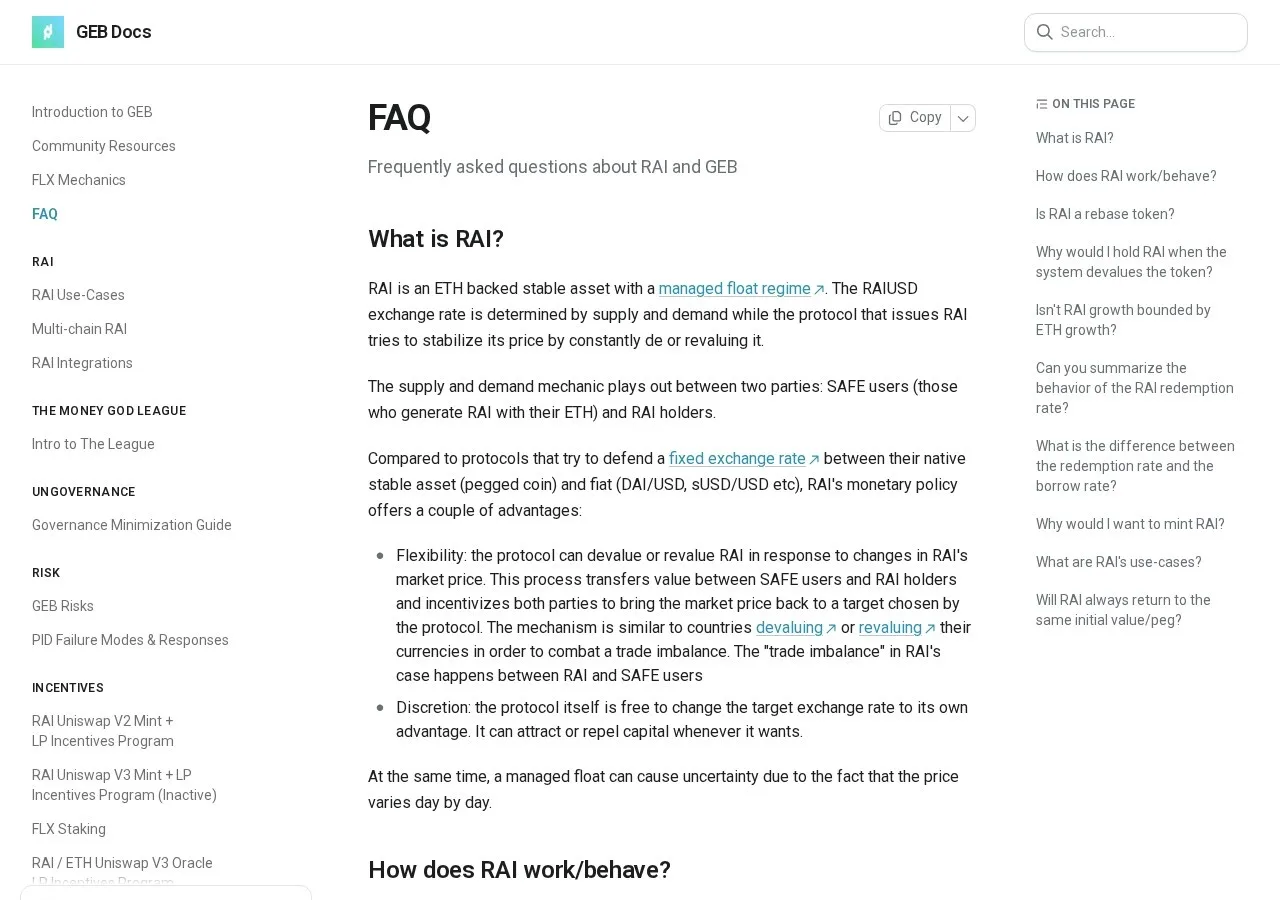
RAI is a decentralized stable asset backed exclusively by Ether (ETH). Unlike conventional stablecoins targeting a fixed $1.00 valuation, it relies on an autonomous managed float regime where a redemption rate adjusts the target redemption price according to supply and demand.
Founding and funding
Reflexer Labs was founded in 2020 by Stefan Ionescu and Ameen Soleimani, an early Ethereum ecosystem contributor who founded SpankChain and contributed to MolochDAO. The project is supported by the GEB Foundation. In August 2020, Reflexer Labs raised a $1.68 million seed round led by Paradigm. The team secured another $4.14 million in a Series A round in February 2021, led by Pantera Capital and Lemniscap.
How the protocol works
Users mint RAI by locking ETH collateral into Maker-style debt positions called SAFEs. The system tracks two distinct prices: the secondary market price and the internal redemption price. When secondary market demand drives RAI above the redemption price, the protocol sets a negative redemption rate to incentivize borrowing and selling. If the market price dips below the target, a positive redemption rate encourages borrowers to buy and repay debt. Liquidations occur when collateral values cross required thresholds, executed via fixed-discount or increasing-discount auctions. Primary minting and settlement operate on Ethereum mainnet, with bridged tokens accessible across Arbitrum, Optimism, Polygon, Avalanche, Fantom, and Solana.
Access and availability
RAI smart contracts are accessible globally on Ethereum mainnet, with bridged tokens on Arbitrum, Optimism, Polygon, Avalanche, Fantom, and Solana. Because the token exists purely as an on-chain smart contract construct, there is no centralized issuer holding bank reserves, nor is there a freeze or blacklist function embedded in the token contract.
Track record and security incidents
The core protocol launched on Ethereum mainnet in February 2021 following initial 2020 tests with Proto RAI. On September 2, 2026, a permissions-check vulnerability in the GebProxyActions contract was exploited. An attacker called the quitSystem function directly, bypassed DSProxy checks, and drained approximately 5.9436 ETH in collateral.
Risks and trade-offs
Holding RAI introduces fluctuating dollar values because the managed float does not maintain a static fiat peg. Users opening SAFEs face ETH liquidation risk during sudden market drops. Bridged tokens on alternative blockchains expose holders to third-party bridge infrastructure risks alongside core smart-contract vulnerabilities.
Founders
Stefan IonescuCo-Founder & CEO
Leading governance minimization and core protocol development at Reflexer Labs.
Ameen SoleimaniCo-Founder
Founder of SpankChain and core contributor to MolochDAO; active in Ethereum since 2016.
Best for:DeFi collateral without fiat riskUsers avoiding centralized freeze capabilitiesETH holders seeking decentralized borrowing
Pros and cons
Pros
- No fiat reserves or banking dependencies
- Smart contracts feature no blacklist or token freeze capabilities
- Pure ETH backing with fully transparent on-chain collateral reserves
- Accessible globally on Ethereum mainnet, with bridged tokens on Arbitrum, Optimism, Polygon, Avalanche, Fantom, and Solana
Cons
- Floats against the US dollar rather than holding a static $1.00 peg
- Collateral depositors face liquidation risk during steep ETH market drawdowns
- Contract vulnerability in September 2026 resulted in an exploit draining 5.94 ETH
- Bridged versions introduce cross-chain bridge smart-contract risks
Our review
3.0/5
Fair
RAI is a non-pegged stable asset backed solely by ETH, but its managed float does not maintain a static $1.00 value.
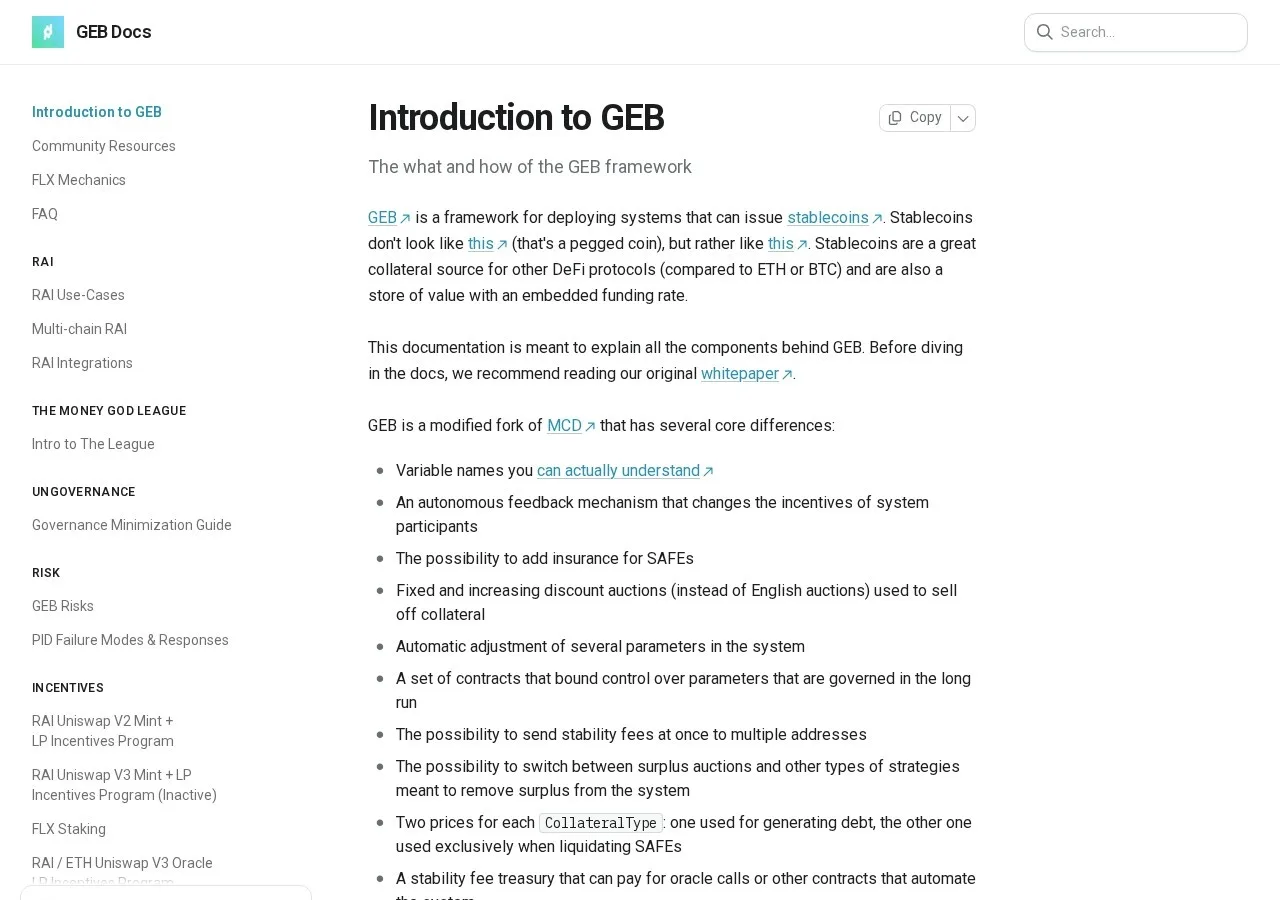
RAI is a decentralized stable asset developed by the GEB Foundation and Reflexer Labs, founded in 2020 by Stefan Ionescu and Ameen Soleimani. Unlike standard fiat-pegged stablecoins such as DAI or sUSD, RAI intentionally rejects a fixed exchange rate. The protocol employs an algorithmic managed float where the redemption price constantly devalues or revalues against the market price using an internal feedback controller. Backed by $5.82M in early-stage venture funding from Paradigm, Pantera Capital, and Lemniscap, RAI aims to serve as DeFi collateral detached from conventional fiat banking risks.
The system relies solely on single-collateral crypto reserves: ether deposited into over-collateralized debt positions called SAFEs. Reserves consist entirely of on-chain ETH, and the token contract has no blacklist or freeze function. When market demand deviates from the redemption price, the protocol adjusts the redemption rate to incentivize minting or debt repayment. RAI does not sit at a flat $1.00. Holders face day-to-day fluctuations in nominal value.
In September 2026, an exploit involving the GebProxyActions quitSystem call allowed an attacker to drain 5.9436 ETH in collateral due to a permissions check flaw.
RAI is an ETH-backed, non-pegged stable asset for DeFi applications.
Specs
| Tickers | RAI · unverified |
|---|---|
| Pegged to | Other · unverified |
| Backing | Crypto collateral · unverified |
| Yield-bearing | No · unverified |
| Regulated issuer | No · unverified |
| Chains | Ethereum, Fantom, Polygon, Solana, Avalanche, Arbitrum, Optimism · unverified |
| Redemption terms | Collateral redeemed from SAFEs via repayment or by token holders through Global Settlement at the floating redemption price · unverified |
| Issuer can freeze tokens | No · unverified |
Not disclosed by the provider: Licenses & charters, Supply / market cap, Reserve reports.
Data from the provider's website and public sources. Fees and availability change; confirm on the official site before you sign up.
Key features
ETH-only collateral backing
Every unit of RAI is backed by over-collateralized ETH locked in autonomous smart contract SAFEs, eliminating exposure to centralized fiat reserves.
Autonomous managed float
The protocol adjusts a continuous redemption rate based on supply and demand deviations between the market price and the redemption price.
Cross-chain bridge access
Minted natively on Ethereum, RAI is accessible via bridges on Arbitrum, Optimism, Polygon, Avalanche, Fantom, and Solana.
Automated collateral auctions
Under-collateralized positions are liquidated using fixed-discount and increasing-discount auctions managed by automated keeper bots.
Global settlement mechanism
If the protocol shuts down, RAI holders and SAFE owners can redeem their proportional share of ETH collateral at the current redemption price.
FLX backstop integration
System deficits are recapitalized through automated debt auctions that mint and auction protocol FLX tokens.
Inside RAI
SAFE Engine
The core database that tracks SAFEs, manages deposited ETH collateral, and mints or burns RAI debt.
Liquidation Engine
Monitors collateral ratios and automatically triggers collateral auctions if a user SAFE falls below the required safety threshold.
Auction Module
Executes fixed or increasing discount auctions for seized collateral, along with surplus and debt auctions to balance protocol accounting.
Oracle Relayer
Acts as the internal link between external Chainlink or medianizer price feeds and the protocol's SAFE mechanics.
Accounting Engine
Tracks protocol stability fees, manages system deficit, and determines when surplus or debt auctions must be executed.
RAI screenshots

What users say about RAI
There is not enough user feedback available to evaluate specific strengths or complaints about the platform.
Based on 1 Reddit posts and comments from the last 12 months, checked Oct 23, 2026. These are posts by users on other sites, not reviews submitted on CryptoReview.
User reviews
No user reviews yet. Have you used RAI? Share your experience below.
Funding and investors
$10MTotal raised
2Rounds
3Investors
-
Series A Feb 2021 $4.1M
-
Seed Aug 2020 $1.7M
FAQ
Who founded RAI?
RAI was developed by Reflexer Labs, which was co-founded in 2020 by Stefan Ionescu and Ameen Soleimani.
Is RAI pegged to the US dollar?
No, RAI is a non-pegged stable asset that runs on a managed float regime. The protocol autonomously adjusts its redemption price and redemption rate based on secondary market supply and demand.
What backs the RAI stablecoin?
RAI is over-collateralized solely by Ethereum (ETH) deposited into smart contract vaults known as SAFEs.
Has RAI experienced any security exploits?
On September 2, 2026, a permissions vulnerability in the GebProxyActions contract allowed an attacker to drain roughly 5.9436 ETH by bypassing the DSProxy check in quitSystem.
Does RAI have a governance token?
Yes, FLX serves as the governance and un-governance token for Reflexer, functioning as a backstop during system debt auctions and surplus distribution.
Which blockchain networks support RAI?
RAI is native to Ethereum and can be bridged to Arbitrum, Optimism, Polygon, Avalanche, Fantom, and Solana.
Latest from RAI on X
Alternatives to RAI

Regulated dollar and euro stablecoins backed by cash and reserve assets
US dollarCash & treasuriesRegulated issuer

Regulated stablecoin issuance and payments infrastructure across 30+ chains with zero-basis-point ramps
US dollarCash & treasuriesRegulated issuer

Regulated stablecoin issuer behind USDP, PYUSD and USDG across seven networks
US dollarCash & treasuriesRegulated issuer
US dollar stablecoin backed by US Treasuries with over $90B issued on Tron alone
US dollarCash & treasuriesUSDT · EURT +1

Yield-bearing stablecoin backed by US Treasuries and licensed under the Bermuda Monetary Authority
US dollarCash & treasuriesYield-bearing

UK-domiciled sterling stablecoin backed 1:1 with segregated GBP reserves across five chains
British poundRegulated issuerGBPA