That's why @chia_project partnered with Brale to bring regulated stablecoin issuance and money movement to its network.
Chia is now live on Brale.

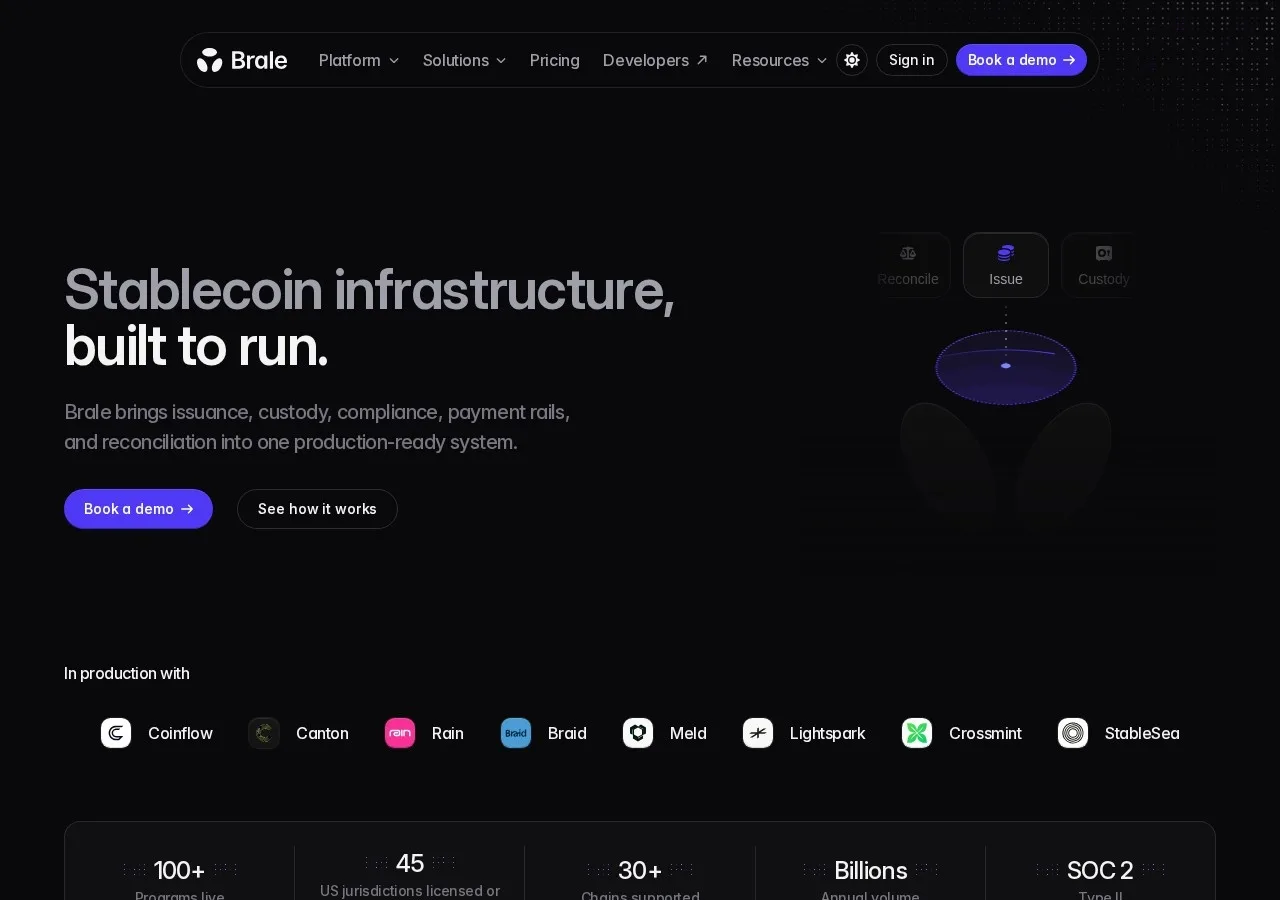
Regulated stablecoin issuance and payments infrastructure across 30+ chains with zero-basis-point ramps
Brale is an enterprise stablecoin infrastructure platform that unifies issuance, custody, fiat rails, and compliance into a single API. Backed by cash, short-duration U.S. Treasuries, and money market funds held in segregated accounts, it enables businesses to deploy branded, fiat-backed stablecoins across more than 30 blockchain networks.
Founded in 2021 and headquartered in Des Moines, Iowa, Brale is led by founder and Chief Executive Officer Ben Milne, alongside Chief Operating Officer Jim Esposito. The company has raised venture backing from institutional investors including Lightspeed and NEA.
The platform is an end-to-end operating system for digital dollar programs. Partners use a unified REST API to mint and burn custom stablecoins, manage institutional custodial wallets, and route fiat transfers through ACH, Fedwire, and Real-Time Payments (RTP). Supported onchain environments include Ethereum, Solana, Arbitrum, Base, Optimism, Avalanche, Polygon, Aptos, Algorand, and Canton. For transfers and liquidity, Brale provides token lifecycle controls such as freeze, denylist, and clawback capabilities. It also offers its ION Protocol to settle stablecoins across chains at a 1:1 ratio without conventional bridge wrapping or pool slippage.
Brale provides 0-basis-point fiat on-ramps and off-ramps. Enterprise partners retain reserve revenue sharing from token balances. The platform is a business-to-business solution rather than a retail consumer wallet. Access requires KYB onboarding and API credentials, with services available to institutions operating within 45 licensed or exempt US jurisdictions.
The issuer is registered as a Money Services Business (MSB) with FinCEN and maintains a SOC 2 Type II certification. Reserves backing issued tokens like SBC and USDGLO undergo monthly attestations performed by an independent certified public accounting firm. Smart contracts have been audited by firms CertiK and Zellic. By October 2026, Brale supported over 100 live programs, including Coinflow's cfUSD and txEcosystem's USTX, processing billions of dollars in annual transaction volume. In April 2026, following the external KelpDAO incident, Brale took down its containerized LayerZero Decentralized Verifier Network (DVN) node. No customer funds were impacted.
Because Brale is a centralized and regulated issuer, partner programs depend on its custodial banking partners and ongoing regulatory compliance in the United States. Tokens issued through the platform feature contract-level freeze and clawback controls, meaning addresses can be denylisted under legal or compliance mandates. The service is restricted to verified enterprise entities and is not accessible to anonymous or retail users.

Previously founded payments network Dwolla
Brale provides regulated white-label stablecoin issuance with full cash backing across 30+ chains, but access is restricted to enterprises undergoing rigorous compliance screening.
Brale is a specialized B2B stablecoin issuance and orchestration platform headquartered in Des Moines, Iowa. Founded in 2021 by Ben Milne, the company is a registered Money Services Business (MSB) with FinCEN and maintains licenses or regulatory exemptions across 45 US jurisdictions. Backed by venture firms Lightspeed and NEA, the platform powers over 100 live programs, including payments-focused stablecoins such as SBC and cfUSD, along with partner tokens like USTX and rUSD. As of October 2026, Brale processes billions in annual volume across more than 30 supported blockchains, including Ethereum, Solana, Arbitrum, Base, Aptos, and Canton.
Reserve transparency is backed by segregated custodial accounts containing cash, money market funds, and short-term US Treasury bills. Brale publishes monthly third-party attestations from independent accounting firms, confirming that circulating supply is matched 1:1 by liquid reserves. In addition to regular reserve examinations, smart contract implementations carry audits from CertiK and Zellic, and the organization holds SOC 2 Type II operational compliance.
As an enterprise infrastructure layer, Brale integrates issuance, custody, redemption, and traditional payment rails (ACH and wire) through a unified API. A major commercial strength is its zero-basis-point model for fiat on-ramps and off-ramps, coupled with automated reserve revenue sharing for token sponsors. To satisfy strict financial compliance requirements, Brale includes operational token controls. Authorized operators can freeze and claw back assets on supported blockchains when legally mandated.
These features create distinct trade-offs. Brale is strictly an enterprise infrastructure provider, meaning it does not offer a direct consumer wallet or retail onboarding. Every client program must complete institutional KYC/KYB screening. While smart contracts have avoided on-chain protocol exploits, Brale contained an incident in April 2026 involving its LayerZero Decentralized Verifier Network (DVN) node during the KelpDAO vulnerability, though no customer funds were lost. The platform suits fintechs and payment networks seeking compliant custom stablecoin rails, but users requiring permissionless issuance should seek alternative models.
| Tickers | SBC, cfUSD, rUSD, USC, USTX, verUSD · unverified |
|---|---|
| Pegged to | US dollar · unverified |
| Backing | Cash & treasuries · unverified |
| Regulated issuer | Yes · unverified |
| Licenses & charters | FinCEN registered MSB, Money transmitter licenses across 45 US jurisdictions · unverified |
| Chains | Ethereum, Solana, Polygon, Arbitrum, Optimism, Base, Avalanche, Algorand, Celo, Aptos · unverified |
| Reserve reports | Monthly reserve attestations published by an independent CPA · unverified |
| Redemption terms | Direct programmatic redemption to ACH, wire, and RTP at 0 bps · unverified |
| Issuer can freeze tokens | Yes · unverified |
Not disclosed by the provider: Yield-bearing, Supply / market cap.
Data from the provider's website and public sources. Fees and availability change; confirm on the official site before you sign up.
Mint and burn fiat-backed tokens across more than 30 supported blockchains, including Ethereum, Solana, Aptos, Base, and Canton.
Route US dollar deposits and redemptions through ACH, Fedwire, and Real-Time Payments (RTP) alongside onchain stablecoin transfers.
Back stablecoins 1:1 with segregated cash, money market funds, and short-term U.S. Treasuries subject to monthly third-party CPA attestations.
Deposit and redeem fiat through on-ramps and off-ramps priced at 0 basis points, with reserve revenue-share models.
Apply denylist, token freeze, and clawback capabilities on supported networks alongside automated KYB and transaction monitoring.
Clear stablecoin transfers across disparate blockchain networks at 1:1 parity without liquidity pools or wrapped assets.
Launches white-label and native stablecoins with programmatic reserve accounting, allowing partners to share in underlying reserve yield.
Manages institutional key infrastructure, programmatic permissions, and multi-user administrative actions through a single control interface.
Routes capital across domestic banking rails including ACH, wire, and RTP alongside automated multichain stablecoin transfers.
Executes programmatic payouts and fiat redemptions directly back to connected commercial bank accounts at zero basis points.
Oversees compliance approvals, transaction monitoring, automated reconciliation, and auditable governance logs from a single system of record.
User feedback directly regarding Brale is currently unavailable in the provided reports, with posts focused only on token delistings in third-party ecosystems. Consequently, there are insufficient reviews to identify specific strengths or complaints about the platform.
Based on 2 Reddit posts and comments from the last 12 months, checked Oct 23, 2026. These are posts by users on other sites, not reviews submitted on CryptoReview.
No user reviews yet. Have you used Brale? Share your experience below.
Brale was founded in 2021 by Ben Milne, who previously founded payment company Dwolla. Milne serves as chief executive officer alongside chief operating officer Jim Esposito.
Brale offers 0-bps fees on standard fiat on-ramps and off-ramps. Revenue is generated through enterprise infrastructure licensing and reserve revenue-share agreements.
Brale supports over 30 blockchain networks. Supported chains include Ethereum, Solana, Polygon, Arbitrum, Base, Optimism, Aptos, Avalanche, Algorand, Celo, and Canton.
Yes. Brale incorporates programmatic token controls that permit freezing, denylisting, and clawing back tokens on supported networks to satisfy regulatory and compliance mandates.
In April 2026, Brale took down its single-node LayerZero Decentralized Verifier Network container following an ecosystem exploit related to KelpDAO. No Brale customer funds or reserves were compromised.
Reserves are backed 1:1 by cash, short-duration US Treasuries, and money market funds held in segregated accounts. An independent accounting firm conducts and publishes monthly attestation reports.


Recent public posts from @brale_xyz, shown as published. Not reviewed or endorsed by CryptoReview.
Regulated dollar and euro stablecoins backed by cash and reserve assets
Regulated stablecoin issuer behind USDP, PYUSD and USDG across seven networks
US dollar stablecoin backed by US Treasuries with over $90B issued on Tron alone
Yield-bearing stablecoin backed by US Treasuries and licensed under the Bermuda Monetary Authority
UK-domiciled sterling stablecoin backed 1:1 with segregated GBP reserves across five chains
Synthetic dollar protocol backed by delta-neutral spot and derivatives positions
Type at least two characters. Press ↵ to see all results.