

#OpenDigest | 30 October 2026
Each week, we bring you the biggest headlines, sharpest insights, and key updates on stablecoins, tokenized RWAs, and the OpenEden ecosystem.
All in one place.👇

OpenEden
Yield-bearing stablecoin backed by US Treasuries and licensed under the Bermuda Monetary Authority
3.9/ 5
Our score
Good
Tickers
USDOcUSDO
Pegged to
US dollar
Backing
Cash & treasuries
Supply / market cap
$14.47M in October 2026
Reserve reports
Daily and monthly NAV reports by fund administrator
Regulated issuer
Yes
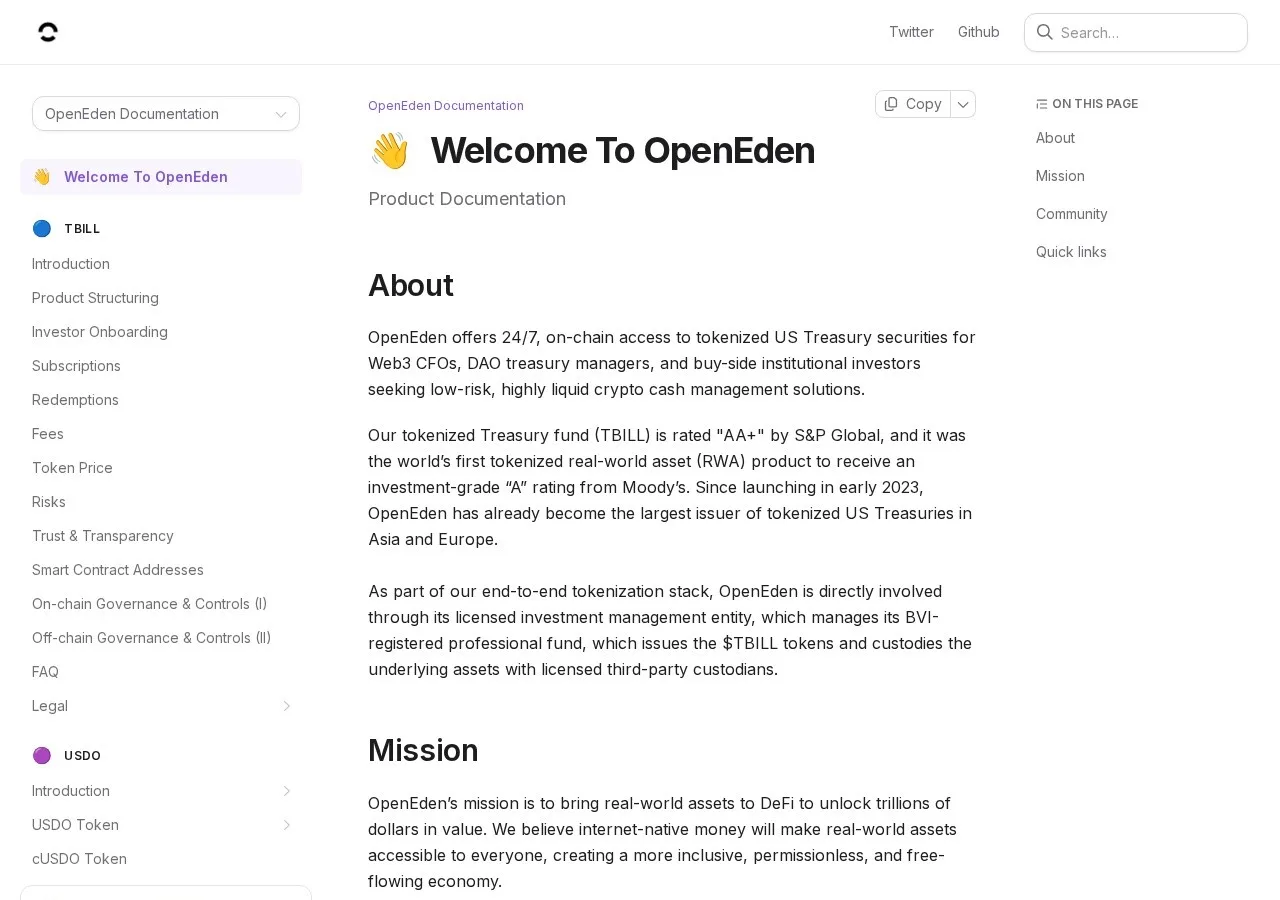
What is OpenEden?
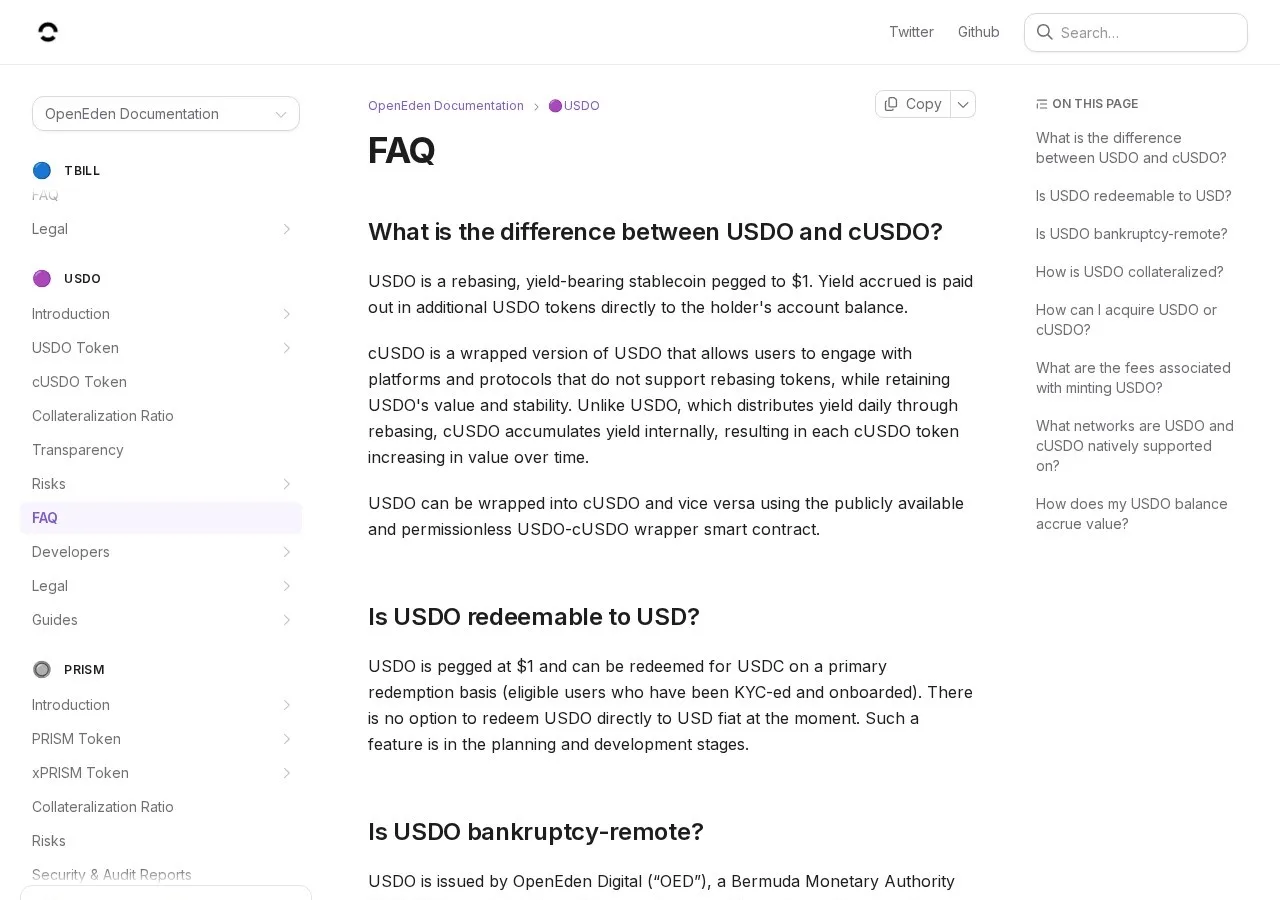
USDO is a yield-bearing, rebasing stablecoin pegged to $1 and backed 1:1 by liquid reserve assets, primarily tokenized US Treasury bills such as TBILL and BlackRock's BUIDL. Yield automatically compounds into holders' balances via daily rebasing, while a wrapped non-rebasing variant, cUSDO, supports decentralized finance protocols that lack rebasing integration.
Corporate background and team
OpenEden was founded in 2022 by Jeremy Ng, who serves as Chief Executive Officer, and Eugene Ng, both former executives at Gemini APAC. The wider executive team includes Chief Technology Officer Duke Du, General Counsel Wayne Tan, who previously held compliance roles at OKX and Bybit, and Head of Product Frederick Chng. OpenEden Group operates its digital token issuance through OpenEden Digital, a subsidiary incorporated in Bermuda. Backers include Ripple, Lightspeed Faction, FalconX, Anchorage Digital Ventures, Gate Ventures, Flowdesk, P2 Ventures, Selini Capital, Kaia Foundation, and Sigma Capital, alongside earlier backing from YZi Labs.
How USDO works and custody structure
OpenEden Digital is structured as a segregated accounts company licensed by the Bermuda Monetary Authority. Under the Segregated Accounts Companies Act, assets backing USDO remain held in bankruptcy-remote vaults distinct from general corporate accounts. For primary minting and burning, users exchange USDC directly against the minting contract at a 1:1 par value. Reserves are maintained primarily in short-term government paper and tokenized liquid treasuries, with secondary DeFi liquidity distributed across exchanges such as Curve. Holders desiring fixed token balances can wrap USDO into cUSDO using a permissionless converter contract.
Fees, limits, and onboarding
Primary minting incurs an issuance fee of 3 basis points (0.03%), while primary redemptions carry an exit fee of 10 basis points (0.10%). Onboarding requires completing full identity verification and a pre-onboarding questionnaire through the OpenEden portal. The minimum initial subscription threshold is set at $100,000, while subsequent primary actions require at least 1 USDC. Redemptions settle natively in USDC rather than direct fiat bank transfers.
Geographic availability and risks
Primary access is restricted to non-US residents and institutions. Prohibited regions include the United States, Russia, Ukraine, North Korea, Iran, and Cuba, among others. Key operational risks include underlying smart contract dependencies, secondary market depeg risk if DEX liquidity thins, and reliance on reserve custodians and tokenized instruments such as BUIDL for liquidity backstops.
Founders
Jeremy NgFounder and CEO
Former Gemini APAC executive.
Eugene NgCo-Founder
Former Gemini APAC executive.
Best for:Non-US corporate treasuries holding idle capitalInstitutional investors seeking tokenized US debtDeFi lenders using wrapped treasury collateral
Pros and cons
Pros
- Reserves legally ring-fenced under a Bermuda Monetary Authority digital asset license
- Yield accrues automatically to wallet balances through daily rebasing
- Collateral backed 100% by US Treasury bills and short-term equivalents
- Permits wrapping to cUSDO for wider protocol compatibility across DeFi
Cons
- $100,000 minimum subscription excludes smaller retail participants from primary minting
- Redemptions settle strictly in USDC rather than direct fiat bank transfers
- Primary access is unavailable to United States residents and entities
- Secondary trading on decentralized exchanges risks temporary deviations from the peg
Our review
3.9/5
Good
OpenEden backs its yield-bearing USDO stablecoin with bankruptcy-remote tokenized Treasuries under a Bermuda license, but primary access requires strict KYC, non-US status, and a $100,000 minimum.
OpenEden issues USDO (OpenEden OpenDollar), a yield-bearing stablecoin pegged to $1 and collateralized by liquid reserves consisting primarily of tokenized U.S. Treasury bills, such as TBILL and BlackRock's BUIDL tokens. The issuer is OpenEden Digital, a segregated accounts company licensed by the Bermuda Monetary Authority. Under Bermuda segregated accounts law, assets backing USDO are legally ring-fenced from the operating liabilities of OpenEden Group, providing structured bankruptcy remoteness for holders.
The token distributes earnings via a daily rebasing mechanism directly to wallet balances. For decentralized finance applications where rebasing mechanics cause accounting friction, the platform provides cUSDO, a non-rebasing wrapper whose value accumulates yield internally against USDO. The architecture provides transparent on-chain exposure to Treasury yields, supported by institutionally focused custodial arrangements including BNY for underlying fund structures.
Primary minting and redemption require thorough KYC approval, exclude all U.S. persons and residents of over thirty restricted jurisdictions, and enforce a minimum initial subscription of $100,000. Minting incurs a 0.03% fee, while redemptions charge 0.10% and settle in USDC rather than direct fiat bank transfers. Direct redemption to off-chain USD remains unavailable.
With USDO circulating supply tracked around $14.5M in October 2026 across supported networks including Ethereum, Base, and BNB Chain, pool depth on decentralized exchanges like Curve can fluctuate. Unverified retail traders relying on secondary markets face slippage and market-pricing discrepancies, as secondary market peg maintenance relies strictly on arbitrage rather than direct access to OpenEden's primary redemption facility.
OpenEden was launched in 2022 by former Gemini executives Jeremy Ng and Eugene Ng, and is backed by investors such as Ripple, Lightspeed Faction, and FalconX. It suits institutional and accredited non-U.S. entities seeking regulated on-chain cash management.
Specs
| Tickers | USDO, cUSDO · unverified |
|---|---|
| Pegged to | US dollar · unverified |
| Backing | Cash & treasuries · unverified |
| Yield-bearing | Yes · unverified |
| Regulated issuer | Yes · unverified |
| Licenses & charters | Bermuda Monetary Authority (BMA) Digital Asset Business Lice · unverified |
| Supply / market cap | $14.47M in October 2026 · unverified |
| Chains | Ethereum, Base, BNB Chain · unverified |
| Reserve reports | Daily and monthly NAV reports by fund administrator · unverified |
| Redemption terms | Redeemable for USDC by KYC-verified non-US users; 0.10% redemption fee; $100,000 minimum initial transaction · unverified |
Not disclosed by the provider: Issuer can freeze tokens.
Data from the provider's website and public sources. Fees and availability change; confirm on the official site before you sign up.
Key features
Daily yield rebasing
USDO distributes treasury-generated yield directly to user wallets by increasing token balances daily while keeping a 1:1 dollar peg target.
Non-rebasing cUSDO wrapper
A dedicated wrapper contract lets holders deposit USDO to receive cUSDO, which grows in token value instead of count for integration into standard DeFi protocols.
Bankruptcy-remote segregated reserves
Issued under the Bermuda SAC Act, reserve assets are legally separated from issuer operating funds to shield collateral during corporate liquidation.
Tokenized treasury backing
Collateral maintains a 100% target ratio held primarily in short-dated US Treasury assets including TBILL and BUIDL tokens.
USDC-based redemption
Eligible primary clients can redeem tokens directly into USDC for a 0.10% redemption fee without waiting for off-chain bank wires.
Inside OpenEden
USDO
The core rebasing stablecoin pegged to $1 that passes Treasury yields directly to token holders through balance adjustments.
cUSDO
A standard ERC-20 wrapper designed for DeFi integrations, where accrued yield accumulates into the token price rather than through rebasing.
TBILL Vault
A permissioned tokenized U.S. Treasury fund for accredited investors offering NAV-based redemptions with custody managed by BNY.
PRISM & xPRISM
A tokenized yield ecosystem where onboarded users can mint PRISM and stake it for xPRISM to earn yield from Treasury and DeFi arbitrage strategies.
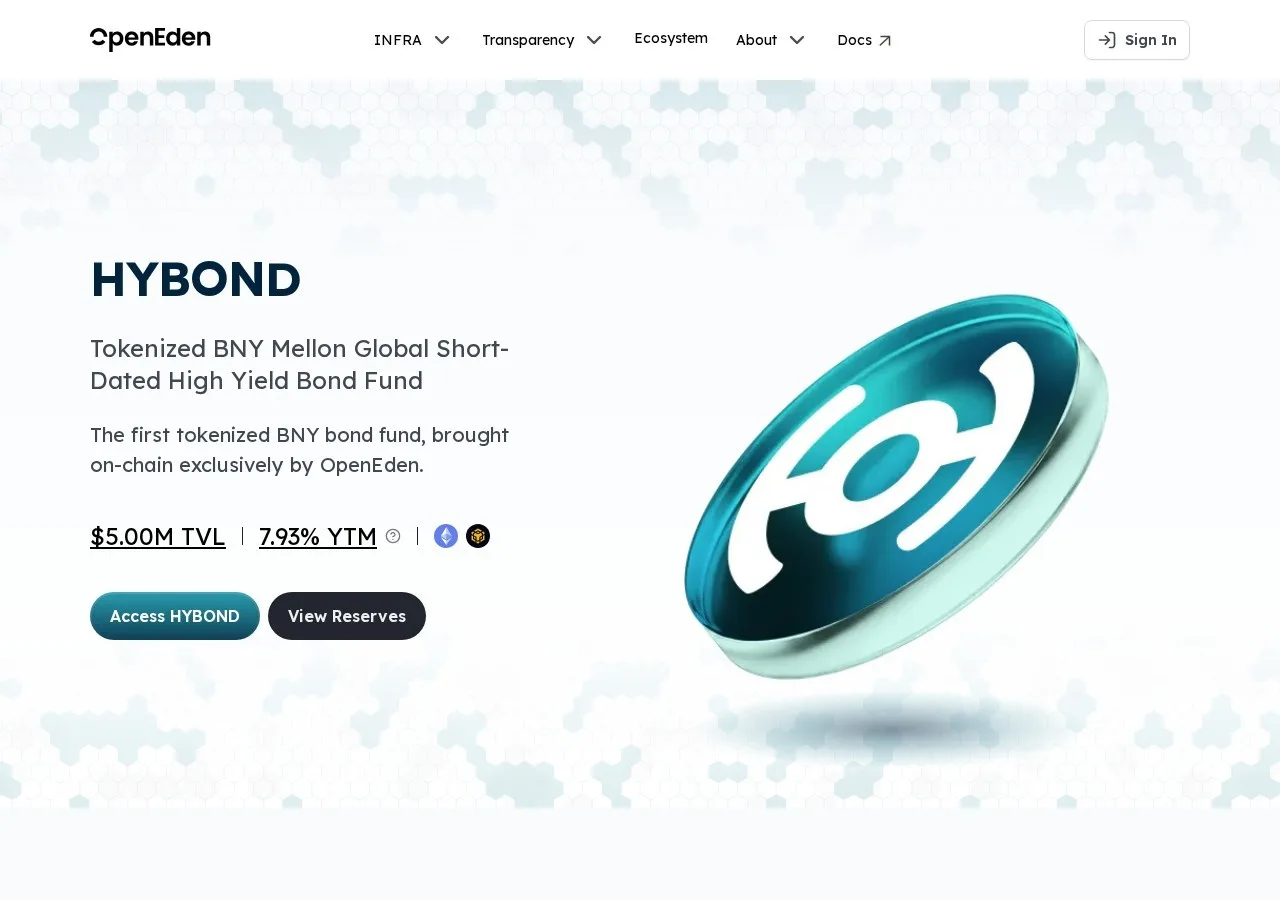
HYBOND
A product providing 1:1 tokenized exposure to corporate bond strategies in connection with institutional asset managers.
OpenEden screenshots
User reviews
No user reviews yet. Have you used OpenEden? Share your experience below.
Funding and investors
$5MTotal raised
2Rounds
11Investors
-
Strategic Dec 2025 Amount undisclosedRI RippleVenture capital Lead AD Anchorage Digital VenturesVenture capital FA FalconXVenture capital FL FlowdeskVenture capital GV Gate VenturesExchange ventures arm KF Kaia FoundationVenture capital LF Lightspeed FactionVenture capital PV P2 VenturesVenture capital SC Selini CapitalVenture capital SC Sigma CapitalVenture capitalSource
-
Funding round Jan 2024 $5MSource
FAQ
Who founded OpenEden?
OpenEden was founded in 2022 by Jeremy Ng and Eugene Ng, both former executives at Gemini APAC.
What fees does OpenEden charge for minting and redeeming USDO?
OpenEden charges a 0.03% (3 basis points) fee on primary mints and a 0.10% (10 basis points) fee on redemptions. Fees are deducted directly from the transacted token amount.
What are the eligibility requirements to mint USDO?
Primary minting requires completing full KYC verification, being a non-U.S. resident, and making an initial deposit of at least $100,000. Minting is restricted across several dozen jurisdictions, including the United States.
What is the difference between USDO and cUSDO?
USDO distributes interest daily by rebasing, which adds tokens directly to a holder's address while preserving a $1 target peg. By contrast, cUSDO does not change wallet balances. It wraps USDO so that accrued yield compounds within the contract, increasing the redemption value of each cUSDO token over time.
Can USDO be redeemed directly for USD fiat currency?
No, primary redemptions for USDO pay out in USDC rather than fiat bank transfers. Direct redemption to off-chain USD fiat is not supported.
Does OpenEden have a platform token?
Yes, OpenEden has the EDEN governance and staking token, along with the PRISM multi-strategy yield token ecosystem.
Latest from OpenEden on X
Get to know HYBOND, the first tokenized @BNYglobal bond fund, and the strategy behind it.
Onboard to access HYBOND: https://t.co/PvUxons7aJ https://t.co/tq1dEojiG0
Onboard to access HYBOND: https://t.co/PvUxons7aJ https://t.co/tq1dEojiG0
An asset can move on-chain in seconds while the underlying investment takes years to mature. Building a market around it means accounting for both timelines.
That gap brought patient capital into the conversation at the @Yield_Summit during TOKEN2049 Singapore week: investors willing to hold for longer can also provide liquidity to those who need an earlier exit.
On her panel, our Chief Strategy Officer, Stephanie Chew @moomoomonster, explored how investor expectations need to match the liquidity of the assets coming on-chain.
Watch the full panel: https://t.co/QjnqVB9mZt
Our work with RedStone reflects a shared ambition to bring real-world assets on-chain with the infrastructure for instant settlement.
Wishing the @redstone_defi team a happy 6th anniversary. Here’s to building more together!
Wishing the @redstone_defi team a happy 6th anniversary. Here’s to building more together!
Tokenized assets become more attractive when investors have more ways to put them to work.
At XRP Seoul, which drew over 5,000 attendees, our Chief Strategy Officer, Stephanie Chew @moomoomonster, discussed how we can build an efficient capital market for tokenized assets by offering greater utility.
While OpenEden's yield-bearing products are well suited for holding, we've expanded their utility by integrating them into secondary markets, as Stephanie noted during her panel.
Watch Stephanie's full @XRPSEOUL panel here: https://t.co/HaSUPDxf5O
Recent public posts from @OpenEden_X, shown as published. Not reviewed or endorsed by CryptoReview.
Latest from OpenEden on Telegram

OpenEden
Join
@openeden · 2.3K subscribers
#OpenDigest | 30 October 2026
Each week, we bring you the biggest headlines, sharpest insights, and key updates on stablecoins, tokenized RWAs, and the OpenEden ecosystem.
🟣 Stablecoin & RWA Market Pulse
→Total stablecoin market cap: $297.155B
→Total RWA on-chain market cap: $39.55B
→Total stablecoin holders: 303.57M
→Total RWA assets holders: 5,456,928
🟣 Top Headlines
→ BNY and Ripple expand partnership with institutional custody for XRP and to advance tokenized trade finance on the XRPL.
→ The OCC calls on community banks to enter the stablecoin payments market by seeking permission to issue dollar-pegged tokens under the GENIUS Act.
→ Hong Kong’s SFC has approved the world’s…
101 View on Telegram
OpenEden pinned a video
Get to know HYBOND, the first tokenized BNY bond fund, and the strategy behind it.
Onboard to access HYBOND: https://app.openeden.com/hybond
https://x.com/OpenEden_X/status/2115827362969669991
Onboard to access HYBOND: https://app.openeden.com/hybond
https://x.com/OpenEden_X/status/2115827362969669991
101 View on Telegram
An asset can move on-chain in seconds while the underlying investment takes years to mature. Building a market around it means accounting for both timelines.
That gap brought patient capital into the conversation at the Digital Asset Yield Summit during TOKEN2049 Singapore week: investors willing to hold for longer can also provide liquidity to those who need an earlier exit.
On her panel, our Chief Strategy Officer, Stephanie Chew, explored how investor expectations need to match the liquidity of the assets coming on-chain.
Watch the full panel: https://youtu.be/X1BwBj3tFwU?si=MGtLHJr3eXgA_BpY
https://www.linkedin.com/feed/update/urn:li:activity:7521506196638363650
103 View on Telegram
Recent posts from the official Telegram channel @openeden, shown as published. Not reviewed or endorsed by CryptoReview.
Alternatives to OpenEden

Regulated dollar and euro stablecoins backed by cash and reserve assets
US dollarCash & treasuriesRegulated issuer

Regulated stablecoin issuance and payments infrastructure across 30+ chains with zero-basis-point ramps
US dollarCash & treasuriesRegulated issuer

Regulated stablecoin issuer behind USDP, PYUSD and USDG across seven networks
US dollarCash & treasuriesRegulated issuer
US dollar stablecoin backed by US Treasuries with over $90B issued on Tron alone
US dollarCash & treasuriesUSDT · EURT +1

UK-domiciled sterling stablecoin backed 1:1 with segregated GBP reserves across five chains
British poundRegulated issuerGBPA

Synthetic dollar protocol backed by delta-neutral spot and derivatives positions
US dollarDelta-neutral (synthetic)Yield-bearing